The Concentric Influences of Sol LeWitt: Foundations, Pivots and Place
July 4, 2026
-
The Concentric Influences of Sol LeWitt: Foundations, Pivots and Place
Venue: RMIT Gallery
05 Jun 2026 – 29 Aug 2026
The Concentric Influences of Sol LeWitt: Foundations, Pivots and Place, currently on view at RMIT Gallery, is the second phase of artist and curator Irene Barberis’s ongoing project examining the American artist Sol LeWitt’s significance and impact. The first iteration, also shown at RMIT Gallery in 2024 as well as internationally (Hong Kong, Amsterdam, Scotland, South Korea), featured the work of Wilma Tabacco, Janet Passaehl, Fransje Killaars, and Barberis herself. Building upon this core cohort, who are again included here, Barberis has assembled a survey of work by mainly Australian artists operating in the long, linear shadow of LeWitt. This unfolds over three rooms and across video, paintings, and drawings, along with select archival material.
The artists assembled here are unified along formal lines: through the grid, use of bright colours, flatness, surface, and line. Without ever explicitly articulating his significance or contextualising his practice for those who may not be entirely au fait with the ins and outs of objects and ideas, the exhibition places LeWitt at the still centre of this turning world.
LeWitt, we are led to understand, is the point of origin, establishing a lineage of received influence. Concentricity implies a centre and a periphery; here on the fringes, far from New York, the negotiation of influence is rarely a straightforward proceeding.

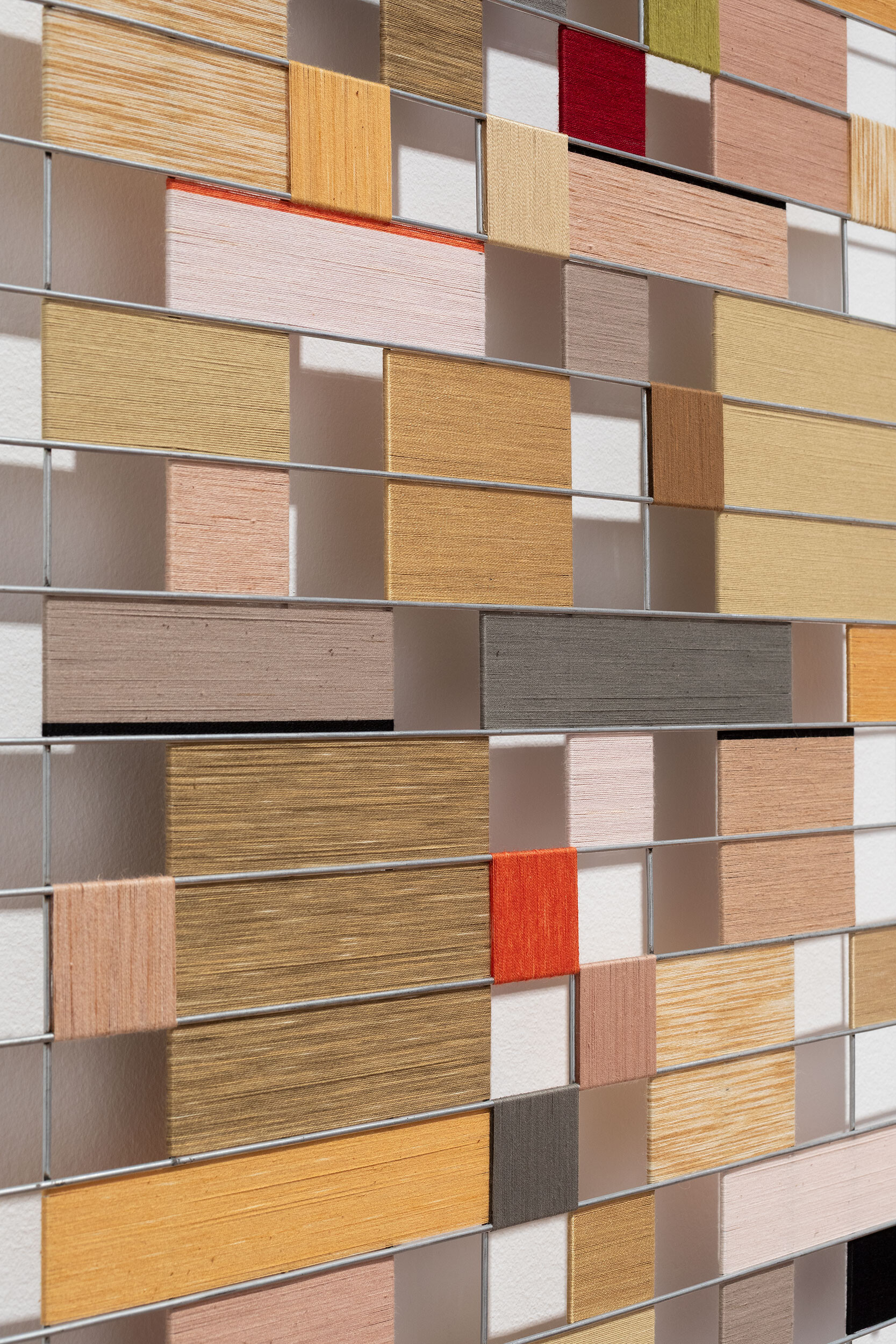
Detail of Jacqueline Stojanović, Field Drawing VIII, 2026, in The Concentric Influences of Sol LeWitt: Foundations, Pivots and Place, RMIT Gallery, Melbourne, 2026. Photo by Christian Capurro.
There are some lovely works here. Wilma Tabacco’s six paintings on paper show graceful movement through a green, transitory world, while Jacqueline Stojanović’s 1mm Squares are exacting and sincere. The snow-blind, Shaker-esque beauty of two white paintings by Robert Hunter (both 1985) is oblique and subtle in the extreme, momentarily making everything else look sickly and sixty in comparison.
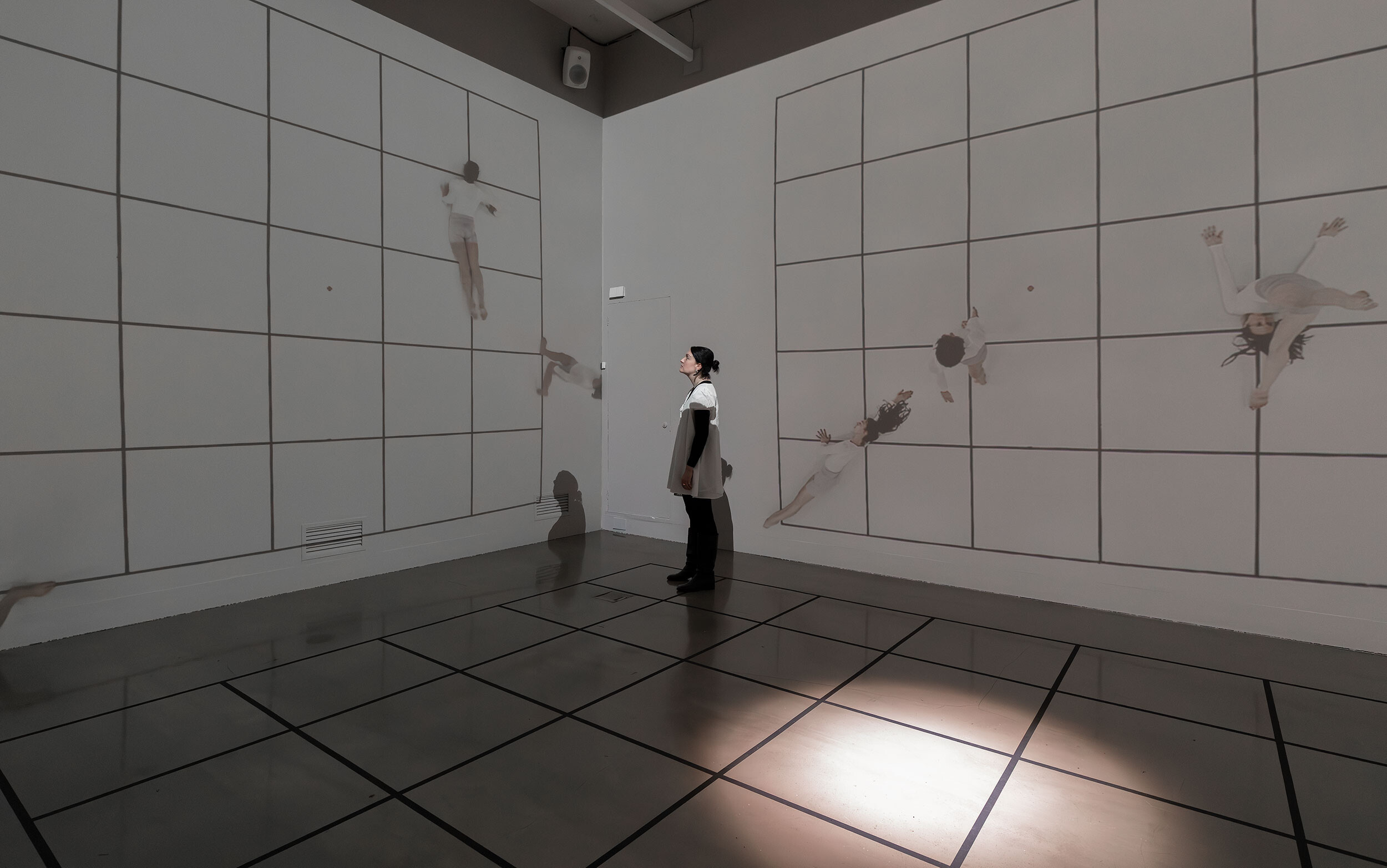
Barberis’s major piece is a collaborative dance work, projected to fill an entire room as a multi-channel video. Three dancers move along and across set diagonals, around and through a taped grid, viewed and filmed from above, placing extreme emphasis on line and alignment. Limbs extend and stretch away from the body as they leap across the square court towards each other and, just at the point of contact, twirl, spiralling away as if magnetically repulsed, paying back the hardness of the grid with soft bends and caresses. The work referenced is Dance (1979), a collaboration between LeWitt, Philip Glass, and Lucinda Childs. It’s hypnotic and marvellous, though given short shrift on a tiny television, wall-mounted at the entrance to the show (no bench). LeWitt does get the best of it, but then that is his line, and he has been getting the best of it for rather a long time.
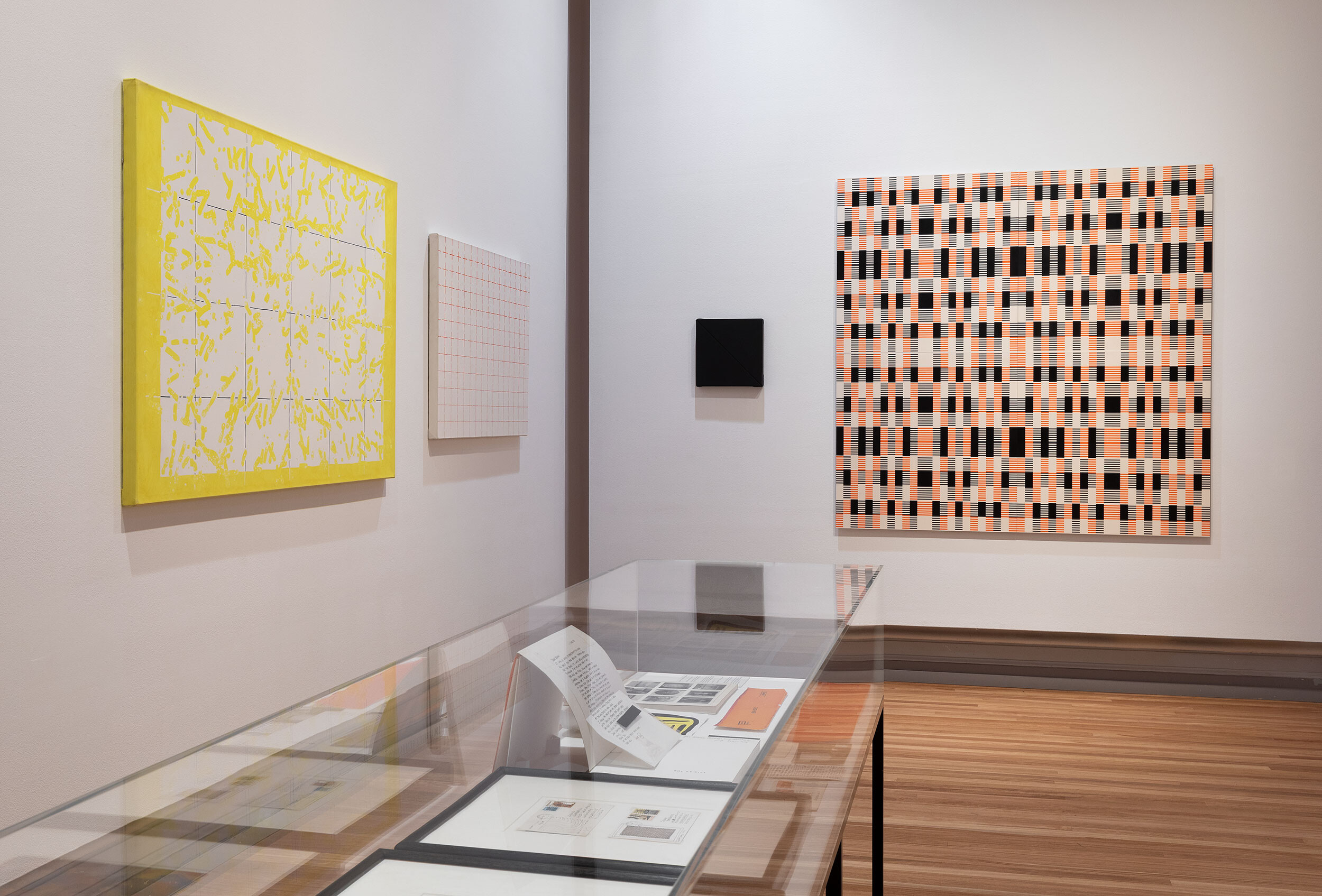
Barberis has a longstanding relationship with LeWitt. After meeting him in New York in late 1974, they maintained a friendship and correspondence. As the show text details, Barberis was the first artist-in-residence to work in his studio after his death in 2007, creating The Choreographing Colour Series: A Scoring of Composers (Sol’s Tapes, Chester). Comprised of layered transparent sheets covered in ordered lines of petal-like fluorescent paint, they curl off the wall slightly in stark contrast to the exacting open grid beside them, occupying the same rough footprint.
LeWitt was a pivotal figure in the development of conceptual and minimal art. Indeed, he has a legitimate claim to be the first to use the hallowed words “conceptual art.” His work is concerned with perception, systems, reduction, geometry, purposelessness, grids, labour, serialisation, reproduction, authorship, and the status of the work of art itself. This conceptual practice produces objects but is not tethered to the object. As LeWitt explained in an interview:
The system is the work of art; the visual work of art is the proof of the system. The visual aspect can’t be understood without understanding the system. It isn’t what it looks like but what it is that is of basic importance.
To us present-day jades, accustomed to immersive extravaganzas, robot dogs, and bananas stuck to walls, that “the idea is a machine that makes the work of art” may seem both a tad obvious and as harmless as a bag of marshmallows. But LeWitt’s clear-eyed articulation of artwork as idea remains potent; after Duchamp, anyway, even a bag of marshmallows is conceptual.

Installation view of Irene Barberis, Sarah Duyshart, Anne Scott Wilson, Dance: Vertical View Collaboration, 2026, in The Concentric Influences of Sol LeWitt: Foundations, Pivots and Place, RMIT Gallery, Melbourne, 2026. Photo by Christian Capurro.
LeWitt’s wall drawings are the most visible aspect of his practice to Australian audiences. Beginning in 1968, LeWitt conceived and wrote instructions for these pieces, to be carried out and executed by others, and adjusted to the size and location of the wall serving as the support—art along architectural lines, with the instructions frequently serving as the title. Take Lines to points on a grid. On yellow: Lines from the center of the wall. On red: Lines from four sides. On blue: Lines from four corners. On black: Lines from four sides, four corners and the center of the wall (1977), a work LeWitt executed at the NGV at the invitation of arts patron John Kaldor (Barberis was one of the assistants for this piece).
There have been several recent LeWitt exhibitions at major Australian galleries. Notably, one 2022 Art Gallery of NSW project, Sol LeWitt: Affinities and Resonances, directly addressed the relationship (read: very close visual similarity) between his late work and that of Emily Kam Kngwarray, whose paintings he collected. “On seeing the work of Western modernists, and Sol LeWitt’s striped works in particular, she asked, ‘Why do those fellas paint like me?’” recounts curator Margo Neale. It’s a much-reiterated observation by historians of Australian art, but one not less true for all that. The centre is influenced by the periphery too; artistic influence is a two-way street, however contested and fraught this exchange might be, particularly when it comes to an American minimal titan co-opting the aesthetic language of an Anmatyerr artist.
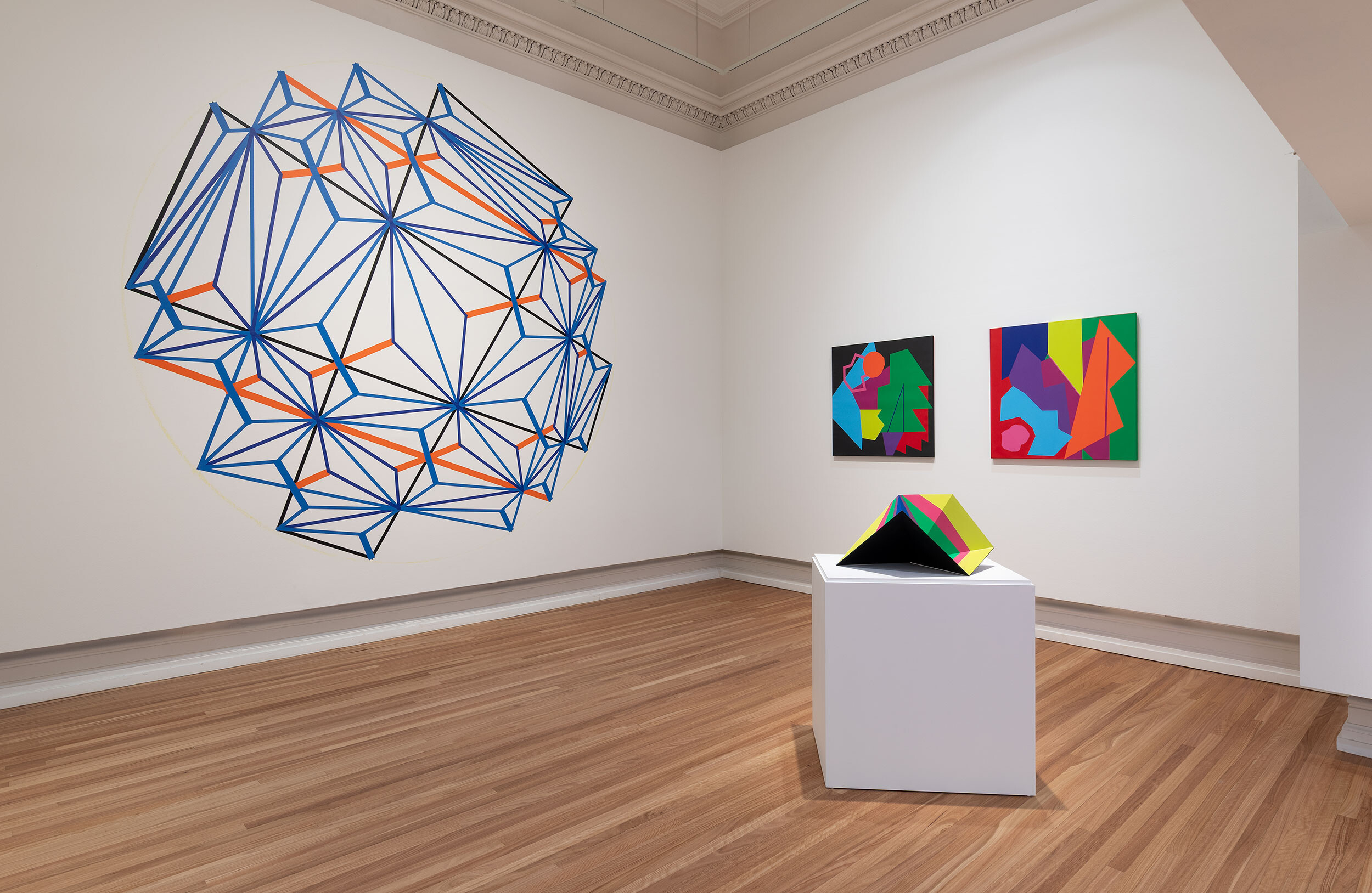
The wall drawing presented here at RMIT is more sombre than the buoyant brightness of the Kngwarreye-inspired Wall drawing #955, Loopy Doopy (red and purple) (2000), or the almost imperceptible pencil parallel quadrants of Wall drawing #338: Two part drawing. The wall is divided vertically into two parts. Each part is divided horizontally and vertically into four equal parts. 1st part: Lines in four directions, one direction in each quarter. 2nd part: Lines in four directions, superimposed progressively (1971) (currently on display at the Art Gallery of New South Wales). Here, white crayon stripes are shakily traced in parallel on a black ground, evoking the concentric rings of tree growth or the identifying ripples of a fingerprint.
LeWitt had also visited Australia earlier in 1974, prior to his Kaldor project. One of his wall drawings, along with a cubed sculptural work, was included in Some Recent American Art, a touring exhibition of minimalist and conceptual heavyweights sponsored by the International Council of the Museum of Modern Art. This exhibition—and, to a greater or lesser degree, the reductive and ostensibly neutral minimal forms of the artists involved—were embroiled in discourses of provincialism and cultural power, indicating the complexities of Australia’s negotiation of global art influences.

Installation view of The Concentric Influences of Sol LeWitt: Foundations, Pivots and Place (including Sol LeWitt Wall Drawing #123A, 2026, acrylic paint, crayon. Courtesy of the Estate of Sol LeWitt, Chester, Connecticut, USA) RMIT Gallery, Melbourne, 2026. Photo by Christian Capurro.
The artist and curator Peter Cripps had been in contact with LeWitt since 1970, worked on his wall drawing in Sydney and Melbourne, and maintained a correspondence in the following years. Other American artists, including Carl Andre, Robert Irwin, Donald Judd, Yvonne Rainer, Lawrence Weiner, and William Wegman, were flown out down-under for the occasion. The exhibition was curated by Jennifer Licht, who met Robert Hunter in Melbourne and invited him to New York to participate in Eight Contemporary Artists later that year, accompanied by Barberis, Hunter’s then partner.
Some Recent American Art met with protest and controversy. It was picketed in Adelaide by the Progressive Art Movement, a group led by artist Ann Newmarch and anti-war activist (and philosopher of ethics) Brian Medlin. PAM viewed the show as emblematic of American cultural imperialism, particularly in light of the Vietnam War. While Australia’s military involvement had officially ended the previous year, defence contractors such as Alcoa were major sponsors of institutions like the Art Gallery of NSW.
The Progressive Art Movement emerged out of an arts and politics class and was Marxist-Leninist in flavour. If you kick a good citizen of Adelaide, you will be greatly sorry, on account of how one’s foot will connect with books by Karl Marx kept in pockets, which, being complex and weighty tomes, will cause toes no small amount of pain. Determinedly anti-elitist, Newmarch and fellow artist-organiser Mandy Martin once set up a print workshop in the Chrysler factory. Promotional posters for Some Recent American Art made good graphic use of the stars and bars, while the catalogue is lovingly bound in blue denim. Copies have frayed and worn beautifully over the intervening decades and now fetch respectable prices from quality booksellers.

Installation view of The Concentric Influences of Sol LeWitt: Foundations, Pivots and Place, RMIT Gallery, Melbourne, 2026. Photo by Christian Capurro.
While Sydney and Melbourne proved more amenable to Some Recent American Art, Perth simply disliked it. Adelaide did ultimately receive a Donald Judd sculpture into the bargain, conceived by the artist in response to the gently sloped lawn of AGSA after a planned work in Sydney fell through—a rare site-specific piece, rather than “medium-sized, portable, inflation-hedging lumps of cult furniture.”
To be fair, Australia was probably a bit sick of hearing about the greatness of American art in 1974. The Blue Poles brouhaha was coming to a close, as the grand canvas was unveiled to a breathless public, travelling from Sydney to Melbourne, Brisbane, and Adelaide alongside Some Recent American Art, though not part of the show proper. This, at least, was recognisably a painting, not a fluorescent light tube (Dan Flavin) or a line of bricks (Carl Andre), albeit one temporarily disguised as a $1.3 million freak show, and thus perhaps a little conceptual after the fact (value is the machine that makes the work of art?).
Also important to this story of conceptual and minimal influences—yet placed slightly out of focus—are works by artists associated with Bruce Pollard’s Pinacotheca gallery, a significant venue for these practices in the late sixties and seventies. Pinacotheca connected Melbourne to a global network of ambitious theoretical discourse and artistic practice, exhibiting work by Joseph Kosuth in 1969, well ahead of his inclusion in Some Recent American Art.
The Pinacotheca contingent is represented here by Hunter, Barberis, Simon Klose, and Jonas Balsaitis. The latter’s hand-drawn frames for a stop-motion video piece are dispersed across the gallery space, on either side of door frames, somewhat diminishing the effect or ability to appreciate them en masse. A vitrine holds a group photo of artists and friends at the final Pinacotheca exhibition, alongside a copy of Seth Sieglaub’s Xerox Book, two handsomely framed postcards from LeWitt to Barberis, LeWitt’s autobiography, and tracings Barberis made of his studio tools.
This connection is obviously important, but we are not provided with the reason why—what exactly Pinacotheca or these artists might have to do with LeWitt’s strategies and concerns, or their significance to this history more broadly, is not elaborated or made apparent to the casual viewer.
Does it help to know that LeWitt worked as a photostat technician, or that Ian Burn and Mel Ramsden showed their own Xerox Book at Pinacotheca in 1969? Rather than the portable group show of Sieglaub’s Xerox Book, Burn and Ramsden’s was blank, contentless; constructed from Xeroxing blank sheets of paper, “as if to realise literally LeWitt’s famous remark that ‘the idea becomes a machine that makes the art,’” writes Ann Stephen.
Imaging, replication, and documentation of artwork are important parts of this relationship. Early encounters with minimal and conceptual work took place and spread through books, photographs, and letters, accounting for the early appearance of these conceptual strategies in Richmond and Hawthorn, far from New York—a radical decentring and exchange. Take Burn’s Referential Line #2 (Sol LeWitt) (Photographic Mirror), a reflexive photographic work that documents one of LeWitt’s open cubed structures in situ at the Museum of Modern Art in New York in 1967–8, which can be read as a formalisation of the artwork slides he sent back to friends in Melbourne.

Installation view of The Concentric Influences of Sol LeWitt: Foundations, Pivots and Place, RMIT Gallery, Melbourne, 2026. Photo by Christian Capurro.
Out in the foyer, set apart from the exhibition proper, and notably absent from the room sheet—perhaps a late addition?—is another vitrine, this time filled with photographs of Pinacotheca itself, taken by Simon Klose in 1971. This is not simply documentation of empty gallery space, but an artwork with a complicated and rather interesting backstory. You wouldn’t know it from the museum label, which credits the photographs only as being commissioned by Robert Ashton and restored by Jeffrey Busby, though unfortunately these digital prints are distractingly varied in temperature.
This work is related to a 1972 joint exhibition at Pinacotheca by Robert Rooney (yet another LeWitt pen pal) and Klose. Incidentally, the two first met when Klose turned up at Rooney’s work to enquire about a Sol LeWitt catalogue Rooney had lent to Robert Hunter. For this show, carrying out a proposition devised by Klose, Rooney and Klose made work as each other (for a thorough investigation of this collaboration, I direct the reader to David Homewood’s RR/SK: Public Exhibition, in Discipline no. 2). The pair shared an interest in the capacity of the camera to index, record, and reduce—LeWitt’s serial photography also works in this register, and as in his wall drawings, the artist is at the mercy of the architect. Rooney’s Klose-style work, rather than photographing across into opposite corners from set points as the piece here does, reverses this procedure, turning the lens outwards into the larger gallery space at Pinacotheca. Given this interest in obfuscated identity, outsourced execution, and authorship, I wouldn’t be surprised if this lack of detail is another layer of the same.
In the room sheet, Barberis describes Hunter at work, “building configurations that resolved as the eye adjusted, they were almost invisible.” So too are the connections that emerge throughout this exhibition, partially concealed and opaque—we receive the work, but not the instruction.
Gallery