Sedition Art Advertising
June 20, 2026
-
Sedition Art Advertising
Venue: Metro Tunnel
–
A new material support for public art has recently appeared on our streets: LED screens. Of course, there are Julian Opie’s birds on St Kilda Rd, and the Buxton Contemporary Big Screen. And let’s not forget Jenny Holzer’s Truisms, broadcast on Times Square in 1982. Given the ubiquity of screens today—screens as surfaces for the projection of being towards desiring subjects (what Laura Mulvey has called “fascination”)—it seems the everyday function of these technologies still precludes their status as an artistic medium. I find a note about public art on the ACCA site that suggests this is because they require a power source, and therefore money, to run. But so does ACCA. Public is not quite the right word here, either. This form of art is closer to Philip K. Dick’s idea of personalised advertising, first aired in 1956. There is an undeniable appeal to mass individuality, emerging on our screens. “Collect from our constantly evolving online gallery of 7,392 digital artworks by 1,218 artists.” This is the offer from the digital art startup, Sedition Art, which was established in London in 2010. Of course, to our readers I am certain this command is as unappealing as it sounds. Yet its advertising (and art) is suddenly everywhere in Melbourne. It’s on highway billboards, a corporate office lobby in the Docklands, BMW is a partner, even the food court at Highpoint has it blasting across the greasy dining hall. Below Forever, Danie Mellor’s glazed façade, covering the escalators and lifts to the State Library Station, Sedition Art has taken over the Melbourne Metro too. Today, all art is digital, and (for now at least) digital art requires screens.
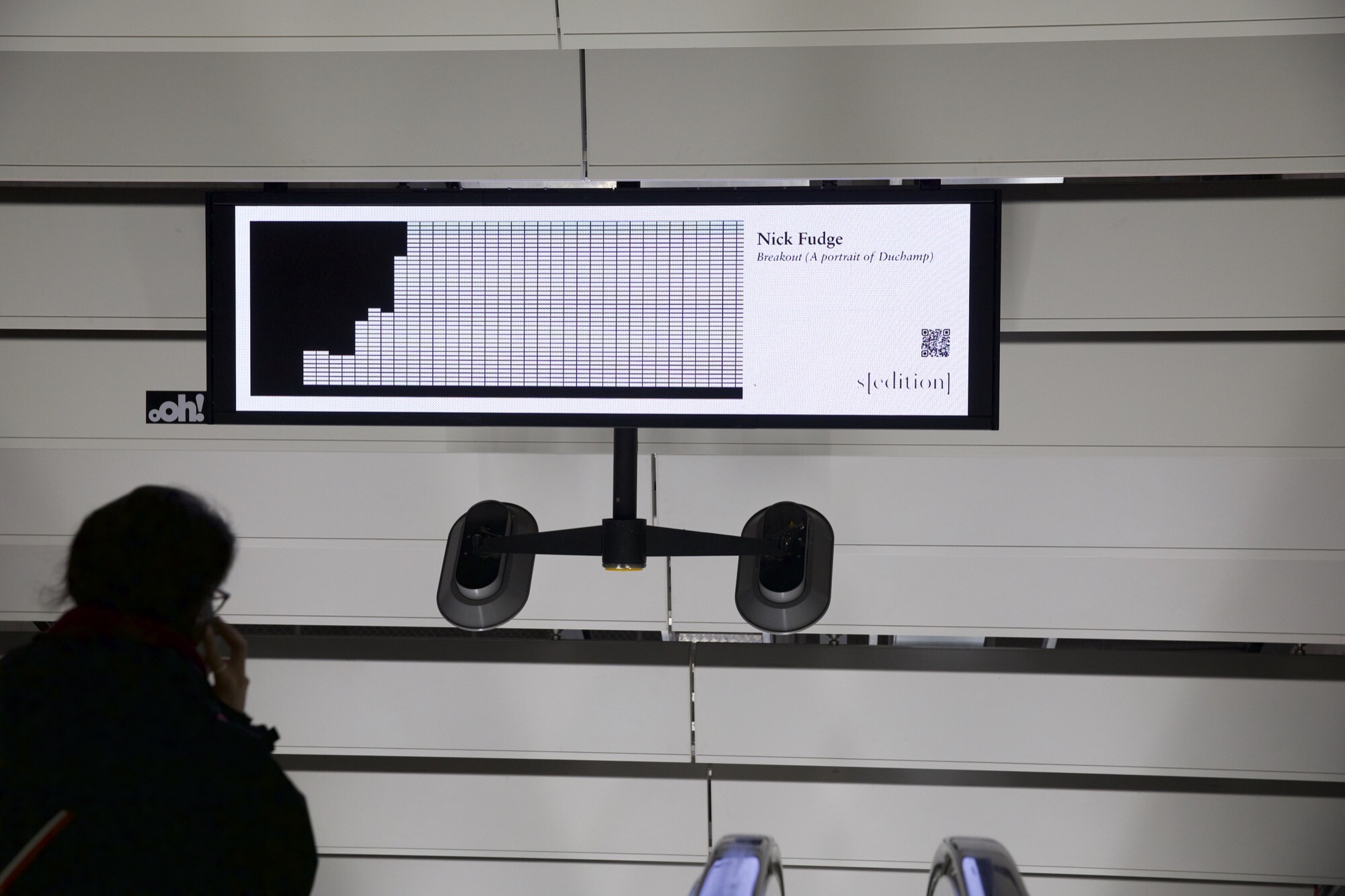
I say this, looking at my iPhone’s OLED (organic light emitting diode) screen, thinking about MOTHER and Tara MacDowell’s thoughtful coverage of the current exhibition for last week’s Memo. My own mother had been to visit, coincidentally on Mother’s Day. Mother is mothering. I’d gone to the footy instead and on the way found myself momentarily trapped, disoriented, in the liminal zone at the State Library Station: Platform Mezzanine. Two identical passenger lifts face each other there at opposite ends of an alkaline corridor, punctuated by a staff-only stairwell and the warm, stale air of an underground tunnel. When I finally emerged, somewhat confused, I was struck by the freshly minted, civic architecture, and particularly by the vibrant ubiquity of the new oOh! billboards installed throughout the Metro Tunnel stations. Most prominently, for our purposes, the hybrid art-advertisements for Sedition Art appeared to me as significant for the attempt to deliver art to popular audiences at the bleeding edge of public space and private enterprise. In fact, they appeared to use art to legitimate the infrastructure as such. All of the seven- or fifteen-second spots, alongside the work, feature a QR-code inviting commuters who are perhaps already phone-in-hand, as I was, to follow the line from a vaguely surprising aesthetic experience (swirling LED-colour and digitally produced nature abstractions) to the Sedition cart. These are giant screensavers, effectively. They exist to facilitate commerce as immediately and seamlessly as the media would allow (think Toy Story 5). Each Sedition artist—Damien Hirst, Tracey Emin, or Jeremy Deller (there are lots of YBAs here, which gives you a good sense of the generation it is founded upon)—has contributed on average about six artworks to the platform in limited, digital editions. But in the station the artists were all unknown to me. The most literal art reference was to Marcel Duchamp, seen in profile on a billboard above an escalator descending to the platforms. How much does an ad on a screen at the State Library platform cost? I wondered, out loud, how many screens are there in the entire station-retail complex? Who is buying this shit? I scanned a QR code and signed myself up immediately.

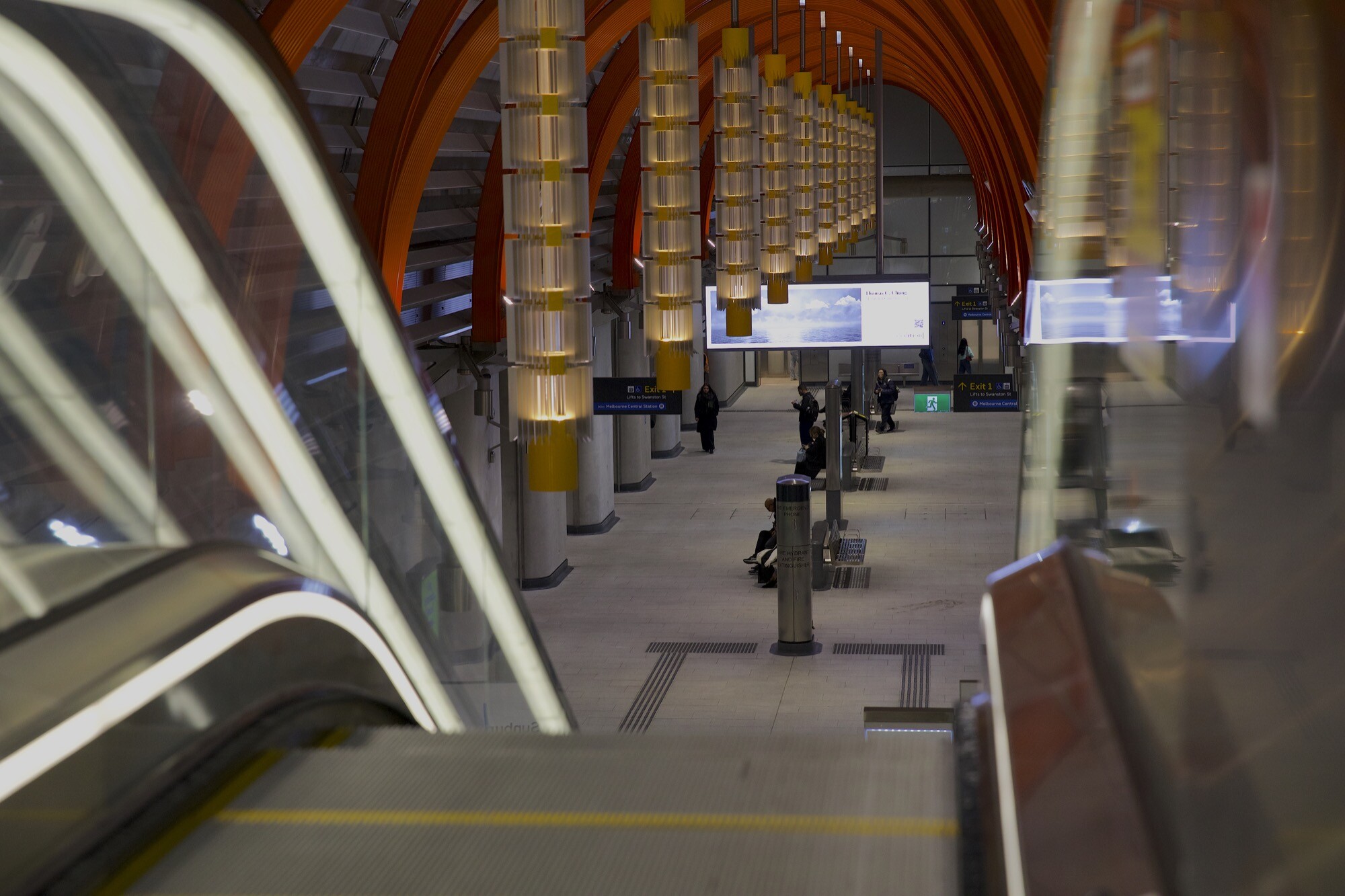
Thomas C. Chung, “As Far As I Could See” (I) (2026), 4 minutes and 56 seconds, $85, edition of 10 (3 sold). State Library Station. Photo: Paddy Hay
The founders of Sedition Art are former Saatchi Art executives (the current slogan on the Saatchi website is also revealing: Surround Yourself with Creativity, Save 10% on Art). Robert Norton and Harry Blain were profiled by Gwyneth Paltrow for Goop in 2011. These are the kinds of people who even today claim to be standing at the intersection of art and technology without any sense of irony. This means video art, but it also means more speculative ideas like Non-Fungible Tokens (NFTs), digital images, essentially. Bill Viola, who died in 2024, was an important early contributor to Sedition. Viola’s two works in the collection are both editions of 500. A 35-second phrase from his work Chris (2011) still lists 366 as available to purchase when I browse the site, some fifteen years later. For $350 you can be the proud owner of this digital portrait (Smartphone-styled) video without the Sedition watermark that allows you to view the work in medium resolution prior to making any investment decisions. Once acquired, you can open the Sedition Art app and look at it whenever you want. You could perhaps gift it to one of your friends or lovers. For just $700, you and your significant other could both have A Phrase from “Chris” playing in tandem on your devices, gazing upon it at the same time, perhaps from a significant distance.
Despite the surplus of remaining editions, Viola’s clips have generated about $50k of sales for Sedition. There is a market here, then. It’s just a bit weird. The central idea appears to be that screensavers are the medium, and these can be turned into artworks with globally recognised names attached to them. Once these editions are sold, they can then be traded on Sedition’s member marketplace. Rarity means the value of your investment can increase (the reality is they decrease), and ideally you could cash out your investments at some point. A Reddit check reveals, however, more than one disgruntled Sedition Art member complaining that their collection is worthless, because they can only exchange editions for credit to purchase more Sedition Art, which, to be fair, is what the T&Cs state quite clearly: credits are not legal tender, not redeemable. Do not fear, this is not Armin Heinrich’s $999.99 “I Am Rich” app, a glowing picture of a diamond launched and then swiftly removed by Apple in 2008. In truth, Sedition Art appears in the wake of app art events such as these, by presenting a serious attempt to use market logics to democratise art in ways that are comparable to music streaming services like Spotify. Oddly enough, the German filmmaker Wim Wenders is the most collected artist on the Sedition platform, with a series of digital photographs. One is titled In Eastern Germany (2006), and depicts (English) graffiti on the side of a building—presumably in the former DDR—with the exclamation “Crush Capitalism!” spray-painted on a greige, rendered wall between two arched windows in white wooden frames. On the Sedition marketplace its lowest asking price is $52, for edition #38. Edition #9 of the same image is listed for sale at $1,800. I try to imagine an elaborate scam where the platform is being used by white-collar criminals to launder money but come up blank. Capitalism?

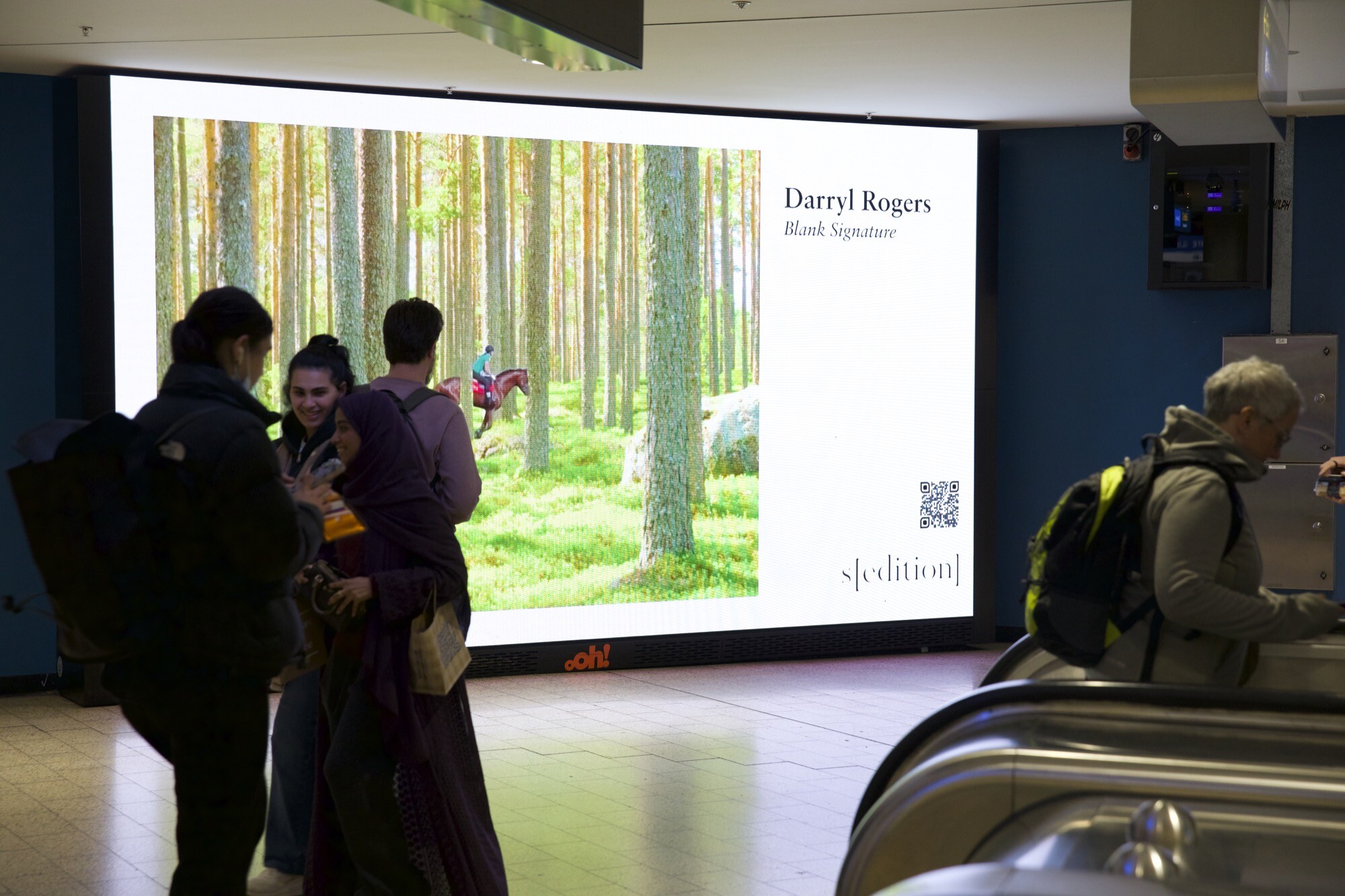
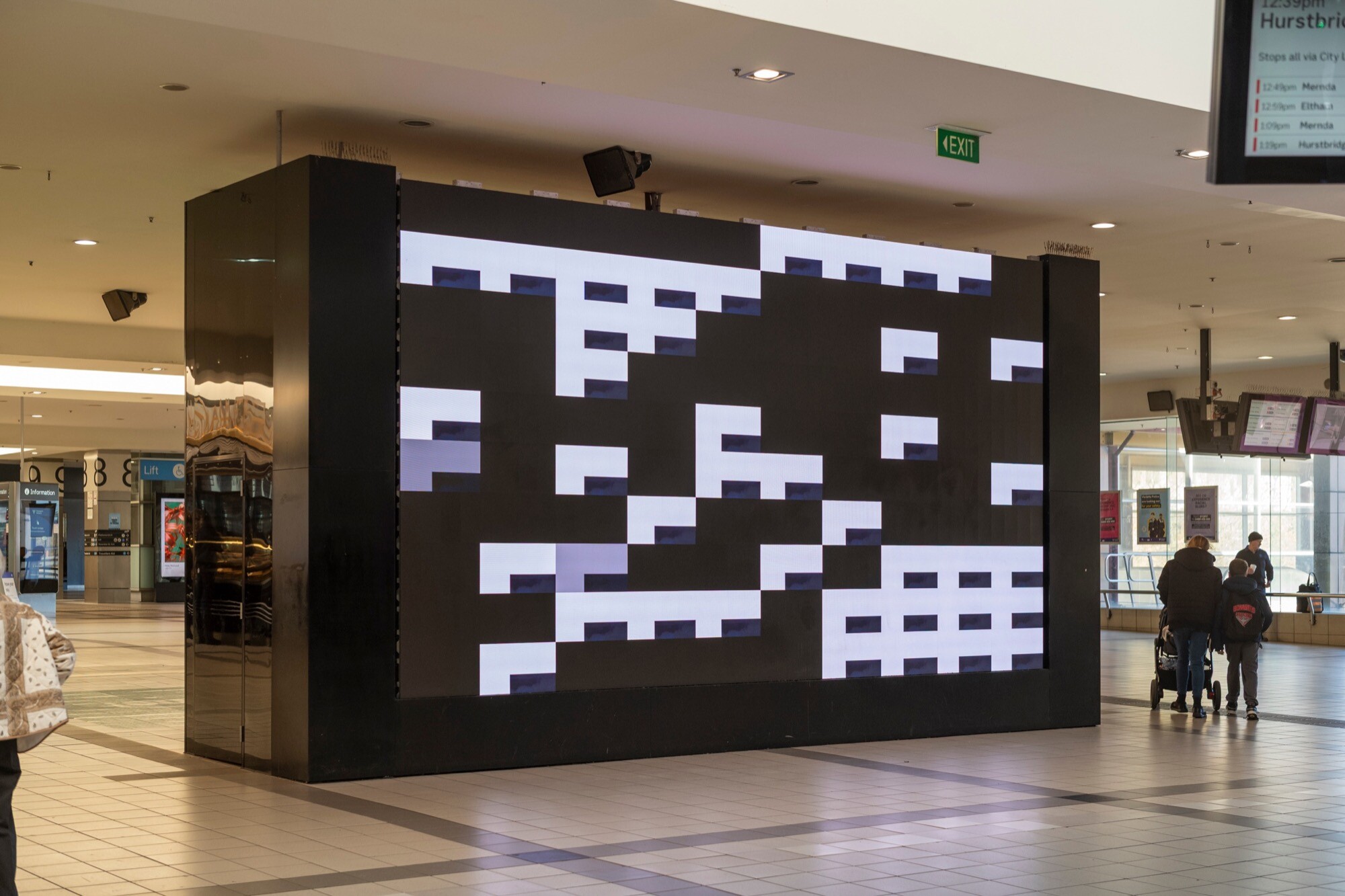
Darryl Rogers, Blank Signature (2022), 35 seconds, $135, edition of 8 (5 sold). Melbourne Central Station. Photo: Paddy Hay
Instead, what I realise is that this is a market-motivated attempt to get art to the masses that is still being tinkered with, hence all the billboards. Refik Anadol is here too, and who can forget the “non-stop plumes, flurries and eddies of multicoloured ejaculative beads,” on display in the foyer at the NGV Triennial in 2020. All new LG televisions, I find out from a Sedition announcement posted in mid-2025, come pre-loaded with the Sedition app: “over 6,000 contemporary artworks are now available for streaming.” I can’t tell if Anadol also created the frozen colour abstractions advertising the televisions online. To narrow the scope of this vertiginous cascade of pixels somewhat, it is the sweetheart deal between Sedition Art and the “Out of Home” (OOH) advertising companies in charge of what are officially referred to as “billboards and street furniture” that focus my attention here. Dozens of these ads appear during my commutes, which otherwise remind me of Standish Lawdor’s classic short film, Necrology(1970).

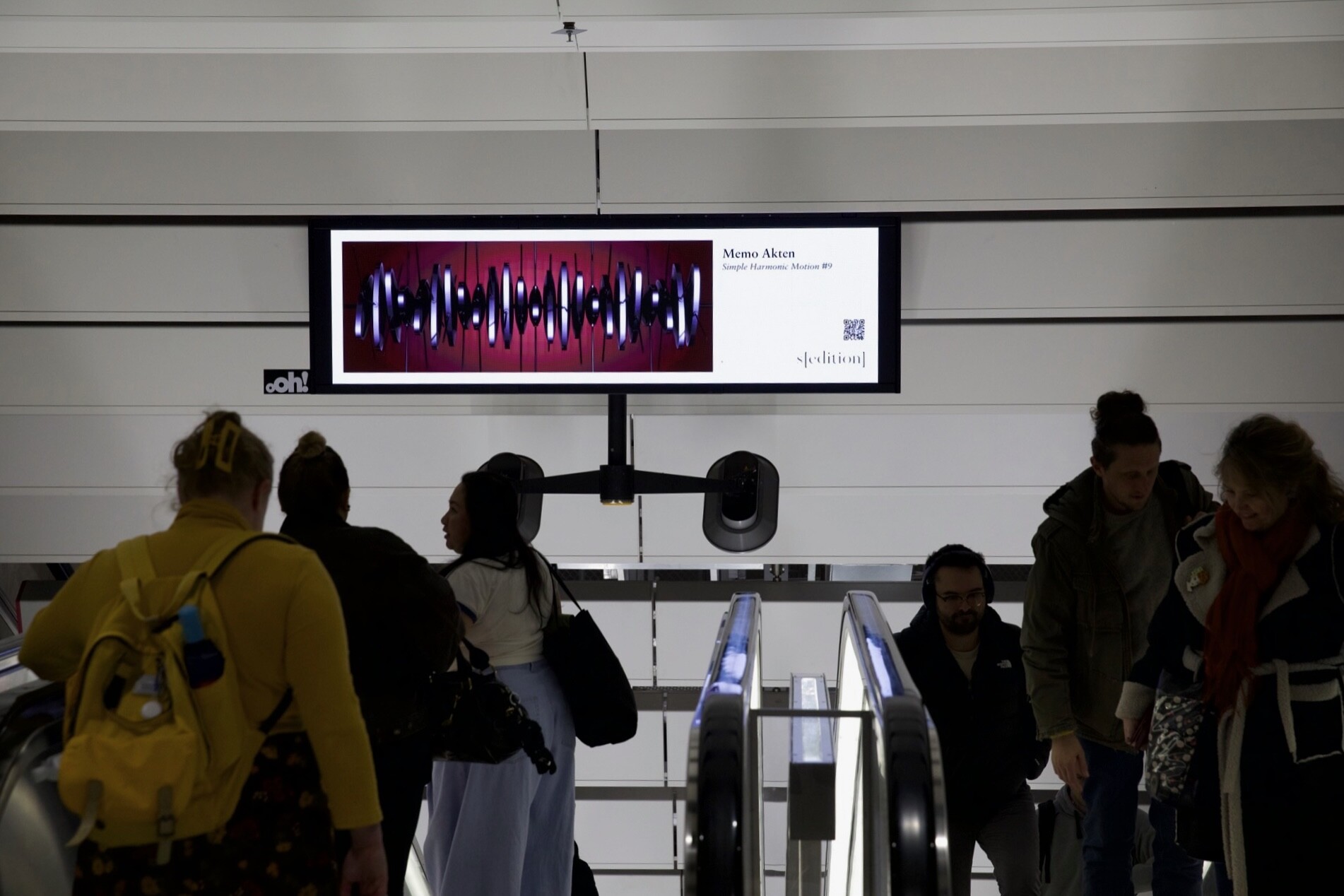
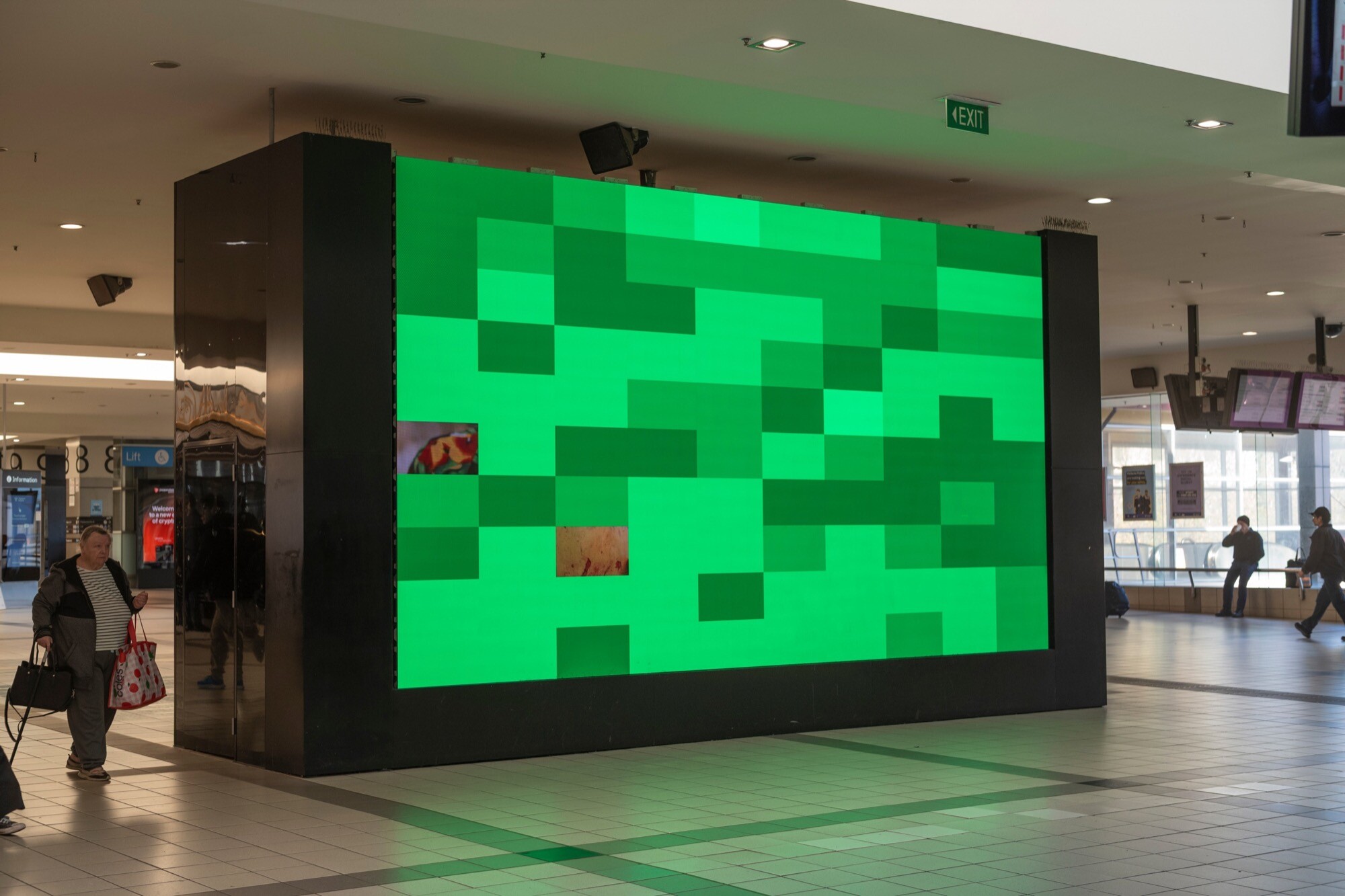
Memo Akten, Simple Harmonic Motion # 9 (2013), 1 minute and 39 seconds, $32, edition of 250 (89 sold). State Library Station. Photo: Paddy Hay
Recently two of Narrm’s most refined culture warriors, David Wadelton and Guy Rundle—separately I believe—espoused the impressive accident that is the Flinders Street Station floor-to-ceiling billboard glitching as commuters rushed to make their connections. It is too easy, I think, to see in these minor eruptions of audio-visual chaos some profound or revelatory experience of post-industrial screen-being that transcends the mundanity of traversing the corporatised corpse of public space like train stations (the industrial site par excellence). Aesthetically, yes, it is exciting to see something break, but is that all we can expect from the world? A kind of reified dasein in all its mystifyingly Heideggerian connotation? Instead, might we re-sharpen our art as propaganda instruments and finally drop, maybe even once and for all, the smugly distant attitude adopted by the slacker avant-garde, one where the privacy of the salon is preferable to the agony of the portico? Are we ready to admit that all artists have professional obligations, and are fighting for their lives in the marketplace of ideas? This, to me at least, is the question that Sedition Art appears to pose. It is difficult, but it speculates upon an entirely different constellation for public art than the atrophied path laid by aesthetic radicalism. Today our challenge is to place art—Real Art—there, and for longer than a handful of seconds at a time, between ads for car insurance and Oura Ring. Would seizing all of the billboards of the world shake us from our contemporary malaise?

“The jumbo screen at Flinders Street Station was glitching the other day, and putting on a great show!” @davidwadelton, 9 June 2026.

“The jumbo screen at Flinders Street Station was glitching the other day, and putting on a great show!” @davidwadelton, 9 June 2026.
This week, reporting in the AFR claims oOh!media is currently subject to an $845m buyout by multiple private-equity firms; all except one are US-based companies. I feel like my finger is on the pulse. In 2024 oOh!media was awarded the contract to install, operate, maintain, and manage advertising services in the Metro Tunnel by the Cross Yarra Partnership, the consortium that had nearly completed the new line. This was in addition to the ambiguous, “multi-year extension” to the existing seventeen-year contract that oOh!media also won in 2024 with Victoria’s Department of Transport and Planning to operate approximately 5,000 bus shelters across Greater Melbourne. This was originally a $200m contract negotiated with Adshel in 2007, which oOh!media acquired in 2018. (JCDecaux has just extended its contract with Yarra Trams to advertise and manage its “furniture” up until 2040.)
Asset management in the form of digitised bollards and even tram stop seating—the smooth transition from marketing to bums on seats is perhaps what leads our resident urban archaeologist, Philip Brophy, to claim that “public transport divides people through aberration.” (It was also Brophy whom I quoted above when discussing Anadol’s reception at the NGV.) Therefore, oOh!media owns and operates these advertising vitrines on which Sedition advertises—today numbering in excess of 30,000 locations across Australia and New Zealand, making up about one-third of the market for OOH marketing in the region—and it proudly promote this model as built upon their being “a trusted partner to councils, government, and property owners,” attempting to make them all sound like one big class interest. Just last month the company announced its largest digital LED screen on the Metro Tunnel. It is sixteen metres long and four-and-a-half metres high, with scalable 3D and 3D Anamorphic capability at Town Hall Station. Artists like Anadol are onto something, I think, imagining the thousands of similar billboards currently being installed in like locations across the globe.

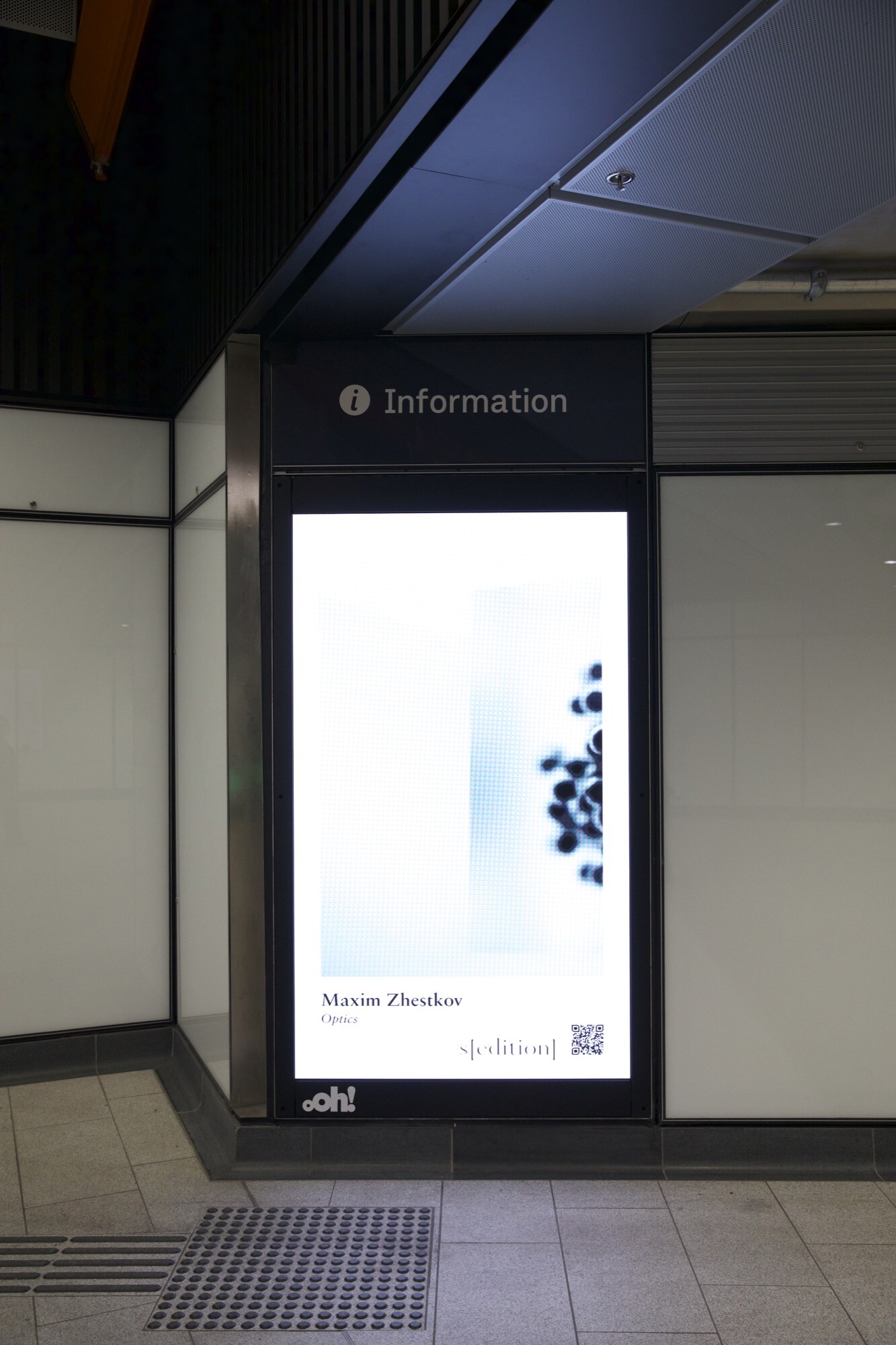
Maxim Zhestkov, Optics (2018), 2 minutes and 17 seconds, edition unknown, sold out. State Library Station. Photo: Paddy Hay
This ecology of what can be shown to the public on a screen inside a Metro station is what makes the presence of art, however weakened, doubly fascinating. Out of Home media is not only advertising, it is a kind of burgeoning interface between the actual sites where public announcements, retail, services, and artwork all freely intermix. The screens are located in high-volume spaces inhabited by the metropolitan public. However aberrant they are, we must use them, and so we get six legacy art commissions by the public-private consortium (Fiona Hall, Abdul Abdullah, Maree Clark, Patricia Piccinini, Raafat Ishak, Danie Mellor), as a way to offset the hyper-commercial retail environments that have been created (and paid for) by the public. (Some of the new stations, like Parkville, seem to have an entire mall underground that is dedicated to retail space.) On the Cross Yarra Partnership website that profiles the artworks and artists, a banner to “Lease. Advertise. Activate.” takes you to the oOh!media contact page. Hence, the platforms and seating on our train and tram networks—as street furniture—naturally offer audio-visual information that sits seamlessly beside public artworks, retail, and advertising, which is in further competition with our miniaturised devices serving atomising content delivery, our personal algorithmic stacks (Smartphones), creating a total aesthetic environment, a contemporary gesamtkunstwerk. This is one that begins with the obscure pixelation of Duchamp in profile, and so I am tempted again to reconsider the avant-garde status of Sedition Art, or at least its complication, at the intersection of art and technology. At Melbourne Central Station, the LED screens behind the train tracks intermittently switch themselves off as a train approaches. Presumably this is so no one is liable if a commuter, like a moth drawn to a flame, absent-mindedly floats into the path of the 5.09pm service to Cranbourne.
“When I am in the cinema, I am in the screen.” The philosopher of technics, Bernard Stiegler, was far more ambivalent about the rise of screen cultures than public debates about it today, which so closely approximate depression-era wowserism as to be basically indistinguishable (they banned barmaids, we will ban cam-girls). Meanwhile screens are now embedded in everything that we do, from birth (baby monitors) to death (funeral PowerPoints). If you can accept, for the purposes of my argument at the very least, that the cinema is the origin of the screen, we should make of the presence of these massive, digital, public screens—onto which advertising is usually transmitted but that could just as easily screen, let’s say, James Cameron’s feature-length historical drama, Titanic (1997)—central to our discussion of public art today. Perhaps Sedition Art, as a digital art platform “pioneering digital art since 2012”, might help answer some of these aesthetic questions, and not just my (political) economic ones. After all, the hill I will die on is art, like the splinter in my eye, is the best magnifying glass.
Gallery