Requiem in Power (RIP)
August 1, 2026
-
Requiem in Power (RIP)
Venue: Bundoora Homestead Art Centre
01 Jul 2026 – 24 Oct 2026
I type −37.718466, 145.042741 into my phone. They are the coordinates engraved in gothic font onto a stone on the gallery floor. The map directs me to a piece of land next to Preston Cemetery, only a few kilometres away, where a solar farm now stretches across a former forest. Only moments earlier, I had driven past it without noticing. Inside Bundoora Homestead Art Centre, those coordinates have become something else, not reference points, but memorial. Requiem in Power (RIP), a collaboration between artists Gabrielle Skye Nehrybecki and Olive Guardiani, is a site-based yet site-removed exhibition that focuses on the remnants of the uprooted forest.
Bundoora Homestead is itself a place layered with memory. Before European settlement, the hilly grasslands were used by Wurundjeri Woi-wurrung traditional owners as gathering grounds when the nearby freshwater creek would flood. Following the First World War, the mansion became a convalescent farm and then a mental hospital, where innovations in music therapy and early lithium treatments took place. Archival photographs show RIP’s room was once lined with hospital beds. This show quietly enters these overlapping histories. With its gravestone-like plaque, preserved organic matter, and meditative soundscape, RIP pulls site into space, continuing the oscillations between preservation and loss, intervention and ritual.

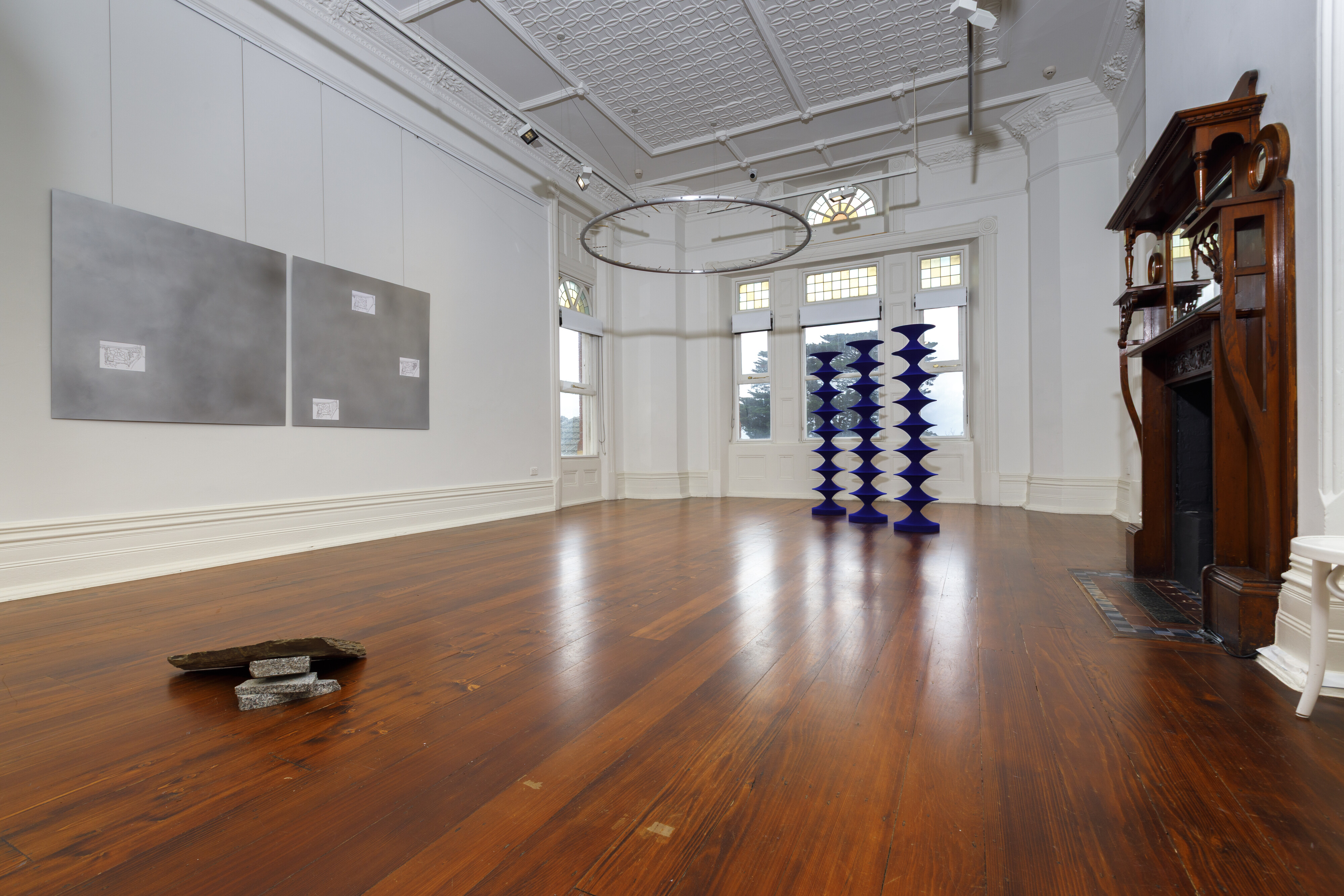
Installation view of Requiem in Power (RIP) by Gabrielle Skye Nehrybecki and Olive Guardiani. Photo: James Henry
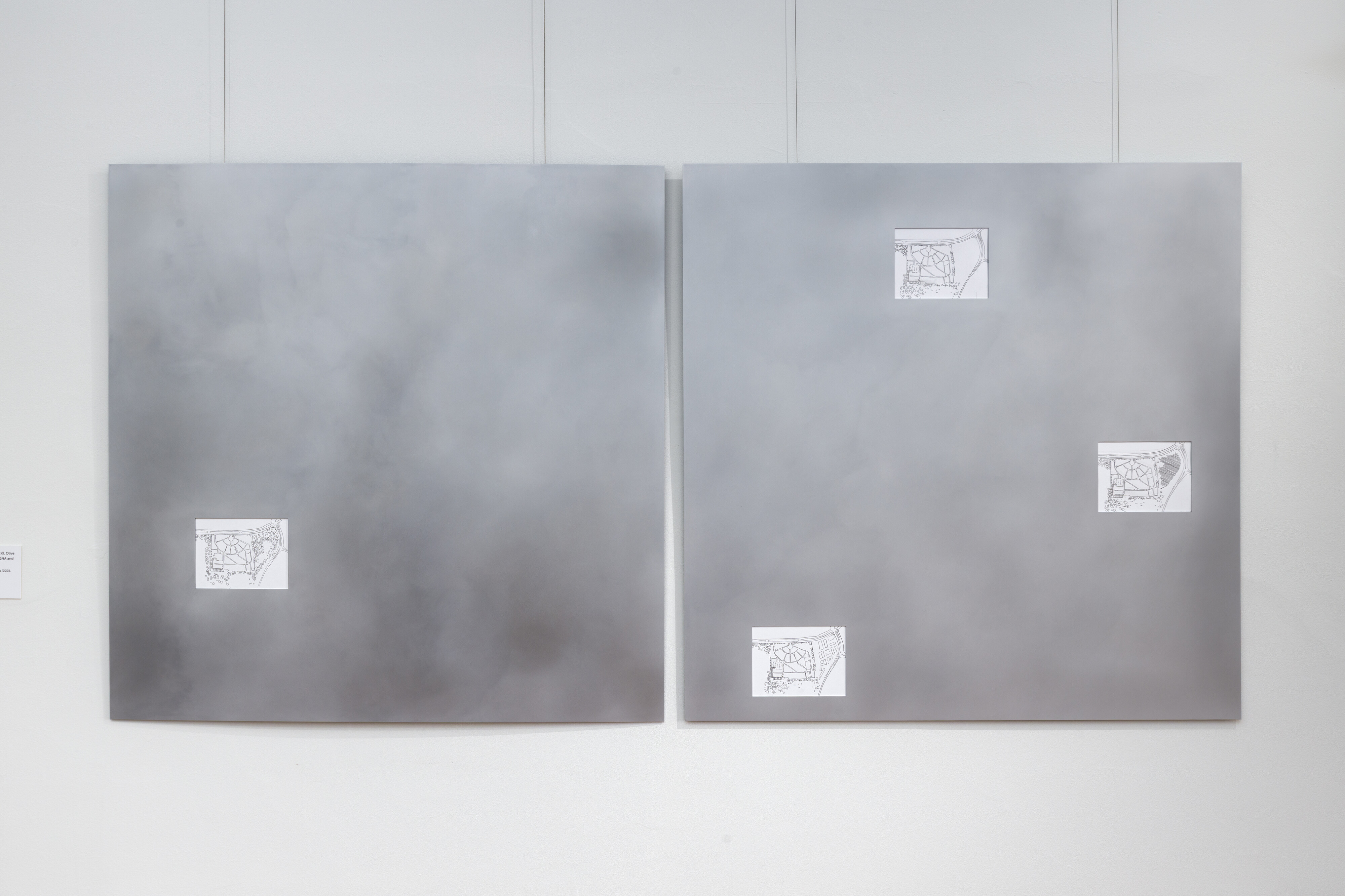
To my left, a chunk of slate begins the exhibition; it appears heavy and weathered. Plaque (2026) sits underneath an aluminium wall work, titled Time Series Satellite Drawings (2021, 2024, 2026, 2050) (2026). The two function as a pair of coordinates: one locates the site, the other traces its transformation across time. The stone plaque is resting on speckled slate sheets. Where erected rocks typically signify markers such as important sights or graveyard headstones, Plaque is removed from the site it indexes. It is displaced. Commemorating within the gallery, the slate memorialises a place. In Bundoora, the gallery is paradoxically both the site where artworks are preserved and where they “die.” Gabrielle Skye Nehrybecki and Olive Guardiani withdraw elements from a place now deceased to form fragments of memorial around the room. Plaque, paired with the satellite drawings above, continue to point beyond the gallery walls, insisting that remembrance remains an active relation to a place that has otherwise disappeared.
Rendered in carbon on aluminium sheets cut to the dimensions of solar panels, the metal wall works trace the site across four moments: 2021, 2024, 2026, and an imagined 2050. Completed in collaboration with architects Nina Nervegna and Felix Garner-Davis, these satellite pencil drawings collapse documentation, speculation, and memorial. The Time Series Satellite Drawings are fundamentally about vision. They are aerial perspectives of the site across time. Donna Haraway describes the fantasy of all-encompassing vision, such as aerial vision, as the “god trick,” a view that appears to come from nowhere while claiming to see everything. While the plaque’s coordinates guide us to these drawings, Haraway reminds us that no view is neutral. As if borrowing the view of a cockatoo overhead, the drawings are not simply mapped but spread across time in constant decay.

Gabrielle Skye Nehrybecki, Olive Guardiani, Nina Nervegna and Felix Garner-Davis, Time Series Satellite drawings (2021, 2024, 2026, 2050), 2026, carbon on paper, aluminum. Photo: James Henry
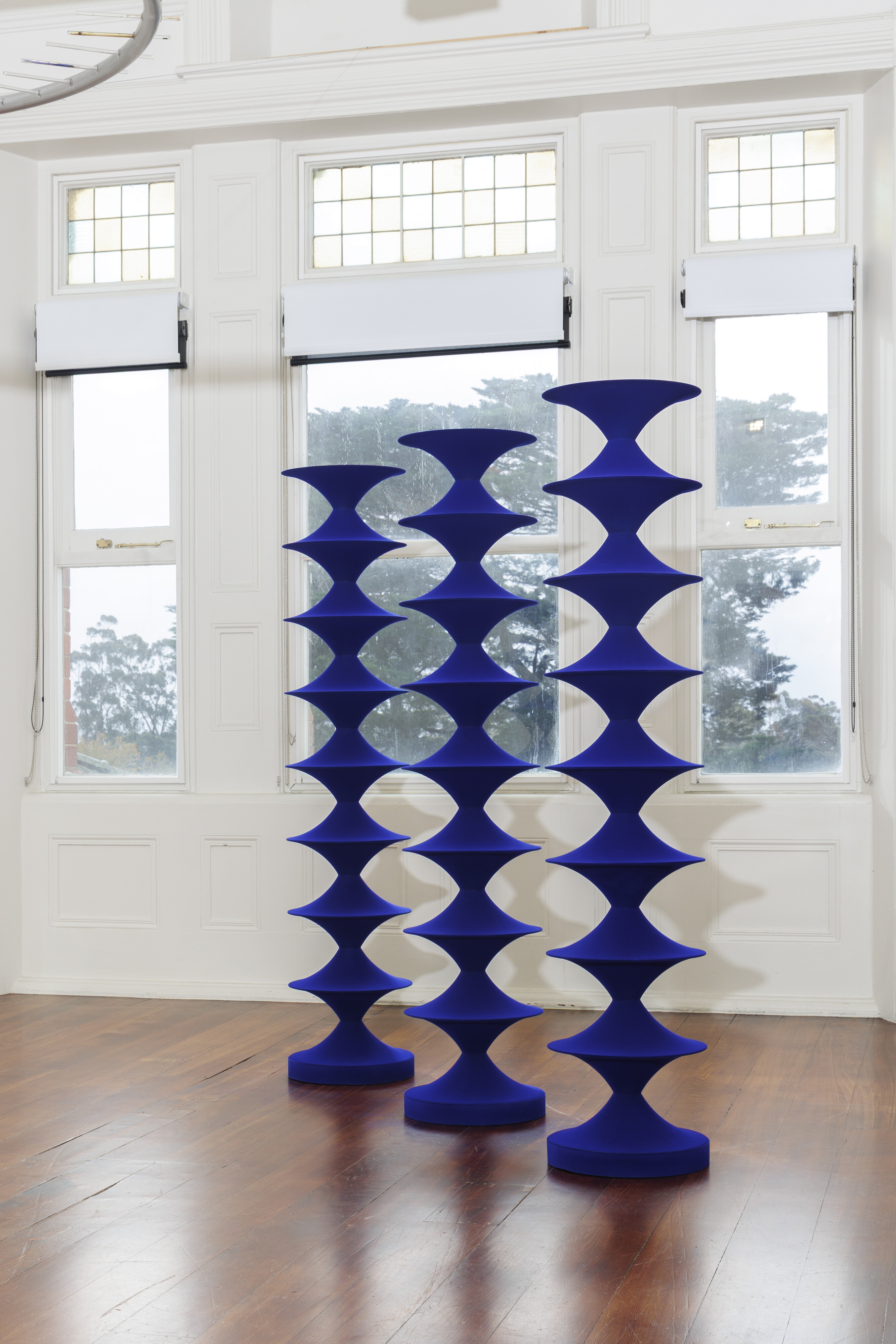
I lean my back on the window, facing into the room. As I grow warmer, so do the radiating sculptures in front of me. Modeled off transformer insulators, typically found atop electrical poles and substations, Breath of the Grid (2026) is Olive Guardiani’s solo sculptural work in the show. Conventionally, insulators come in ceramic, glass, or composite materials; for RIP they are remade in polyethylene foam and enveloped in a dense royal-blue velvet coating. The monochromatic dark hue of blue glows and absorbs light at the same time. The winter sun continues to glare into the room, my Uniqlo Heattech top doing its job, and the three prongs stand there, dense, harnessing light. Guardiani rejects surface patterns purely to accentuate the curving forms that ripple in and out. Standing at roughly my height, their triad formations are more human than belonging to the world of voltage.

Olive Guardiani, Breath of the Grid, 2026, polypropylene, synthetic fibres, steel. Photo: James Henry
A resonance sounded from one side of the room, where strings at first copy a radiator’s buzz, but as I listen on, the sound piece swells in and out, breathing. A looped composition by Louis Virgil emanates from speakers concealed within a blocked Victorian fireplace. The sounds hum, envelope, and round off, repeating again at a higher frequency, and, along with my exhale, mellow out. Breathing Capacitor (2026) treats air with sonics. In similar sound pieces by the New Zealand-born composer Annea Lockwood, the sound of breathing is a guide more than a notation. In Breathing Machine (1970) and Becoming Air (2018), Lockwood tends to the air in the space, filling it, sucking it in, and moving it into sounds. Similar to Virgil’s composition, air, vibration, and duration become ways of encountering landscape beyond vision alone. If the satellite drawings challenge the detachment of aerial observation, Breath of the Grid and Breathing Capacitor ask for a different form of attention, one grounded not in surveying the land from above but inhabiting its altered space.
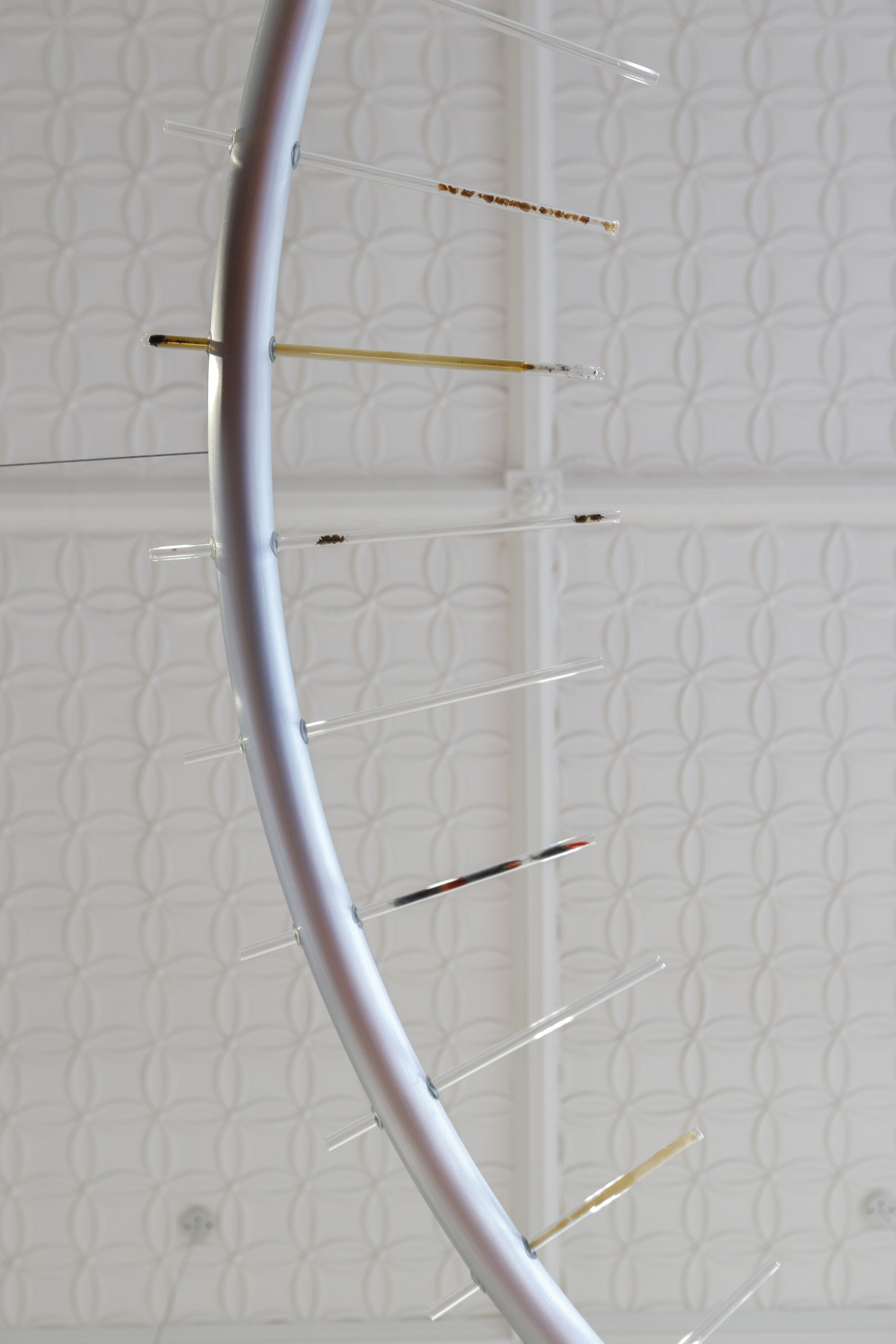
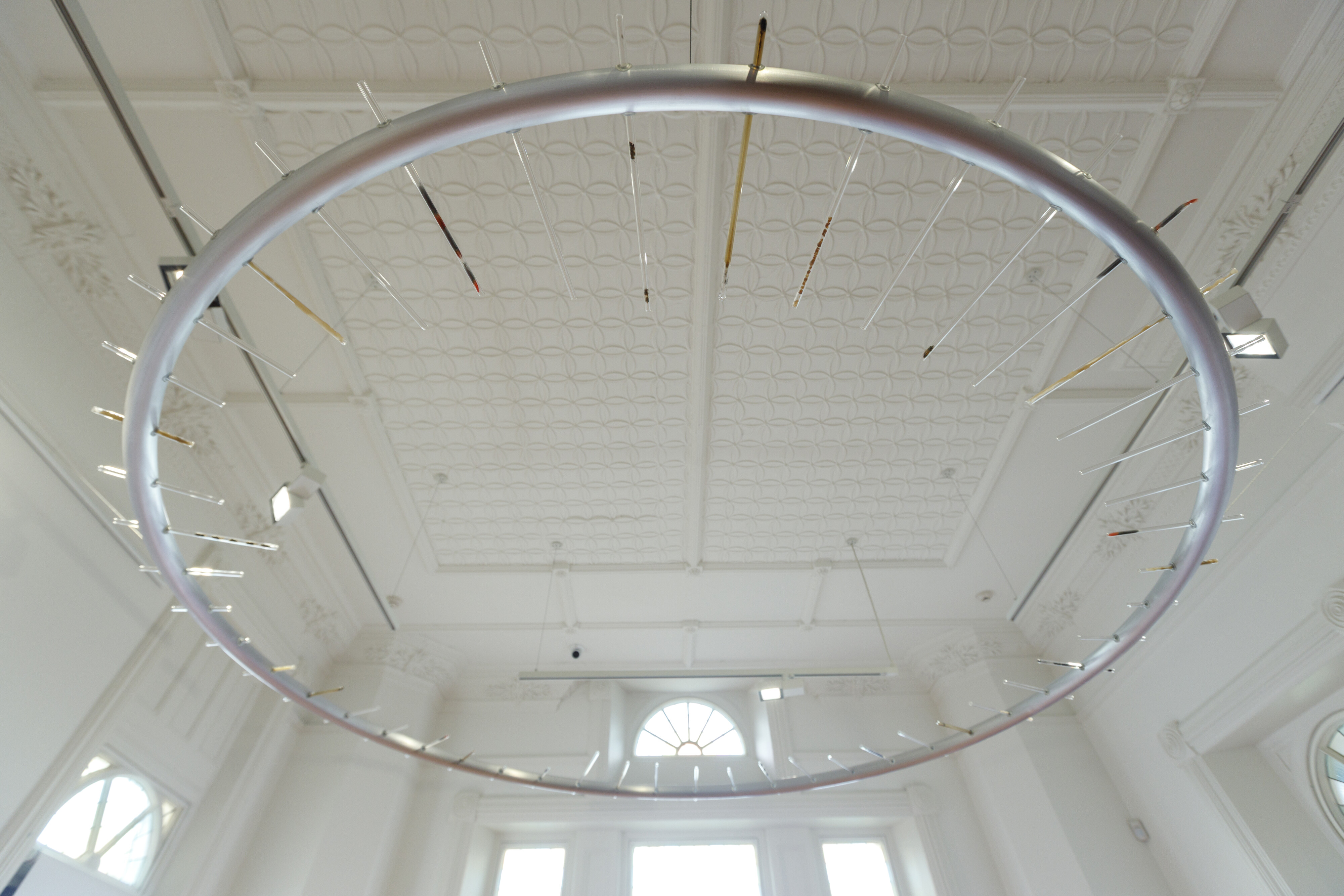
If the plaque preserves memory and the sound work preserves the atmosphere, the exhibition’s most literal act of preservation is reserved for its central work. Requiem in Power (RIP) shares its name with the exhibition title. Standing directly beneath it, I felt as though I were about to slot into a halo brace, its circular metal ring hovering at the height of a tree canopy or the crown of a head. The diameter is measured from a remaining trunk left behind at the site; it has been reformed in the shape of a large aluminium ring lined with glass tubes. From my angle below, and with the gallery’s lighting above, each soda glass tube is backlit to expose the intricate details inside. Skye Nehrybecki and Guardiani present lab archives and a forest’s altar at the same time. Debris is jammed inside, with charcoal, shaggy ink cap mushroom residue in some, and sap and beeswax coating the inner walls of other tubes. Walking in circles around the work, I am focused on the bees and feathers, which, unlike the other components, are delicately placed in threes and fives, frozen in flight, their tiny bodies and wings perfectly fit inside without being crushed. Just as patients once slept in the room, the forest remnants are collected for examination.

Gabrielle Skye Nehrybecki and Olive Guardiani, Requiem in Power (RIP), 2026, aluminum, soda glass, feathers, tree sap, charcoal, bees, beeswax, Corprinus comatus (Shaggy ink cap). Photo: James Henry
Birds, their feathers, and nesting homes have been a primary focus in Gabrielle Skye Nehrybecki’s practice. Tracing all the way to France, the artist exhibited her “clocks of locks” at The Whole World, a Paris attic gallery started by Tarquin Charlesworth. In Jeu d’Oeuf she presented a series of ostrich eggshells fitted with ticking mechanisms that used the artist’s own hair as clock hands. Going slightly further back to 2025, the show Recipe for Survival, in collaboration with Ava Clifforth at 1/53 Bourke Street, saw Skye Nehrybecki crafting a nebulous light out of eggshells, incubating and glowing. In the same show, dislocated rainbow lorikeet wings were contained inside a large bulging frame.
Leading on from last Saturday’s review published by Memo, in which Jarrod Zlatic questions what is at stake in representing gum trees in institutional galleries, RIP moves away from direct representation. Trees here are encountered through coordinates, sounds, preserved material and infrastructural traces, asking how a place might be remembered after it has already been destroyed. In doing so, the exhibition rejects a simple opposition between nature and technology. Instead, it traces the conditions through which one world is dismantled as another is assembled around the site at –37.718466,145.042741. Étienne Souriau understood existence as something continually brought into being rather than fixed; worlds emerge through acts of composition while others become partial, fragmented or disappear altogether. Rather than reconstructing the lost forest, RIP memorialises it through sound, air and suspended remnants, presenting remembrance itself as an ongoing process of world-making in ruin.
Driving home from the gallery, I pass the site in question. I take a series of photos out of the moving car, but all I capture is the big sky that is now visible due to the deforestation, and in my head, I replay a lyric by The Kinks that goes:
People lift up their hands and they look up to the Big Sky,
But the Big Sky is too big to sympathise,
Big Sky’s too occupied,
Though he would like to try.
Gallery