Rayner Hoff
March 14, 2026
-
Rayner Hoff
Venue: Norman Lindsay Gallery
28 Nov 2025 – 30 Mar 2026
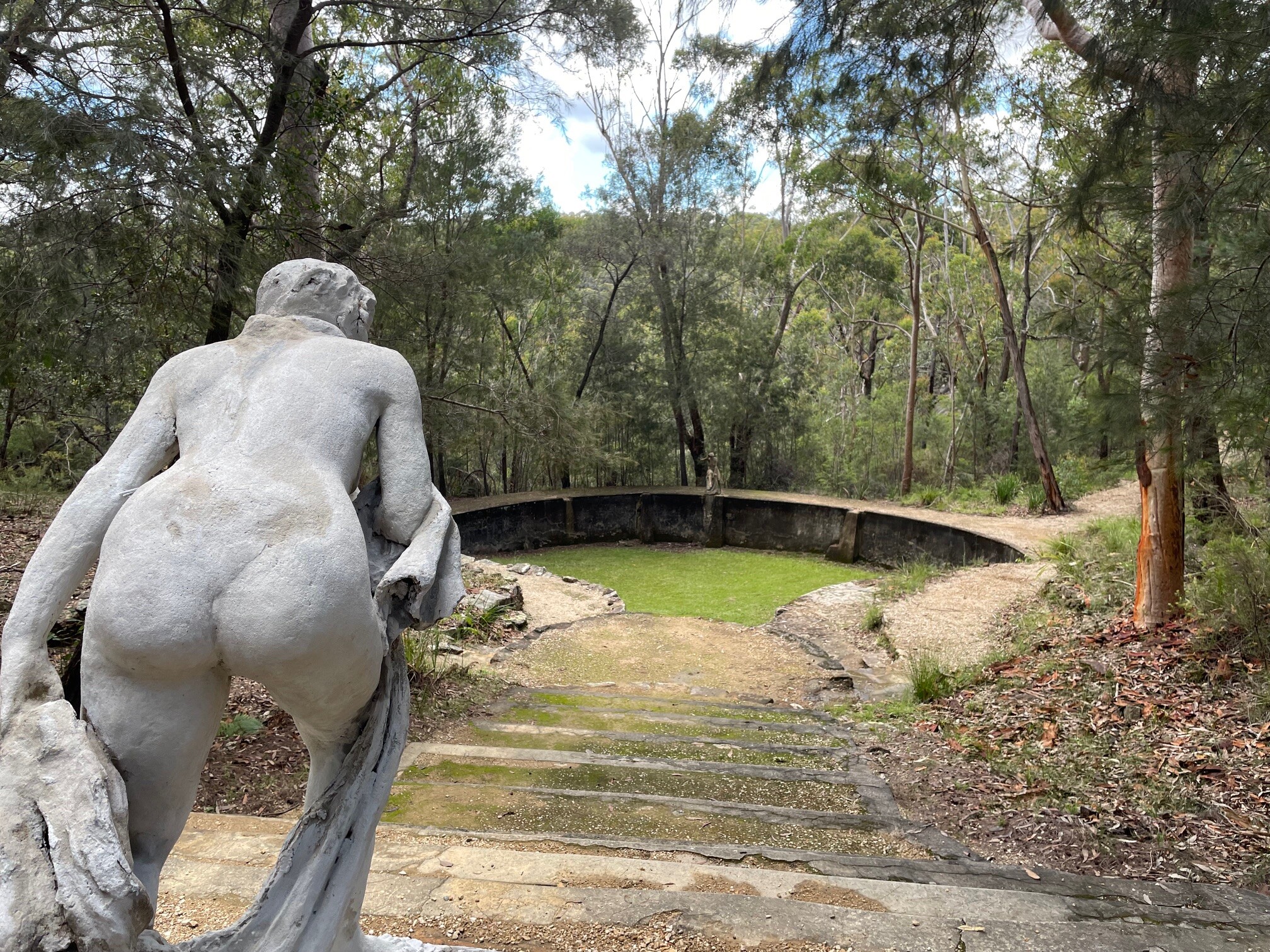
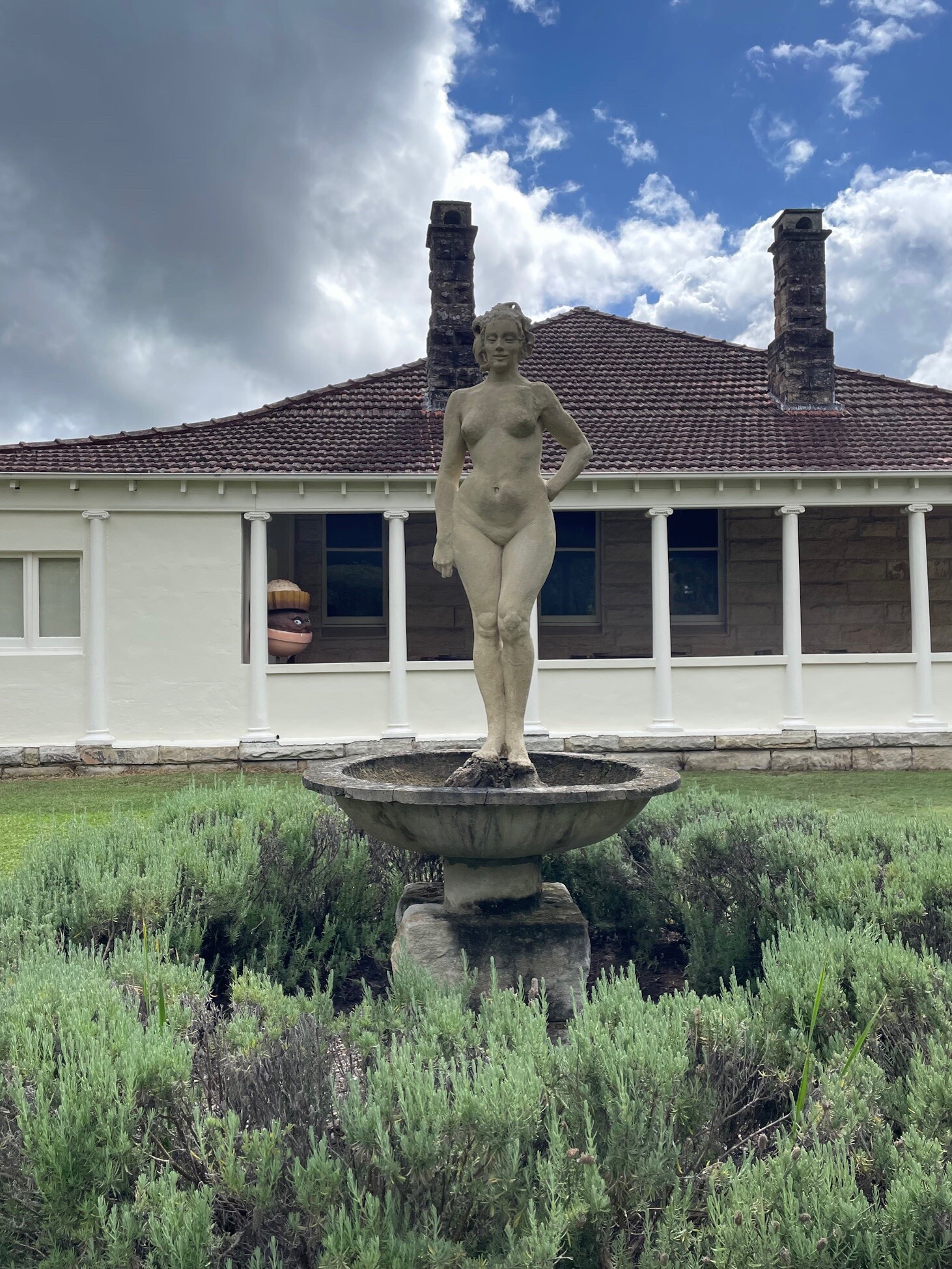
The Norman Lindsay Gallery—originally called Springwood and the artist’s former home—sits up in the Blue Mountains seemingly fated to a half-life. Three years ago I visited and the concrete statues decorating the titular artist’s garden were covered in bird shit. This time some of it has been removed. Some has not. The statues, I am assured, have recently received conservation work.

Norman Lindsay, Untitled, concrete, n.d. Norman Lindsay Gallery, Springwood, 2026.
An easy question to ask would be: “what for?” Robert Hughes once wrote of Norman Lindsay’s place in Australian art history: “Never was more fuss attached to a sprint up a blind alley.” Posterity seems to have confirmed his words. Racist, sexist, and reactionary—not much of Lindsay has been deemed worthy of conserving. And yet, just like Hughes, Lindsay once saw himself as an arbiter of good taste amongst the under-cultured Australian public, translating European ideas into consumable form. At a time when overarching accounts of “Australian” art history like Hughes’s The Art of Australia (1970) are cracking under the weight of shouldering a nationalism built on a settler-colonial amnesia, perhaps his blind alley needs reconsideration. What is it about Lindsay that has relegated him to a blind spot of cultural cringe that the nation cannot bear to face?
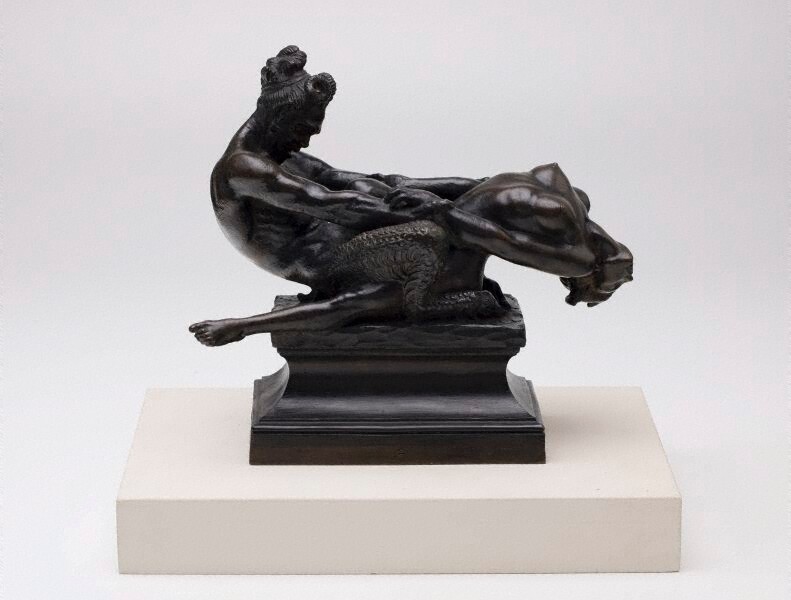
The gallery’s current exhibition, Rayner Hoff, lays bare the answer even as it tries to bring Lindsay’s artworks back into relation with a broader national canon of Australian art. For whilst Lindsay’s work is easily isolated as an eccentricity amongst his Australian painting contemporaries, his figurative obsession with the female nude finds good company alongside the sculptures of Rayner Hoff. Alongside Lindsay, the British-born sculptor—best known for his work on the Anzac Memorial in Hyde Park—led an early-twentieth-century figurative tradition in what Ian McLean has dubbed the “White Australian nude.” In the hands of Hoff, as in his Faun and Nymph (1924) on display, the salacious fantasies of Lindsay’s early bacchanal scenes took on three-dimensional form. Here the intermingling of the counterbalanced figures’ forms provides a physical metaphor for the creative act—one that is tellingly indifferent to eliciting a mix of female pain and pleasure in its exertion.

Rayner Hoff, Faun and Nymph, 1924, bronze, 26.6 x 28.6 x 14.0 cm. Art Gallery of New South Wales, Sydney.
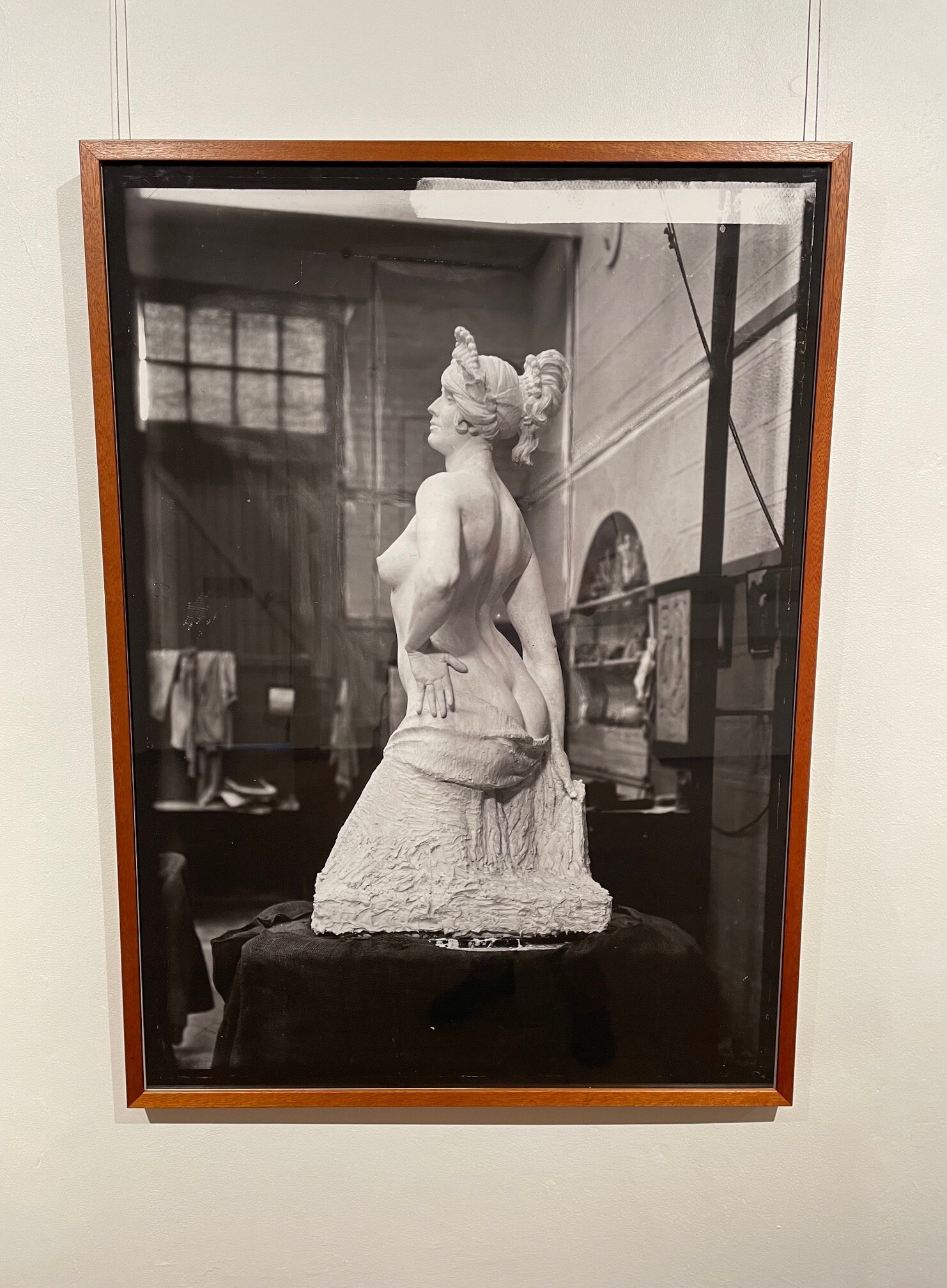
The satyr—emblematic of an Antipodean rebirth of Greco-Roman life force—epitomised the nationalist strand of eugenics with which these artists inflected the Classical figures of antiquity. Hoff, an avid surfer, shared Lindsay’s belief in a nationally distinct Nietzschean vitalism, perpetuating an emergent rhetoric that elevated the white Australian body as physically superior to that of the sickly British Victorian. The inclusion of Harold Cazneaux’s photographic series Mrs Rose Lindsay Statue (1925) in the exhibition (a substitute for Hoff’s now lost sculpture), testifies to the wider proliferation of this national figurative tradition amongst contemporaneous photographers, including Max Dupain. As such, these artists mark an alternative distillation of the image of an Australian Arcady, first popularised at the start of the twentieth century and long overshadowed by its more familiar iteration in Australian landscape painting.
Side by side, Lindsay and Hoff’s works seek to legitimise the flagrant voyeurism of their art as “serious business.” As outlined in Lindsay’s text Creative Effort (1924), the subject of the female nude is rationalised as a “pure object” of (masculine) creative energy. Carnal eroticism is sublimated into Platonic idealism. This pseudo-intellectualism—alongside accounts of Lindsay’s respectful treatment of his models, his much-less-fantastical actual sex life, and a lifelong frail constitution—has long served as a catechism for those seeking to rebuke his labelling as a pervert. Hughes, for example, described Lindsay’s “melon-breasted, ham-thighed Playmates” as “the very embodiments of adolescent sexual fantasy.”
Hoff, by contrast, was a more respectable character, cultivating a loyal and talented generation of female sculptors including Barbara Tribe, Eileen McGrath, Jean Broome-Norton and Marjorie Fletcher. And yet, masked beneath his vitalist ideas lies the same vein of blatant erotic enjoyment. As a wall label for the exhibition quotes, Rose Lindsay wrote that whilst modelling for Hoff in nothing but “a wedding ring and head-dress” he commented that she “had a most remarkable figure for (her) age.”

Installation view of Harold Cazneaux, Mrs Rose Lindsay statue (four views of Imperia in the studio), 1925.
But whilst Lindsay has been hung by the court of public opinion, Hoff has not. The suitability of sculpture over painting for figurative representation partially explains this. A settler-colonial obsession with depicting the landscape has fostered a national tradition that smiles cruelly upon figurative painting. And what little representation of the Australian landscape Lindsay did offer in his early work vanished in the wake of World War II as Lindsay retreated from reality. So too has Hoff’s Art Deco style aged better than Lindsay’s gaudy Art Nouveau figures. Clean, elongated, and semi-abstracted human forms are easier to anoint as embodiments of ideals than Lindsay’s muscular and fleshy women.
Considerations of style and subject, however, distract from a more glaringly obvious reason for these artists’ diverging fates: the Hoff PR campaign is easier to run. Political views aside, whilst Lindsay antagonised the institutions, Hoff built them—his most famous artworks being the aforementioned Hyde Park Anzac Memorial as well as the Holden lion emblem. He was the head of the National Art School back when it was the East Sydney Technical College. By contrast, Lindsay maintained an elitist conception of national identity built on individual exceptionalism that was fundamentally anti-institutional. Without depicting the national landscape or embedding his works within the institution, it is unsurprising that Lindsay has been discarded as cultural cringe—there is nothing left to be embraced as Australian.
While Lindsay’s hostility has isolated him in posterity, Hoff’s institutional contributions have secured his legacy. The exhibition’s wall labels evidence the point: the majority of loaned works in Rayner Hoff are from the National Art School, delivered through the support of NAS archivist Deborah Beck, who has incidentally written a monograph on Hoff. Even so, actual sculptural pieces in the exhibition are few and far between, confined to the somewhat cramped rear exhibition space. A lack of loaned major works and an over-reliance on secondary documentation suggests a hint of institutional reluctance to support what could be easily dismissed as a regional gallery or worse, a cultural backwater. Raynor Hoff, then, is perhaps better understood as more gallery-PR strategy than retrospective. Emphasising Lindsay’s relation with Hoff, both personal and intellectual, the Norman Lindsay Gallery is making a gambit that some of Hoff’s respectability and institutional endorsement might rub off on Lindsay. So goes the difficult work of institutionalising an openly anti-institutional figure.
Rayner Hoff reveals the Norman Lindsay Gallery stuck between a rock and a hard place. Typical of Lindsay’s self-centring nature, the acquisition of the Springwood property and its transformation into a gallery for the permanent display of his work was a condition of Lindsay’s bequest to the National Trust. It is isolated, underfunded, and tasked to manage the singular excess of Lindsay and his legacy within Australia. The recent publication Venus in Tullamarine: Art, Sex, Politics, and Norman Lindsay (2023) demonstrated that there is a way to engage with Lindsay’s works and acknowledge his politics. The edited collection navigates Lindsay’s Classical and Nietzschean influences, the postmodern aftermath of his erotic picture factory, and his dialectical engagement with national politics. By contrast, the Norman Lindsay Gallery struggles to do any of this. Instead, it remains unchanging, refusing to historicise Lindsay, with some works even remain undated. However, through this inability, the gallery provides a much more direct answer regarding Lindsay’s status as a blind spot of national cultural cringe by making us acutely aware of the blind spot itself. Ironically, the gallery’s denial of history allows for the material return of Lindsay’s artworks themselves, no longer overwhelmed by his personality. Having posed himself as the artist-as-hero against the uncultivated masses, affect has too often replaced object in discussions of Lindsay’s artwork.
If we are trying to look beyond an institutionalised national art history (and I very much am), the objects born from the blind sprints by Lindsay-like figures deserve reconsideration. They mark the limits of settler-colonial artistic practice to enunciate the nation, to institutionalise its false claim of sovereignty. Take the key ingredients of Lindsay’s works on paper. Classicism, Rococo decadence, Rabelaisian humour, Orientalism—there could not be a more conservative list of interests for a European artist at the start of the twentieth century. Lindsay’s references are firmly and unapologetically drawn from the archaic institutions of Europe. But rather than successfully reifying European superiority—the foundational tenet of settler-colonialism—Lindsay’s work crumbles into irrelevancy within the colony. His cultural references overstep the limits of the nation. In their excess they claim too much as “Australian.”

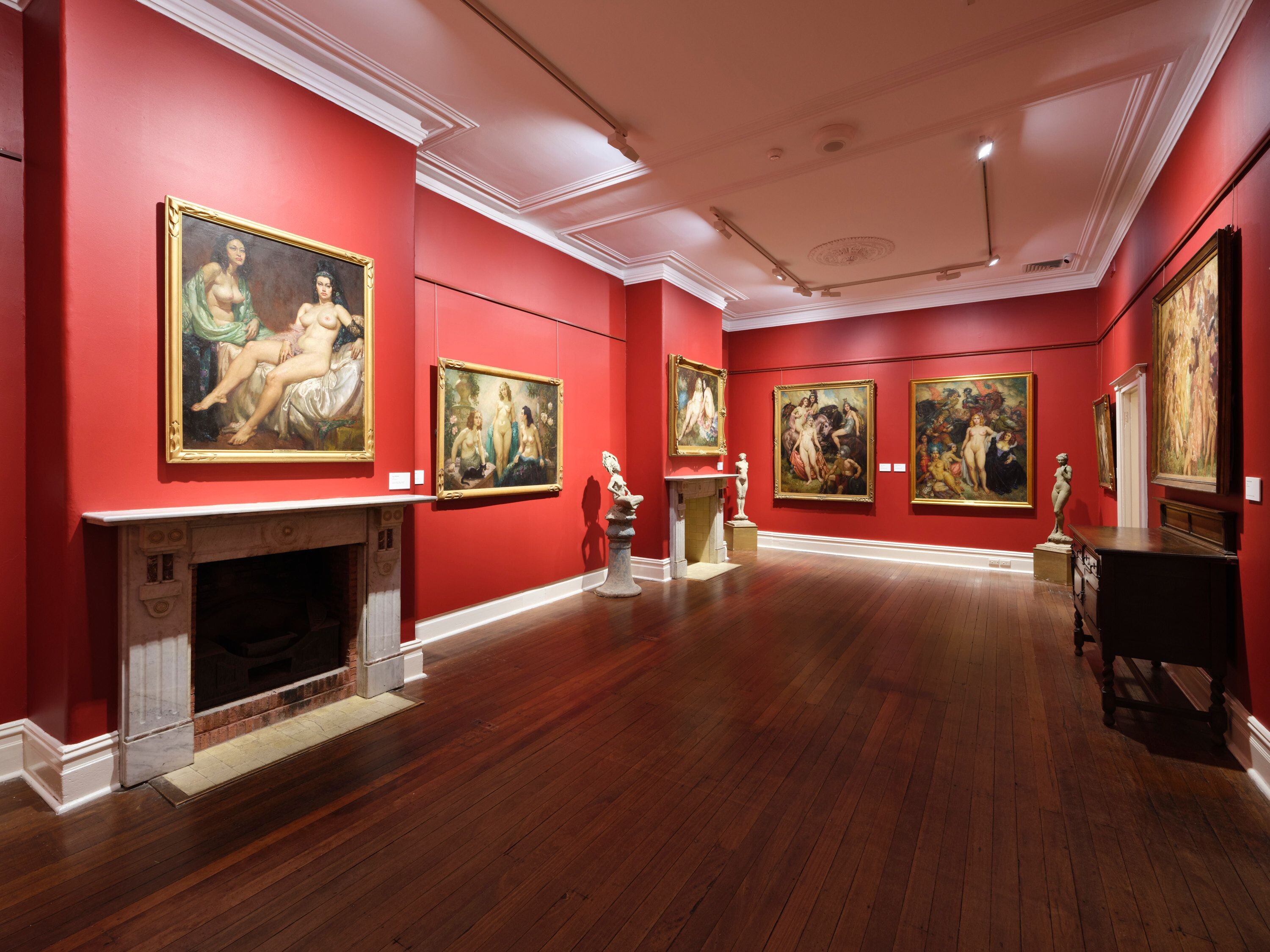
Installation view of the permanent display of Norman Lindsay’s work at Norman Lindsay Gallery, Springwood, 2026.
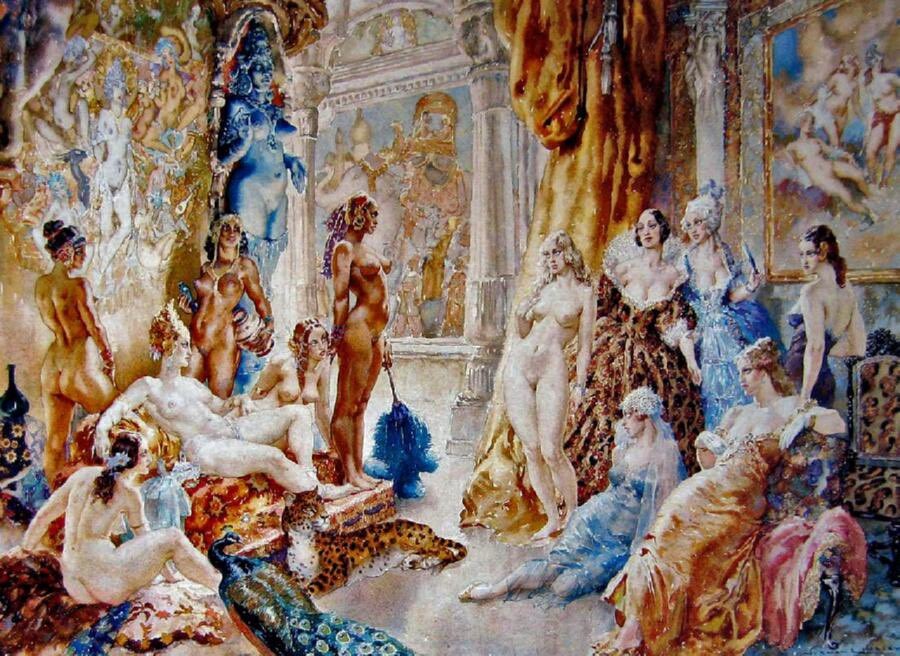
Time to try out a new label on Lindsay. Forget about “reactionary nationalist,” let’s call him a “fascistic globalist.” This more aptly captures the vertiginous mix of visual styles and subjects within his works. The painting East and West (1934) lays out the terms: for the white male artist, nothing is beyond his remit. Under Lindsay’s gaze, Rococo ornamental excess merges with Oriental eroticism, all within the nascent third space of the settler-colony. Here Lindsay builds his ahistorical pantheon in which tradition and culture are separated from any specificity of time or place. Globalism apes localism. And so instead of equalising east and west, Lindsay’s embrace of conflicting cultural signs reproduces an imperialistic cultural supremacy in its unifying vision. Labelling this as a “national” art, Lindsay exemplifies the Australian doublethink that could at once claim its globalised British colonial heritage and its localised geographic separation to legitimise the nation.

Norman Lindsay, East and West, 1934, watercolour. Norman Lindsay Gallery, Springwood.
This is the only thing left in Lindsay’s art that is “Australian”: the fascistic naturalisation of domination that was used to claim sovereignty over stolen land. Hierarchy needs no justification; Lindsay’s art is Australian because he dared to call it so. That’s the blind spot—the abject fact repressed beneath the guise of “cultural cringe” which the nation cannot ingest into its canon. And so, what literally emerges from behind Lindsay’s work, out of the background, is an object so completely embodying this repressed racism:

Norman Lindsay, No Title (Standing Nude), c.1913. Norman Lindsay Gallery, Springwood.
Squirreled away down the side of the building sits a figure of Lindsay’s Magic Pudding. It’s one of three versions still on display at the Norman Lindsay Gallery—the final signs of the unmanageable excess of the objects housed here.
On the grounds of the gallery there is a closed and collapsing gallery café, a garden full of Monterey cypresses and pencil pines landscaped to look like ancient Rome, and an emptied, crumbling concrete swimming pool overlooking Faulconbridge Creek. The unhistoricised bubble of colonial nostalgia in the Blue Mountains is slowly deflating. Time is catching up. Even so, the Norman Lindsay Gallery has no choice but to try to endure. And so, in Rayner Hoff it has attempted an exhibition that deserves not just cynicism but sympathy, witnessing, and not forgetting. There is still something worth looking at in Springwood. Go on. The pudding is waiting for you to meet his gaze.
Gallery