Ray Jackson Doing Time with Penrith Miers Archive
August 2, 2026
-
Ray Jackson Doing Time with Penrith Miers Archive
Venue: Numbers Gallery
04 Jul 2026 – 02 Aug 2026
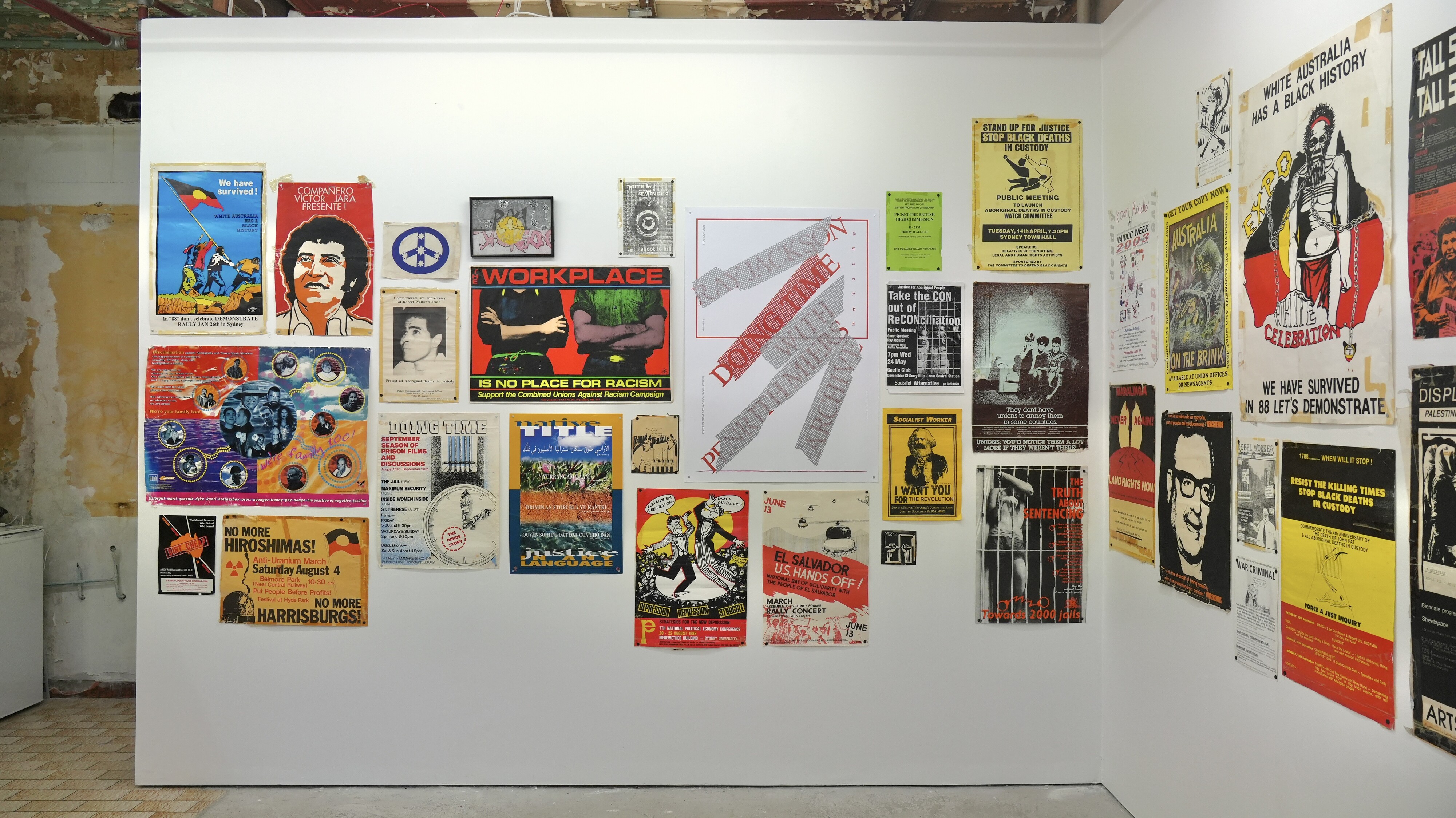
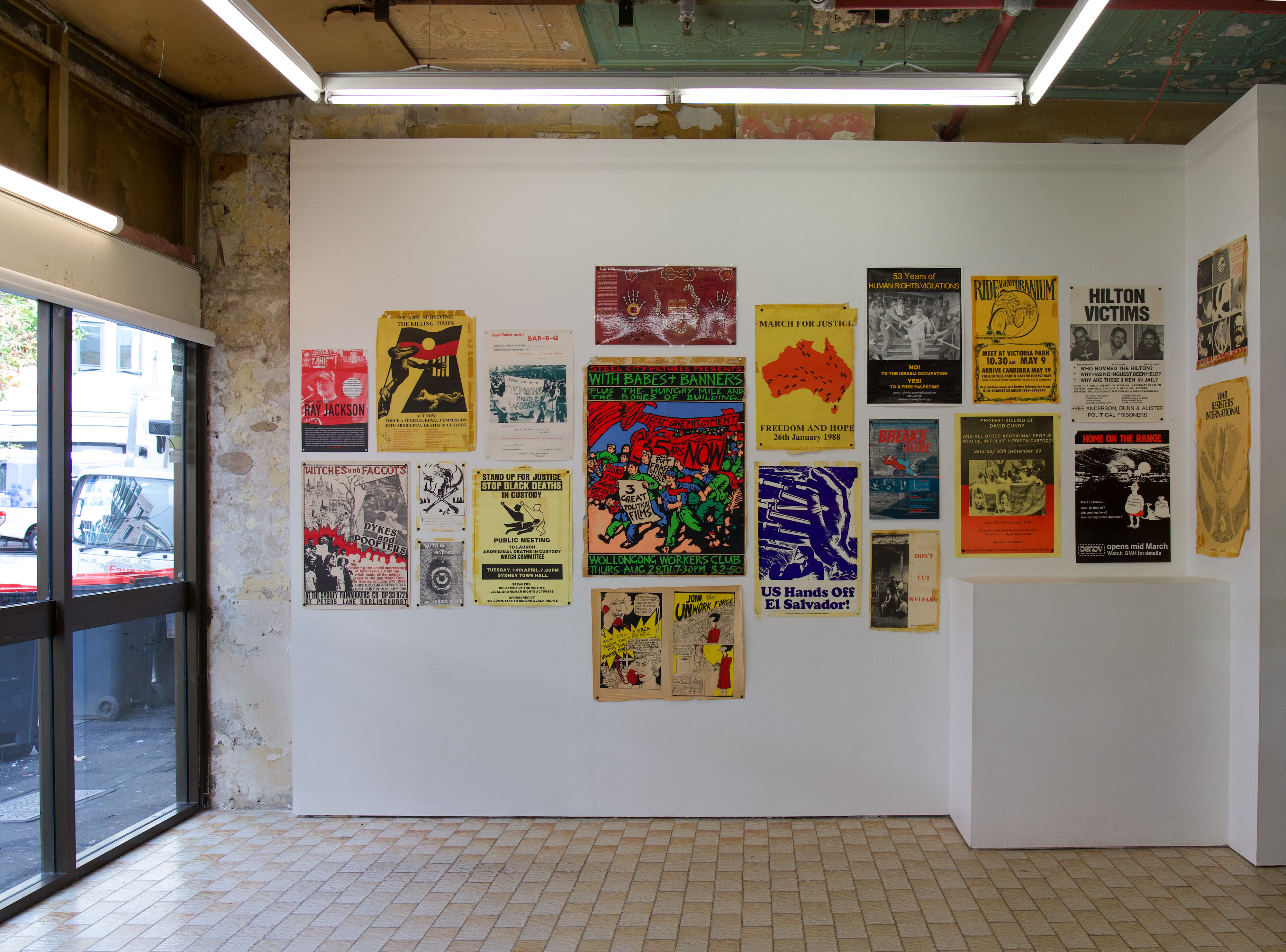
Doing Time collapses time, bringing historic activism into the present. It does so with a wall-to-wall exhibition of late 20th- and early 21st-century posters, memorabilia, and ephemera drawn from the personal archive of Ray Jackson, a Wiradjuri activist, unionist, and campaigner for Aboriginal sovereignty. Jackson helped establish the Aboriginal Deaths in Custody Watch Committee in 1987, and started the Indigenous Social Justice Association (ISJA) in 1991. He fought for innumerable social justice issues, and justice for those killed by state violence, until his 2015 passing.

Installation view of Penrith Miers Archive, Doing Time, Numbers Gallery, Potts Point, 2026. Photo: Numbers Gallery.
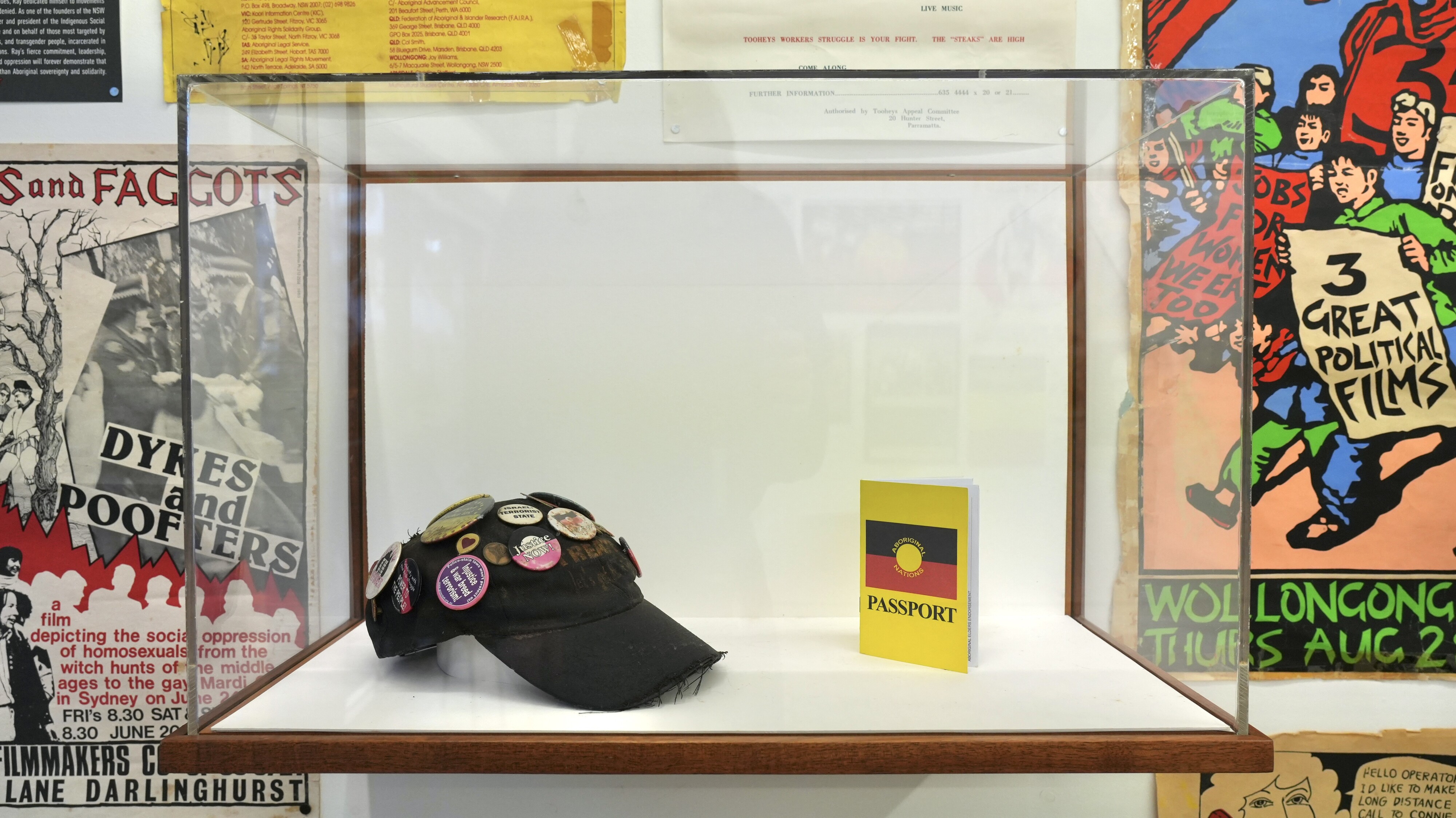
A summary portrait of Jackson as activist and thinker is offered by two objects in the exhibition, placed carefully in a glass cabinet: a badge-adorned flat-top cap, and a yellow Aboriginal passport. In collaboration with other Indigenous leaders like Robbie Thorpe, Jackson staged Passport Ceremonies at the Settlement in Redfern, conferring official recognition to migrants and refugees including Palestinian activist Rihab Charida, and former Guantanamo inmate Mamdouh Habib. Jackson also smuggled passports into Villawood Detention Centre and issued them to Tamil men who were denied permanent visas. In Jackson’s words: “Whilst they acknowledge our rights to all the Aboriginal Nations of Australia, we reciprocate by welcoming them into our Nations.” This small powerful document sits in front of the poster display, without curatorial text. The material document refuses Australia’s sovereignty and ridicules the settler state’s attempt to naturalise itself. Like other forms of Indigenous activism critiquing the nation-state like the long-running Aboriginal Tent Embassy, the Passport project asserts that First Nations people never ceded their sovereignty.
Doing Time takes place at Numbers, a recently-minted ARI occupying a former barbershop on Kellett Street, Kings Cross. The gallery is committed to platforming things that “aren’t art,” and to programming socially engaged exhibitions. The exhibition has been curated by Penrith Miers Archive, an organisation run by the inheritor of Jackson’s collection, his granddaughter Madika Penrith, a Wiradjuri, Yuin, and Gumbaynggirr archivist, alongside her ethnomusicologist partner Sam Miers. The duo’s work includes sonic, filmic, and curatorial projects that reclaim archival space for First Nations stories. An accompanying online text reveals this exhibition has emerged out of a long friendship between the archivists and the gallerists. The careful stewardship and presentation of Jackson’s collection attests to this intimacy.

Jackson’s cap and an Aboriginal Passport, Penrith Miers Archive, Doing Time, Numbers Gallery, Potts Point, 2026. Photo: Numbers Gallery.
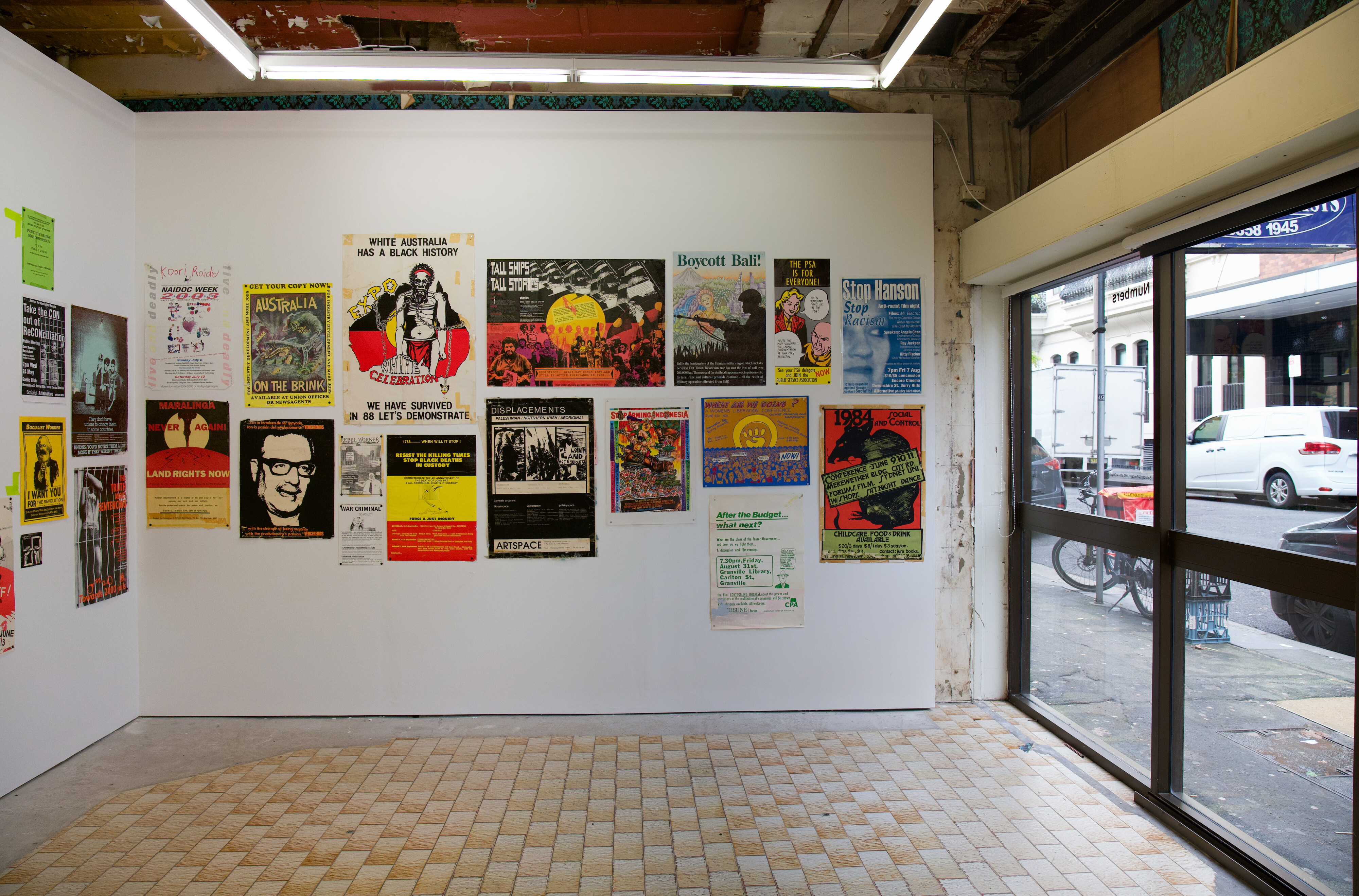
In addition to the cap and passport mentioned above, the show is mostly comprised of variably-coloured and -sized posters, which cluster onto Numbers’s three walls. The curators and gallerists drew the most visually striking posters from Jackson’s collection of one hundred and twenty posters to demonstrate the breadth of his interests—the result attests to Jackson’s all-encompassing, internationalist, and communist worldview. One is immersed in a constellation of solidarities: US disarmament, Irish peace, Palestinian justice, prison reform, Indigenous land rights, feminism, discrimination against queer people, labour rights, and deaths in custody were all matters of deep concern to Jackson. As the exhibition’s title suggests, a large percentage of the posters relate to Jackson’s deep engagement with the prison-industrial complex and make clear the connection between incarceration and racialised state violence.
The posters’ rhetorical immediacy and their polyphonic display compete for the spectator’s attention. Some of these posters are notable for outright visual impact, like “No racism in the workplace,” a staunch fluoro poster that Wollongong-based Redback Graphics created for the ACTU. This is political art at its most direct and utilitarian. Others are more subtly crafted screenprints, playfully using historical scenery and bold lettering. Others are DIY missives, for direct actions and protest. They proclaim in all caps: “STOP ARMING INDONESIA,” “DON’T CUT WELFARE,” and “NO MORE HIROSHIMAS.” There’s a front page from Rebel Worker, a circular still printed by local anarcho-syndicalists. The collection offers a portrait of Sydney’s left-wing and art-activist scenes, with pieces advertising local rallies, strikes, conferences, launches, community radio stations, exhibitions, local events (like breakdancing in Glebe), and film screenings.

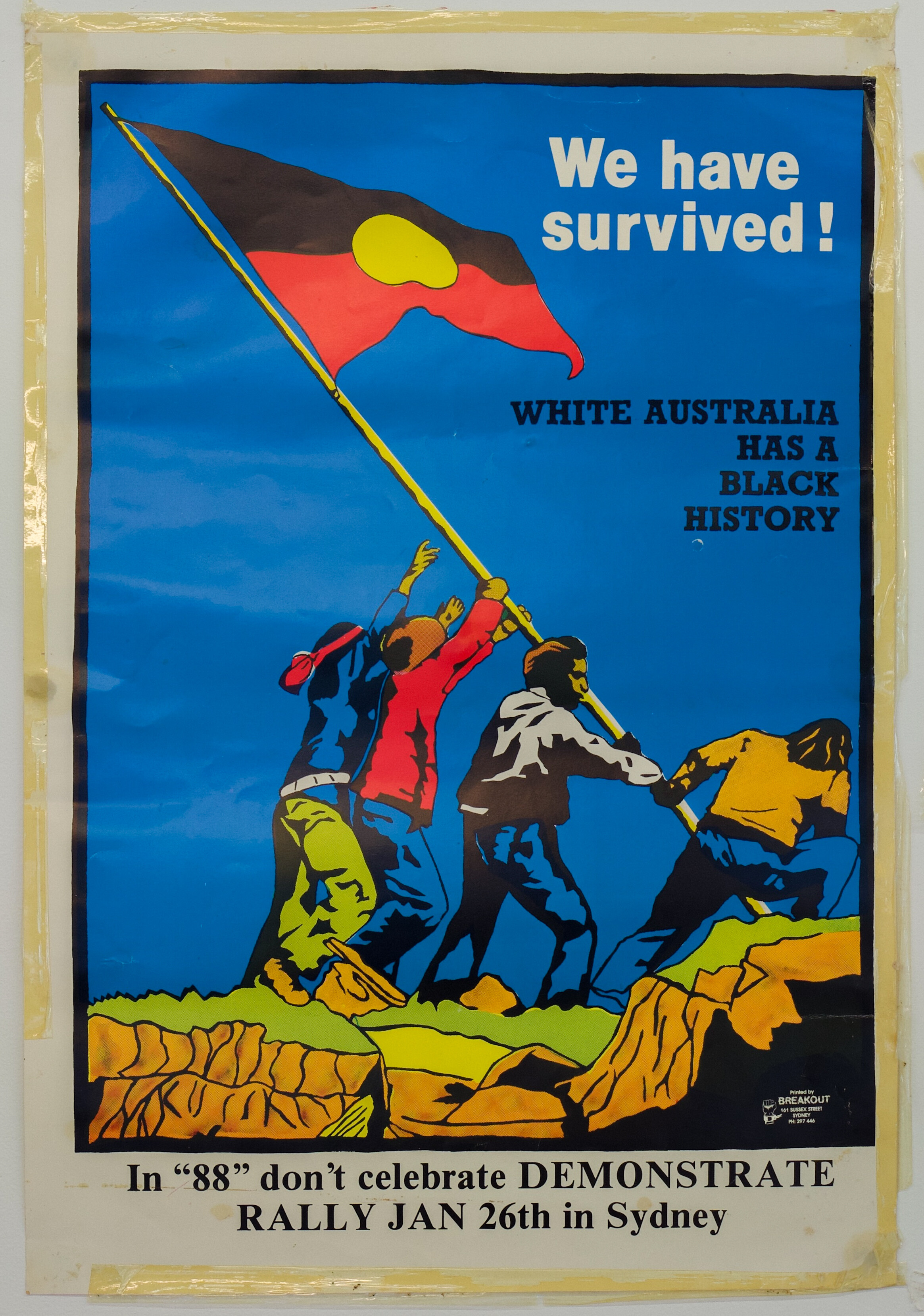
Peter Chester, We Have Survived, Penrith Miers Archive, Doing Time, Numbers Gallery, Potts Point, 2026. Photo: Numbers Gallery.
One iconic poster is from the Bicentenary. Indigenous graphic designer Peter Chester created the “We have survived” poster in 1988. Against an azure background, four men plant an outsized Aboriginal flag on a rocky precipice. Chester received permission to recreate parts of Chips Mackinolty’s 1977 land rights poster advertising a dance at Balmain Town Hall. In the 1988 poster, Chester’s pastiche of the iconic war photograph reclaims glory over the nation-state. The original image, taken by Joe Rosenthal in 1945, captured six US soldiers raising a flag and claiming the territory of Iwo Jima, a small island off the coast of Japan. The poster’s bright colours and striking text, and its iconographic use of a WW2 image, testifies to the energy of Indigenous activism around the Bicentenary—two hundred years had passed since invasion, and resistance hadn’t waned. There’s no mention of the Bicentenary, only the simple salient phrase: “We have survived!”
By placing them in a living, homely, and political archive, Doing Time illuminates the more common presentation of such material: the institutionalisation of political posters and their politics. Many screen-printed posters are part of civic collections, entombed in university, national, state, and council repositories, or included in school syllabi to invoke pride in our supposedly dissimilar present. Institutions smother the active and rallying cry of these posters, turn icons into iconography, and language into mere slogans. The slick, unwavering smile of the art market responds similarly; many posters are now valuable collectors’ items. The archivists consciously ensured that these pieces didn’t follow the trajectory of becoming “pristine archival objects,” and allowed the posters to retain their authority and immediacy. The art here is cultural change itself.

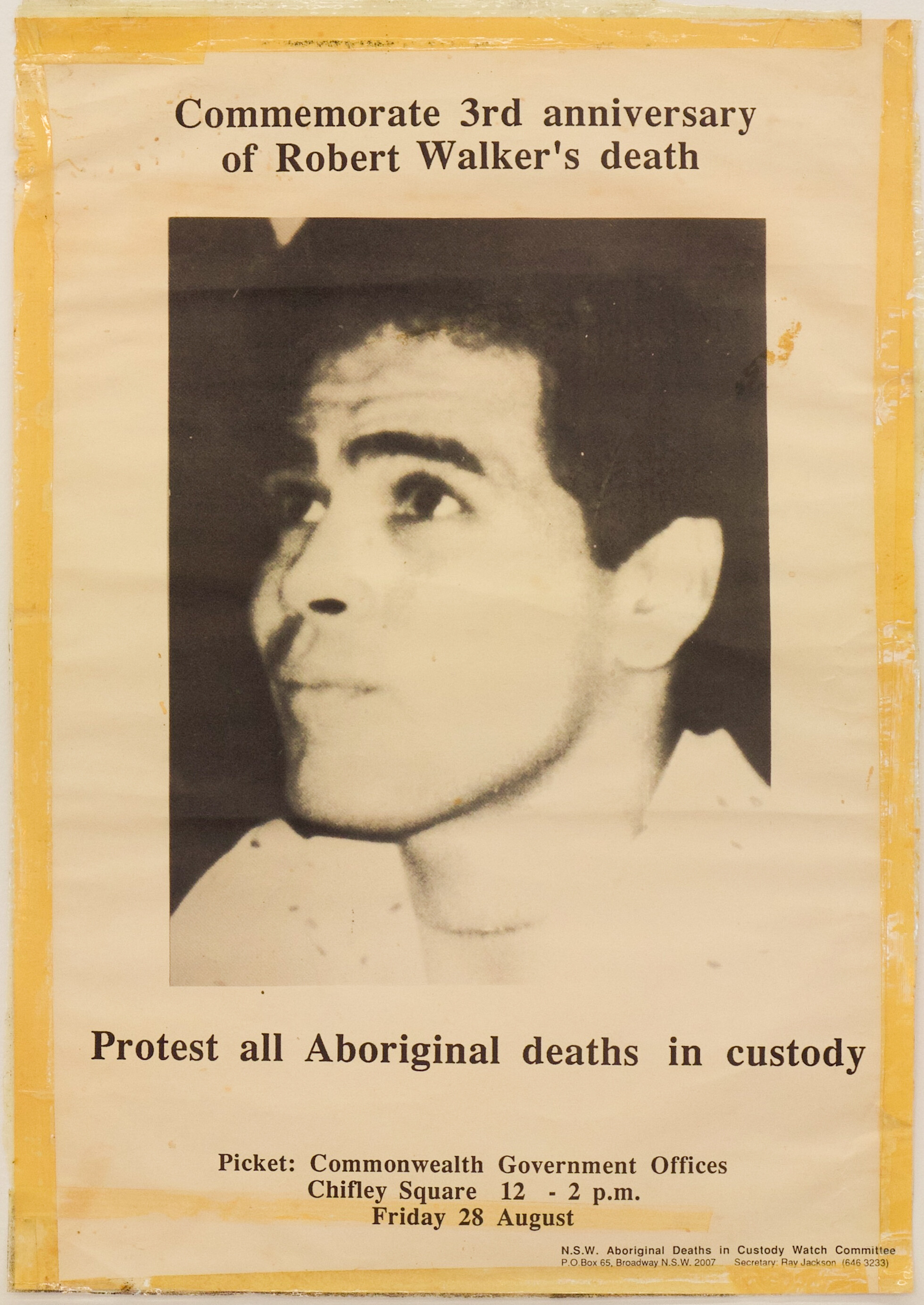
NSW Deaths in Custody Watch Committee, Commemorate 3rd Anniversary of Robert Walker’s death, Penrith Miers Archive, Doing Time, Numbers Gallery, Potts Point, 2026. Photo: Numbers Gallery.
Another poster was created by an organisation of which Jackson was part, the Deaths in Custody Watch Committee. This poster, a simple A4 black and white portrait with centre-aligned serif text, calls audiences to the third anniversary of Robert Walker’s death. Walker was killed at Fremantle Prison at age twenty-five after a brutal beating. The 1987 Deaths in Custody Royal Commission attributed the death to the police officers’ “misguided use of force.” This horrible death goes largely unremembered by official Australian history—one of many deaths in custody that haven’t received justice. Alongside Walker, Jackson was involved in getting justice for TJ Hickey, Eddie Murray, and Mark Mason. Today, the numbers of deaths in custody are the highest they’ve been since official counting began in the 1980s. Out of the three hundred recommendations handed down by the Royal Commission, only a handful have been implemented.

Installation view of Penrith Miers Archive, Doing Time, Numbers Gallery, Potts Point, 2026. Photo: Numbers Gallery.
The past collapses into the present in a duo-toned image of Pauline Hanson. “Stop Hanson, Stop racism,” it cries, advertising an anti-racist film night at long-gone Encore cinema. Political and artistic groups, like screen-printing collectives, filmmakers, radio stations, have always worked together, attesting to the fact that fighting the issue and communicating the fight are part of the same battle. As Pauline Hanson’s One Nation climbs in the polls and our media become its amplification device, such organising remains as important as ever. This poster pushes up against the Kellett Street window; the 1990s are bleeding into the present. This continuum overtly refutes the settler-colonial narrative of progress. The arc of the moral universe does not bend towards justice. Bare-faced, free of glass and frames, these posters demand to be read as contemporary objects, not historical artefacts.
Despite their aesthetic appeal, it’s clear that the posters on display weren’t made by artists for an exhibition. Indeed, most weren’t created by Jackson: he simply collected and then sticky-taped them onto the walls of his one-bedroom Waterloo flat. The tightly-spaced, salon-style hang of the show is a nod to Jackson’s original arrangement, remnants of sticky-tape still framing the posters’ yellowing edges. The audience steps into a recreation of Jackson’s Waterloo flat, the centre of operations for his ISJA work and other campaigning. Penrith (herself an archivist) has described Jackson’s flat as a kind of archive, pointing to his retention of copies of deaths in custody case files, email correspondences, videotapes, books, and posters. Others have described his small flat as full of “neatly-labelled lever arch folders.” The ARI’s small space is able to (re)present the activist archive as a familial, intimate subject rather than an institutional, artistic object. Amongst the array are two posthumous works: Mickie Quick’s 2018 two-color offset printed poster of Ray Jackson for the Peoples History international poster series, and a newly-commissioned work by designer Alexander Tanazefti. Tanazefti’s poster, the only object for sale, is a visual response to the Jackson’s collection, using the sticky tape motif to signify use and reuse. These two contemporary posters reflexively intervene in the assemblage, opening Jackson’s collection to a new family of practices.
The non-linear salon-style hang also breaks institutional history’s obsession with periodisation and refuses teleological narratives. The contextual sparseness forces the audience to draw their own conclusions between each movement, its context, claims, and impact. The viewer is invited to piece together these parts. In so doing, they may realise that historians are merely organisers of data to construct their own social reality. Our present is not dissimilar from our past as 1980s movements swirl in a temporal loop with early noughties fights for land rights. History cannot be domesticated and packaged into discontinuous sets of time. Especially when history keeps repeating itself. As spectators, we are eyewitnesses to the lack of change in the settler-state.
Part of this dynamic is achieved by Numbers’ street adjacent gallery cove. Along Kellett St, Numbers enjoys high foot traffic and a contested locale. The fit-out of the former barbershop diminishes the interior and exterior divide, and the white cube’s pretense of neutrality. The posters are entirely visible from the street and become part of the streetscape, where they were once wheatpasted. The street noise intrudes into the gallery space. Numbers’ own adjoining music programming with emerging and experimental artists further disrupts the quiet contemplative paradigm. It is refreshing to see a gallery stick to their promises rather than offering objects that apparently obliquely contain serious social commentary. This direct engagement with local politics, like Numbers’ recent show on Newtown’s gentrification that opened at the Waterloo campout, is what inner city ARIs should be doing.
The show’s past and present calls for action are made more important amidst the left’s current static state. The momentum seems to have quietened since Jackson’s time. No longer are the organisations behind posters strong, nor can they count on youth membership. Penrith states that the left has lost its way. Younger Australians seem to participate in social causes only individualistically and reactively. Much engagement with Indigenous justice activism is contained to attending an Invasion Day protest. We should be inspired and mobilised by Jackson’s visual milieu. Doing Time is a call to collect again, and engage with fights against continual settler violence, in Australia and elsewhere.
Gallery