Possibly Perpetuating Pop, Personalism, Post-Punk and Post-Conceptualism: 7 Decades of Jenny Watson
October 31, 2026
-
Possibly Perpetuating Pop, Personalism, Post-Punk and Post-Conceptualism: 7 Decades of Jenny Watson
Venue: Fiona and Sidney Myer Gallery
20 Oct 2026 – 20 Nov 2026
-
Ngarn Wa’ngal: Art of the Gum Tree
Venue: The Ian Potter Museum of Art
10 Jul 2026 – 21 Nov 2026
-
Venue: National Gallery of Victoria | The Ian Potter Centre: NGV Australia
–
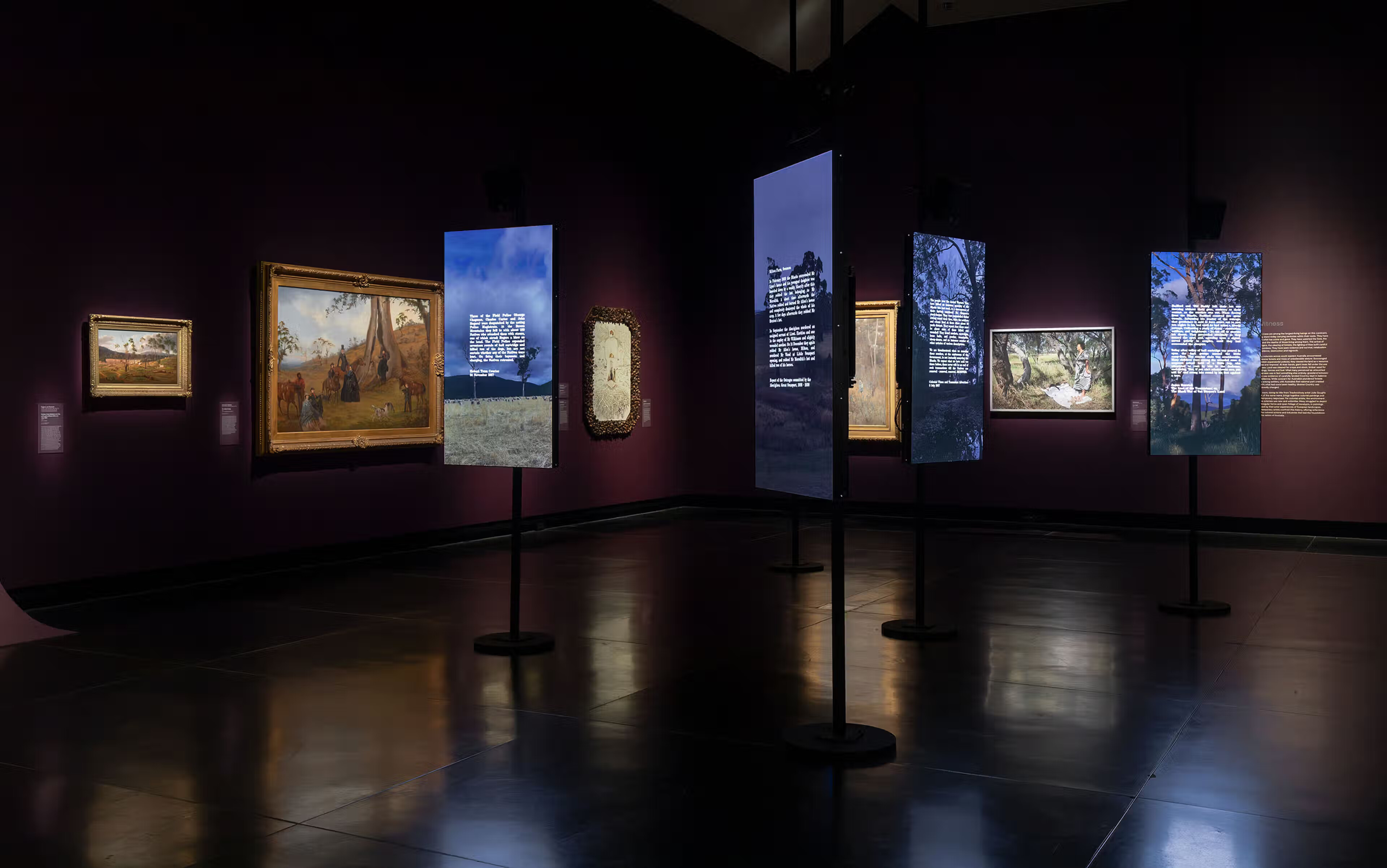
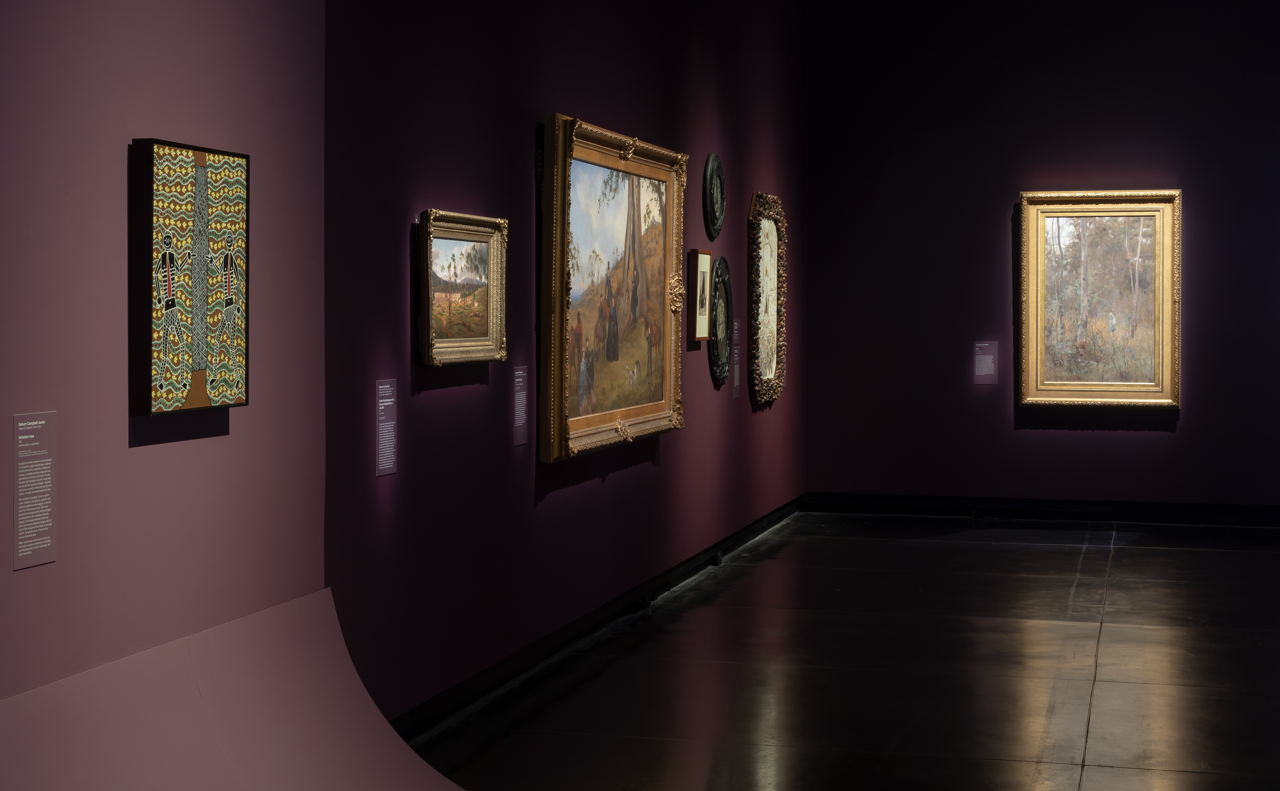
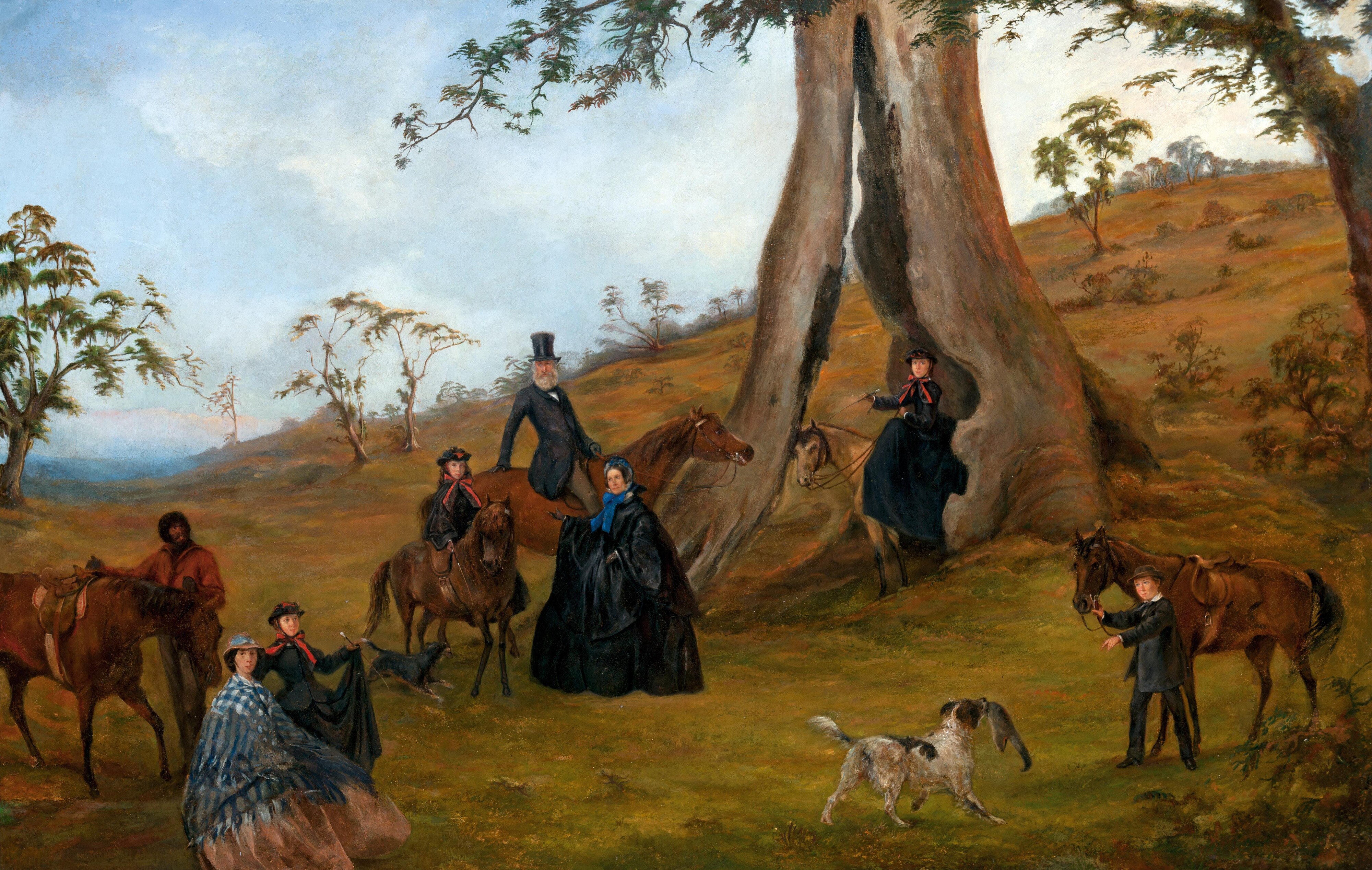
The other day I dropped into Ngarn Wa’ngal: Art of the Gum Tree and, having breezed past the Ian Potter Museum’s foyer café and waded through a uniquely Australian perfume of eucalyptus blended with the fragrance of café sausage rolls, made my way into the first gallery on the ground floor, seeming to gravitate, like a moth towards a candle flame, to the centrally hung, brightly lit colonial painting by Alexander Schramm, The Gilbert Family.

Alexander Schramm, The Gilbert family, 1864, Adelaide, oil on canvas, mounted on board, 106.3 × 168.0 cm; Gift of W.A. Gilbert 1970, Art Gallery of South Australia, Adelaide.
Painted in 1864, the work is a family portrait featuring the South Australian pastoralist and early Barossa Valley wine grower Joseph Gilbert before a great old gum, wedged between family members, most shrouded in dark Victorian dress. Mr Gilbert is perched upon a chestnut horse (he was also a horse breeder, having bred an 1874 Adelaide Cup winner). The children have their own ponies, as does an Aboriginal man depicted to the left who, it seems, was considered a part of the family. And beside the patriarch, the matriarch, atop her own steed, seems to blend into the old split gum, as though a spirit on horseback were being exorcised from the tree. Yet this ancient gum tree is, like a royal oak, the purported family tree, anchoring all the associated ideas of genealogy, inheritance, bloodlines, and possession.
Then, to the right of The Gilbert Family, was a photograph of a similar scene. Again, a family, hovering on horseback in the blackened heart of an open gum, rising forth out of the tree. Mother, father, son, daughter, horse, gum—all seemingly inseparable. As I continued to look around, I noticed that these colonial pictures of gum trees were everywhere accompanied by pastoral scenes featuring horses, cattle, and sheep.
There, in Louis Buvelot’s Gisborne Hill from the Slopes of Mount Macedon, the foreground, an open paddock with cattle, fenced in by looming gum trees. Or there, too, John Glover’s Patterdale Landscape with Cattle, in which the writhing limbs of the central majestic gum are equipoised above the calm, curious cattle, some grazing, some wandering about, some turned towards the viewer, as though they just caught Glover painting them. Or Hans Heysen’s The River Bend, where a flock of bark-hued, bespeckled sheep drift along the course of the river between glowing gum trees.

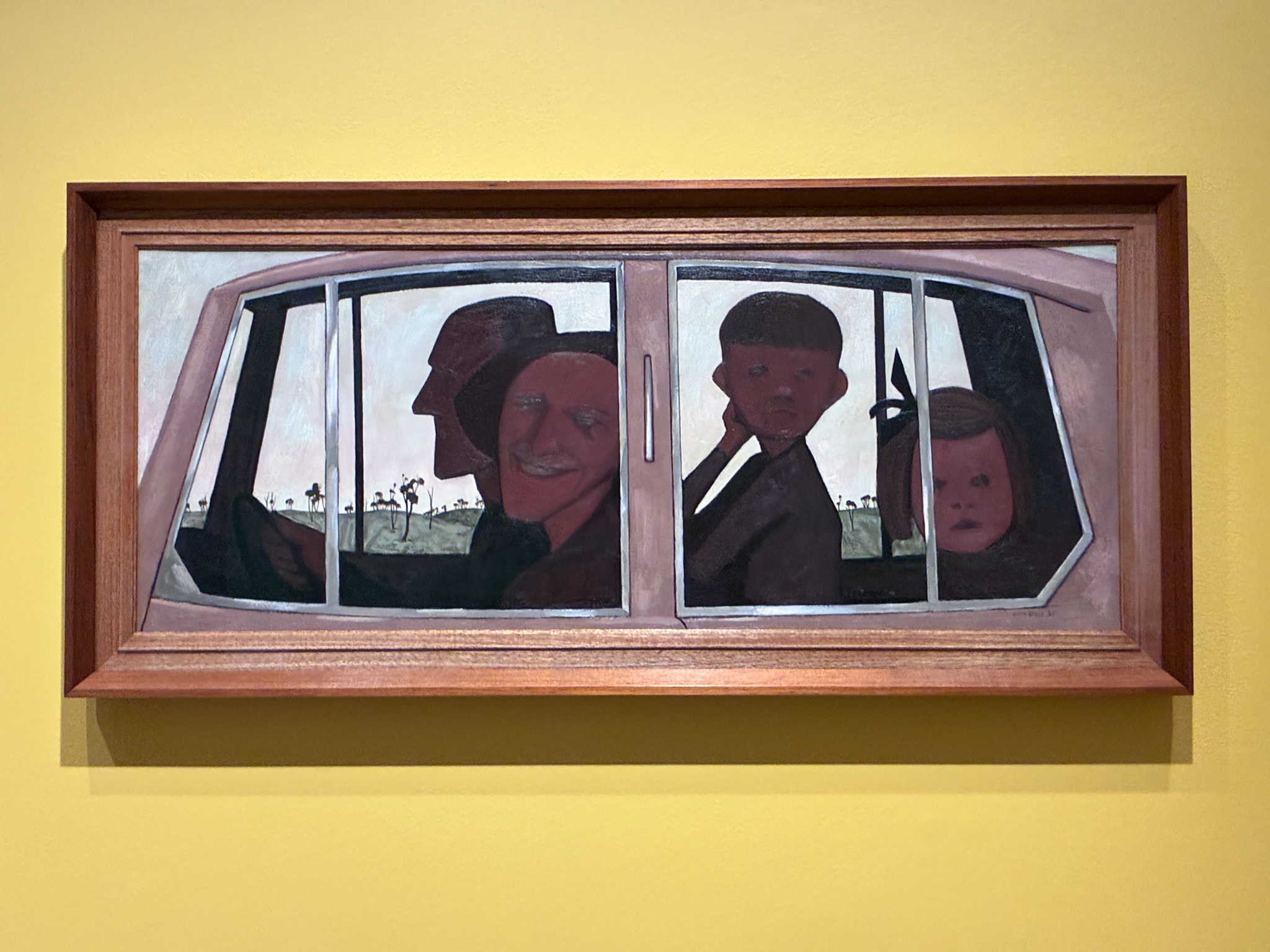
John Brack, The Car, 1955, oil on canvas, 41 × 102.2 cm, National Gallery of Victoria, Melbourne. Purchased, 1956. © National Gallery of Victoria.
Or there again, John Brack’s The Car (relevantly, a word that originally referred to the horse-drawn carriage), in which a nuclear family crammed into a small sedan drives through the Australian landscape in the modern urban world’s horse: the automobile, which has, of course, had all the symbolic weight once ascribed to the horse transferred upon it. It is a totally new, better horse now associated with modernity rather than classicism and, with its whole new level of mobility and mechanical reproducibility, leaves in the dust the slow husbandry of horse breeding and rearing. But this family in The Car, were they too not also—like the horse, the cattle, the sheep, the gums, the Gilberts—in some way products of a certain crude social “husbandry,” an ideal national type? Is this not also a family portrait, like the Gilbert family, uniting progenitor and progeny, the landscape and the bush, through the updated motif of the automobile, here presented as a figure of alienation imprisoning the nuclear family in its dream?
And what is it about the horse in particular, alongside the gum, that seems to have a forgotten symbolic power to anchor a national identity?

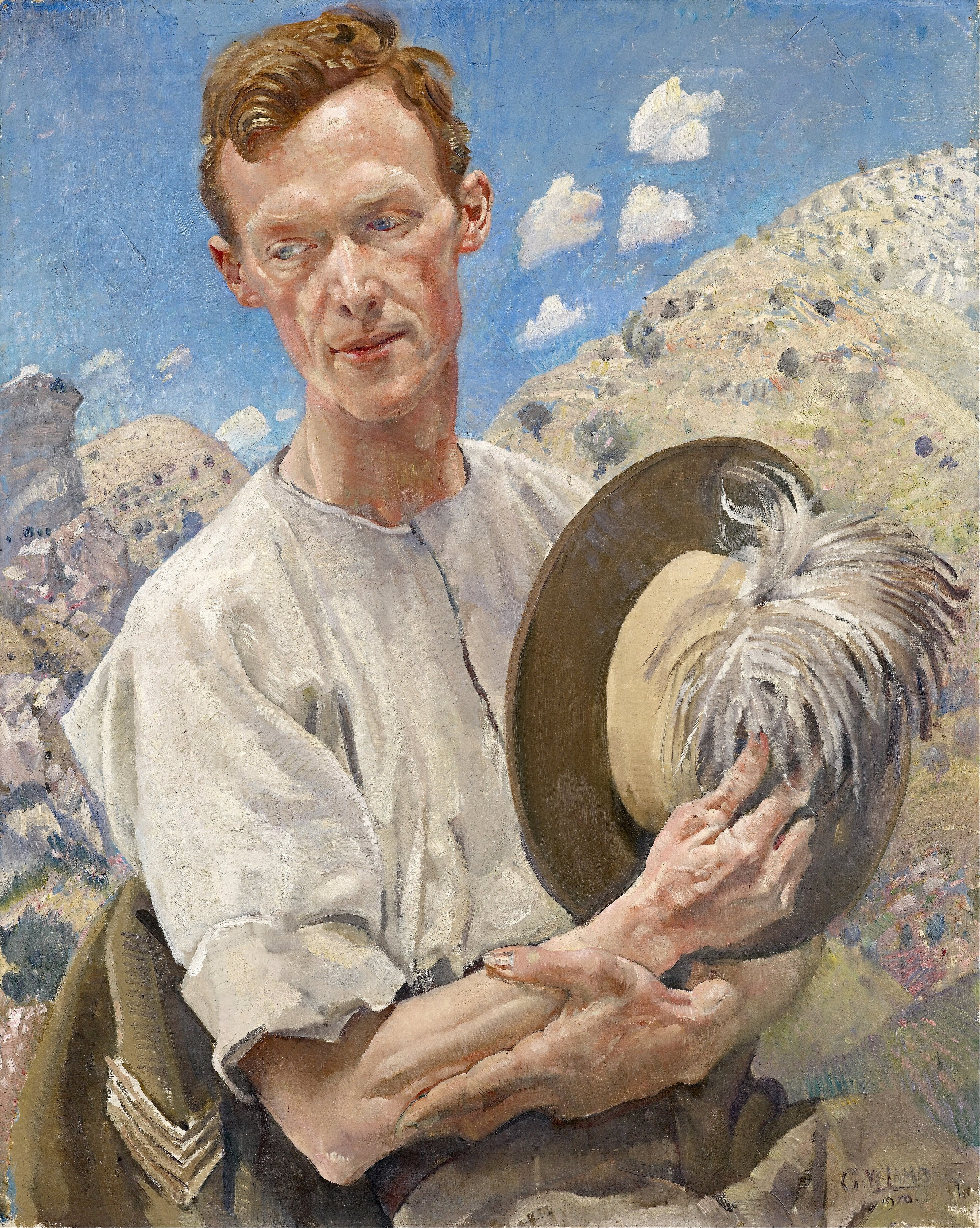
George W. Lambert, A Sergeant of the Light Horse, 1920, oil on canvas, 77 × 62 cm, National Gallery of Victoria, Melbourne. Felton Bequest, 1921.
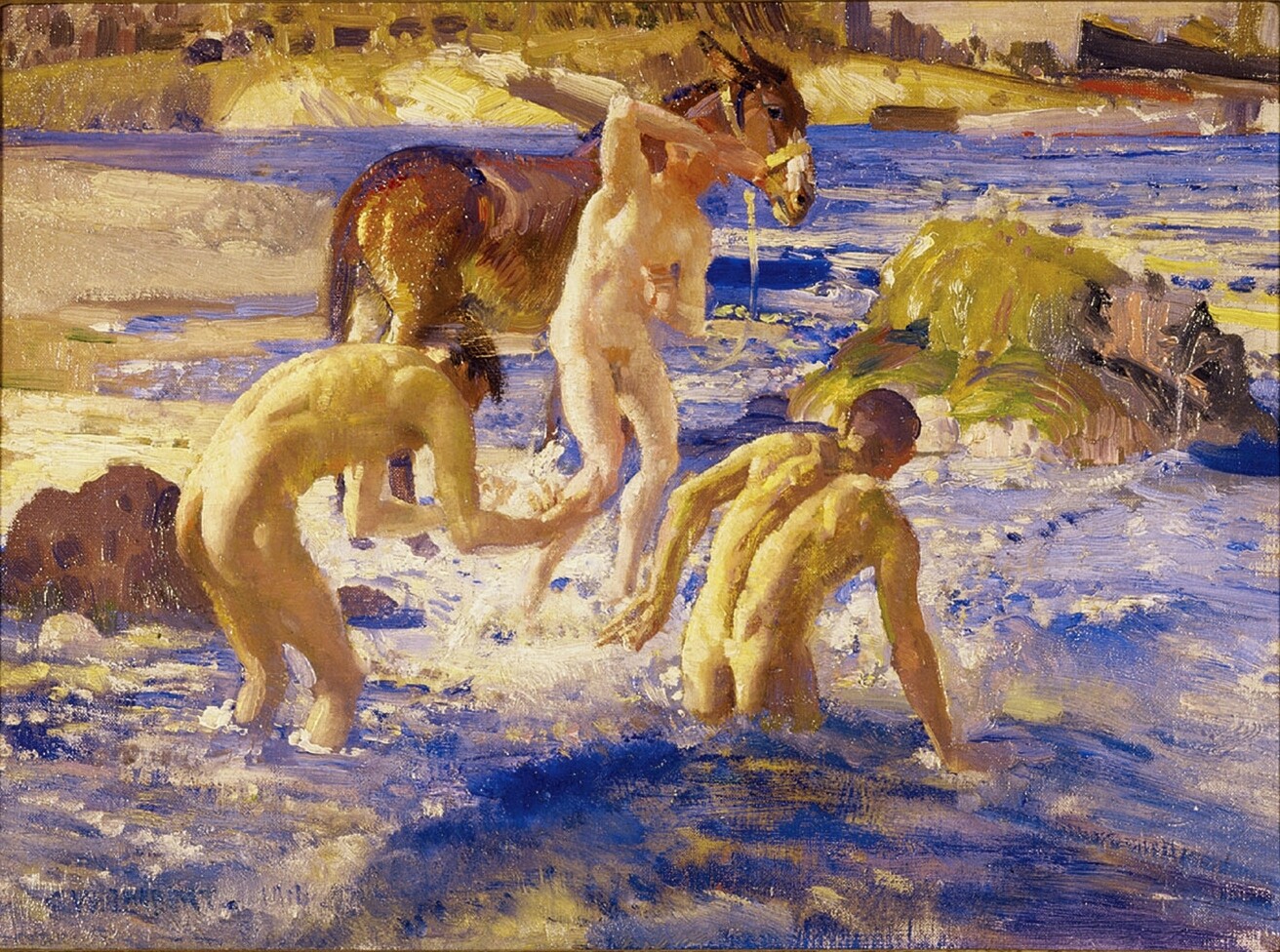
Then I wandered down the road to the National Gallery of Victoria and looked through the Australian art galleries on level two. And I can only scratch the surface here because once you see the horse, you see it everywhere, and even when you don’t see it, you see it—for there I found not only Russel Drysdale’s Station Blacks, Cape York (1953) and its suggestion of Aboriginal stockmen but also that archetypal image of the Australian Anzac, George Lambert’s A Sergeant of the Light Horse (1920), which continues to define a national ideal. The sergeant is sat upon the rolling hills of Palestine as though on horseback, an antipodean crusader in the Holy Land. The rosy-cheeked, blue-eyed man, with those worn, dextrous, rein-bearing hands, is supposed to capture the stamina and adaptability of a new Australian type formed, so the myth goes, for a newly born nation. At that time, the Australian light horsemen were symbolised by the Waler, a hybrid crossbreed of various types of horses regarded as testament to new Australian industry and which were exported throughout the British imperial military system. And then I remembered Lambert’s earlier Anzac’s Bathing (1916), depicting four bathing figures (three men; one horse, peeking knowingly through one eye at the viewer) on their odyssey at the beaches of Ilium, with the central naked figure fused with the horse, his legs standing in for the Waler’s, his torso wrapping around the horse’s nape, transforming into it, frozen in an Ovidian metamorphosis.

George W. Lambert, Anzacs Bathing, 1916, oil on canvas, 26.3 × 36 cm, Mildura Arts Centre, Mildura. Bequest of R. D. Elliot, 1955.
Then the horse just kept coming closer. A short walk further down the road and I was at the Fiona and Sidney Myer Gallery where there is a retrospective of Jenny Watson’s work in the ambitiously alliterated Possibly Perpetuating Pop, Personalism, Post-Punk and Post-Conceptualism: 7 Decades of Jenny Watson. (The exhibition is also paired until 31 October with a group of Watson’s paintings at Anna Schwartz Projects’ entitled Signs.)
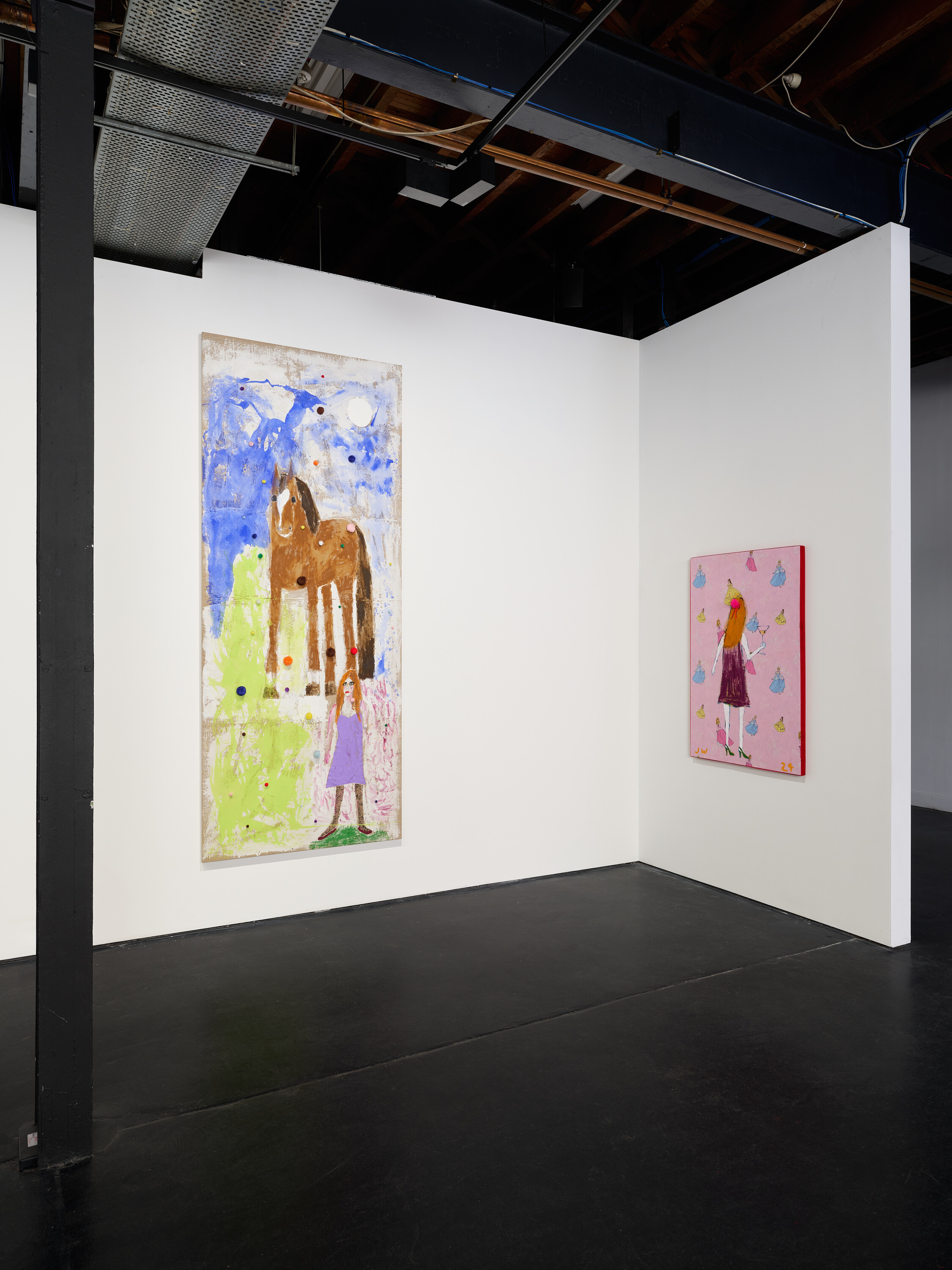
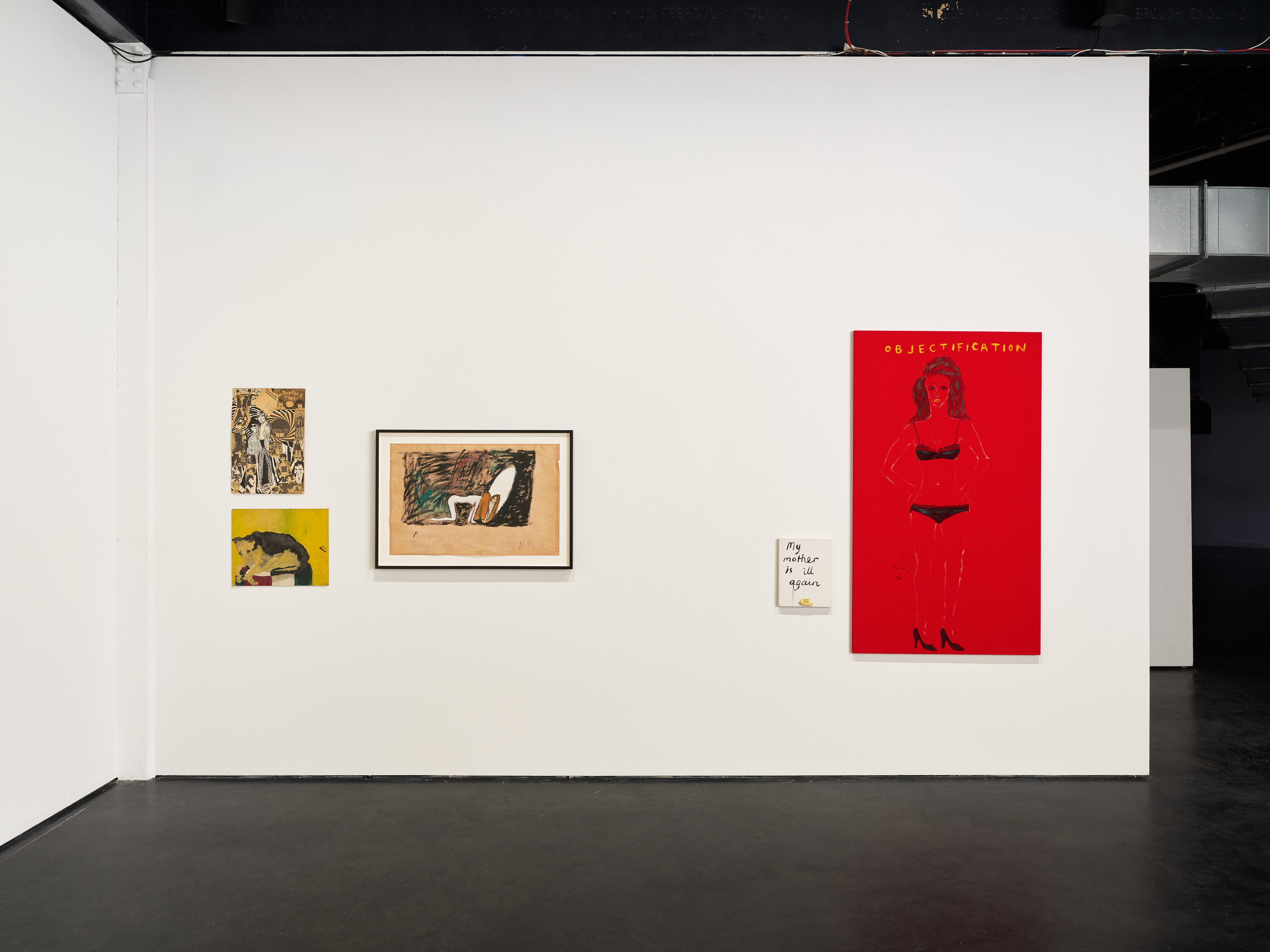
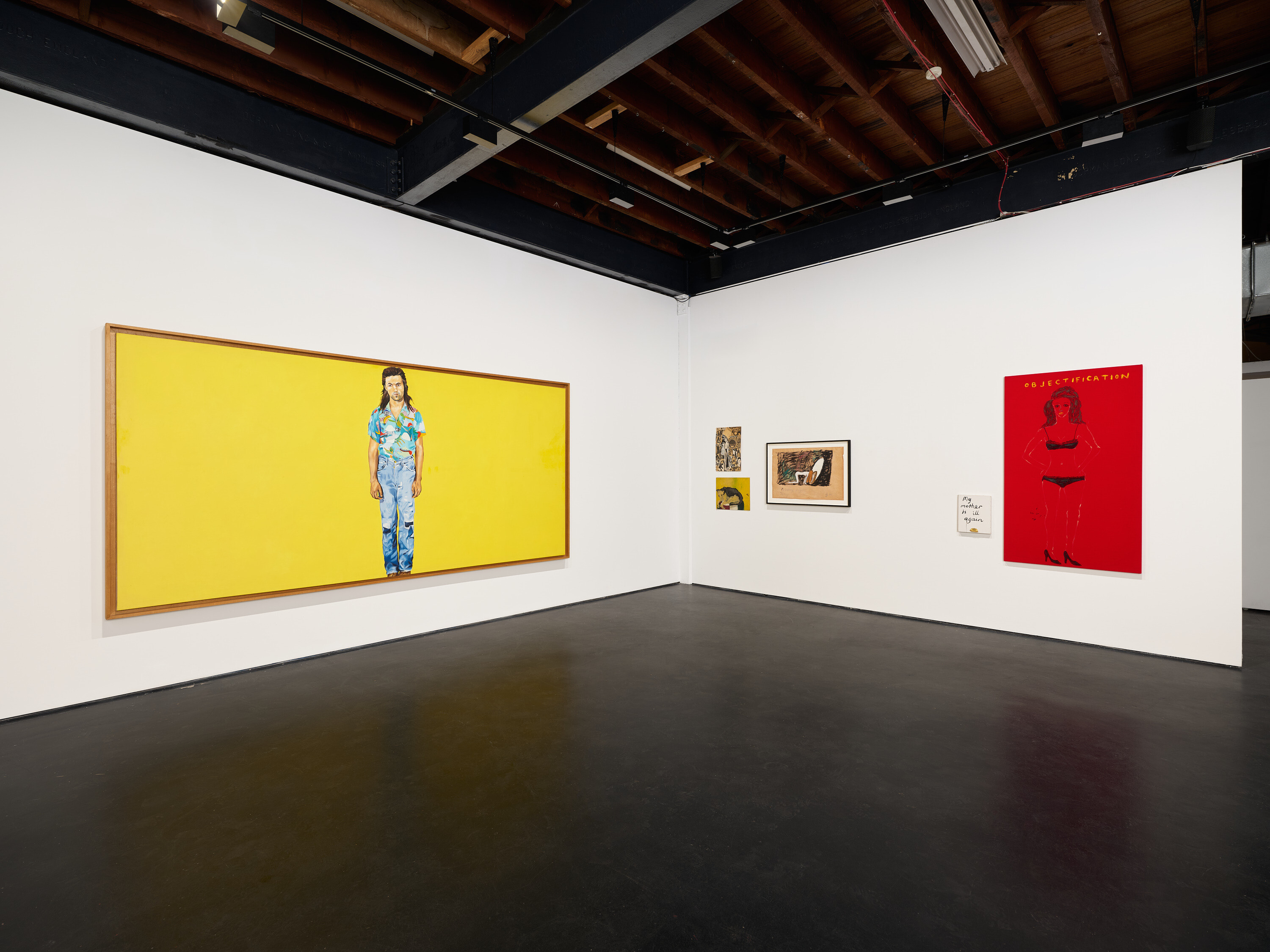
As the title suggests, 7 Decades of Jenny Watson takes us from some of Watson’s earliest paintings, such as Blackie (1968) (what appears yet again to be a beloved family pet), through to the classics of the 1970s like Yellow Painting: John (1974) (from the period when Watson was a central figure at the pioneering Art Projects alongside John Nixon, Peter Tyndall, and Tony Clark), and up to recent works such as Party Girl with a Pink Pom Pom (2024).

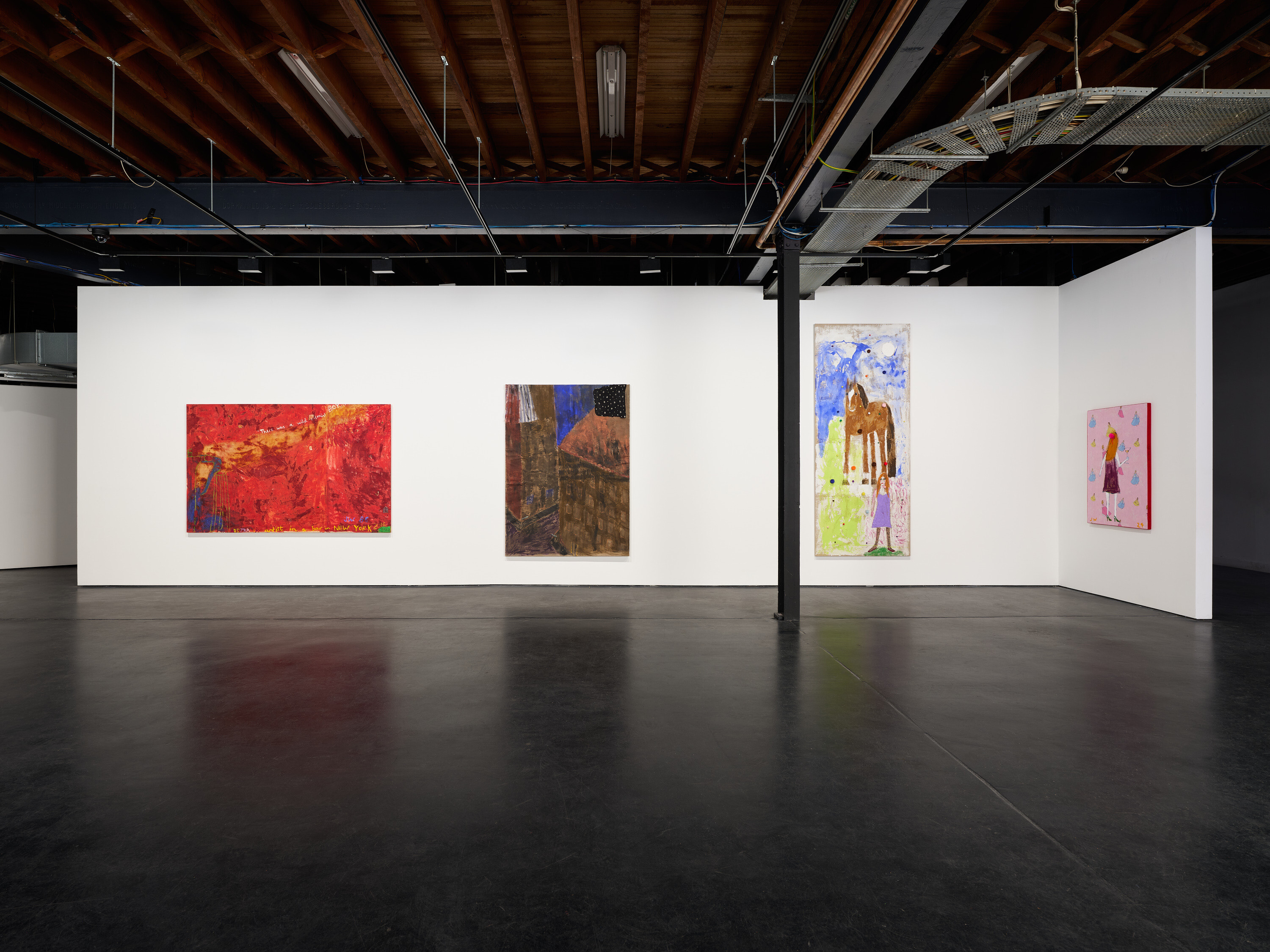
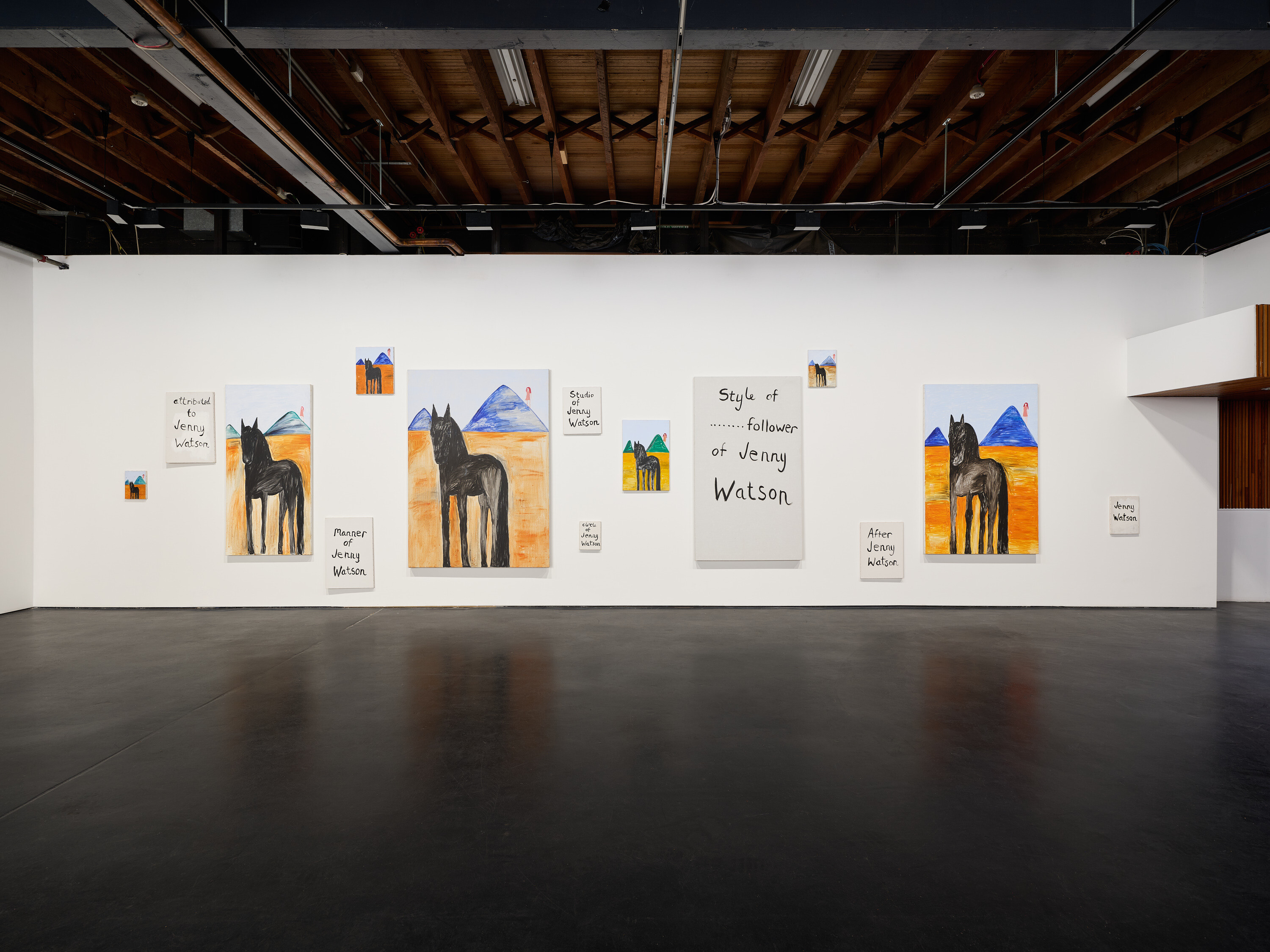
Installation view of Jenny Watson, Possibly Perpetuating Pop, Personalism, Post-Punk and Post-Conceptualism: 7 Decades of Jenny Watson, 2026, Fiona and Sidney Myer Gallery, Melbourne. Photo: Christo Crocker.
But the show also centres (how could it not given Watson’s lifelong equestrian preoccupation?) on the oeuvre-defining motif of the horse, which has carried with it all manner of associations, from a girlish “Pony Club” obsession to a feminised Lambertian fusion of woman and horse. There is, in Watson’s relationship to the horse, a sense of mutual self-formation. As one cares for the self, one tenderly grooms the horse, brushes its air, combs and plaits in mane, washes its coat, tends to its skin, dresses it up in ribbons. Watson too, in a short conversation with David Sequeira published alongside the show, speaks of the relationship to the horse as that of sculptor to sculpture, describing how “riding correctly is an art form because you are changing the shape of the animal. You’re actually drawing the muscular structure and improving it by the gymnastic exercises in riding.”
Yet unlike the boyish fixation on the formation of the national type in Lambert, Watson evokes a subjective, personalistic, and even deliberately innocent interrelationship of self and horse–formation, which can be felt in Moon, Sophie + Me’s (2013) soft palette and loose brushstrokes, coupled with its cute, fluffy pom-poms affixed to the picture’s Disney cotton fabric surface.

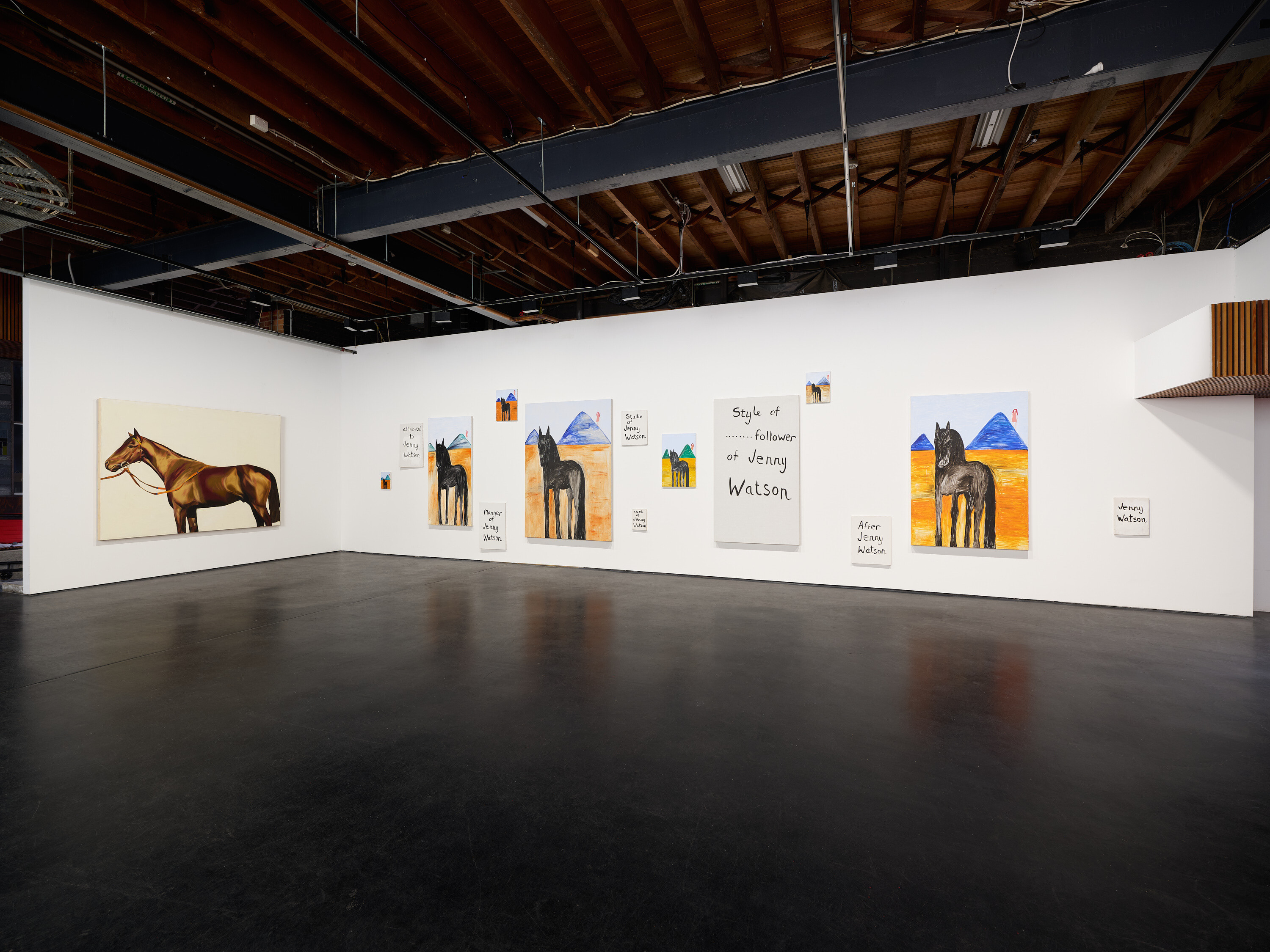
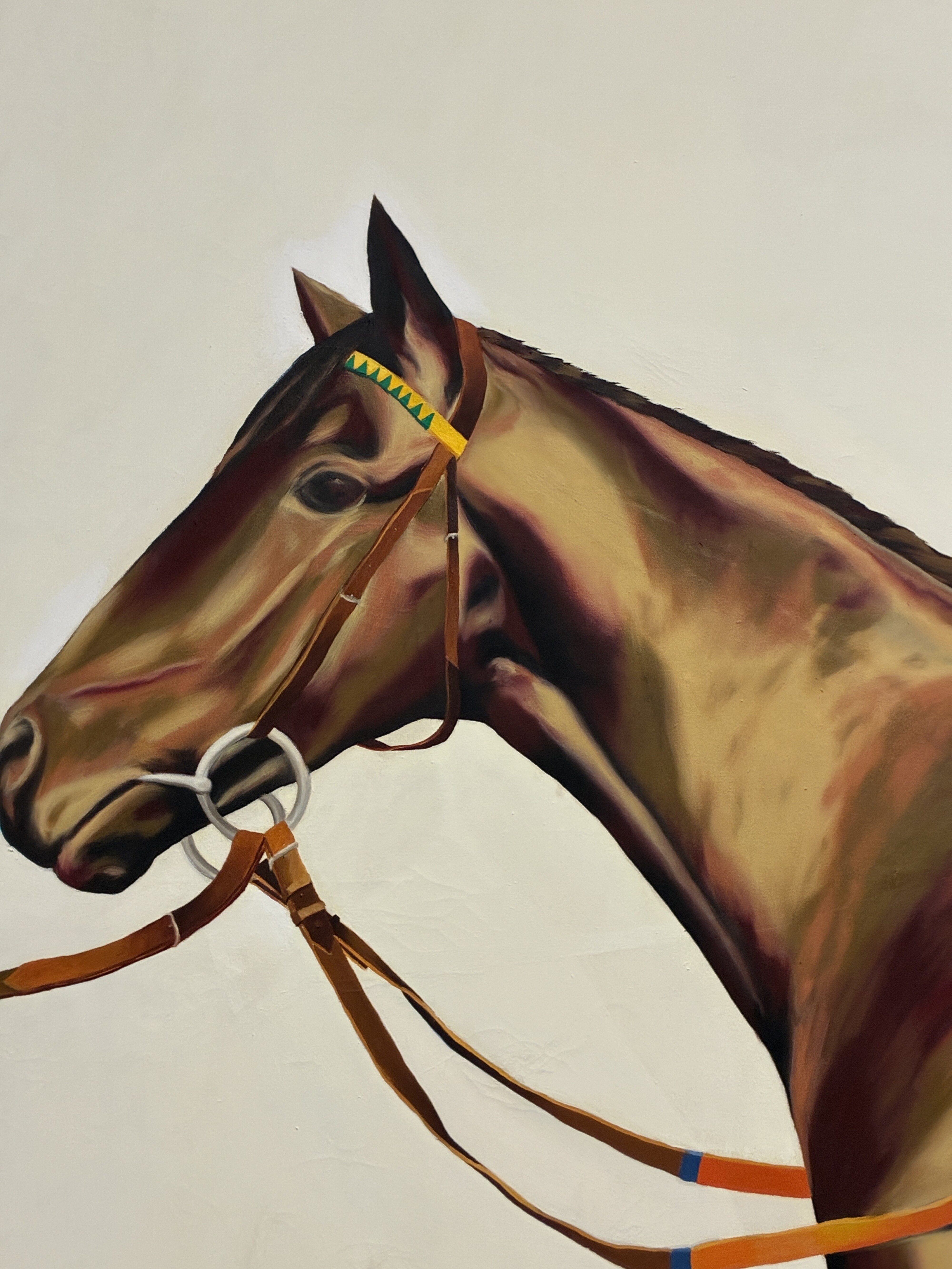
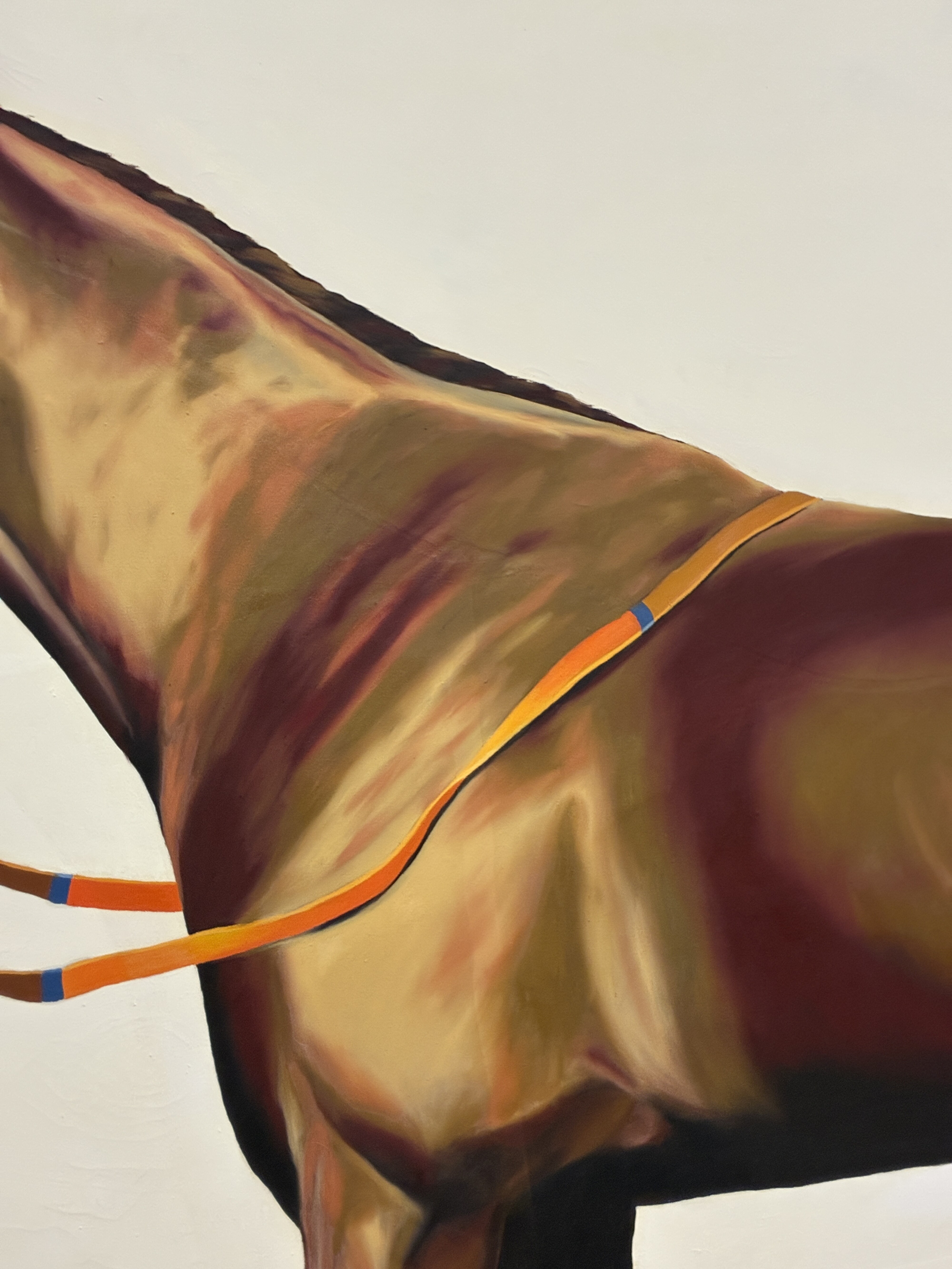
Detail of Jenny Watson, Brown Horse with Yellow/Green Headband, 1973, synthetic polymer paint on canvas, 182.5 × 250 cm, Monash University Museum of Art, Melbourne. In Possibly Perpetuating Pop, Personalism, Post-Punk and Post-Conceptualism: 7 Decades of Jenny Watson, Fiona and Sidney Myer Gallery, Melbourne, 2026. Photo: Paris Lettau.
Earlier works, like the large photorealistic Brown Horse with Yellow/Green Headband (1973) show a blown-up apparition pulled from glossy racing magazines, its attentively painted green-and-gold headband at once national colours and a pretty tiara-like flourish, with the bridle draping loosely over the horse’s withers. Or then again, the classic horse motif recurs in the multi-canvas work Self-Portrait, Landscape + Sotheby’s Definition (1989–90), where in these landscapes the horse has migrated from national consciousness and ancestral connections to another mythic sphere of selfhood, introspection, and interiority.

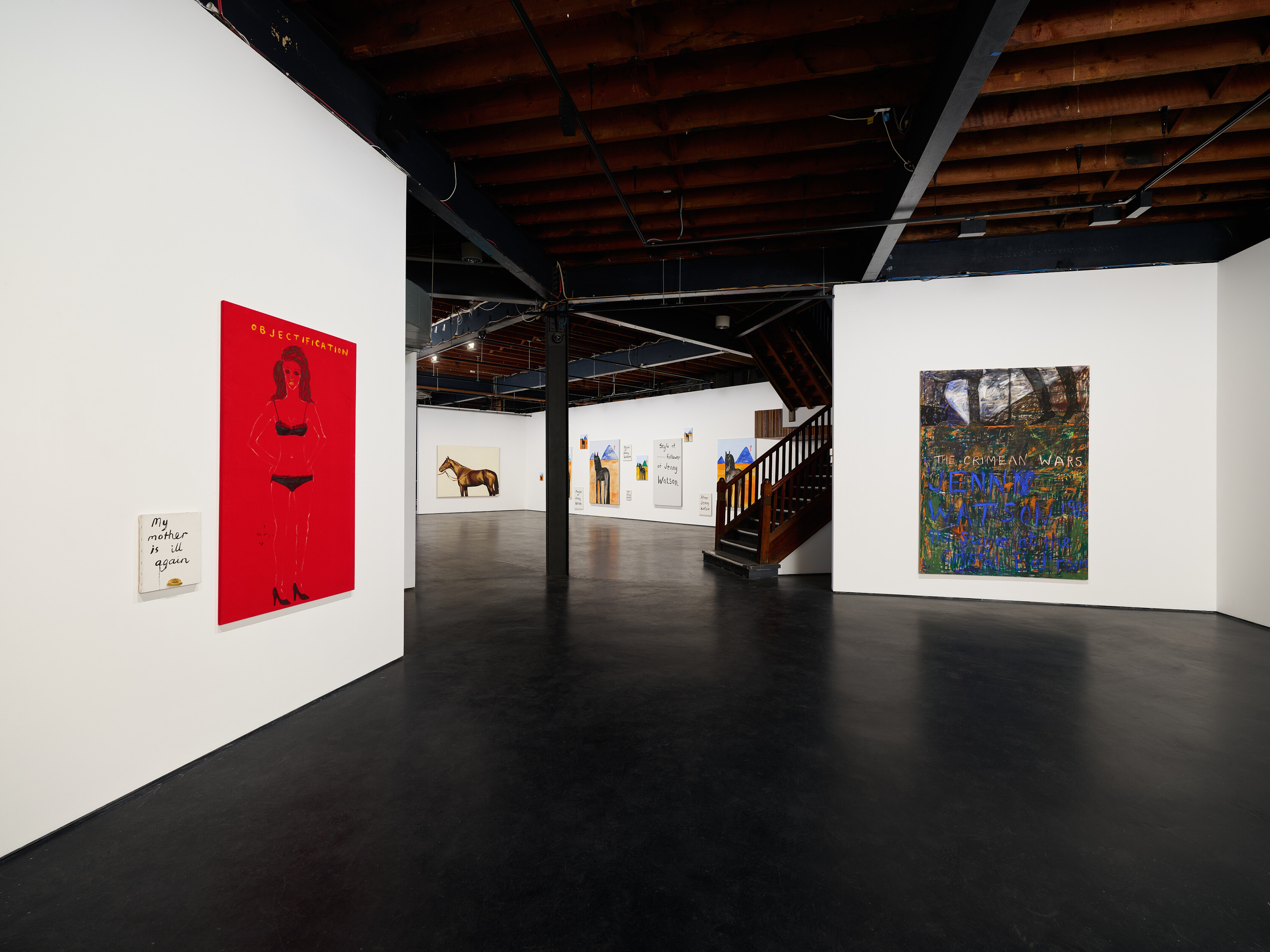
Installation view of Jenny Watson, Possibly Perpetuating Pop, Personalism, Post-Punk and Post-Conceptualism: 7 Decades of Jenny Watson, 2026, Fiona and Sidney Myer Gallery, Melbourne. Photo: Christo Crocker.
The shadowy form of the horse in Self-Portrait, Landscape + Sotheby’s Definition suggests a psychological zone, a mysterious space one escapes to in dreams. An escape from what? From conformity, emotional suffocation, monotony, the oppressive respectability of the 1970s suburban family life Watson has spoken of in various interviews? Is Watson perhaps that bemused girl seated in the back of Brack’s The Car, staring out the car window, dreaming of an elsewhere she can never quite make it to?

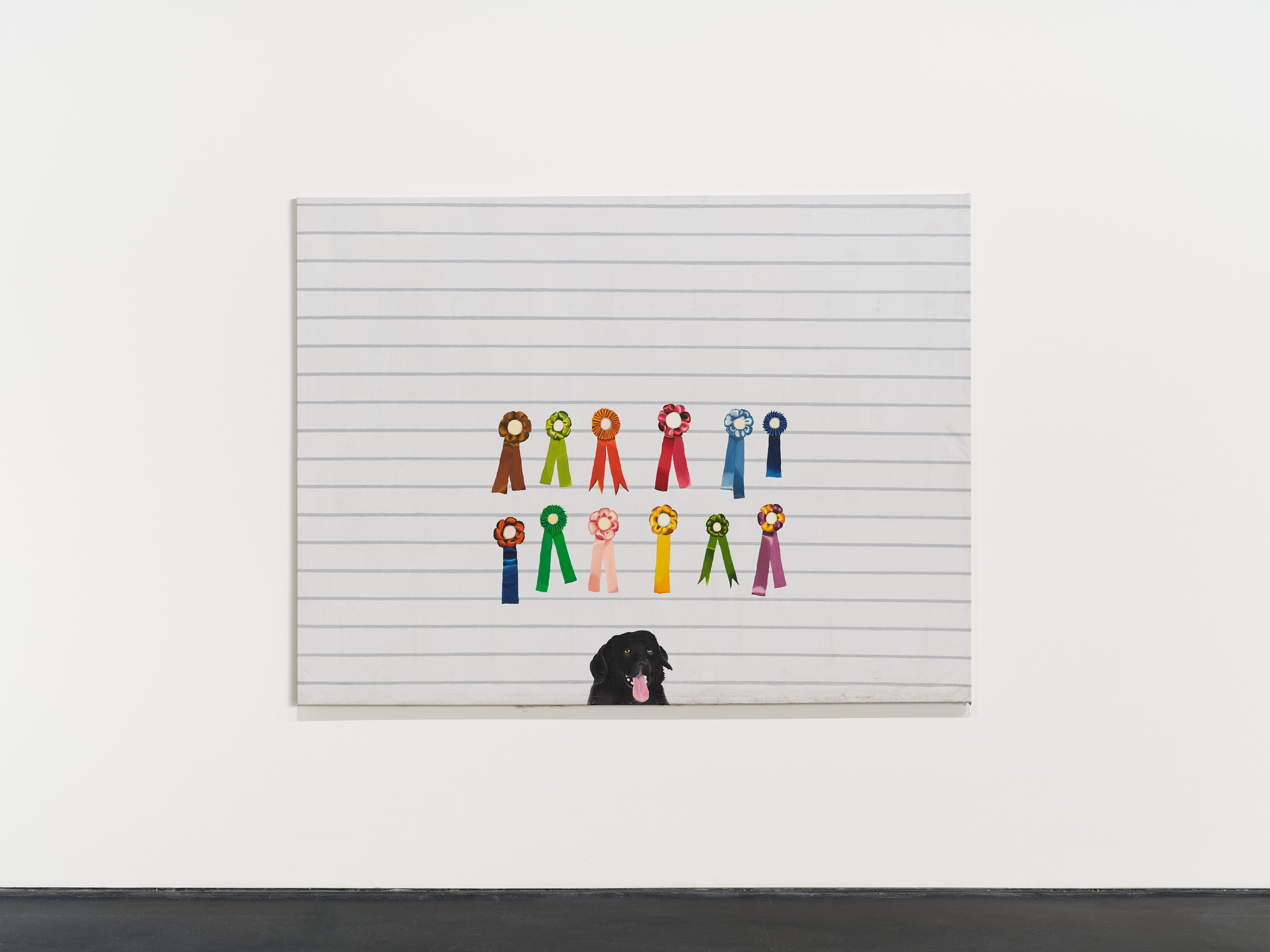
Jenny Watson, Black Labrador Retriever with Rosette, 1972. Installation view of 7 Decades of Jenny Watson, Fiona and Sidney Myer Gallery, Melbourne, 2026. Photo: Christo Crocker.
Indeed, the ambivalence of this escape is also there in the work. Black Labrador Retriever with Rosette (1972), presumably again depicting the family pet Blackie, shows the dog accompanied by an assortment of pleated cloth rosettes of the sort awarded as a prize at horse shows and dressage competitions. These are at once signs of self-worth and childlike accomplishment—but also of competition, discipline, the aspiration to meet an ideal, to prove oneself to Mum and Dad with small school prizes and awards.

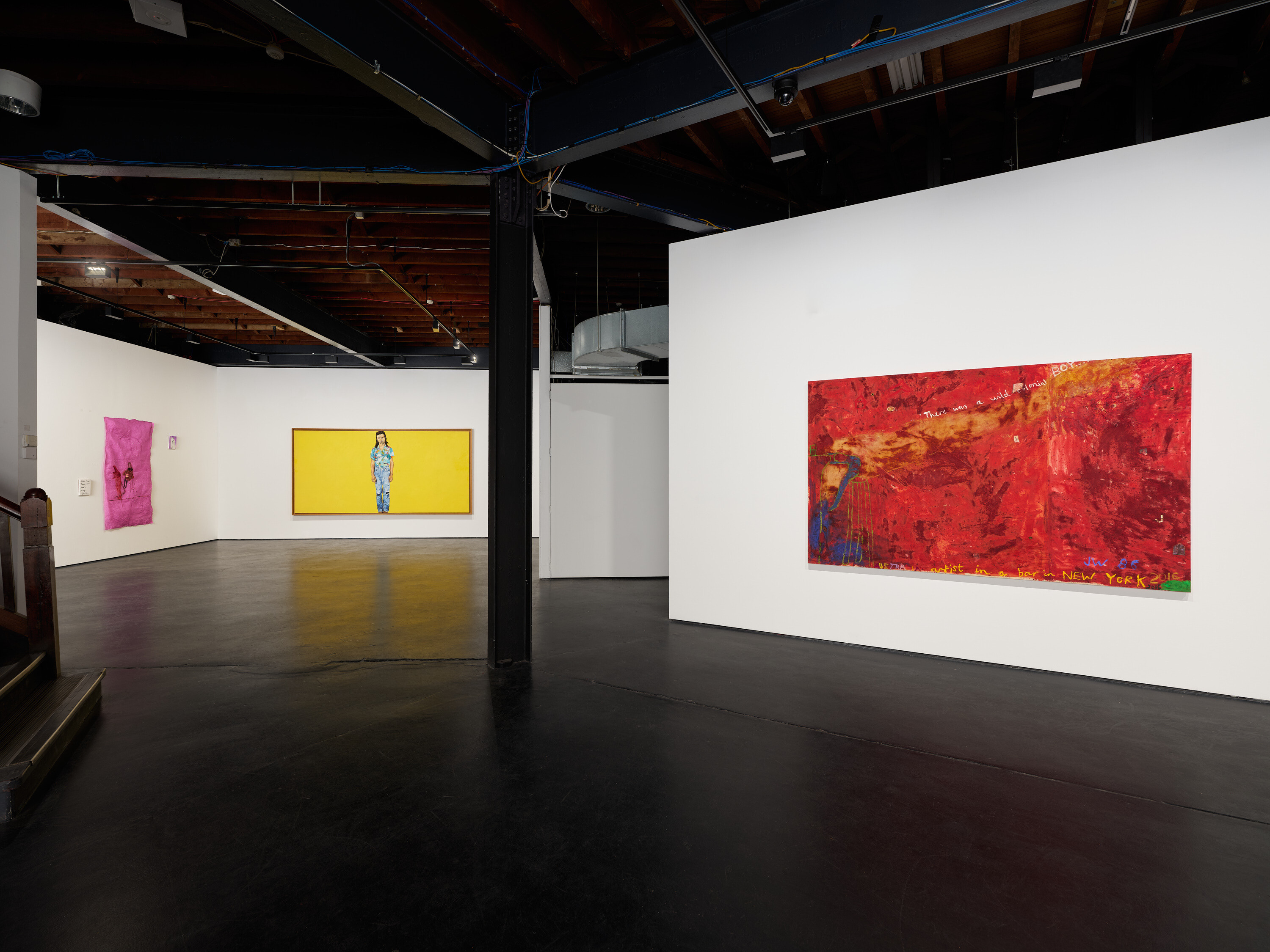
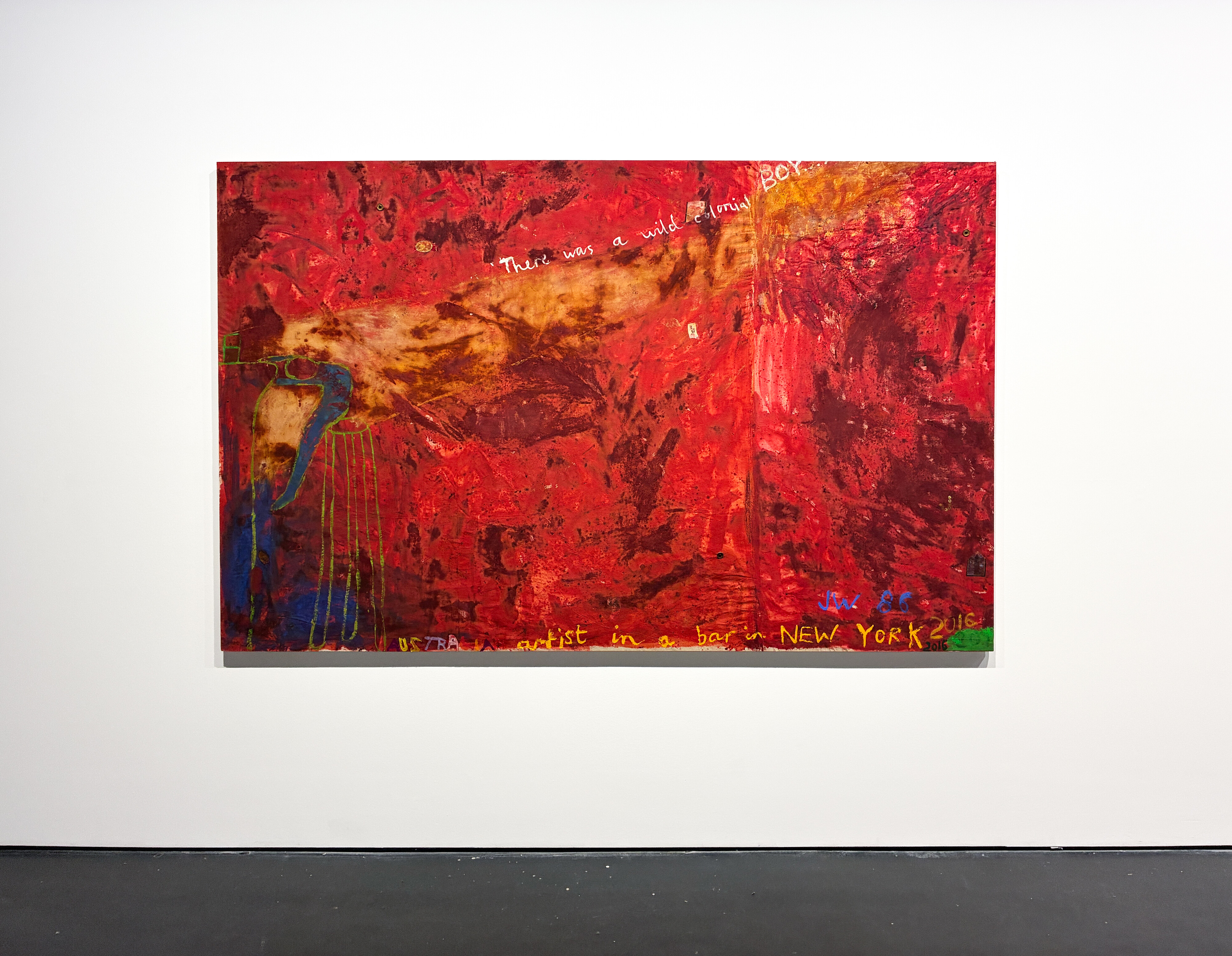
Jenny Watson, Australian Artist in a Bar in New York in the Year 2016, 1986. Exhibited in Possibly Perpetuating Pop, Personalism, Post-Punk and Post-Conceptualism: 7 Decades of Jenny Watson, Fiona and Sidney Myer Gallery, Melbourne, 2026. Photo: Paris Lettau.
This ambivalence in the show goes beyond the family to the provincial anxiety of the Australian artist. Australian Artist in a Bar in New York in the Year 2016 (1986) projects a sullen figure. A “wild colonial boy,” imagined thirty years after the work was painted, is slumped lonesome in a bar, like a little boy perched on a tall stool, chasing recognition in a global centre that is never looking. And then Corner of Broadway and Prince Street New York 1991 (2022), this time looking back in time some thirty years, presents an empty, grey, desolate New York. Uninviting, inhospitable, even unliveable. Is this really so different from that same dreary Australian suburban life?
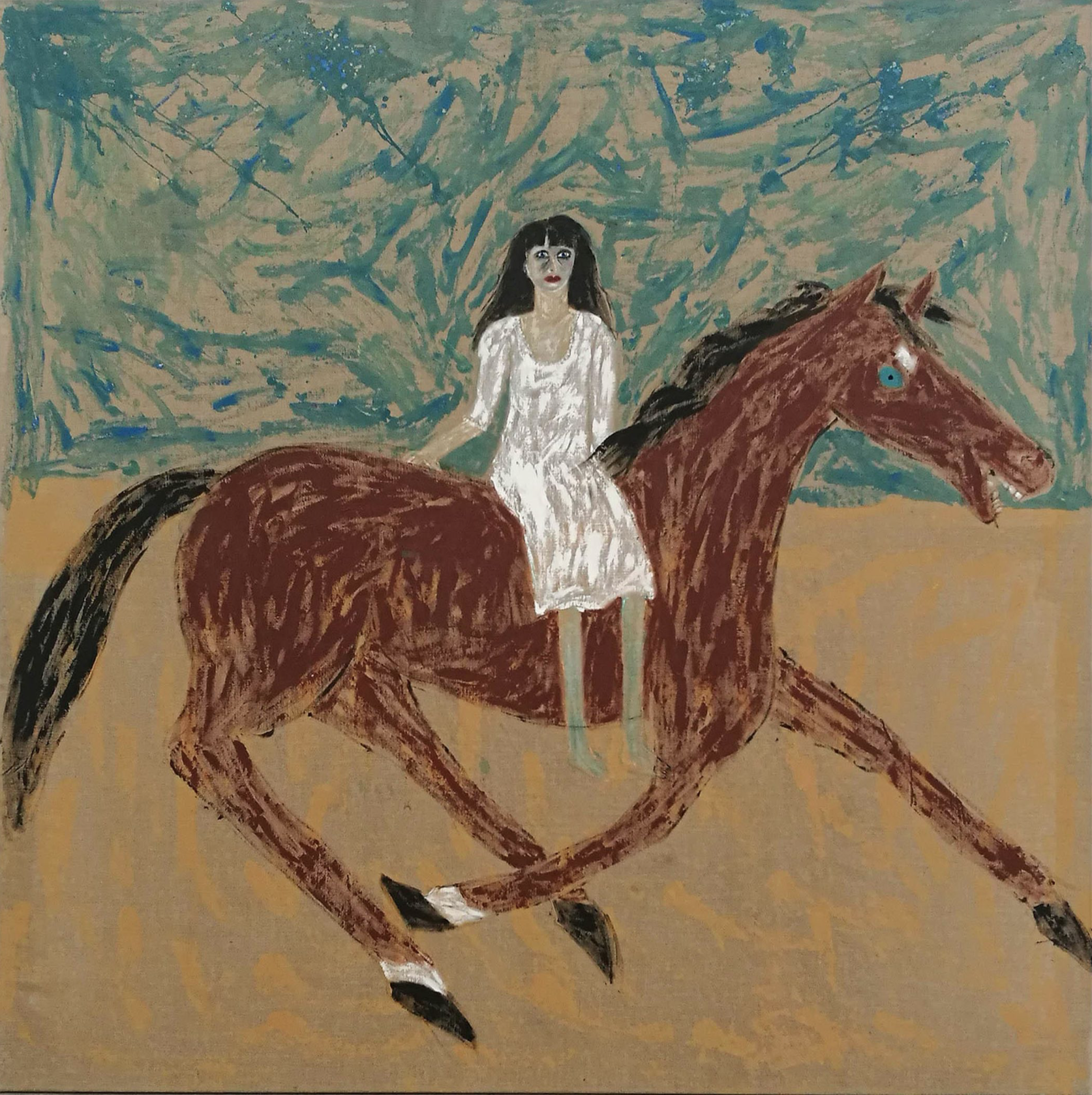
And of course, this morbid, existential weight is again projected by Watson onto the horse through the recurring motif of death in her work, represented in the show by Mortality on Horseback (2003) which hangs in the gallery office, the white-clad Watson figure seated sideways on the horse’s back, surely a reference to Sidney Nolan’s similar scene in Steve Hart Dressed as a Girl (1947).

Jenny Watson, Mortality on Horseback, 2003, oil on linen and text panel on Thai silk, 205 x 208 cm. https://annaschwartzgallery.com/artist/jenny-watson. Courtesy Anna Schwartz Projects.
Does not all of this also express the world of a certain artistic provincial type, or perhaps rather an alienated rootless cosmopolitan type, or even simply the type of artist on the edges of art (Watson after all describes dressage as a kind of refuge from art), bemused, stuck, somehow arrested in development, unsure how to commit, captured by those same postwar ideals (and contemporary art is included here), crammed in the back of a car, or a small apartment, or a semi-suburban share house. Watson, whose influence particularly on Melbourne art has perhaps been greater in attitude than in style, seems to embody this subjectivity: one that knowingly turns adolescent attachments, suburban awkwardness, the appearance of artistic ineptitude, the conviction that artistic life can be constituted from fairly unpromising circumstances, into a way of being an artist.
There is an irony to Schramm (who emigrated from Berlin after the failed 1848–49 German revolutions) and Lambert, who, through their realism, suggest an optimism in national life at infancy, a confidence in taking possession of a country and establishing a genealogy, despite all the awkwardness of those out-of-place figures in the portrait of the Gilberts. We know from Brown Horse with Yellow/Green Headband that Watson too is technically accomplished and perfectly capable of rendering a hyperreal horse, but chooses not to. Her naïve, deskilled technique rather holds this infantilism in suspension, suggesting an artificiality of a subjectivity that nevertheless remains committed to its own ambivalence. Has this story of a nation told by a horse ended badly? Or did it only begin that way? Is the horse even a reliable narrator?
Gallery