Margaret Preston and Gordon Bennett, Home Décor (Re)view (After Margaret Preston)
October 3, 2026
-
Margaret Preston
Venue: National Gallery of Victoria | The Ian Potter Centre: NGV Australia
04 Sep 2026 – 31 Jan 2027
-
Gordon Bennett, Home Décor (Re)view (After Margaret Preston)
Venue: Sutton Gallery
11 Sep 2026 – 03 Oct 2026
I read somewhere in the Margaret Preston catalogue that shows of Preston keep on being restaged because her art and legacy remain unresolved, and are perhaps unresolvable, and that this is what makes her such an important Australian artist.
And that seems to be true. After all, the National Gallery of Victoria’s Margaret Preston has been preceded by O’Keefe, Preston, Cossington Smith: Making Modernism at Heide in 2016, Margaret Preston: Art and Life at the Art Gallery of New South Wales in 2005 and Margaret Preston: Australian Printmaker at the National Gallery of Australia in 2004 in just the last twenty-odd years. And art historians continue to write volumes about her, as they have since Bernard Smith devoted some four pages to her in his Australian Painting back in 1962.
But who else seems to raise or at least embody all of those issues that we seem to feel so relevant today: the status of women artists, same sex relationships, the possibility of a national “Australian” art, and the relationship of settler Australians to the continent’s First Nations peoples?

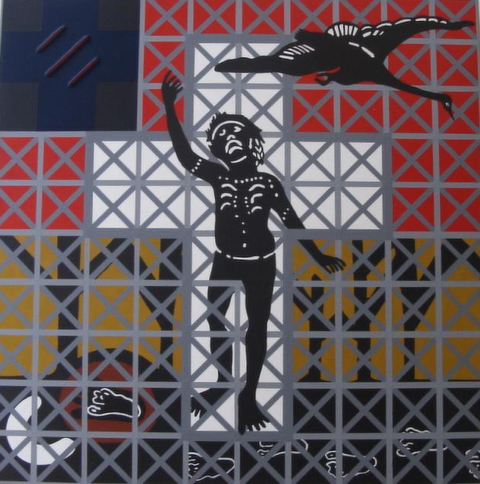
Gordon Bennett, Home Décor (Preston + De Stijl = Citizen) Black Swan of Trespass (1996). Image courtesy Sutton Gallery and Leanne Bennett.
And yet I think that this might be the last Preston retrospective, or at least for a long time. For Preston’s legacy is now not so much resolved as understood as unresolvable. And it is not Preston who best or perhaps most symptomatically expresses the question of black-white relations in contemporary Australia, but Gordon Bennett. This is to say that, if Preston—retrospectively and against the grain—is now understood to be the defining Australian artist of the second half of the twentieth century or at least of modernism, it is Bennett who is the defining artist of our time or post-modernism, precisely because he makes himself inseparable from Preston or maybe even becomes Preston.
Allow me to explain.
Margaret Preston is a wonderfully inclusive exhibition. It has the flower paintings from Preston’s shows at the Australian Pavilion at the World’s Fair in New York in 1939 and the Golden Gate International Exposition in San Francisco also in 1939, it absolutely acknowledges her relationships with Bessie Davidson and Gladys Reynell, it has all of her well-known works (I went looking for her iconic modern kitchen implement Still Life (1927), which I knew so well from books, without realising that it has been lost for almost a century and exists now only in reproduction). But the real subject of the exhibition, which was not seen in any previous version, or at least did not feature so strongly—and here I am thinking of the voice or influence of co-curator Michael Gentle, until recently the NGV’s Curator of First Nations and Australian Art—is the critique of Preston for her “appropriation” of Aboriginal art and culture.
It comes out about every third page in the introduction to the catalogue, co-written by Gentle and his fellow curator Beckett Rozentals, Senior Curator of Australian Art. Take this, for example: “While (Preston) was the first to recognise the merit of First Nations art, by appropriating it for her own prints and paintings she produced a body of work that was resolutely Australian.” Or this: “(Preston’s) strategy reflects the broader extractive logic within settler-colonial visual culture, in which Indigenous forms are removed from their cultural contexts and reconstituted as aesthetic resources.”
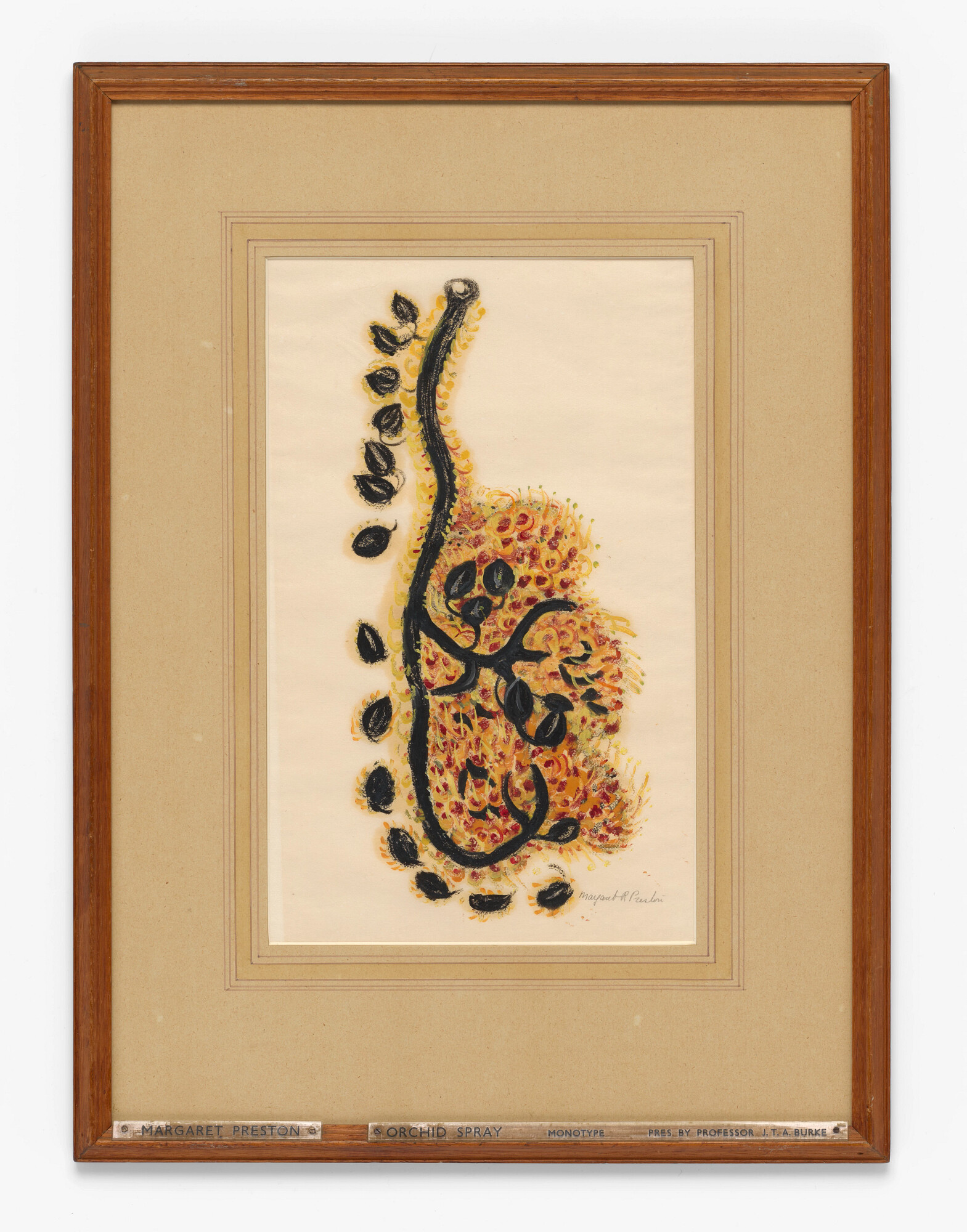
It is something spoken of in a number of the other catalogue essays as well. But, again, just to take two examples, here is curator Ann Ryan in her essay “An Art of Its Age and Place: Preston’s Call for a New National Art in Australia”: “The art of other cultures was seen through an aesthetic lens decontextualised from broader cultural, spiritual and social meaning”. And here is Lévi McLean, collaborator with the Tennant Creek Brio, in his “The Decorator’s Affair”, speaking first of Preston’s use of non-European cultures in her art: “Preston is known for instrumentalising (or perhaps co-opting) several non-European techniques and forms.” And then, more pointedly, of Preston’s use of a sacred Indigenous image in her Orchid Spray (1946), based on an unauthorised sketch made by anthropologist Baldwin Spencer when he visited Tennant Creek in 1901: “Preston certainly knew a lot more about traditional Aboriginal culture than her art reveals. Her work, however, aligns with a modernist ideology that discounted iconography; it is Preston’s art, not her, that has ‘Nil’ anthropological knowledge.”

Margaret Preston, Orchid Spray (1946). Colour monotype, 48.5 x 31.5 cm (sheet). The University of Melbourne Art Collection. Gift of Professor Joseph Burke, 1948.
The subject comes up frequently in the didactics for the show too, so that spectators would be aware of it even if they didn’t buy the catalogue. Take this, for example, in a room devoted to Preston’s stenciled works of the 1940s: “In 1930 Preston published an essay instructing artists to ‘be Aboriginal’ in their use of Indigenous designs. Whatever her intended meaning, Preston’s words dissociate Aboriginality from First Peoples themselves.”
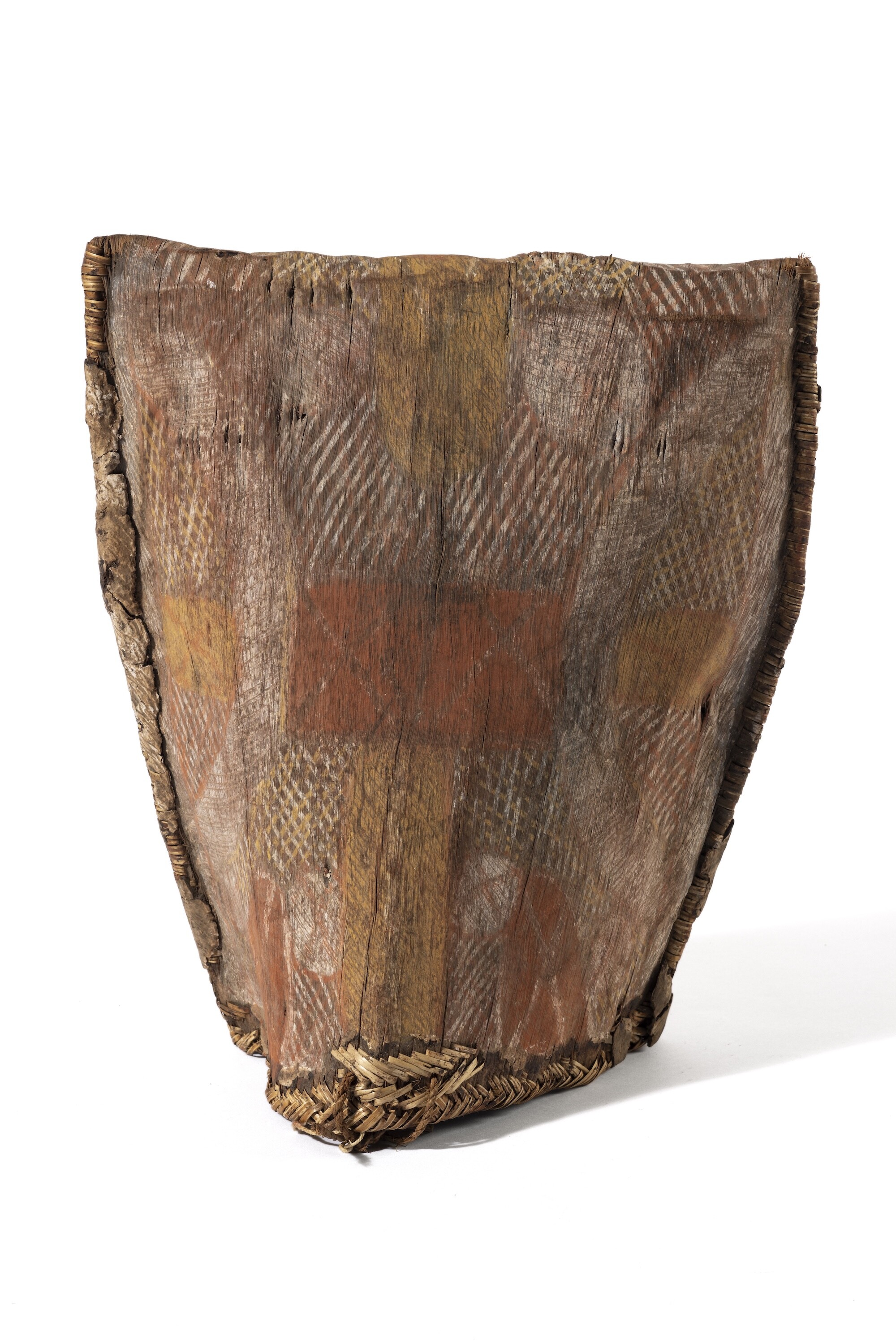
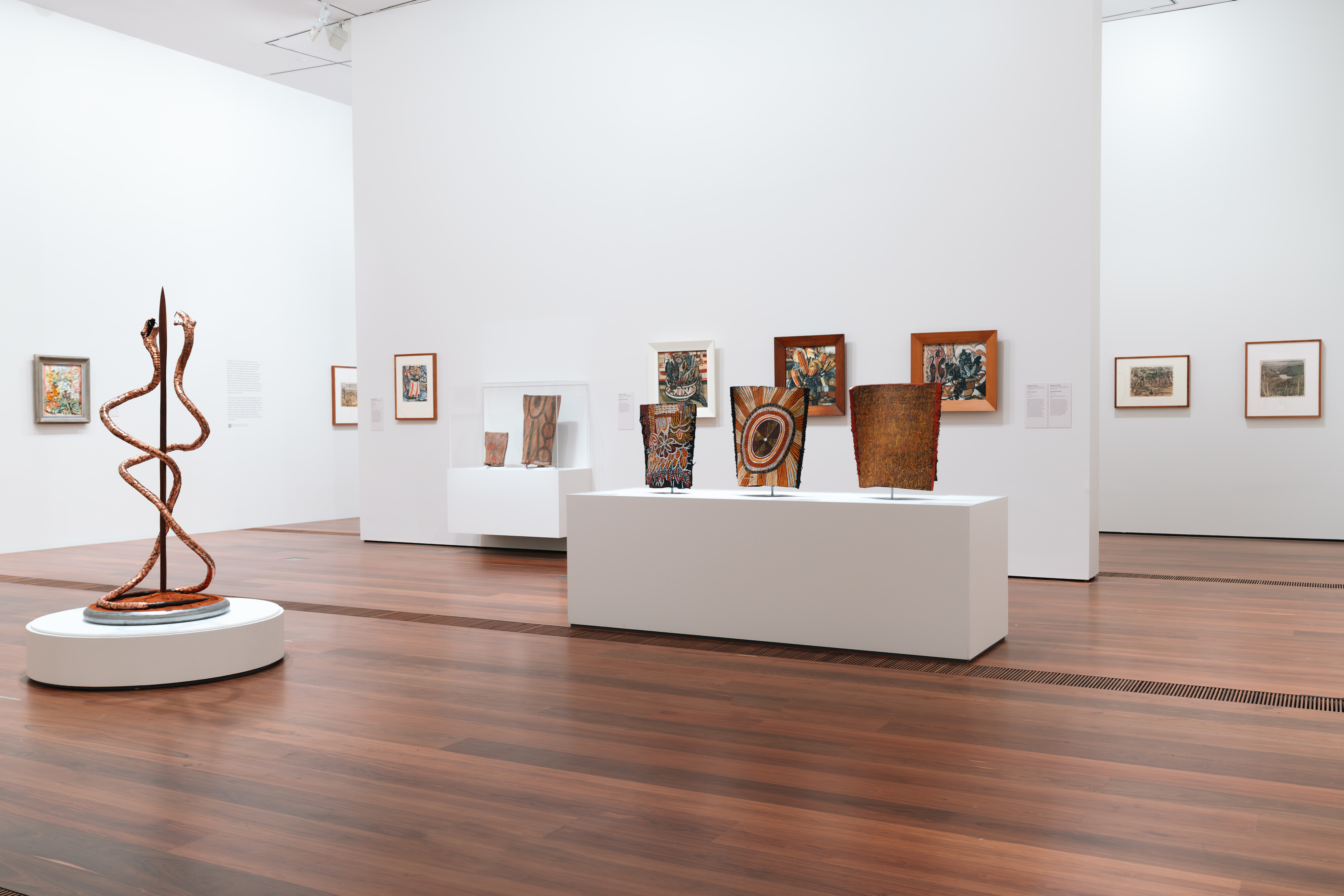
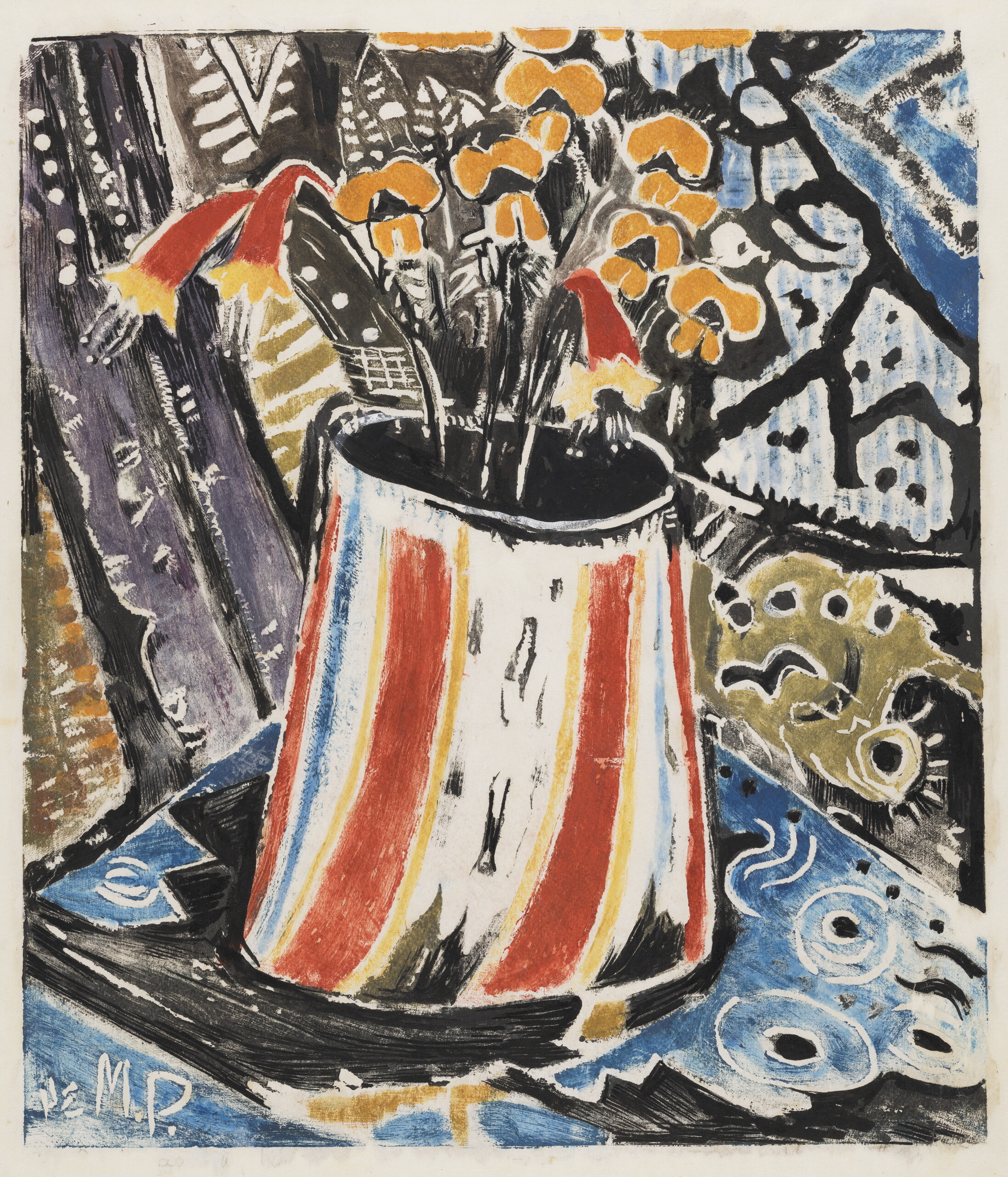
The decisive innovation of the show, however, is the decision to include works by a number of Indigenous artists, either to rebuke Preston for her appropriation of Indigenous artworks or to make clear the then-contemporary reality of that Indigenous art from which she appropriated. Thus we have Trevor Nickolls’ ironic Homage to Margaret Preston (1988), in which native flowers wink at the viewer after being placed in one of Preston’s typical marked-up vases. We have Tony Albert’s remake of Preston’s The Expulsion (1952), in which two Indigenous figures play Adam and Eve being expelled from Eden, carved out of his typical “Aboriginalia”—kitsch reproductions of Aboriginal culture designed for white Australians’ houses, in principle inspired and authorised by Preston—in his Conversations with Preston: Expulsion (2020). As well, Badjijal woman Marilyn Russell reworks the “Aboriginalia” we see in Preston’s N.S.W. Everlasting Flowers (1929) as three real shellwork jewelery boxes. And Wadawurrung woman Deanne Gilson paints the banksia dilly bag we see in Preston’s Banksia (1953). And the curators even borrowed the original Tunga bark basket from the Australian Museum and the carved sandstone sculptures from the Art Gallery of New South Wales, which Preston gifted in 1948 after collecting them during a trip to Northern Australia with her husband William and incorporating them into such works as The Bark Bag (1943).

Margaret Preston, The Bark Bag (1943). Colour woodcut, 36.0 x 31.2 cm (block), 38.0 x 32.0cm irreg. (sheet). Art Gallery of New South Wales, Sydney. Purchased 1964.

Artist once known, Tunga, bark basket (1940s). Bark, natural fibre, pigments, 66.0 x 45.0 x 32.0 cm. Australian Museum, Sydney.
But undoubtedly the key interlocutor for Preston for the curators—and also in a parallel exhibition running until today at Sutton Gallery—is Gordon Bennett. Margaret Preston has a considerable number of Bennett works scattered throughout, from teapots with such things as black dogs and Preston’s house in Cremorne on them to his Home Décor (Preston + De Stijl = Citizen) Black Swan of Trespass (1996), just before the final exit of the exhibition.
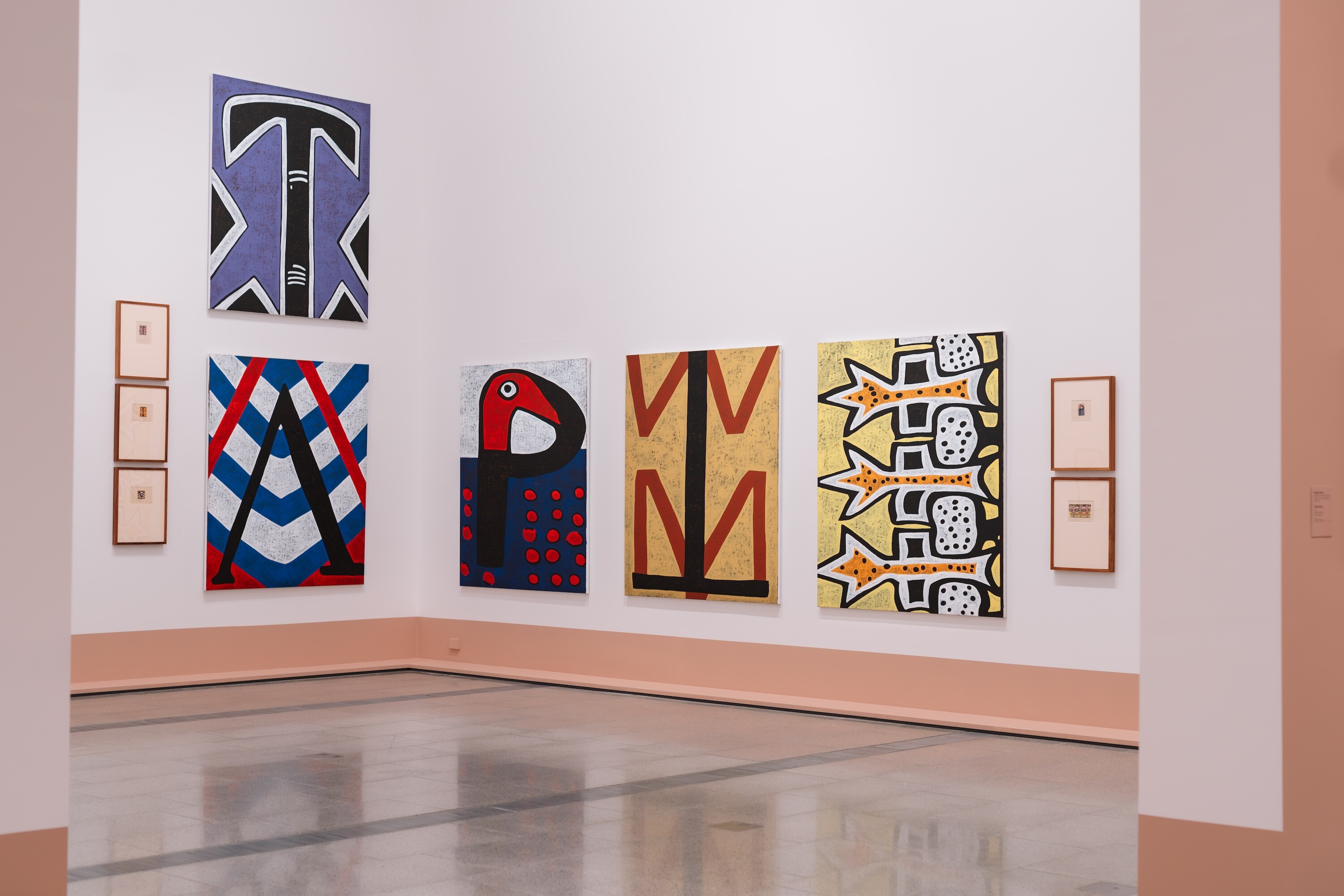
However, it is in a room devoted to a series of works that Bennett made in response to a series of Preston gouaches, in which she attempted to construct a kind of Aboriginal visual alphabet, that the show makes its proper argument. The hang, in fact, more or less replicates an exhibition first mounted at dOCUMENTA (13) in Kassel in 2012, curated by Carolyn Christov-Bakargiev, for which Bennett first made the works knowing that they would be seen alongside Preston. (And in the international context, we cannot help making the contrast to the similar putting-together of a mud painting by the English land artist Richard Long and a ground painting by six Warlpiri men from Yuendumu in the Jean-Hubert Martin-curated Magiciens de la Terre in Paris in 1989, although the juxtaposition here is far more interrogative than the supposed connection between Long and the Warlpiri artists insofar as both demonstrate some “spiritual” connection to land.)
What exactly is going on in Bennett’s “appropriation” or let us say “counter-appropriation” of Preston, and why is it such a brilliant, although largely unrecognised, act of criticism or better self-criticism on his part? And why in a way after it does Bennett become the next great “Australian” artist after Preston, her true inheritor and the one through whom all debates concerning her legacy and Indigenous-settler cultural relations must now be channelled?
In his Home Décor (After M. Preston) series (2010), Bennett more or less directly remakes Preston’s 1927 Aboriginal Design series of gouaches, which she had made based on a number of Indigenous objects she found in Australian museums, for example, a Pikan shield collected from Russell River in the Australian Museum in Sydney. But, as opposed to Preston’s small, sketch-like, wanting-to-be-instructional gouaches, Bennett’s towering acrylics are flat, uninflected, neutral, mostly directly copying the Preston originals, as in Home Décor (After M. Preston) #4, but sometimes turning the original sideways, as in Home Décor (After M. Preston) #5, and sometimes even the original upside down, as in Home Décor (After M. Preston) #7.

Margaret Preston, Aboriginal Design series (1927) and Gordon Bennett, Home Décor (After Margaret Preston) (2010). Image courtesy National Gallery of Victoria.
What exactly is Bennett doing here? To answer the question—and the didactics speak of him as the central figure in the “postcolonial reassessment of Preston’s work”—we might go back to his decisive The Nine Ricochets (1991), in which he appropriates Imants Tillers’ Pataphysical Man (1984), in apparent revenge for Tillers appropriating without permission in his The Nine Shots (1985) Michael Nelson Jagamara’s Five Stories (1984). It is a work for which Bennett won the 1991 Moët & Chandon Fellowship, in many ways launching his career, and we can see why it appealed to the judges—the same sentiment runs through the Preston show—for its apparent speaking up on behalf of Indigenous artists against their colonisation and appropriation by their “European” invaders.
But Bennett’s work is far more ambiguous and self-divided than this—and he would later write his name GORDON BENNETT in a strikethrough font, the way someone like Jacques Derrida placed the words “truth”, “origin”, and “presence” under erasure. For Bennett well knew—and I dare say he did not directly consult Jagamara before making his work—that not only as an Aboriginal man of mixed descent but perhaps as any Aboriginal man not of Jagamara’s moiety he had no particular right to be speaking for Jagamara. Or, to put it even more strongly, Bennett well knew that in making his work he too was appropriating Jagamara, not only in re-using aspects of his iconography, but in speaking for him and on his behalf at all.
And, of course, the same would go for Bennett speaking out against Preston’s use of Indigenous objects and iconography in her Aboriginal Designs, and he knew it. Who or what authorises him to intervene, and isn’t he in doing so repeating exactly the same sin for which he is condemning Preston?
And dare I say—for I am, of course, committing an act of appropriation myself here—this goes for all those speaking out against Preston in the show: the curators, the artists commissioned by the curators to make work for the show, the artists who had already made works for the show? Isn’t the exhibition of those original Tunga bark baskets from the Tiwi Islands and even the commissioning of their remakes an act of cultural appropriation, exactly like that of Preston in acquiring them, making work about them and gifting them to museums and galleries? Isn’t it to subject them to those same “European-mediated representations” criticised by the curators, although their own catalogue introduction necessarily also does this? And don’t art galleries do this all the time? Go down a level from the Preston show to the gallery of 19th Century Australian Art. There at the entrance we’re greeted—thank goodness, finally a rehang—by a series of works on the subject of the Seven Sisters by Nyanjilpaya Nancy Chapman, Wingu Tingima, Sylvia Ken, and Christine West. Are these works in any nationalistic sense “Australian”? Are they even of the nineteenth century? Of course, they’re being used as a kind of Acknowledgement of Country before the usual story begins in the next room with Robert Dowling, John Glover, and Augustus Earle.
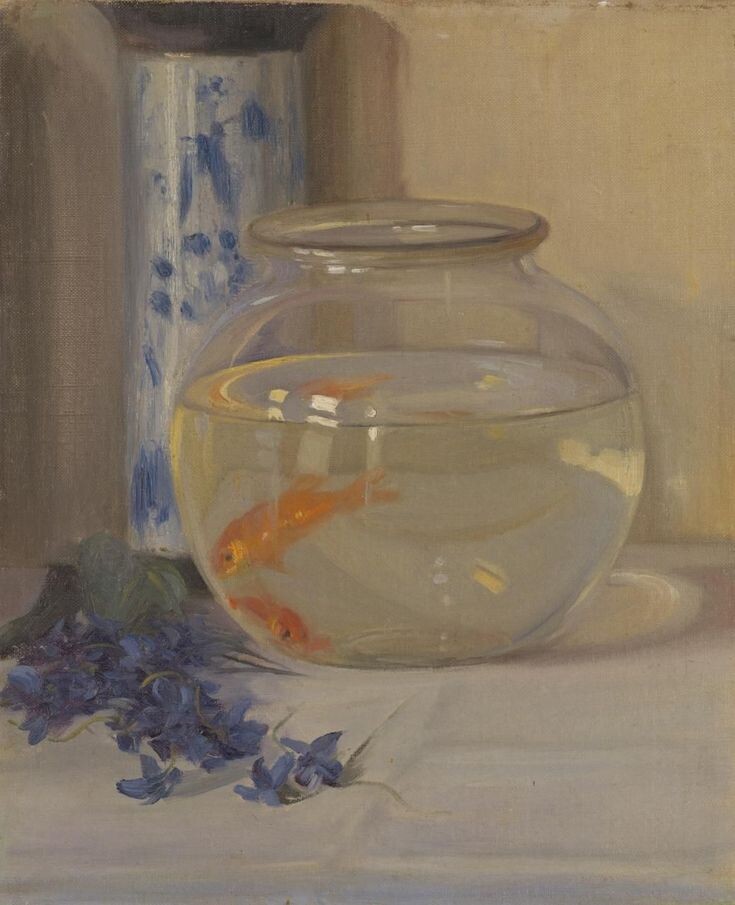
And, again, Bennett knew all of this and made work about it, but he also knew that in condemning it he could only repeat the same thing. He knew that he was right to criticise Preston for appropriating Aboriginal art and the galleries for showing her, but he also knew that in saying this the same criticism would apply to him. This is why he divides his name down the middle and why he eventually ended up making stripe paintings. And perhaps in the light of Bennett we can even see something of this awareness in Preston, for she too appropriates Aboriginal art while speaking out against its appropriation by others. (If you want evidence of this, take a look at her 1930 essay “Away with Poker-Work Kookaburras and Gumleaves”.) Indeed, can we not now see—of course, anachronistically—the reflective surfaces of her teapots and pewter jugs, the rolling onions and broken eggs and perhaps even that lonely goldfish looking at its reflection in the bowl as figures or allegories of the self-division and self-contradiction she understood her art as embodying?

Margaret Preston, The Fish Bowl (1910). Oil on canvas on composition board, 48.0 × 39.4 cm. National Gallery of Victoria, Melbourne. Purchased with the assistance of the National Gallery Society of Victoria, 1977.
But all is not lost, or at least something is gained in being lost. It might be suggested by some—although I am sure it is others putting words in their mouths—that only Indigenous people should write about Indigenous art. But, on the contrary, I’d like to suggest that you win, not lose, by being appropriated. It’s what’s happened to the Bible, to Shakespeare, to English and to European culture. I think it’s fine that Olivia Newton-John speaks with an Australian accent in Grease, that Joseph Beuys and Nancy Holt and Richard Serra made works called Boomerang, that artists all around the world have depicted kangaroos, platypuses, and gumtrees. If the critique of appropriation is appropriation, appropriation is also the critique of appropriation.
Maybe, after all, Preston’s great failure is not that she used Aboriginal art in her work, but that she tried to make it “Australian”, that is, tried once again to limit how and for what purposes it could be used. (And, again, a special room in the show has her essay “The Indigenous Art of Australia” (1925) from Art in Australia saying something like this.) She was happy to appropriate, but sought to put limits on others appropriating.

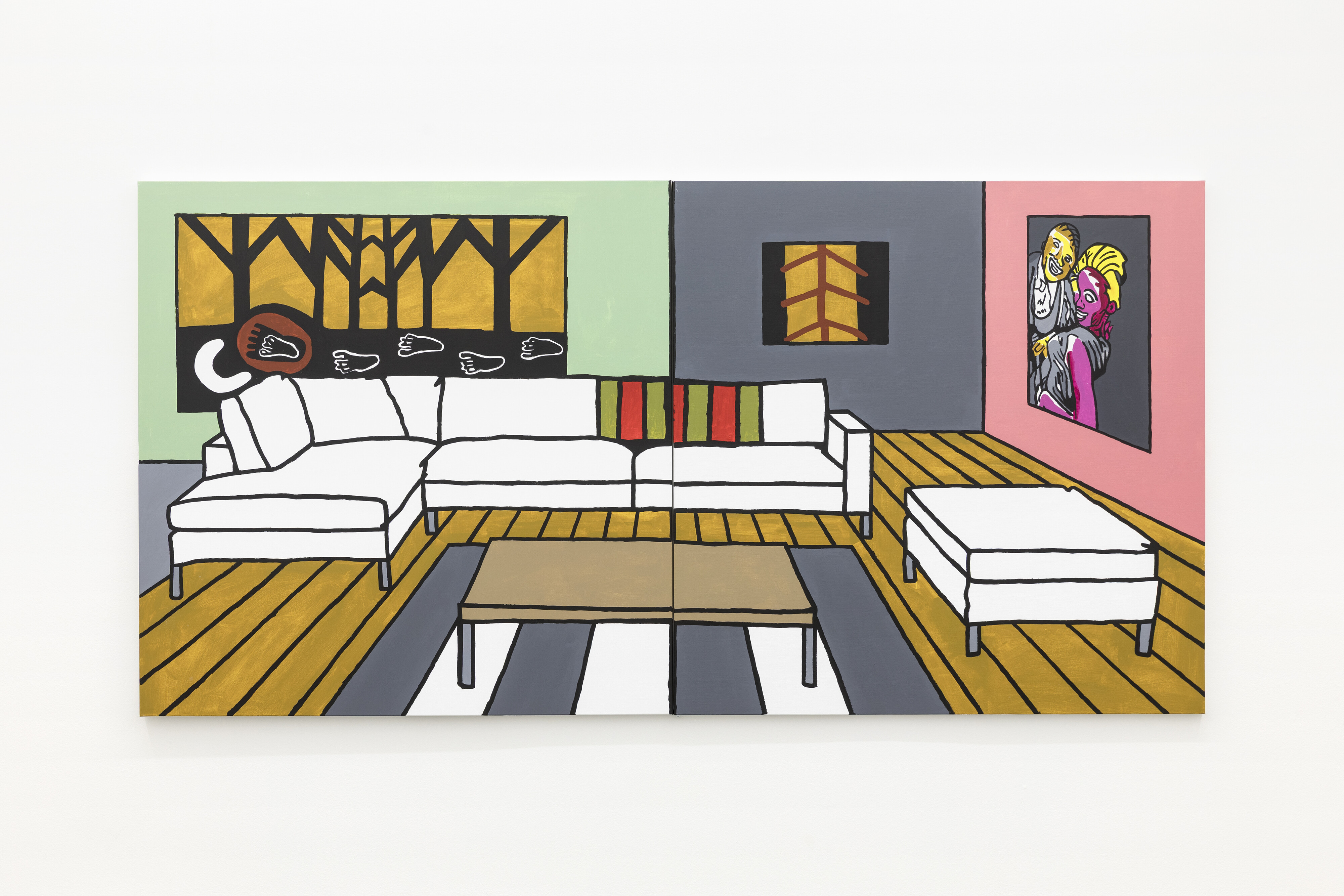
John Citizen, Interior (Home Decor), 2005, acrylic on linen, two panels, 152 x 304cm (overall). Photography: Andrew Curtis.
And perhaps Bennett is making this point too in another large series of works also in the Preston show, Home Décor (Preston + De Stijl = Citizen) (1996). But to help explain, we might turn to the extraordinary ongoing project by curator Djon Mundine tracing the history of the reception—of course, appropriation—of Aboriginal art in Europe, which needless to say takes it outside of Australia and any project of using it to create a “national” art. It is indeed what we might call an “UnAustralian” Aboriginal art, an art not of Australia but of “citizens”, in which Aboriginal art and culture wins, precisely by being appropriated. In his series of paintings entitled Coloured People, Bennett represents this new subject and audience—we see one of these paintings on the right-hand wall in his John Citizen-painted Interior (Home Décor) (2005) at Sutton Gallery. For I think what he is suggesting is that we are all “coloured people”. Or, as Mundine says in a recent essay in Art + Australia, “A Continuing Circular Conversation”, based on his experience of living with Indigenous Australians:
Firstly, you can never (or should never) tell another adult human what to do. You may give advice, but cannot be forced. Secondly, to remember that an argument is really a conversation so it’s important to find the core of the problem being presented. And lastly, you can never hold a grudge or long vendetta but always strive to remain, at some level, in conversation with the other party concerned.
What is the lesson of the Margaret Preston show that Bennett reveals to us, and why will we not need another Preston show for quite a while? It is that we are all Preston, that we all appropriate from others all the time, even when criticising others for doing so. Not that we should not criticise them, but our criticism of others is first of all a criticism of ourselves. And that for all of its appropriation, in fact, “Aboriginality” is the new universal in Australia, the name of that by which we judge ourselves, although no one actually occupies it because there is no place to speak the “truth” of this appropriation from anywhere outside of it. The Voice might have failed, but the voice continues to speak to us all.
Gallery