John Gollings
May 6, 2026
-
John Gollings Artist Room
Venue: National Gallery of Victoria | The Ian Potter Centre: NGV Australia
28 Feb 2026 – 26 Aug 2026
John Gollings AM is ubiquitous, insofar as, when I visit his collection hang at the National Gallery of Victoria, the man is there. “I’ve shot 12500 jobs in my life. All on a database,” he texts me beforehand. Prior to drone domination, he was in a helicopter every week: the human embodiment of a photographic satellite. Despite his sweeping documentation of Nawarla Gabarnmang (a sacred geologic edifice in Arnhem Land), bushfire-razed landscapes, and ancient Khmer temples, Gollings is best known as a contemporary architectural photographer. Of his iconic building snaps, Cassandra Fahey—Melbourne architecture’s glam queen—touted “every time you open a (architectural) book or a magazine, it’s there.” The exhibition at NGV Australia, one Artist Room plastered with 32 photographs (some held by the collection, some that ought to be), reinforces this reputation. Every image foregrounds the built environment.
NGV’s newest department is Contemporary Design and Architecture (est. 2015), preceded by the Photography department (est. 1967), and it’s the thrust behind this exhibition. Given that we are in a time when picking up an image-saturated phone is, to quote Vincenzo Latronico, like “walking through the world’s most hectic street market on cocaine”—and given that Gollings himself is huge on Instagram—what is the function of displaying a photography collection as a design and architectural exhibit? The institutional format persists as a method for canonising culture spatially. Doing so produces a static but simmering shared point of reference, an alternative to satanic follower metrics and the algorithmic doomscroll.
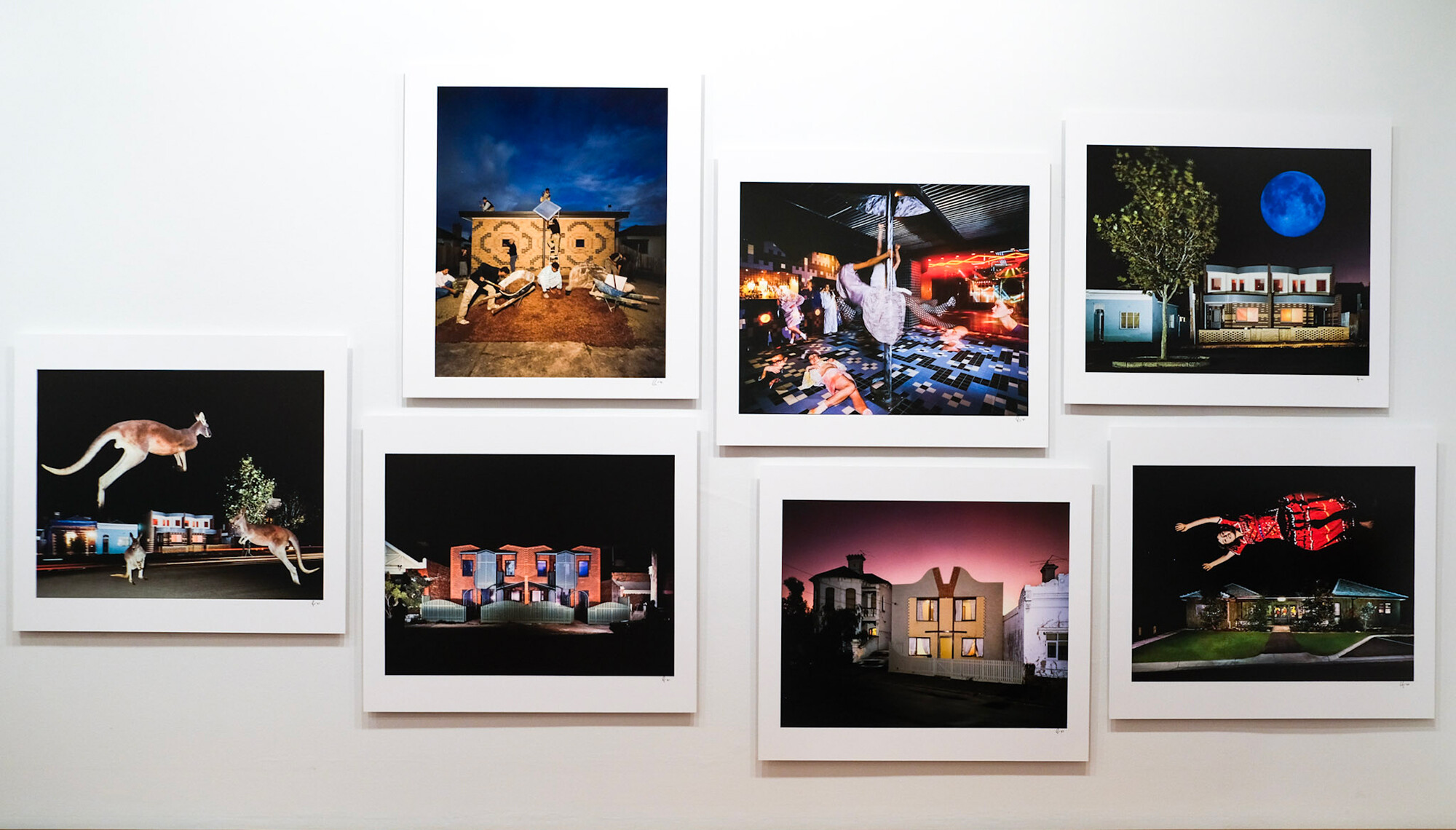
Rather than appearing next to a meme, John Gollings has been placed by NGV Curator of Contemporary Design and Architecture Timothy Moore next to four photographers: Max Dupain, David Moore, Mark Strizic, and Wolfgang Sievers. Corresponding to each of these photographers, four small greyscale towers (1955-68) are arranged in a neat, framed line. Gollings’ works (1978–2025) then explode around the space in big, full chroma, unframed jagged-asymmetrical tiles, as if to say: Suck my Eureka tower, postwar era! We are hit with the next version of Melbourne, flaring from monochrome to high contrast technicolour—octane marketable yet post-punk inflected—with hideous to the eye/fat little insect undertones, à la Nick the Stripper by The Birthday Party. Banter comes up again through Gollings’ wryly humorous anecdote that Max Dupain, nonetheless a respected mentor, used to “ring me up and criticise me.”

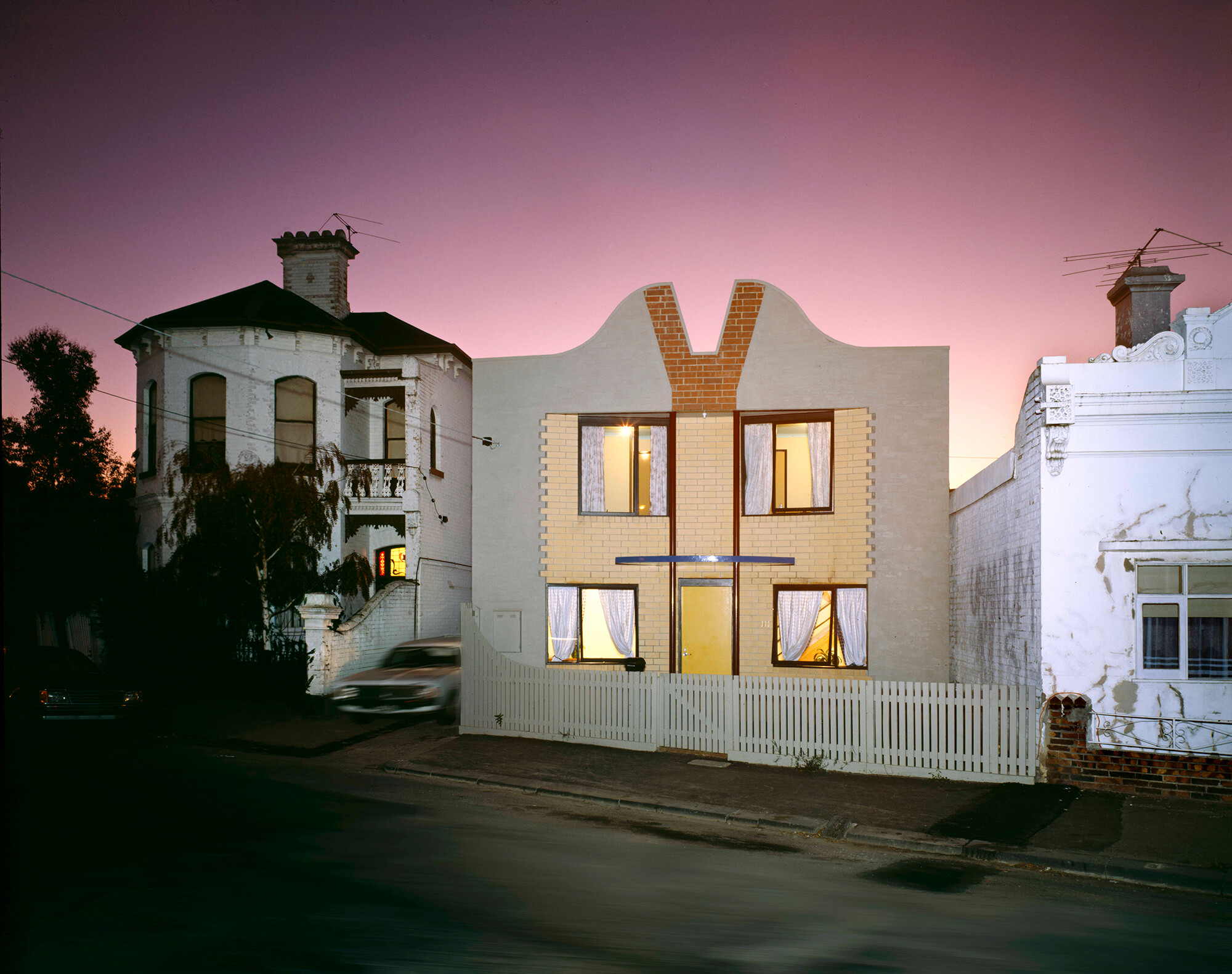
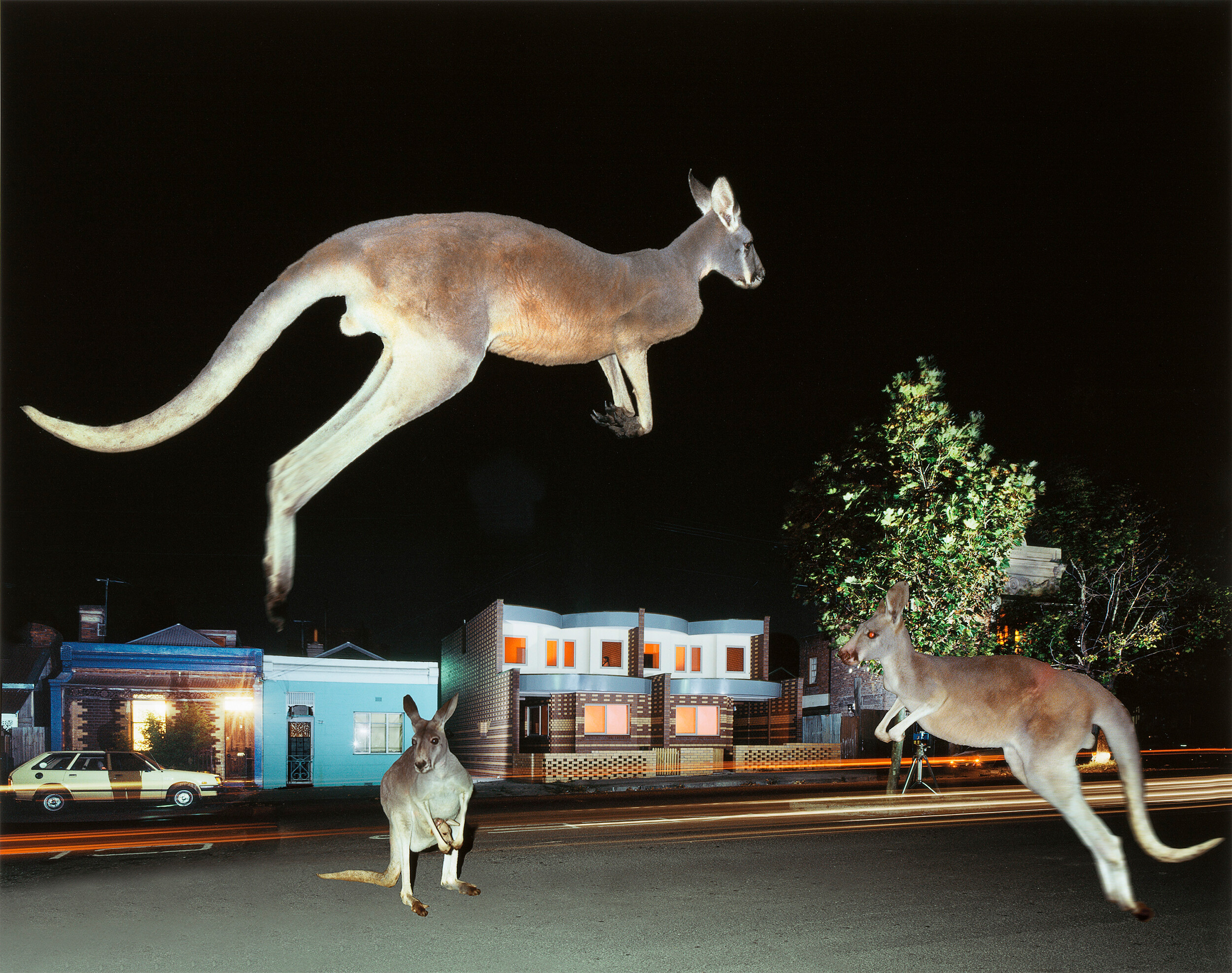
John Gollings, Fitzroy House – Norman Day 1983, Naarm/Melbourne © John Gollings. Photograph courtesy of John Gollings.
In architectural photography, the “hero shot” is widely understood as the signature portrayal of a building. Gollings proactively defined this muscular genre, particularly through his affiliation with Kennett government-commissioned architects Denton Corker Marshall, deconstructivists (PoMo subgenre rather than an architectural translation of Derrida) who are featured in eight of the exhibited works. Moreover, within this constellation of photographs, there is a dialogue between what has since been hypermediatised as hero shot and—by way of new nomenclature—what I call the anti-villain lens. The anti-villain creeps through the exhibition’s dark wall, a plane of vintage nighttime photography awash with flash. She is latent in the analogue, punk postmodernist imagery of Gollings, and beguiles you with whimsy, contradiction, and subversion. More on this later.

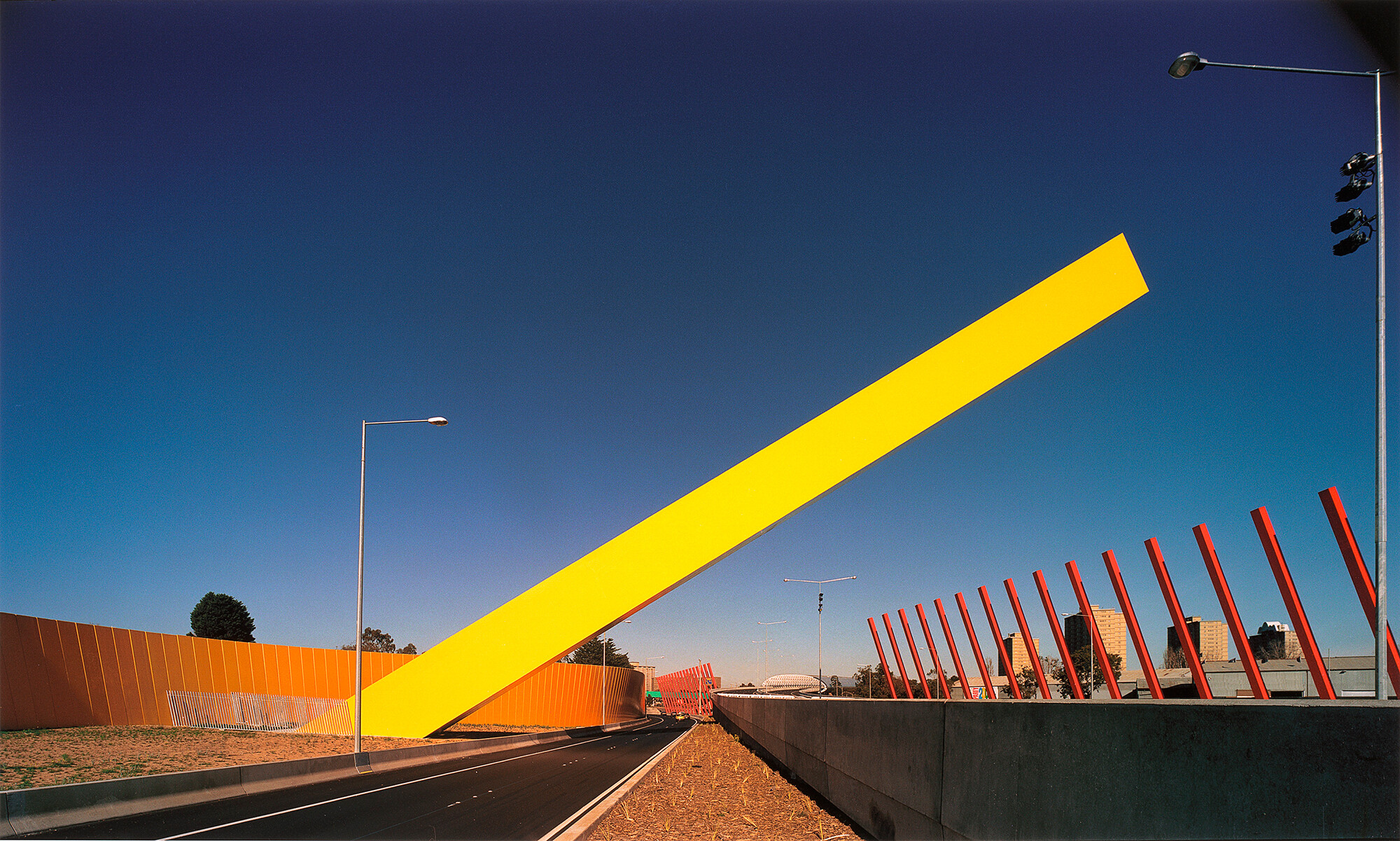
John Gollings, Tullamarine Freeway entry statement – Denton Corker Marshall 1998, inkjet print, 84.0 x 110.7 cm, National Gallery of Victoria, Melbourne. Purchased, Victorian Foundation for Living Australian Artists, 2017. 2017.418 © John Gollings. Photograph courtesy of National Gallery of Victoria.
In the exhibition space, John Gollings is explaining particulars of analogue lighting and multiple exposures, when we are interrupted by a stranger (let’s call him Peter; mainly because Parlour noted that more Peters have been awarded the Australian Institute of Architects Gold Medal than women). Peter recognises John through their mutual contact: the nation’s most famous modernist, Harry Seidler, who was Peter’s boss while working on the Waverley Civic Centre (soon after, Seidler reportedly also took on client Donald Trump for a Sydney casino, later axed by the NSW government due to Trump’s Mafia ties). This prompts John to recollect that he shot this very Waverley Civic Centre in Polaroid and showed it to Seidler, who lost his temper, saying, “that’s the worst fucking photograph I’ve seen in my life.” Seidler delivered a no-frills message that haunts nearly every photo in the Gollings NGV Artist Room: show the whole building.

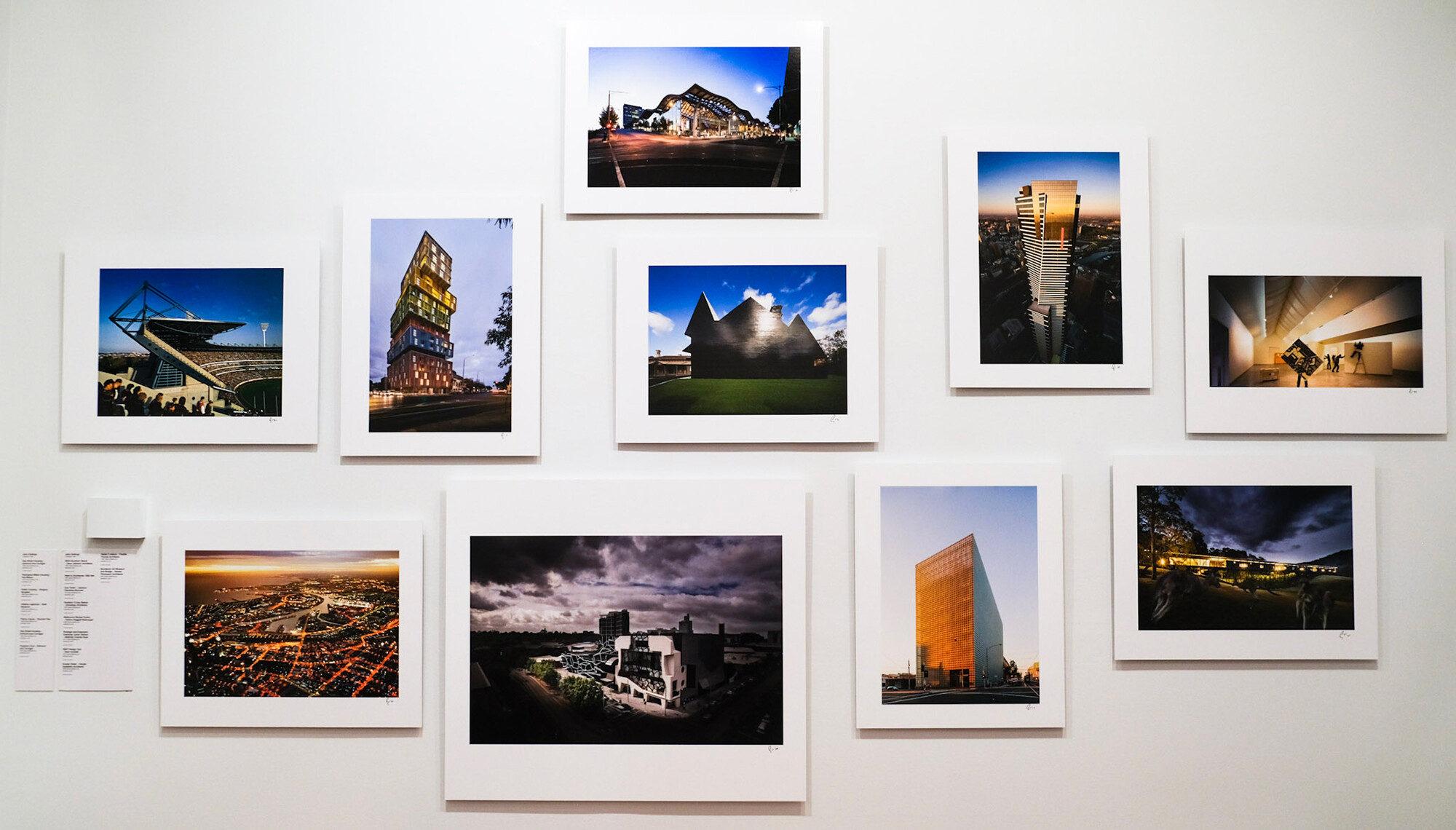
Installation view of John Gollings Artist Room, 2026. South wall. Photography by Jack Le Riche.
Such is the first rule in the Gollings hero shot artillery. Known by more lippy critics as the “wide-angle queen,” his archetypal hero shot squeezes the maximum amount of information into a single image, sometimes slightly distorting the perspective to bring in context. It is a commanding signature. He prefers to shoot at dusk, to catch both exterior and lit-up interior—the consequence is electric colour: ultraviolet, neon orange, dusk blue, voltaic yellow. Composition is dopamine-inducing dumb (smack in the middle), not romantic (rule of thirds). The aim is strategic: to take the one definitive shot of a building is to take the image that will be published, and on repeat. It is a savvy marketing tactic with roots in a commercial background; Gollings skipped out of architecture school to pursue advertising photography. His first assignment was shooting for Marlboro ciggies in 1975, a brief steeped in status and masculinity.
Is a hero shot fuelled by testosterone? Much like the Marvel universe, there’s no denying Melbourne architecture of the 1980s was a boys’ club. The class around 1964 at The University of Melbourne included a slate of (male) starchitects depicted in the NGV Artist Room—Gollings was putting them on the map, none more frequently than DCM, who, among other things, designed the house of Melbourne art figure Anna Schwartz. DCM’s John Denton, Bill Corker, and Barrie Marshall (known respectively as “the diplomat”, “the suit”, and “the artist”) had an interest in monumental sculpture which, to quote Denton in the eponymous documentary, cut out an architecture of “strong, singular, powerful, rigid form.” Or, in the words of Roger Wood, the type of architecture that could “really get you in the shin, if you’re not careful.” Power and inequality accumulated; major projects by DCM were commissioned by the Jeff Kennett Government (1992-99), known for extreme privatisation, budget cuts, and high-profile capital works. Almost as a miniature culmination of this forceful illogic—the compulsive need of certain politicians to take up space—an architectural model of DCM’s Webb Bridge (2003, with Robert Owen) is additively plonked in the centre of this NGV Artist Room exhibition of an architectural photographer.

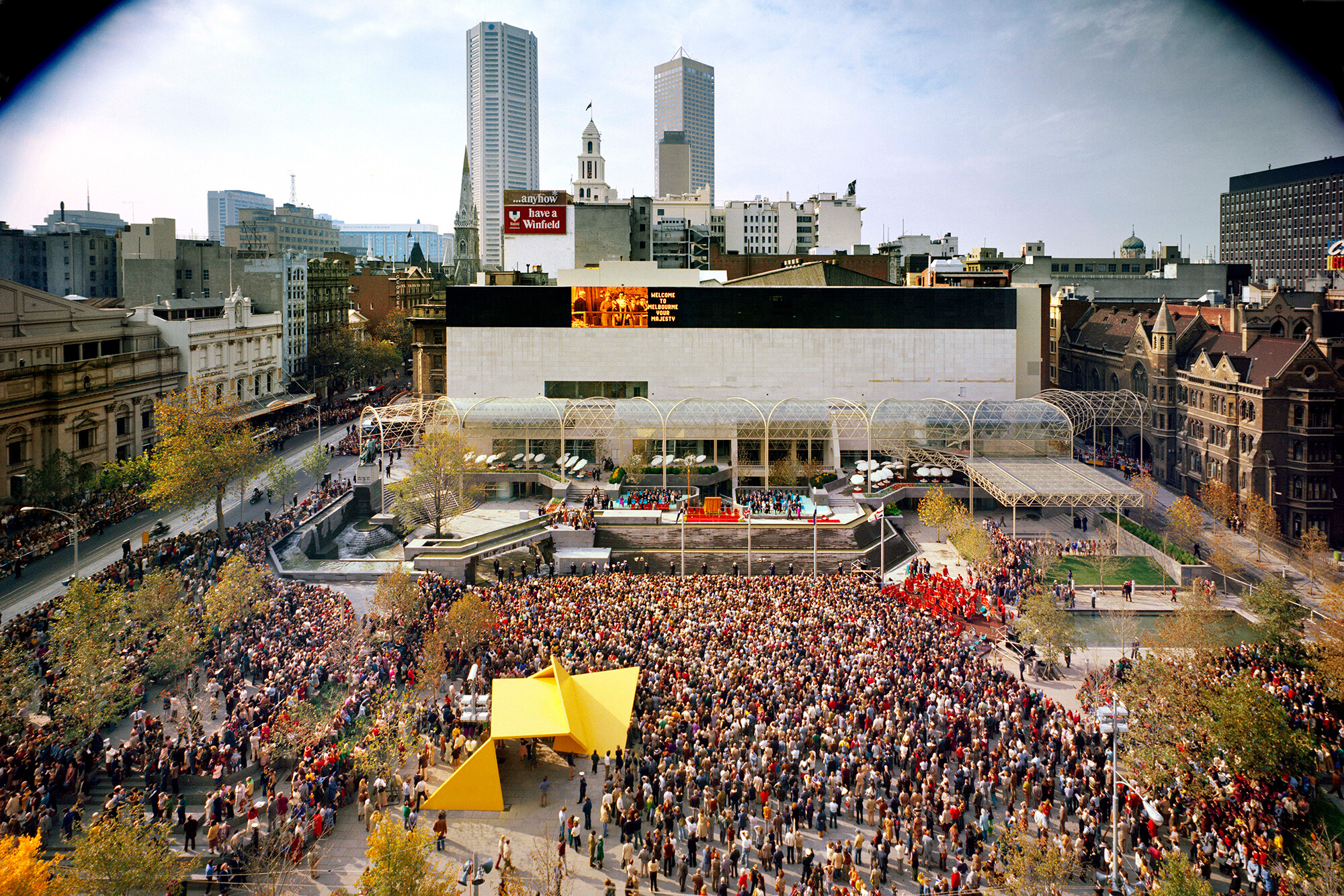
John Gollings, City Square – Denton Corker Marshall 1980, Naarm/Melbourne © John Gollings. Photograph courtesy of National Gallery of Victoria.
Beneath crisply pixelated steel and glass armour, Gollings conveys a sweet sensibility of fragility. His photograph of DCM’s Melbourne Museum finds the angular, cantilever roof partially obscured by a veil of leafless trees. In the foreground, sweethearts cuddle. In a documentary by Sally Ingleton, he tells us, “I worry about the maintenance… there’s not much to make a ruin of in this building. The glass will break, the steel will fall to pieces, and that will be the end of it.” Loss gently permeates the collection; nearly every photograph in the Artist Room is one that cannot be recreated, or taken again. We are shown the MCG Southern Stand, before the Northern Stand was built to block it. We are shown the infamous, demolished City Square—acknowledged by many as Melbourne’s first significant public space—nonetheless described by citizens as “bloody awful,” “a monstrosity,” and “very grey, unfortunately.” Altogether, temporally contrasting images of Naarm-Melbourne melt into a tender, candid urban portrait of this colonised place, choked by tussling cycles of public provision and real estate development.

Installation view of John Gollings Artist Room, 2026. East wall. Photography by Jack Le Riche.
Kay Street Housing (1982) is the exhibition’s focal point, yet ironically it is a photograph that breaks nearly all self-imposed Gollings hero shot rules. It holds relative transgressive power. The image is placed directly adjacent to curatorial text, which describes it as harnessing the “energy of Melbourne’s postmodern architecture movement.” Kay Street Housing architects Maggie Edmond and Peter Corrigan were RMIT Melbourne’s counterparts to Denise Scott-Brown and Robert Venturi, whose Learning from Las Vegas (1972) distilled the pith of postmodern architectural discourse. Irritated by monumentality and heroism, Kay Street is an exercise in the ugly and ordinary, and the type of building that could easily fly under the radar—or a bounding kangaroo. It was part of the Ministry of Housing’s 1980s infill public housing program, and in 2024 included in the Heritage Council of Victoria register, a stark ideological contrast to the political instrumentation that enabled DCM’s heroic city-making. Beneath this striking image, a question persists: is it good architecture? Perhaps this is a question that residents have the authority to answer.
How then, to make a building perform? So, the story goes, Edmond and Corrigan were to be featured in the Italian magazine Domus, issue #663, ‘Ciao Australia, Coast to Coast: the Last Wave.’ As the official photographer for Melbourne Zoo, John Gollings already had permission to visit the zoo after dark and chase kangaroos around with a flash gun. A scheme was hatched to trick the Italians—instead of dogs prowling the city streets, in Australia, there are kangaroos. Given that Photoshop was only introduced in the 90s, and that this Kay Street Housing photograph was created in 1982, the image was analogue and labour intensive. Assistants would run around with flash machines; long exposures patiently stood by; darkroom entered; film masked out to layer roos with street. Gollings paints with light and flash to impart an experimental, sharp composition, wherein architecture submits to marsupial. The image teases our Australian imaginary—with deadpan delivery it “dethrones the serious,” subverting airbrushed heroic expectations with camp collage. It is a theatrical exercise in trickery and whimsy, illuminating playfully dark anti-villain qualities (think manic pixie dream assassin, Villanelle, in Killing Eve, or Terri in The Electrical Experience). Kangaroos reappear in a stormy, dramatic Bundanon Art Museum and Bridge (Kerstin Thompson Architects, 2025), the only other building designed by a woman in the NGV Artist Room.

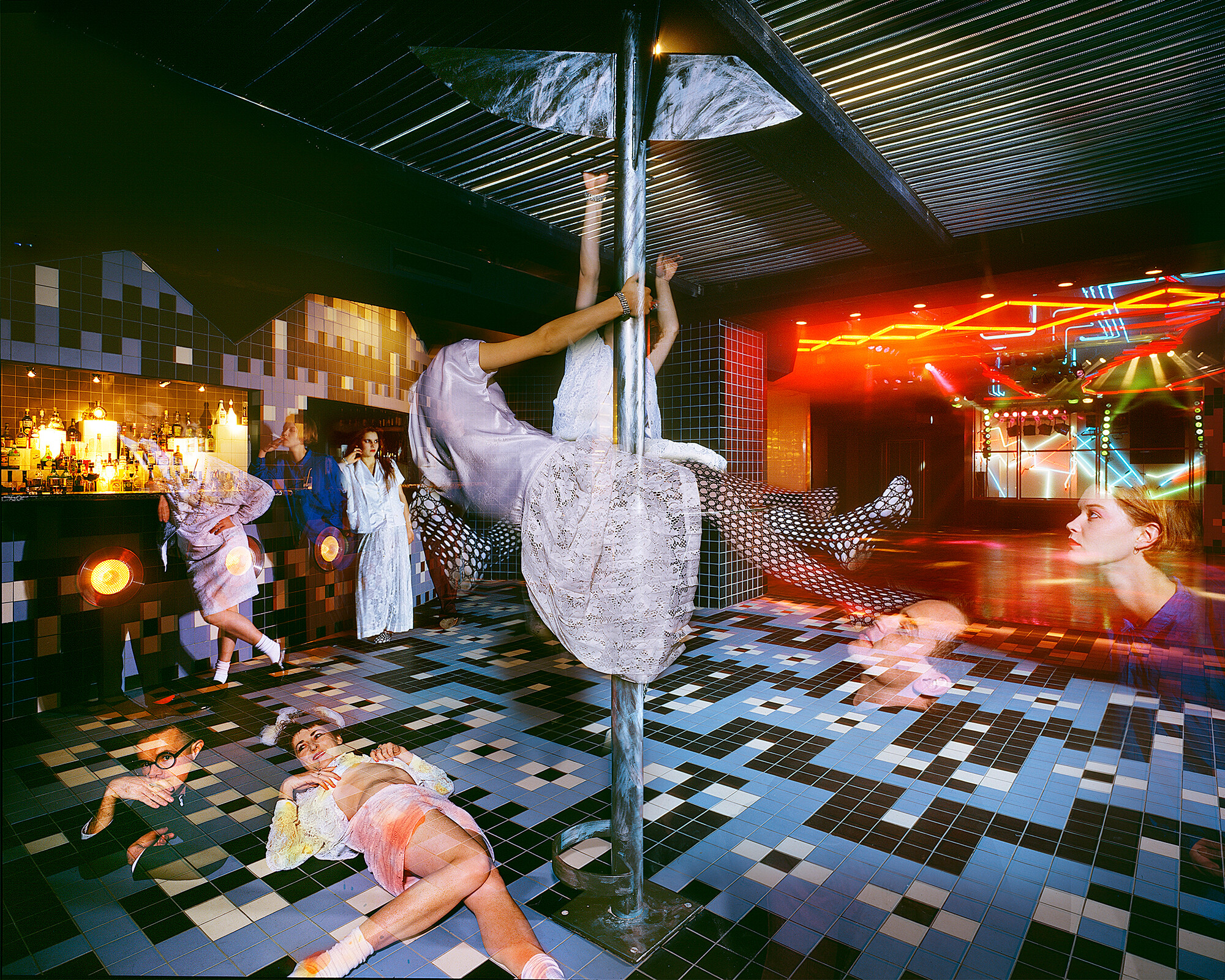
John Gollings, Inflation nightclub – Built Moderne 1985, Naarm/Melbourne © John Gollings. Photograph courtesy of John Gollings.
Hero shot foil, the anti-villain shadow slinks around Gollings’ 80s analogue nighttime photography. In After Nightfall, NGV Curator of Contemporary Design and Architecture Timothy Moore writes about nightclubs as clashing domains, at once “inclusive and exclusive, egalitarian and elite, resistant and submissive.” Inflation Nightclub (1985) is one of only two interior photographs in the NGV Artist Room exhibition. Designed by Built Moderne (three RMIT graduates, two went on to establish Wood Marsh), Moore reveals the nightclub’s description by a 1987 review as “idiosyncratic, aggressive, arty, threatening.” John Gollings’ Inflation photograph, darkroom alchemised, swirls into this trippy world where bodies dissolve like smoke into light and fishnet stockings mesh with pixel wall tiles. Greased hammertone pole drips with lilac satin and synthetic lace. Clean boundaries and dualism blur into a beautifully grimy mixing chamber.
There is a sense, immersed in this NGV Artist Room of John Golling’s photographs, that one is at the edge of a thickly connected, temporally dense network of people and places. The man says yes to everything, and this life-affirming energy flashes, supercharged, through the Gollings lens. Despite the oversight of most critics, it is a fallacy to detach our postmodern era of Melbourne architecture from the photographer who has been actively defining it. His photography is never neutral. His images don’t document so much as fix structures into our collective memory, as though pinning insect exoskeletons coated with heroic gloss or anti-villainous grit. To be photographed by Gollings is to be admitted into a canon of sharp-focus mythmaking.
Gallery