Janina Green, A Country Practice
May 9, 2026
-
Janina Green, A Country Practice
Venue: Latrobe Regional Gallery (LRG)
24 Jan 2026 – 23 May 2026
What is a “country practice”? For many Australians, the phrase recalls the television pastoral of A Country Practice (1981–1993): the fictional town of Wandin Valley, where the petty dramas of rural life unfold in episodic rotations of gossip, short-lived romantic disputes, and interpersonal grievance, all expressed in the twang of Anglo-Australian speech. But in Janina Green’s exhibition of the same name, the phrase adopts an entirely different reality. If the TV version of A Country Practice imagined country Australia as socially coherent and warmly familiar, Green’s photographs expose a far more uneven reality: a Latrobe Valley shaped by postwar migration, economic extraction, loneliness, fragmentation, and the ever-present infrastructure of the mining industry; the Valley sits atop some of the world’s largest brown coal deposits. Like the children of many Eastern European families who arrived in the region through migration schemes tied to the Valley’s industrial expansion, Green’s childhood was marked by linguistic fracture: a father who “could not read or write,” and her own movement between “simple Ukrainian and broken English.” Here, “country practice” names not a sentimental vision of regional belonging, but the social conditions that structured Green’s life in the Valley. Now residing in Carlton, Green has had a long career as a photographer and influential mentor at the Victorian College of the Arts (VCA), where she taught photography until 2022. While the Latrobe Valley forms only one strand within Green’s wider oeuvre, it remains a recurring point of return throughout her work as a photographer.
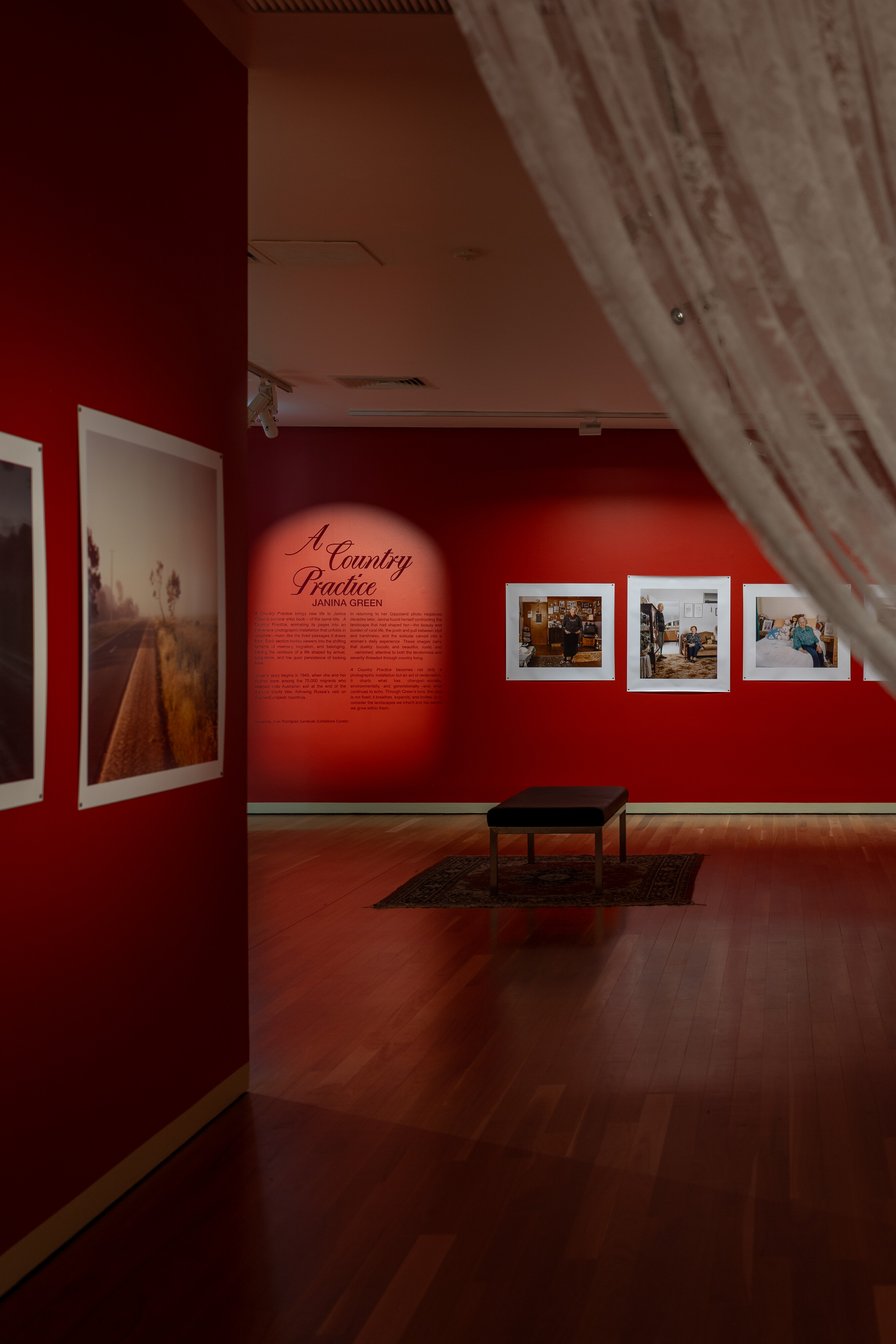
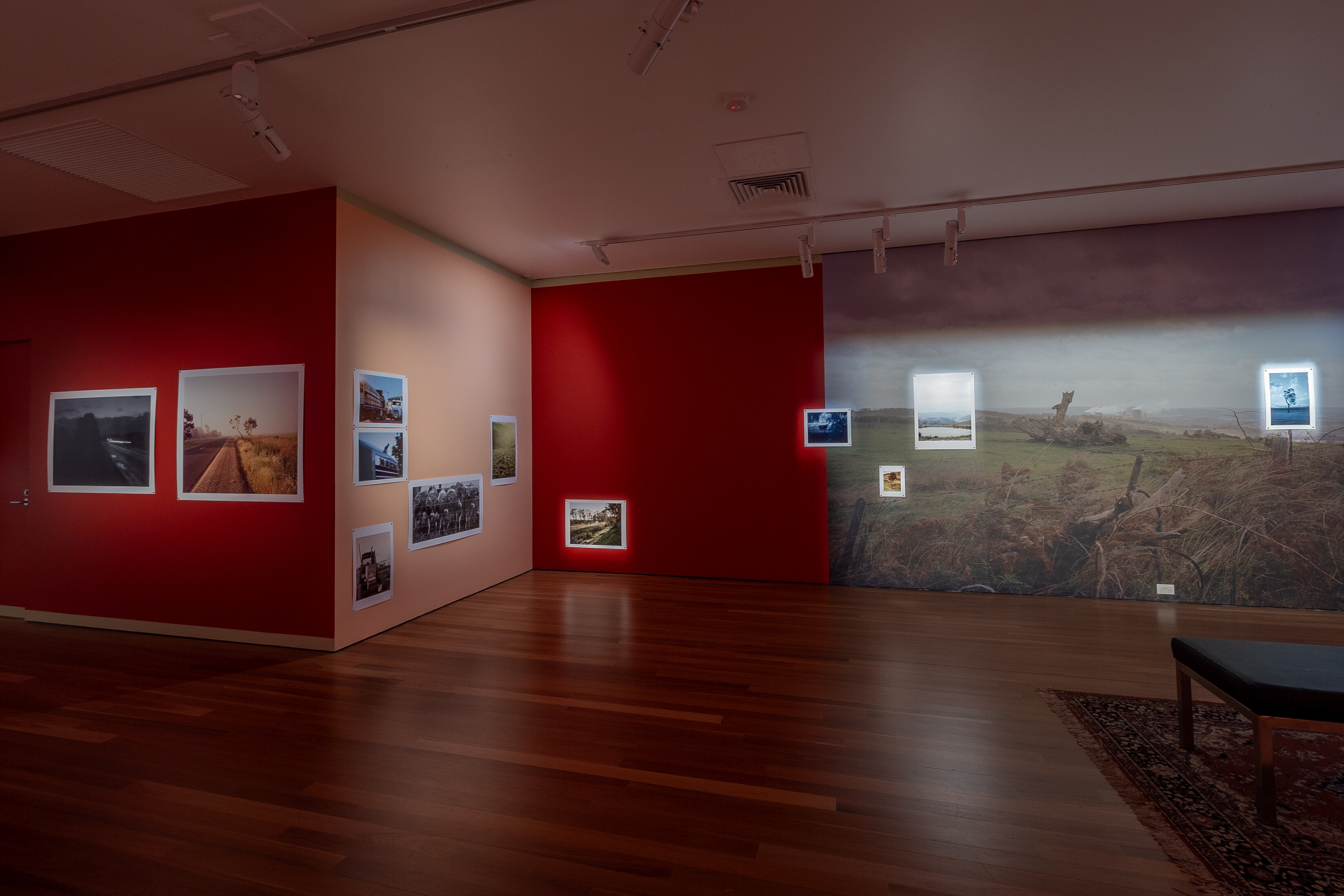
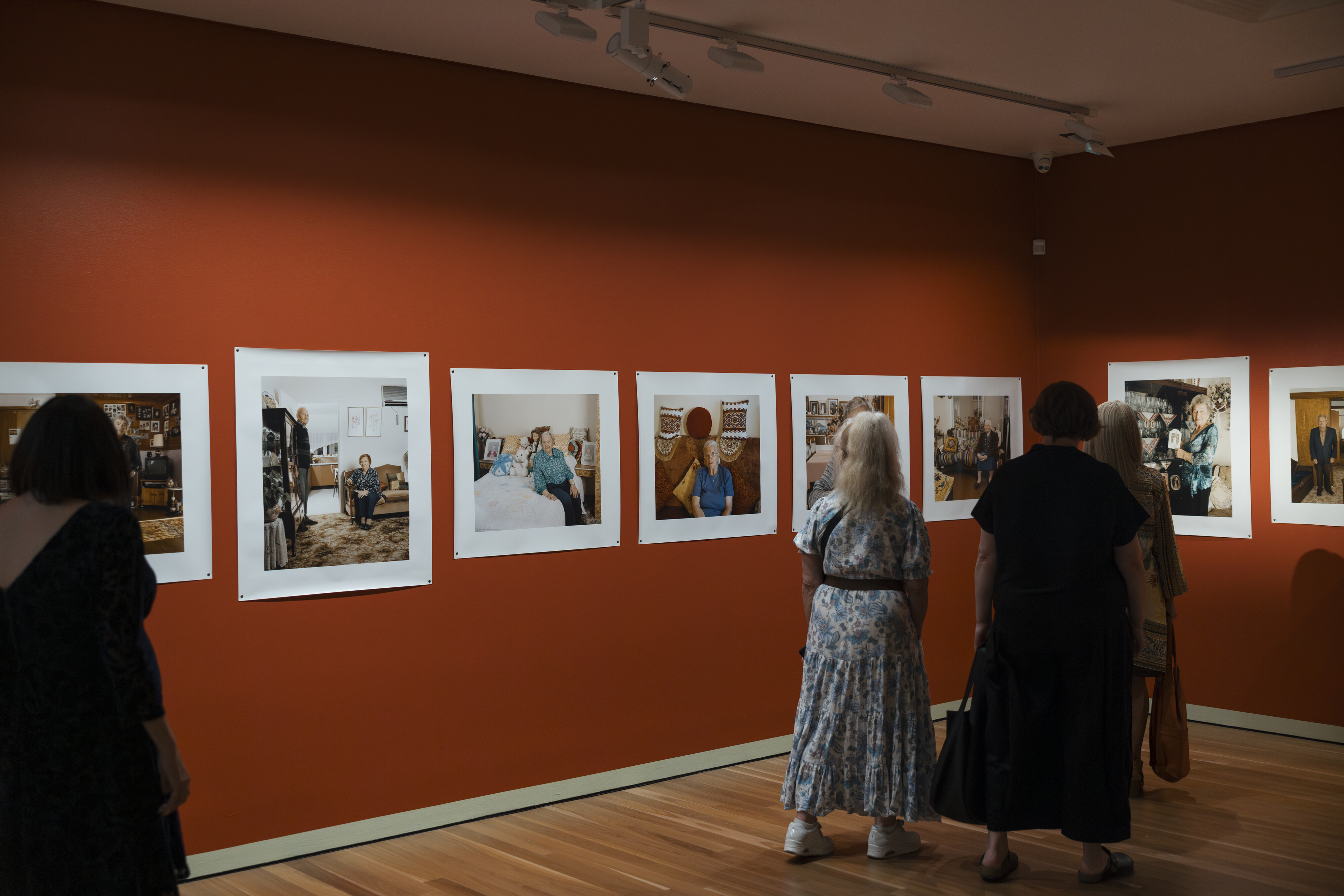
The exhibition also shares its title with Green’s photobook, first published in 2017 by editor Helen Frajman’s imprint M.33. Its red, ornate cover depicts an interior lined with flowered wallpaper. A heavily varnished painting is partially cropped to the centre-left top of the cover. A vase rests on a wooden plinth. There is the suggestion of a hall or entryway. The exhibition is installed in a single upstairs room at Latrobe Regional Gallery and, as well as showing Green’s photographs, restages elements from the photobook’s cover as objects in the space: a vintage lamp, a small wooden table, a vase of flowers, and even white lace curtains flank the edges of the room. These read as fragments or stand-ins, and it’s as though they have been cropped from the book’s cover and brought into the gallery. Even the pins that fix each photograph to the wall are flower-shaped, as if plucked from the wallpaper.

Installation view of A Country Practice, Latrobe Regional Gallery, 2026. Photo: Karli Duckett, The Good Side Photography, 2026.
The majority of the photographs on display, first taken in 2008–9, are drawn from this photobook and now reprinted and reimagined. Originally issued in a limited edition of just sixty copies and not available in the gallery (the book is sold out and proof of a keen fandom), it remains largely inaccessible, making the exhibition the primary point of encounter for most viewers, and perhaps their first and only. The shift in scale is not insignificant: moving the work from the book’s modest, compact format into the gallery, the prints acquire a physical presence absent from the page. Installed unframed, the C-type prints’ rich tonal range and slight surface undulations register the photograph as more than a purely reproductive image, anticipating the exhibition’s broader concern with the material conditions of the Valley itself. Exhibition curator Juan Rodriguez Sandoval also reorganises the work, transforming the book’s looser sequencing into eight distinct “chapters” that move across distinct registers of Green’s photographic sensibilities. There are portraits, domestic interiors, collage, still life, candid snapshots, streetscapes, and landscapes.

Installation view of A Country Practice, Latrobe Regional Gallery, 2026. Photo: Karli Duckett, The Good Side Photography, 2026.
What binds these disparate genres is Green’s upbringing in the rural-industrial town Yallourn North, north-east of Morwell, where her working-class childhood unfolded within a Ukrainian migrant community that was part of a broader wave of Eastern European migration to the region. Born in Essen in 1944, she arrived in Australia as an infant following her parents’ postwar migration—one of seventy-five thousand arrivals that year. As detailed in Latrobe Valley Ukrainian Stories (2009), a photographic and oral history project documenting Ukrainian migrant experiences in the region, Green recalls her father travelling ahead in October 1948, departing from Genoa and arriving in Sydney a month later. Green and her mother remained in Europe and followed soon after, with Green still a child at the time of the journey. They moved by train through northern Germany to a refugee processing centre in Fallingbostel, a former spa town repurposed after 1933 for military training. From there, under the auspices of the International Refugee Organization, they travelled south to Naples, eventually departing for Australia aboard the Anna Salen in May 1949, alongside approximately fifteen hundred displaced persons from across Eastern and Central Europe. The voyage took a month.
Upon reaching Sydney, her mother was issued a temporary exemption from the restrictions of the Immigration Act, a document reflecting the conditional and tightly regulated conditions of postwar migrants to Australia. The pair travelled on to the Latrobe Valley to rejoin Green’s father, who had begun work with the State Electricity Commission at Yallourn. The family built a life in Yallourn North, one of several nearby towns transformed by industrial expansion and postwar settlement. Green worked briefly as an art schoolteacher at Moe High School in 1966 before relocating to Melbourne a decade later to teach at Mitcham High School. In the 1980s she turned seriously to photography, later studying the medium formally at Preston Institute (now RMIT) in 1986. The broader histories of staggered arrival, administrative control, and enforced resettlement that underpin Green’s own biography also sit quietly beneath the work in A Country Practice. It registers less as narrative than as structure: in the repetition of interiors, the careful arrangement of objects, and the sense of a life assembled from fragments and held together in photographs.

Installation view of A Country Practice, Latrobe Regional Gallery, 2026. Photo: Karli Duckett, The Good Side Photography, 2026.
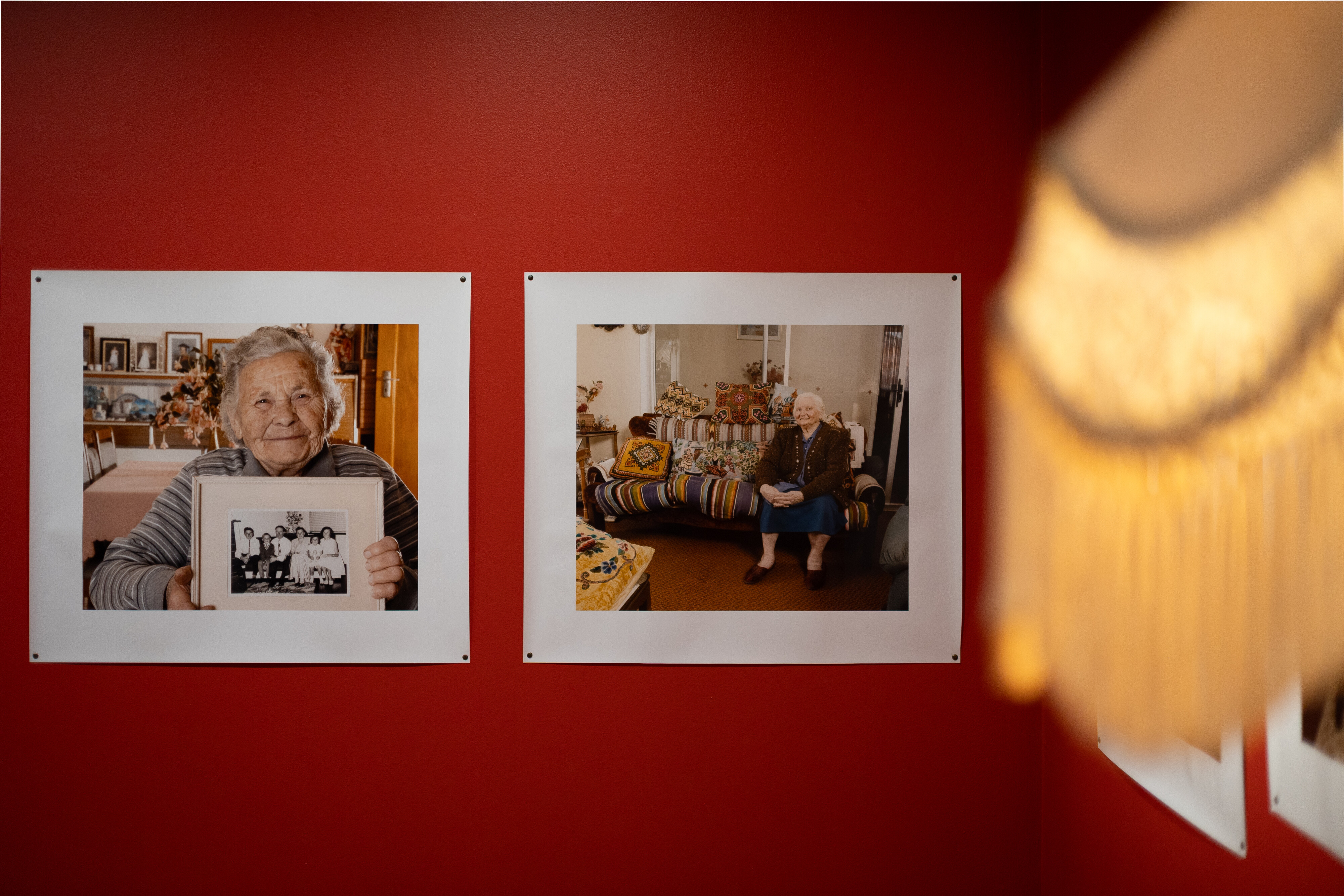
A series of eight portraits of members from Ukrainian Australian families from towns in the Latrobe Valley (Newborough, Morwell, Moe, and Yallourn North), all of whom Green knew, opens the exhibition’s first chapter. Titled Old Friends, the series operates as a kind of social record, dense with visual detail. The subjects, many of them elderly women, are pictured seated or standing within the interiors of their well-lived-in homes. In one photograph, Anna Gorbal stands in her living room wearing velvet slippers, her walls crowded with framed family photographs, stacks of old newspapers gathered nearby—the stuff of life. In another, Kateryna Malinin smiles while holding up a framed family photograph from what appears to be the 1950s, where you can easily spot her as a young girl with her parents and siblings (it’s all in the eyes!). Her hands, worn and slightly cropped, firmly hold the edges of the picture frame. An immaculate dining table recedes behind her. She seems almost to fall out of the frame of the image in her insistence on looking toward the past, her past. I am reminded of Susan Sontag’s observation about how difficult we find getting rid of photographs.

Installation view of A Country Practice, Latrobe Regional Gallery, 2026. Photo: SODA Creatives, 2026.
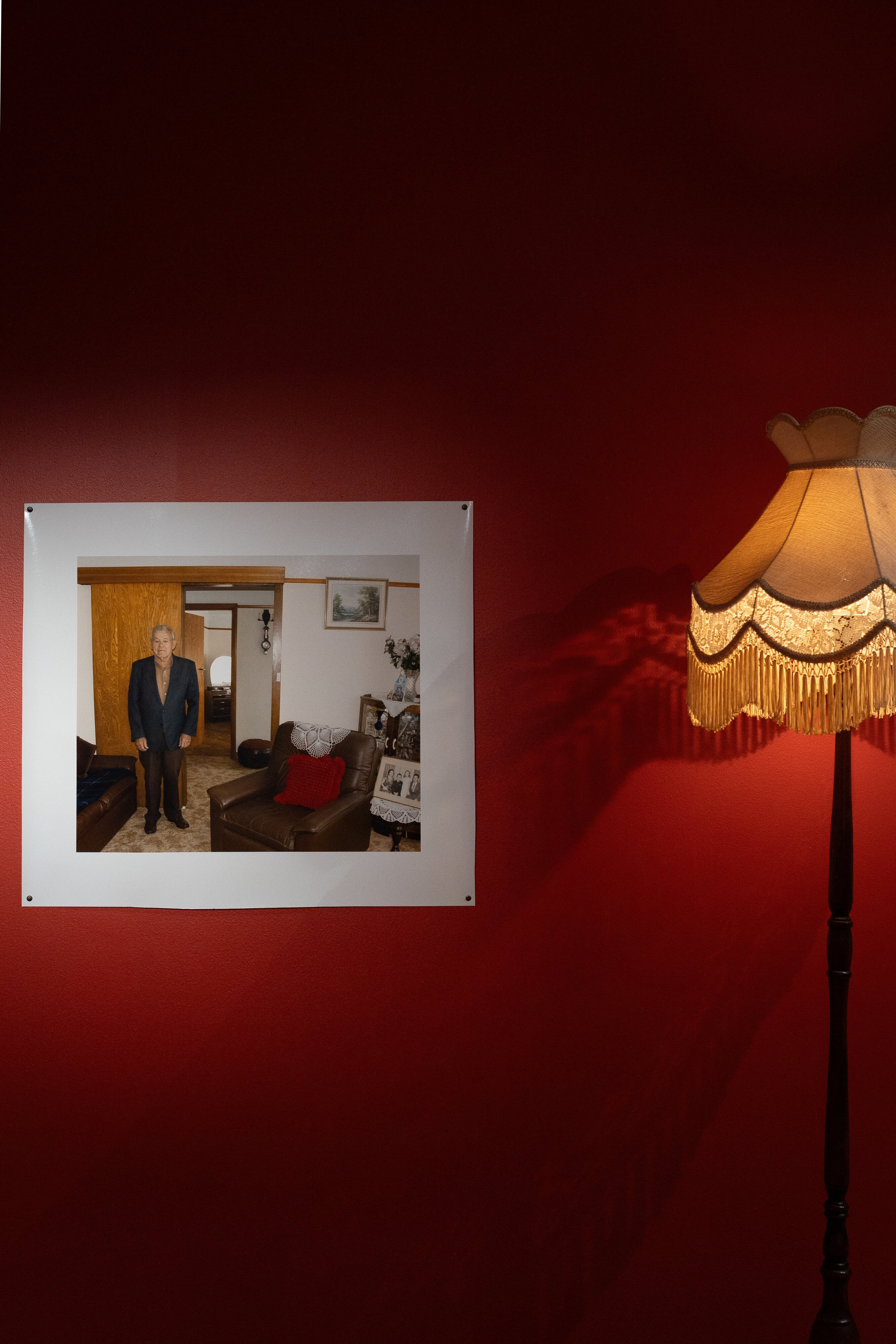
I realise that some of the stories detailed in Latrobe Valley Ukrainian Stories are also the subjects pictured in the exhibition. In the far corner, Mykhalio Andrijczak, who left Germany in 1948, recalls arriving in the Latrobe Valley and finding work in the open-cut mine at Yallourn. It was filthy work. The pay wasn’t even good, either—not enough to support his family, who eventually joined him five months later. Andrijczak recounted one night he spent cutting down three long trees to brace the roof of his home against the wind after the roof had blown off the shack his family had been living in. Eventually, he built a home in Newborough, a small neighbouring town adjacent to Yallourn and Moe, which he occupied for the rest of his life. His account sits within a broader history of the region, where the original town of Yallourn, built on Brayakaulung country in the 1920s, was progressively dismantled and literally had to be relocated between the mid-1950s and its final demolition in 1983 to make way for the expansion of the open-cut mine, now the second largest in the country. This is a landscape in which settlement was never entirely secure. In his portrait, he stands alone in his living room, facing the camera, his expression held, slightly withdrawn, refusing to give much away. Yet the photograph also suggests a degree of familiarity and trust between Green and her subjects; it is difficult to imagine these interiors opening themselves so readily to an outsider. The images avoid the voyeuristic distance that often structures documentary photography, residing less in disclosure than in the earned familiarity between photographer and subject.

Installation view of A Country Practice, Latrobe Regional Gallery, 2026. Photo: Karli Duckett, The Good Side Photography, 2026.
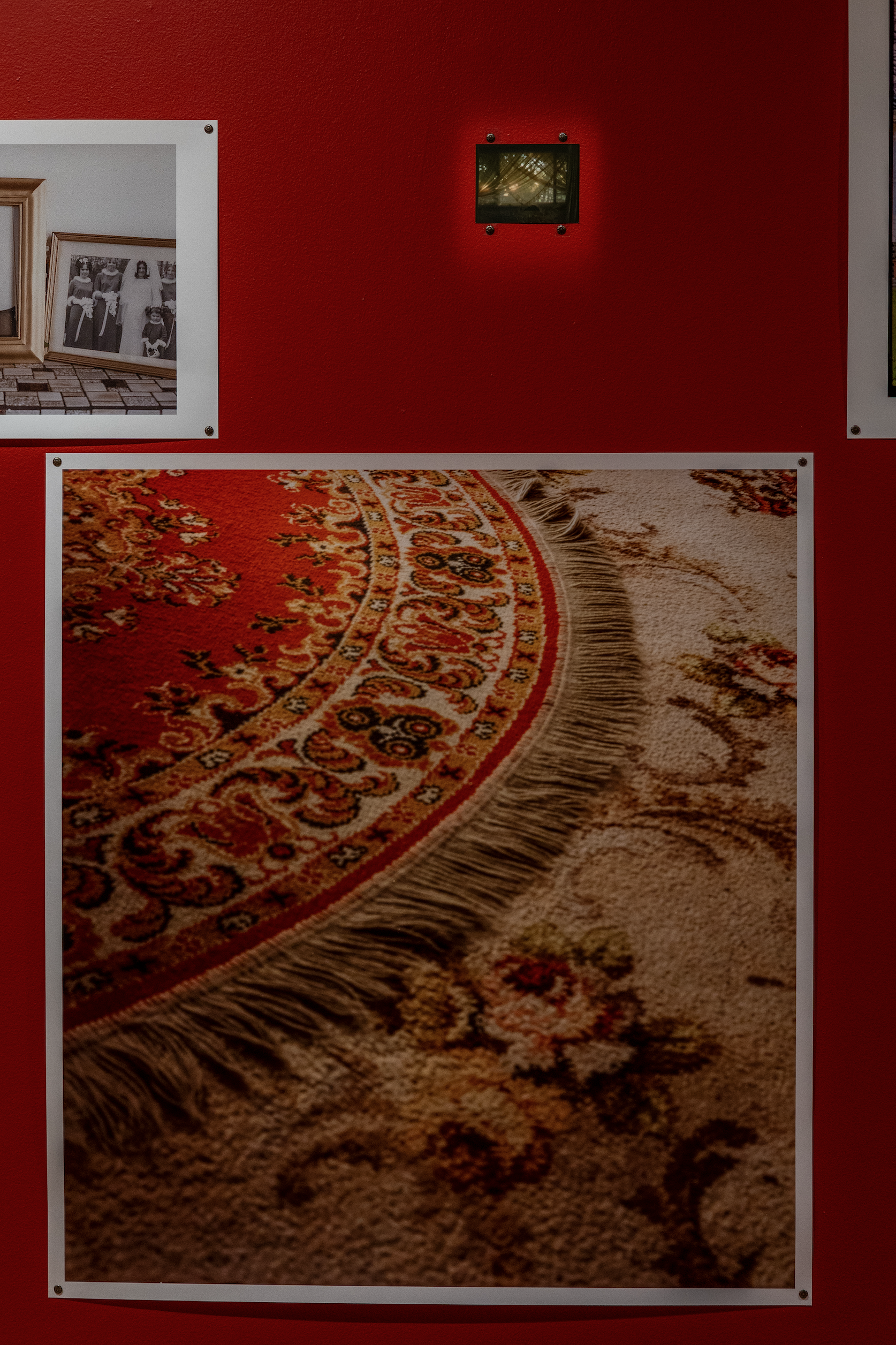
Across the portraits, curated cabinets filled with crystal and other keepsakes recur. Needlepoint-style cushions accumulate on bedside tables and couches, giving the interiors an almost overfurnished density. The “nice stuff,” preserved and carefully displayed, seems to speak to small acts of holding things in place. The cabinets become miniature systems of order, ways of arranging and stabilising a world shaped by migration and settlement in Australia. Another stand-out is a large print depicting a rug, similar to those found in Green’s 2025 joint exhibition at the Fiona and Sidney Myer Gallery, where she photographed the interior of a vacant Coburg home that once belonged to a Ukrainian woman she knew. Here, the compact surfaces of carpet and rug meet in close-up, their busy patterns and textures melting into one another and flattening space into a field of detail.

Installation view of A Country Practice, Latrobe Regional Gallery, 2026. Photo: Karli Duckett, The Good Side Photography, 2026.
The exhibition’s account of Ukrainian diasporic life also belongs to a distinct historical moment, tied to postwar displacement and Soviet-era migration rather than the more recent waves of forced migration following Russia’s invasion of Ukraine. The war remains notably absent from the exhibition, lending these photographs the feeling of documenting an earlier generation of Ukrainian-Australian life.
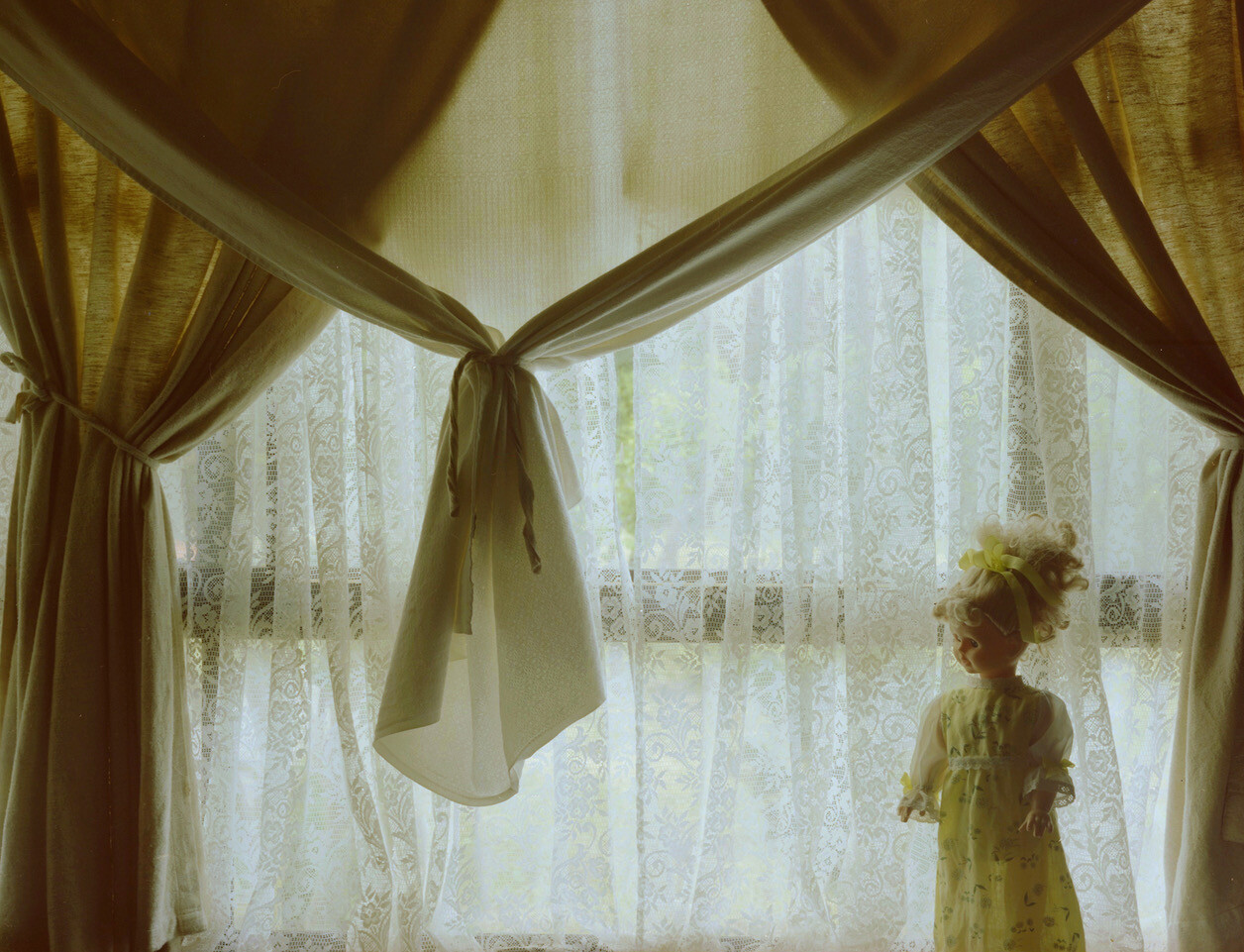
Across from these portraits, the chapter “Dwellings of the Nostalgic Mind” shifts to a more introspective domestic register. One of the most striking, and deceptively simple, compositions shows a doll on a windowsill, gazing downward, sat in front of a pair of curtains gathered and tied at the centre. The doll’s pale curls are held with a yellow ribbon, and the sheer dress catches the backlight, rendering the small figure faintly translucent, its thick legs just visible beneath the fabric. The lace backdrop diffuses the light, giving the scene a softened, almost suspended quality. The smallest print in A Country Practice, too, a few prints across from it, captures the light entering a curtained window, filtered through sheer fabric into a hazy, golden wash.

Janina Green, Untitled (Doll and lace blinds), 2008-09, C-type print, 42 x 59.4cm. Courtesy the artist and M.33
Elsewhere, Green’s experimentation with found vintage magazines extends this logic of fragmentation. Domestic scenes—a nuclear family playing dominoes, women playing cards, a mother selecting frozen foods—are partially obscured by blotches, unsettling their quiet ordinariness. Alongside them, a still life of a heated roller iron registers a similar attention to the everyday, where repetition and routine can threaten to slip into boredom, and the near-to-hand becomes a site of Green’s focus. Seen together, these works render the past as fragmentary and uneven: scenes populated by figures are partially obscured, while objects are fixed in a more static, isolated clarity. Their muted tonal range lends the images a subdued, slightly exhausted atmosphere.
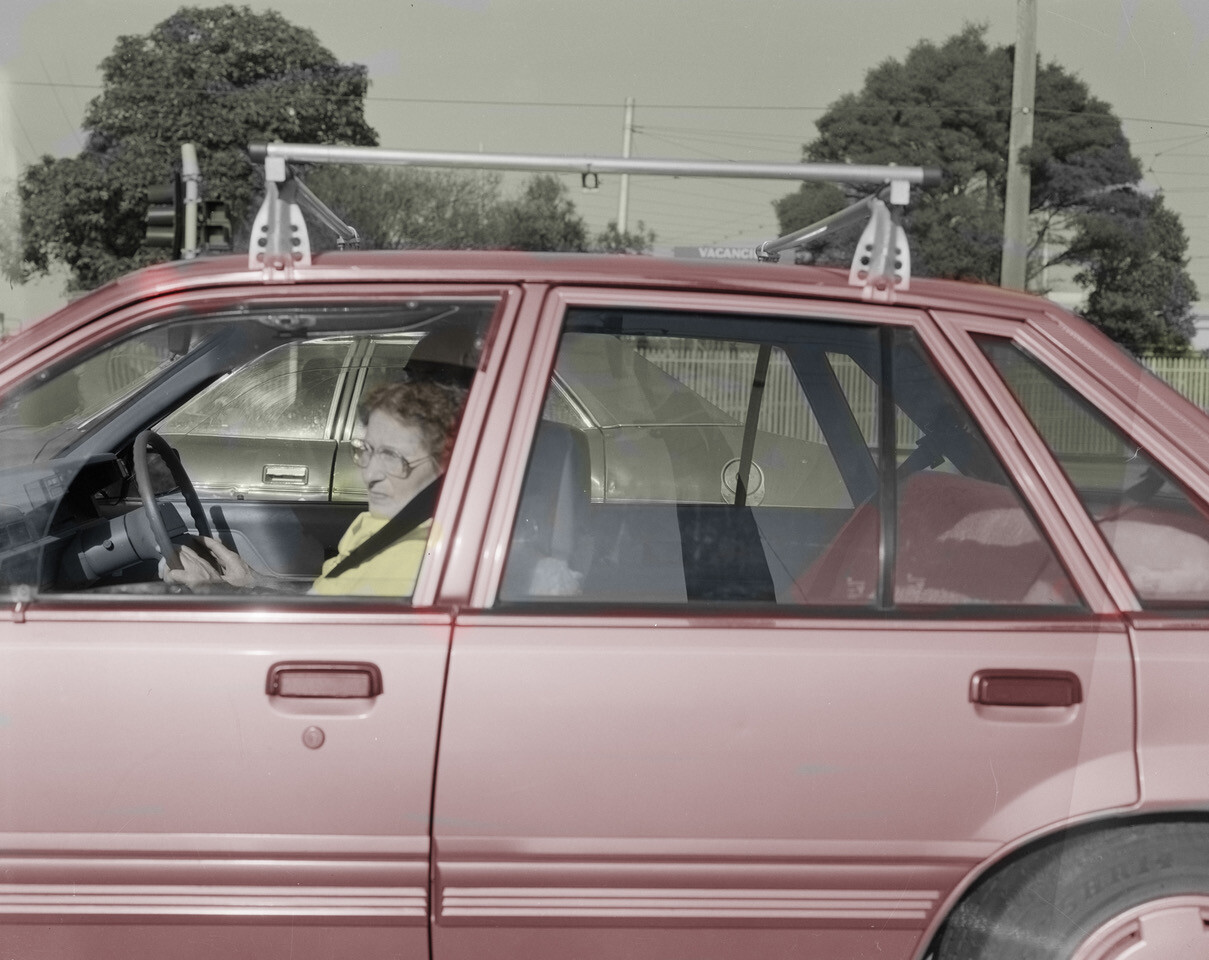
This type of fragmentation carries through to the neighbouring cluster of prints, wherein women, whom I take to be factory workers, are pictured driving—coming and going between work and home. Here, I find parallels with Allan Sekula’s Untitled Slide Sequence (1972), which documents workers leaving a factory at the end of the day, their movement unfolding as a collective flow, with some figures glancing toward the camera, briefly registering its presence. In Green’s images, however, such figures are isolated, distracted. They are individualised subjects, contained within their Corollas and sedans, each unaware of Green’s camera.

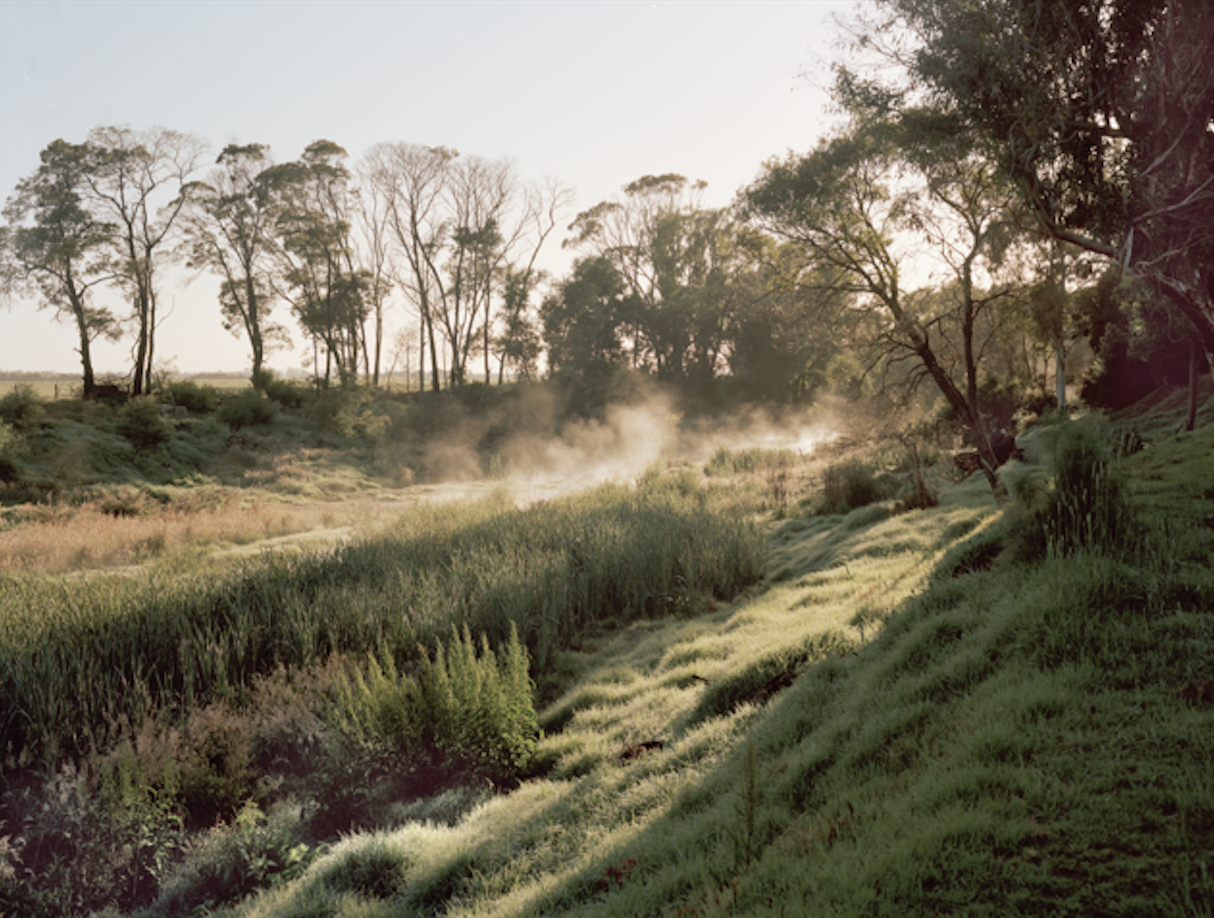
Janina Green, Untitled (Water mist), 2008-09, C-type print, 29.7 x 42 cm. Courtesy the artist and M.33
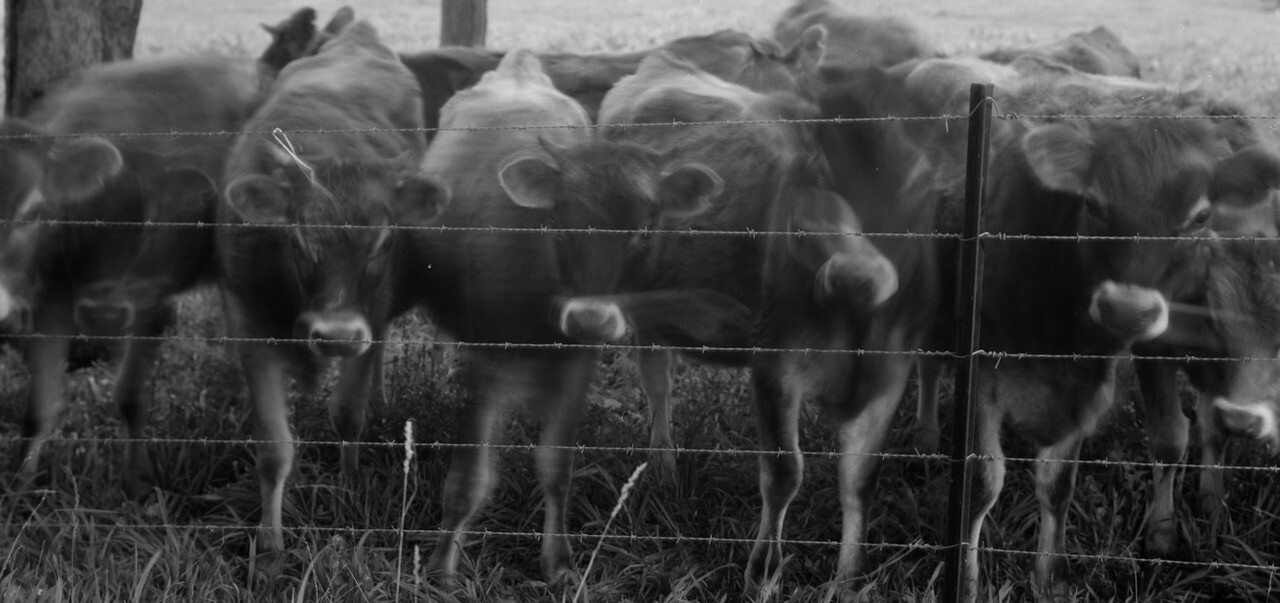
Green’s documentation of rural-industrial life is further registered in a series of landscapes and streetscapes spotlit and wrapped around the rest of the gallery. Quiet suburban roads, churches, dried-out paddocks, and dams at dusk and dawn appear suspended in an uneasy stillness, where pastoral space sits in constant tension with industrial intrusion. A small church is dwarfed by an expanse of brittle grass, while elsewhere highways cut against tree lines and open land, marking unstable boundaries. Throughout the exhibition, smokestacks, debris from abandoned power stations, and blurred images of coal infrastructure recur as looming industrial presences. In one photograph, the cooling towers of a thermal power station appear only indirectly, photographed through the glow and distortion of a television screen. These works produce a sense of physical and psychological distance, where the landscape appears both inhabited and estranged, caught between attachment and the desire to leave: the cows roam the paddock, but I can still see the fence.

Janina Green, Untitled (cows), 2008-09, C-type print, 90 x 77 cm. Courtesy of the artist and M.33
In Anne O’Hehir’s essay for Christine Godden’s recent photobook Light Touch (also published by M.33), she describes how Godden resists the pressure to constantly “make sense” of images—to immediately absorb, categorise, and extract meaning from them. O’Hehir writes about the difficulty of this as a curator: “I am often operating in this way, pragmatically, anxiously: what is the photographer saying, how can I translate that information into words. The end. (…) I remain in a state of uncertainty.” I recognised myself in this description. Part of me wanted more contextual information from Green’s exhibition—more historical detail, more orientation, more explanation. Yet the longer I looked at the work, the more that demand for clarity began to feel inadequate. Perhaps Green makes sense of these landscapes differently, not through explanation or resolution, but through distance, repetition—through documenting the unresolved experience of leaving a place that continues to exert its pull.
Gallery