Hugo Blomley: Pump Cover
October 10, 2026
-
Hugo Blomley: Pump Cover
Venue: Neon Parc
11 Sep 2026 – 10 Oct 2026
How might we account for Hugo Blomley’s meteoric success? At the tender age of thirty, Blomley only recently graduated from art school but has been quickly whisked into the Neon Parc stable. He has rapidly ascended the ranks, in fact, headlining the gallery’s showings in art fairs, such as at Untitled Miami Beach in 2025 alongside long-time Neon Parc artist Dale Frank. Perhaps Blomley is the obvious Gen Z match to Frank’s position in the gallery’s stable as the brattish but charming man-boy. The image I have of Blomley in my mind’s eye is the one of him standing next to a Sports Illustrated–style calendar in his studio, photographed by Nicholas Mahady. This is the version of couldn’t–care–less hetero masculinity popularised by Pollock and Picasso before him. I wonder, why does Melbourne have a soft spot for naughty-boy artists?
And then there are the dicks. In Blomley’s Neon Parc solo exhibition last year, The Same Eyes as Yesterday, we saw them as smooth, dildo-esque forms finished to look like rose quartz. In 2024 Blomley was working with decidedly more industrial forms, such as in Piece by Piece at Sutton, yet still the hooded shafts took centre stage. The most straightforward reading of these works is as the expression of some unrequited desire, or as a fixation on the phallus perhaps better understood via psychoanalysis. Maybe the appeal of these sculptures can be put down, in part, to the present popularity of undertaking analysis amongst the art crowd and the cultured elite, titillated by thoughts of the Oedipus complex and penis envy.
Hugo Blomley is a very good artist. By introducing his work in this way, my intention is not to dismiss the work as simple “dick art,” but to make the point that any discussion of Blomley’s work invariably circles back to gender, the body, and desire. Pump Cover, which closes today at Neon Parc, is a great opportunity to interrogate the artist’s appeal. What is the balance that Blomley has struck that allows him to operate within the grotty Gen Z Melbourne scene and also be desirable to collectors?
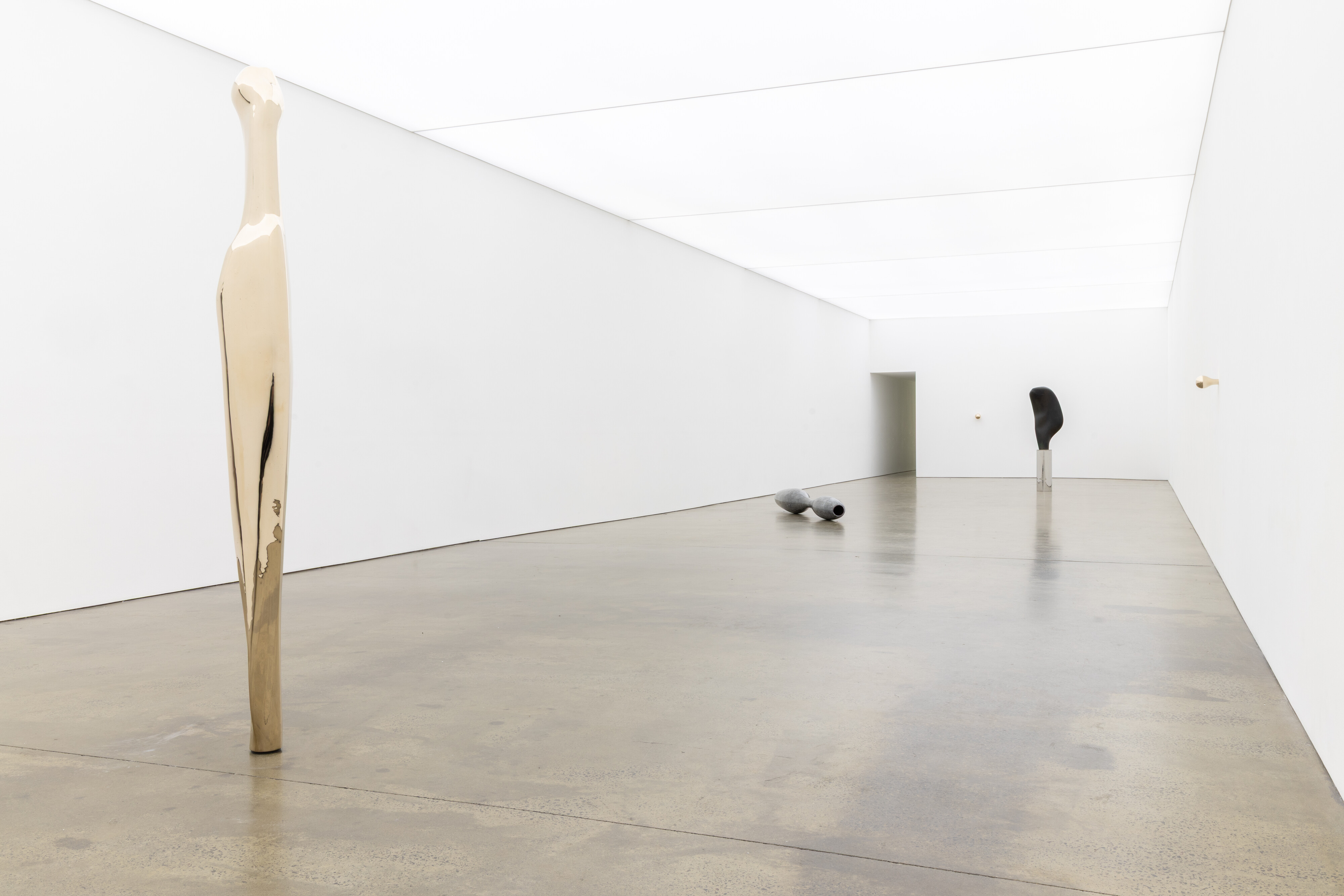
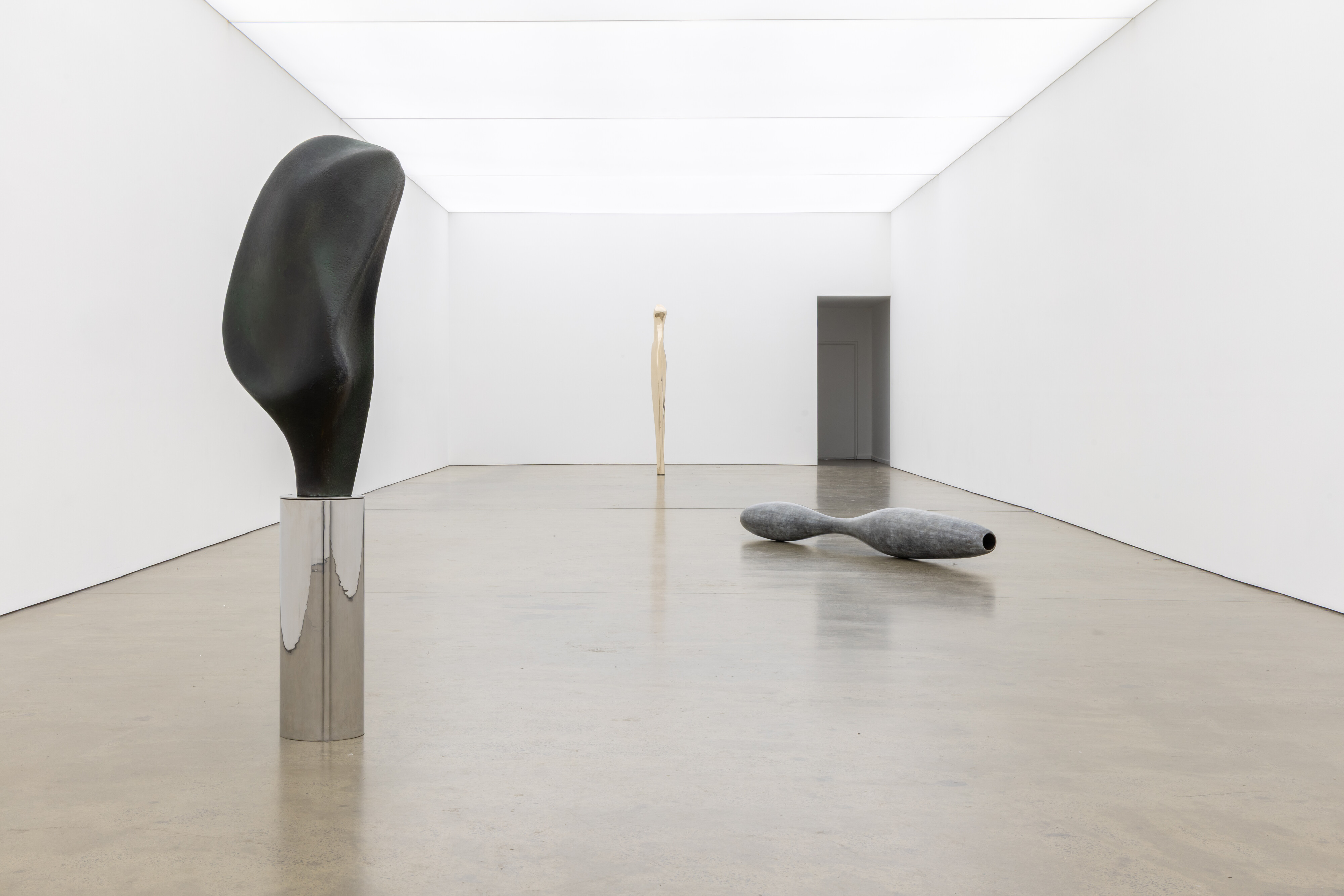
The phallic is, surprise, on display again in Pump Cover. The exhibition is sparsely populated, composed of just three elongated sculptures—two standing upright and one lying on the floor—and two bronze wall-mounted orbs. Squint and the sculptures might be mistaken for willies and balls—or breasts. Blomley leans into the tropes that define formalist Modernist sculpture, such as an emphasis upon rounded forms with a simultaneous apparent removal of the hand, and samples the medium’s material hallmarks in the form of plinths and various bronze finishes. On opening night, the storeroom was also open for interested buyers to peruse several new, smaller sculptures. The decision to leave these out of the exhibition proper was wise because it would have complicated the precise dialogue happening between the five objects on display. There is a confidence that borders on arrogance in the conviction that five works are enough for a commercial exhibition, but this move has paid off—the result is exceptionally balanced.

Hugo Blomley, installation view of Pump Cover. Photo: Nicholas Mahady
I’m not the first to speak of Blomley’s work in libidinal terms. Savanna Szelski wrote in 2025 of Blomley’s “erotics,” writing that the relationship between the cast and mould in the casting process he uses mimics penetrative intercourse. The sculptures’ lives, in fact, start digitally; the moulds are 3-D printed. But a hallmark of Blomley’s work is the energy he puts into his hand-finished surfaces. Recently, including here at Pump Cover, the sculptures have all been finished to a smooth, even, glossy sheen, prompting Tara Heffernan to describe them as “sensual” in her catalogue essay. You really do want to touch the works. But—and this is important—for all their tactility, they remain ungraspable due to the ambiguity of the forms they call to mind.
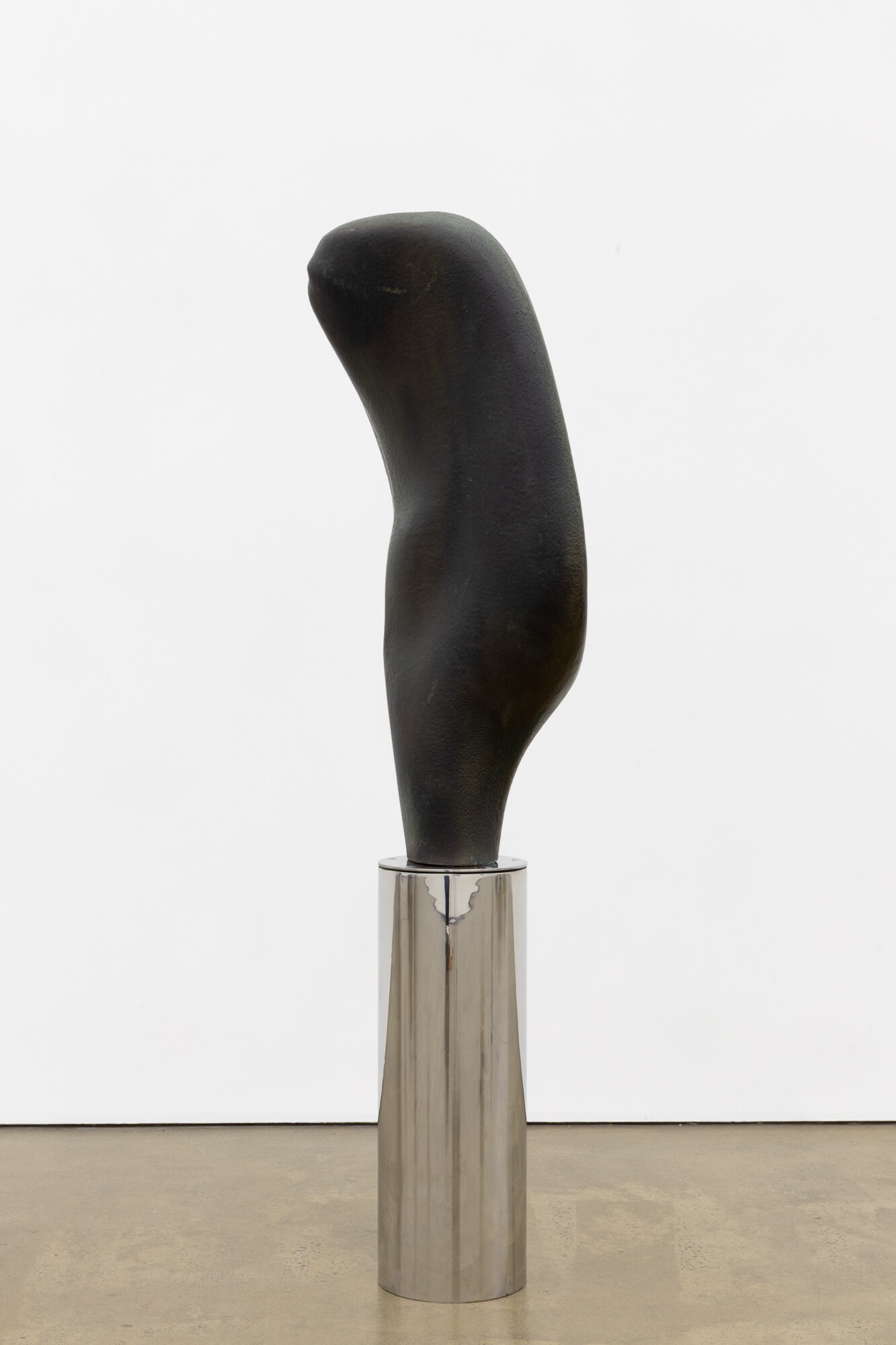
The frustration of not being able to place these objects is critical to their appeal. Heffernan recognises that Blomley “tease(s) the tension between recognition and abstraction.” Take, for example, a patinated bronze sculpture atop a stainless-steel plinth. (All works in the show are untitled and dated 2026. Though I’m a little sick of artists refusing to title their works, I will allow it in this case because ambiguity is key.) It looks somewhat like a paddle, but as one circumnavigates it, the form changes. It’s a bone, maybe. Or a butter knife. Just as you think you have it, you move an inch and the form takes on a new referent. Meanwhile, the polished steel plinth, almost the length of the metamorphosing sculpture it supports, reflects the viewer back onto themselves as a distorted form.

Hugo Blomley, Untitled, 2026. Patinated bronze and stainless steel, unique. 193 x 55 x 34 cm. Photo:
Blomley leans into an eroticism by way of this controlled abstraction. Again, Heffernan writes: “Like drapery sheathing the idealised bodies of classical nudes or pumped muscles, these sculptures solicit recognition without submitting to full disclosure.” In “soliciting” recognition, Heffernan suggests that the sculptures are teasing the viewer like the performers in a peep-show. Indeed, the allusion to sexy classical nudes—whose entire bodies might be imagined despite (or because of) a sculpted clinging fabric cover—is perhaps the crux of Heffernan’s essay; Blomley’s works act as fetish objects because they give away just enough, but pull back as soon as the viewer thinks they have it.
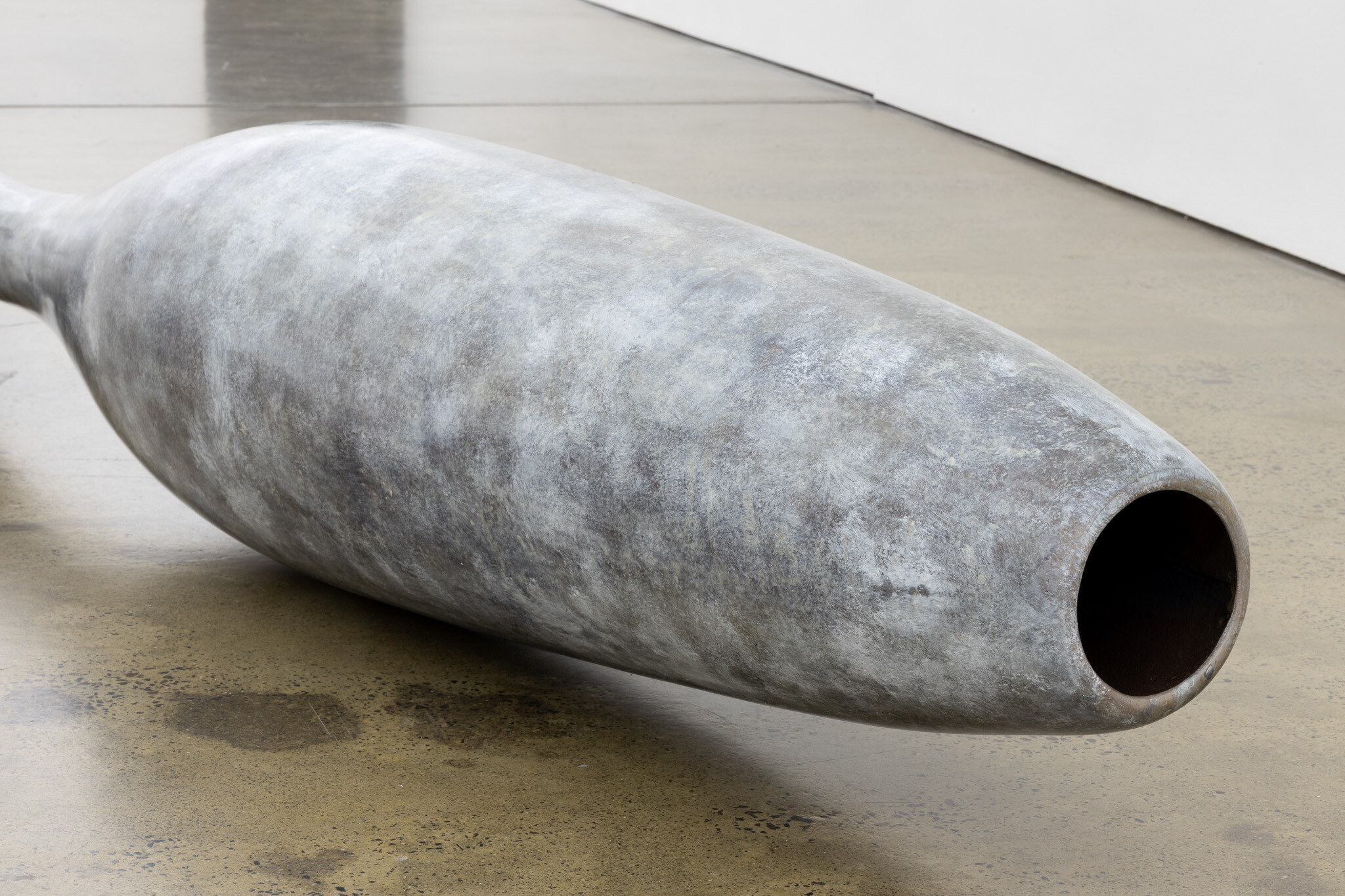
So, we have established that there is a withholding, an ungraspability, that titillates the viewer and directs their desire. This tantric game of fort-da also energises the relationship between the works. At the centre of the Pump Cover is a long horizontal sculpture that is hollow and cinched in its middle—a perfect round hole at each end entices the viewer to look through it like a telescope, should they be confident enough to lie on the ground. The finish resembles the mottled green of exposed bronze. It should also be noted that all Blomley’s surfaces, despite their apparent smoothness, are subtly “flawed.” Dents, pockmarks and seams reveal themselves upon close inspection. For their intimate proximity the viewer is rewarded with a sense of self-satisfaction in the feeling that they have discovered something reserved only for the especially observant. But again, this feels like control—Blomley letting the viewer experience a small win.
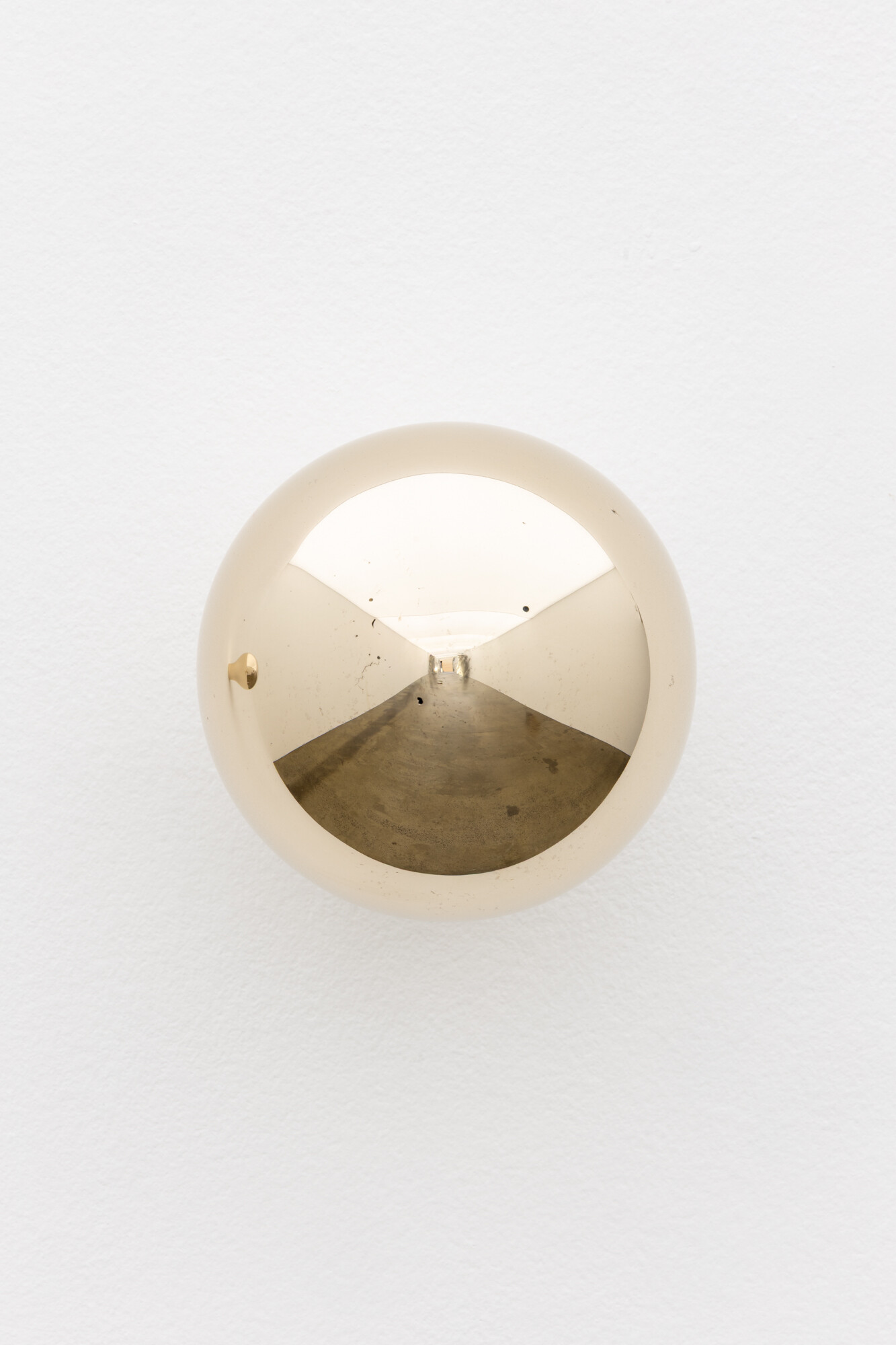
While this central sculpture might induce the feeling of having “penetrated” (sorry) some secret interior, this receptiveness is explicitly denied by the other four sculptures. The bronze orbs, positioned on perpendicular walls, are insanely deflective. With my reflection distorted like a fisheye lens, I feel like I’m in a Jamiroquai music video. If the hollow central work provides access, it does so in a way that almost feels like a debasement—penetration is quickly followed by disgust. The carrot is yours, but what now? This is perhaps the crux of Pump Cover. Here, the exhibition stages the consumer psychology of extended desire followed by repulsion. Blomley, it would seem, is trying to tell us that the satisfaction that comes with obtaining the desired object rarely lasts.

Hugo Blomley, Untitled, 2026. Patinated bronze, unique, 40 x 275 x 40 cm. Photo: Nicholas Mahady

Hugo Blomley, Untitled, 2026. Bronze, unique, 16.5 x 10 x 10 cm. Photo:
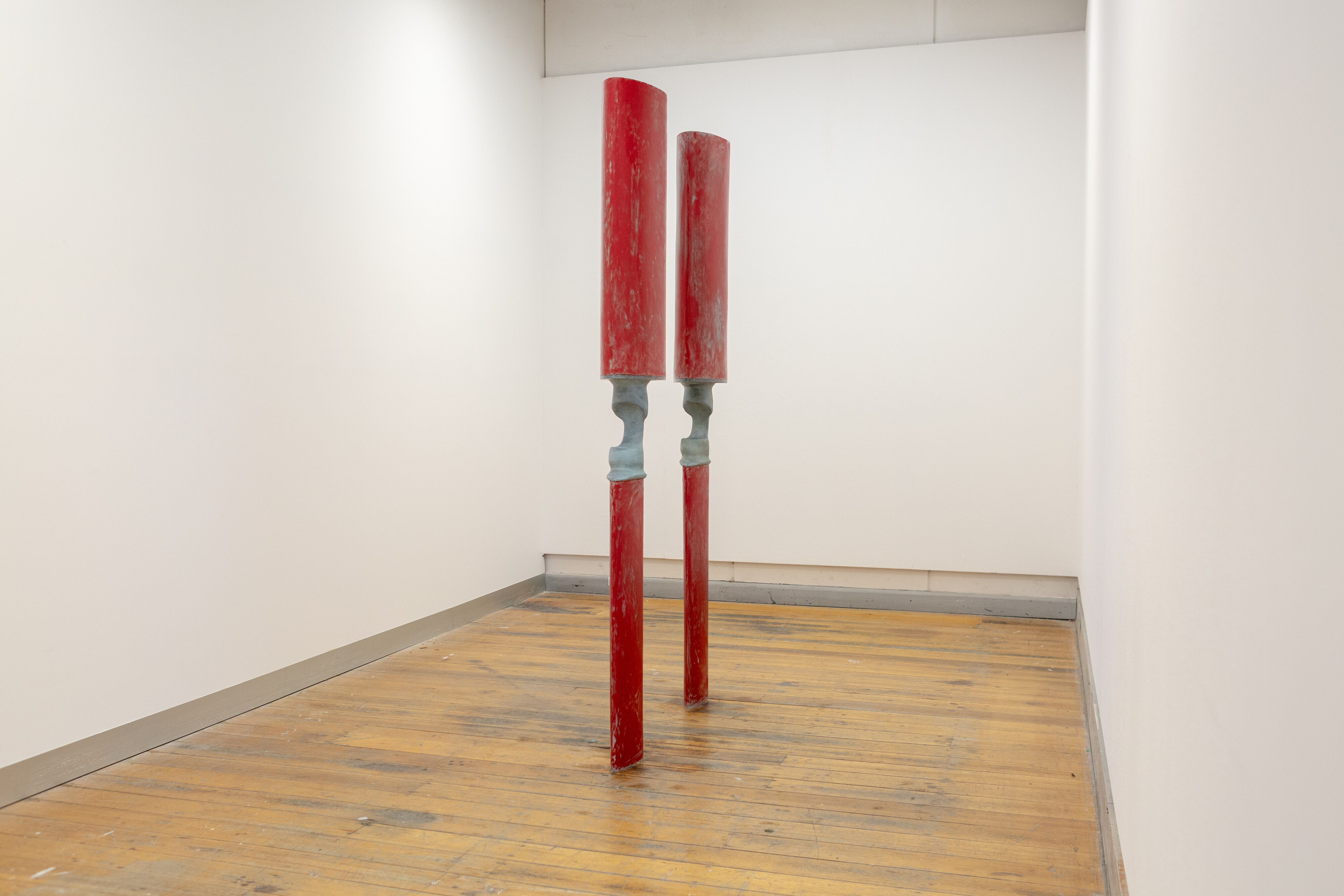
Blomley’s earlier sculptures, produced during his 2022 honours year at Monash University and shortly thereafter, were more concerned with permeability and a grubby sensibility—attributes more readily associated with the Melbourne set he has come up with. Around this time he was regularly showing with small backyard galleries and ARIs including Asbestos, Hyacinth, and Cache. His graduate work at Monash stood out for its Minimalist aesthetic, but one more indebted to the grittiness of post-war West German minimalism than that of the American set. The work consisted of two identical, upright, totem-like sculptures. These poles appeared whittled away in the middle, and the ends of each were painted with shiny red paint. The paint had then been sanded to partially reveal a grey base beneath, giving the effect of paint sandblasted from concrete. Where previously Blomley’s work was rough with some smoothness, now the sleekness dominates. The works appear so shiny—slippery even.

Hugo Blomley, Untitled, 2022. Fiberglass, bronze, polyester resin, acrylic lacquer, polyester filler, epoxy, beeswax, damar resin, alkanes, power steering fluid, cadmium pigment. 190x20x30cm. Photo:
In his book Saving Beauty, Byung-Chul Han argues that, in contemporaneity, beauty has been replaced by smoothness—a form that offers consumers immediate, frictionless gratification. Examples include iPhones, Jeff Koons, the Brazilian wax. Not only is Apple’s hardware sleek but its recently reimagined interface design was named Liquid Glass for its ultimate transparency and fluidity. At Blomley’s opening, I noted several influencer-types posing against the works to get the shot. The most appealing works for this exercise were the two upright sculptures—both of which had sold by the time I revisited the exhibition a week after the vernissage. The best work in the show, the horizontal, hollow one, was still available. Its status as harbinger of an ultimately disappointing gratification is perhaps why it was less appealing to the buyer (as I’m writing, the sculpture is still unsold), but there seems to be a knowingness in its relationship to the screen happening in Blomley’s work.
To rescue beauty, Han argues, we need to return to negativity. “Negativity is the invigorating force of life. It also forms the essence of beauty. Inherent to beauty is a weakness, a fragility, and a brokenness.” The work that Blomley puts into his finishes, pushing them almost to perfection, but then ultimately leaving flaws, is perhaps his way of simultaneously leaning into the smooth and immediately undermining it. In addition, the hollow of the central sculpture is a material negative space that further undermines desire. Importantly, however, the sculptures do appear to be completely smooth when photographed, and it is the screen, I believe, that mediates Blomley’s conceptual framework.
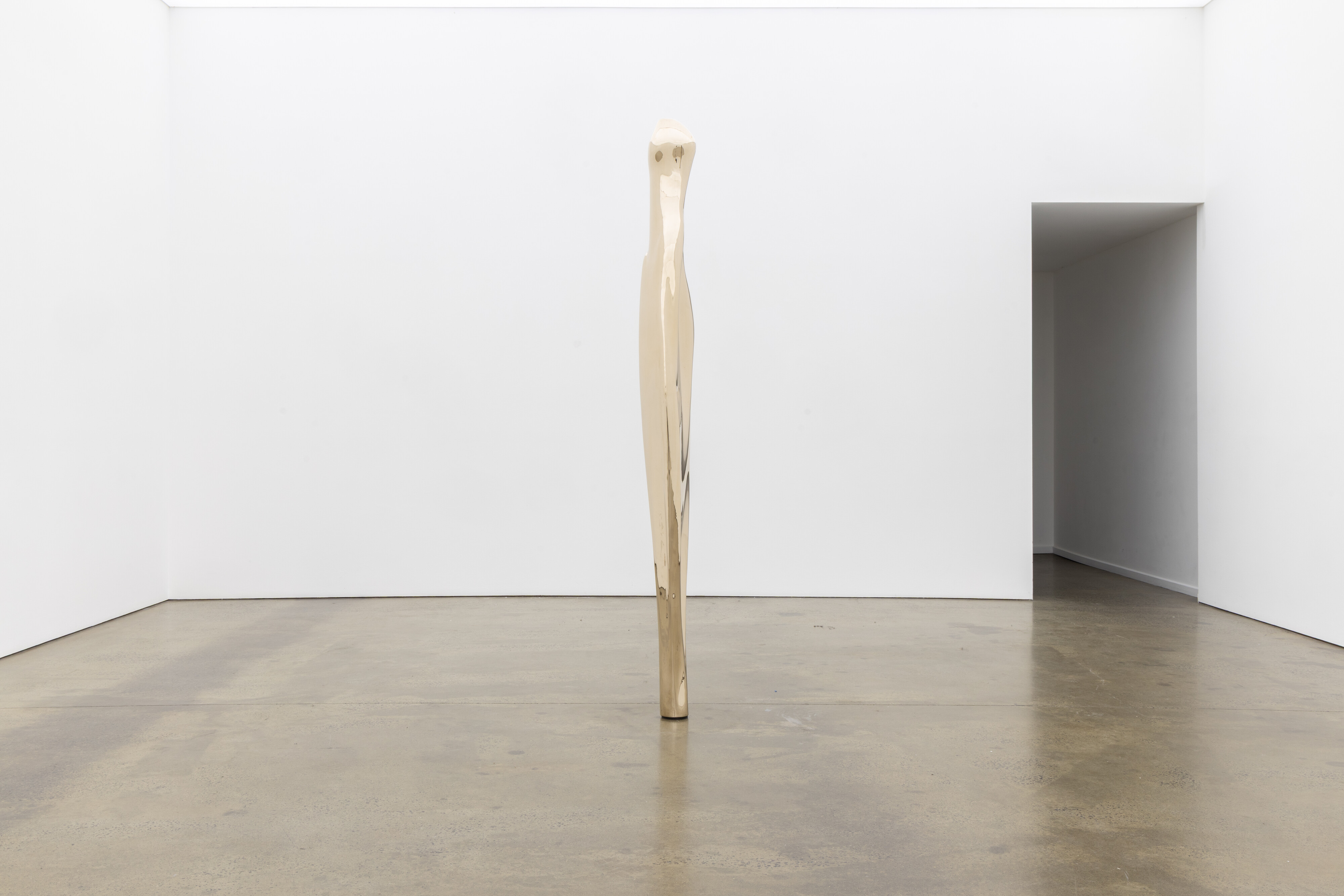
Perhaps the irony of Blomley’s works operating so closely within the discourse of the digital is that they are, of course, deeply tactile. Formally, they have more to do with twentieth-century modernism that they’re given credit for. On an obvious level, this discussion of the libidinal in his practice is something that has all too often been assigned to canonised sculptors—Alberto Giacometti, Hans Arp, and Constantin Brancusi. Brancusi famously made a sculpture that resembled a phallus, Princess X (c.1915), though he insisted it was in fact a representation of Marie Bonaparte, but, also, “all women rolled into one.” It has often been said that Brancusi grappled with the “problem” of Rodin (that oligarch of sculpture with feeling), who relied so heavily upon a figuration that bore the trace of the hand. To come out from under Rodin’s shadow (Brancusi had been one of his studio assistants), Brancusi turned to an essentialising of form that was so abstract it could be anything. A woman or a penis, dealer’s choice! It’s impossible not to think of Brancusi when looking at Blomley’s work. In particular, we see him in the skinny, reflective bronze form in Pump Cover that contains a multitude of curved planes, allowing it to deflect at all angles. Funnily, there is a human form amongst that ambiguity. And what becomes apparent is that I have been anthropomorphising Blomley’s ambiguous forms all along. In fact, the sculpture is a contained entity unto itself.

Hugo Blomley, Untitled, 2026. Bronze, unique, 234 x 24 x 19 cm. Photo:
If Brancusi said “this sculpture is everything,” then perhaps Blomley is bringing that mantra into 2026. Remember, Blomley’s works depend on a cast and mould model, a system of positive and negative that are so co-dependent that they are both one another’s opposite and two parts of one whole. While the hard exterior shell plays host to the fantasies of the viewer, who projects their Instagram wants and dreams onto the sculpture’s surface, perhaps Blomley’s sculptures have also built and protected an interior world unto themselves. The surface of desire—the “smooth” that Han laments—is operating as a decoy in order to ensure the sculpture’s self-preservation. This is not some tired rehashing of modernism, but, in fact, a way of reconfiguring the universal of Brancusi to include the totalising effects of the digital in our present day. Artificial Intelligence, of course, is the perfect example. Human-made but, in the not-so-distant future, intelligent enough to stand up on its own, to conceal its own strategising for survival. If Brancusi’s work abstracted to the point of the utopian, there is something more stressful and dystopian about Blomley’s post-AI sculptural practice.
I think about my favourite sculpture in Pump Cover, the hollow one, prone on the gallery floor. I hope someone has given it a home. For all the dicks-and-orifice chat surrounding Blomley’s work, I feel like what he articulates is the uncomfortable attachment we insist on having to things—materialised or dematerialised. It was there in Freud’s freaky-deaky theories, and it has reinvented itself as the AI-girlfriend today. Of course, this kind of art—that is, the art that deals with technology in the post-internet age—has always been largely dominated by the bro. But Blomley’s sculptures are worlds away from those of Jordon Wolfson, for example. If I were to name the appeal of Hugo Blomley’s works, it’s that they are genuinely interesting distillations of desire relative to the age of autonomous technology and contemporary image culture. Indeed, it is desire—he correctly understands—that is the key to what keeps all of these dizzying systems alive.
Gallery