HOUSE
May 23, 2026
-
HOUSE
Venue: Animal House Fine Arts
14 May 2026 – 30 May 2026
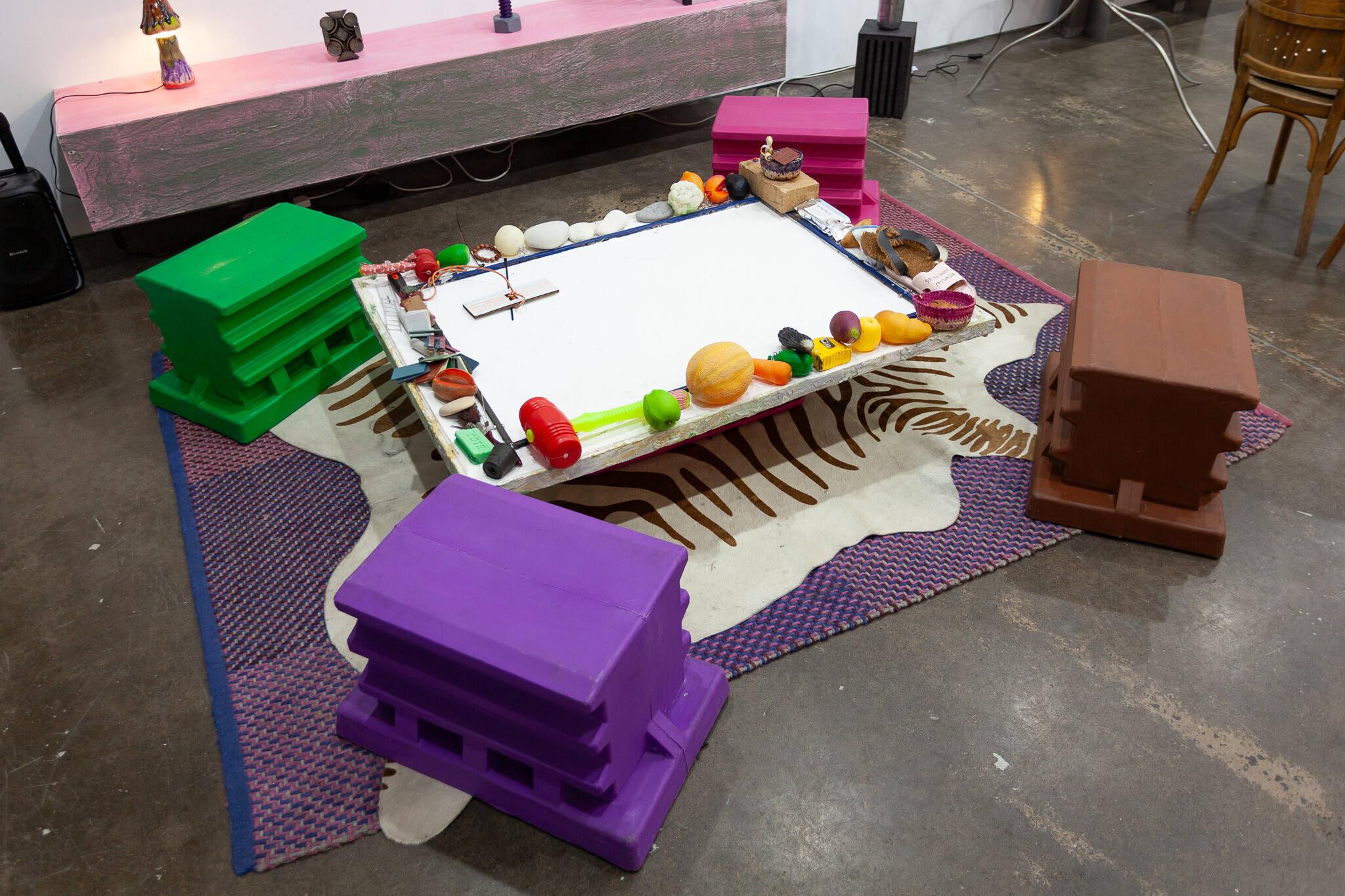
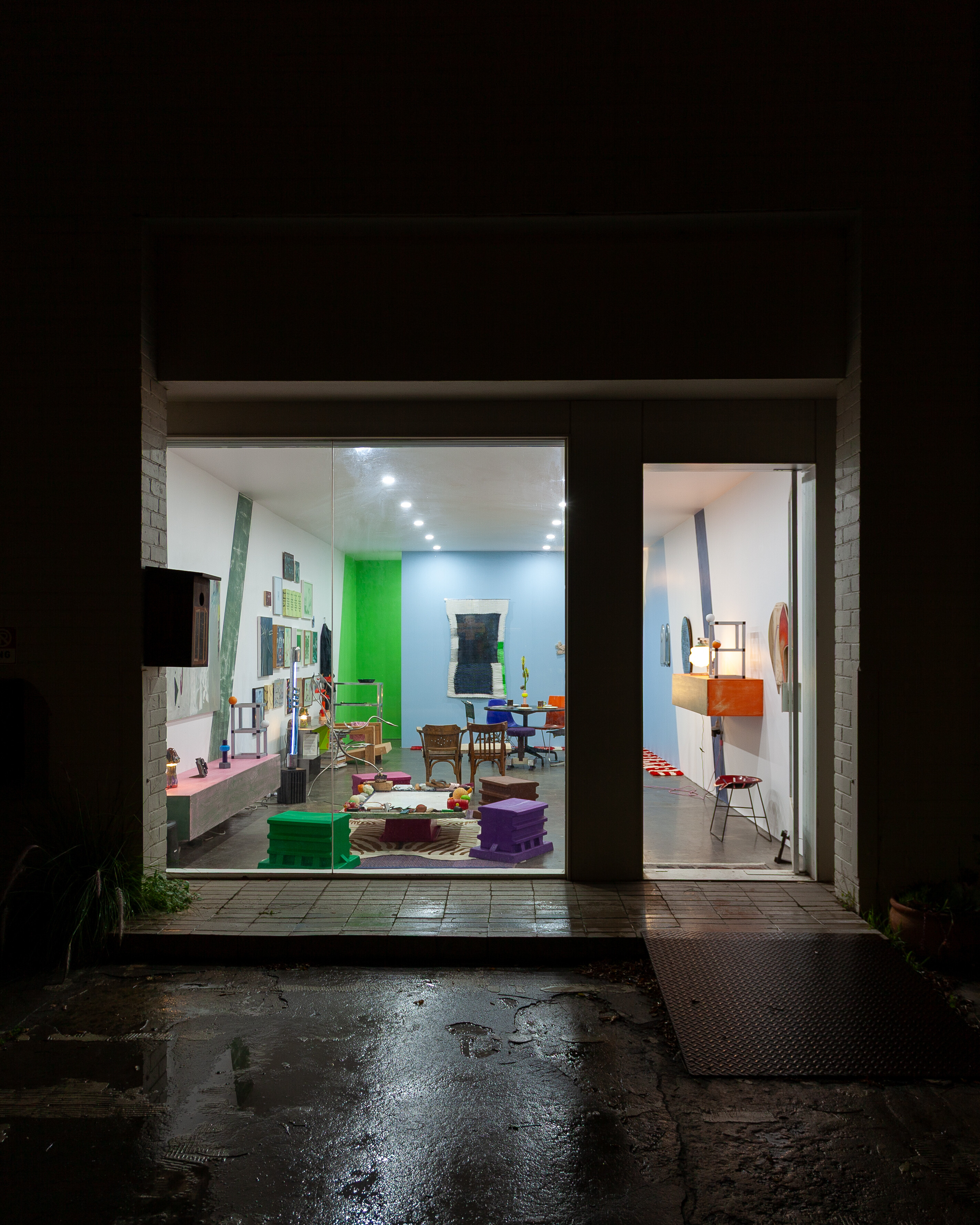
The Melbourne Design Week (MDW) tagline is “design the world you want” and their “About” page includes the same old tiresome revolutionary vagaries that relentlessly proliferate: “a force for good in an increasingly complex world” and an opportunity to “shape a better future.” At Animal House Fine Arts, the collaboration was announced on Instagram with a little less ambition: “HOUSE turns the gallery into a semi-functional simulation of an apartment lived in by someone who owns nice things but doesn’t really know what to do with them.” I was wondering who this well-to-do idiot was meant to be as I approached the gallery to find a child, somewhere between four and six, hammering on Mike Hewson’s Double Rug Coffee Table #1 with a plastic mallet.

Mike Hewson, Double Rug Coffee Table #1, 2025–26, polyurethane, custom-moulded extra-heavy-duty plastic tub, salvaged textiles, objects from studio, custom-moulded extra-heavy-duty plastic tubs. Courtesy Animal House Fine Arts.
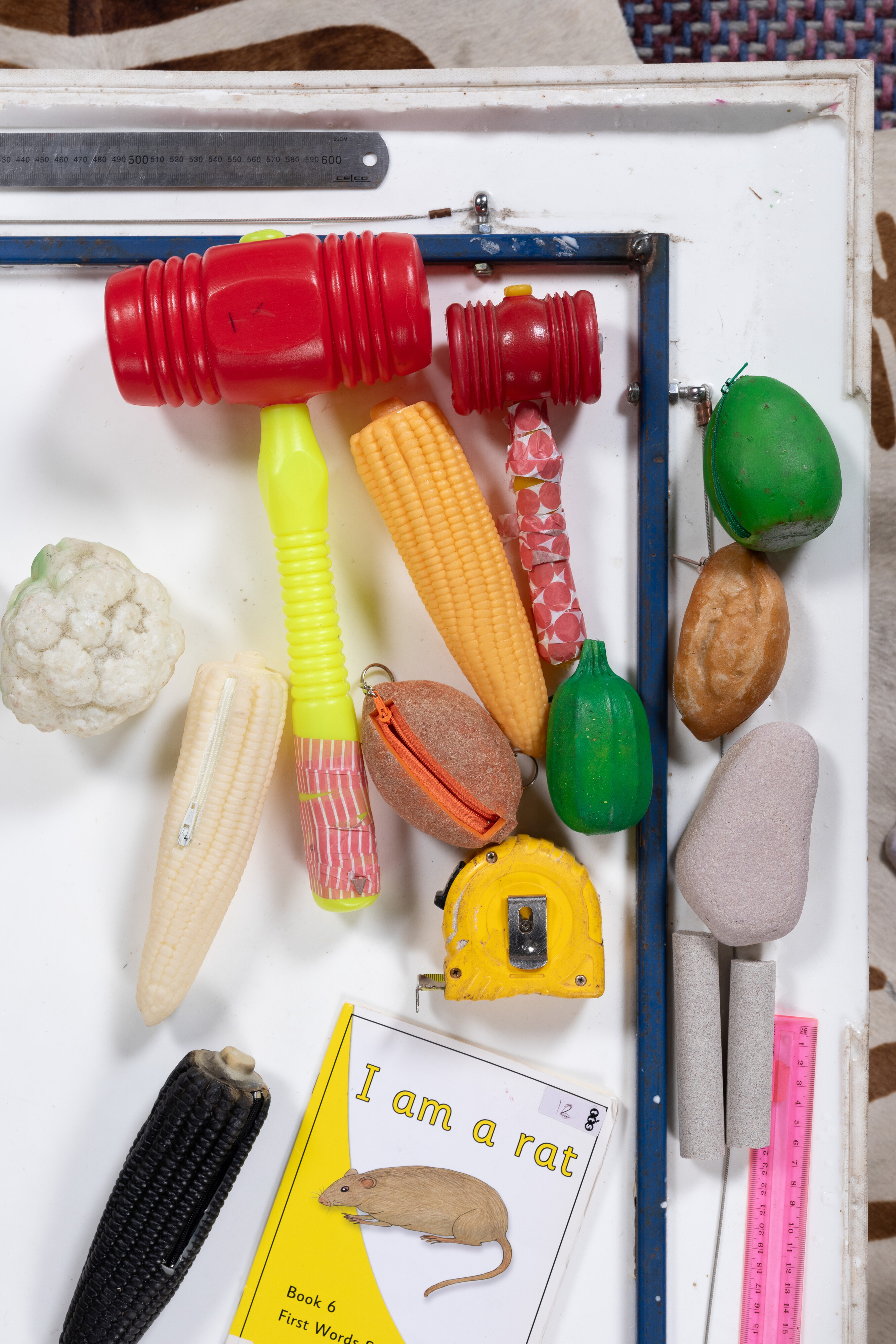
I hadn’t encountered Hewson’s work before but I understand this to be the point. His larger-scale installation works resemble Jumpside in Moorabbin or Rush HQ in Rowville. Indoor adventure parks. According to one NSW Memo, there’s something somewhere that transforms the “chaotic playspace” into a “speculative urban ecology,” but it’s hard to see what that something is from the documentation. This work, as the name suggests, is a coffee table with two rugs beneath it: a zebra hide on top of a purple jute-esque woven thing. On the coffee table were various other playthings from plastic croissants and corn to swatches, a wooden beaded bracelet and a highlighter.

Detail of Mike Hewson, Double Rug Coffee Table #1, 2025–26. Courtesy Animal House Fine Arts.
Out the front, opposite the vanilla vodka trestle table, was a Melbourne Design Week poster with “HOUSE” spray painted across it in yellow. “I love that we’ve got a gallery right next door,” trumpeted a woman to her friend. Her friend, apparently unmoved, replied: “I thought this was the teacher’s union, but this is something quite different.” As though each were conducting a separate conversation, the first woman cheerfully announced, “Jimmy had his first rally the other day. Radicalised from the get go.” The little revolutionary waddled up and said with a sigh, “You’re talking about me aren’t you?” Undeterred: “What’s your favourite?” A third adult: “He likes the table.” Jimmy interrupted: “I like the mushroom.”
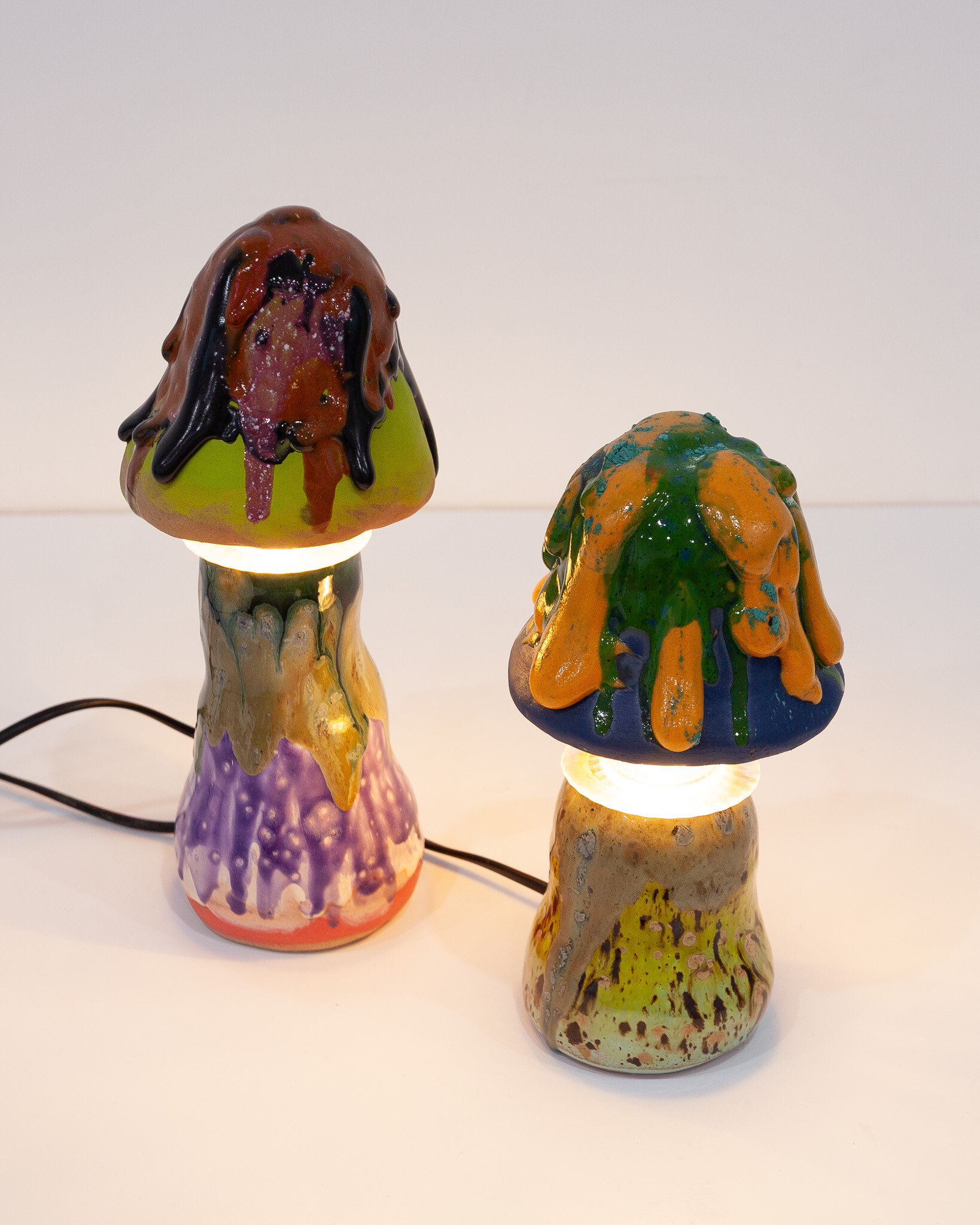
I scanned the room and landed on a gloopy ceramic lamp by Annie and Jonathan Zawada—a blue mushroom head with giant dollops of orange glaze dripping over it. The title in the catalogue is Mushroom Lamp small (Orange Drip) (2026). Jimmy is not the kid’s real name.

Annie and Jonathan Zawada, left to right: Mushroom Lamp Tall (Black Drip), 2026, ceramic and light fitting, 28 x 10 x 10 cm; Mushroom Lamp Small (Orange Drip), 2026, ceramic and light fitting, 24 x 10 x 10 cm. Courtesy Animal House Fine Arts.
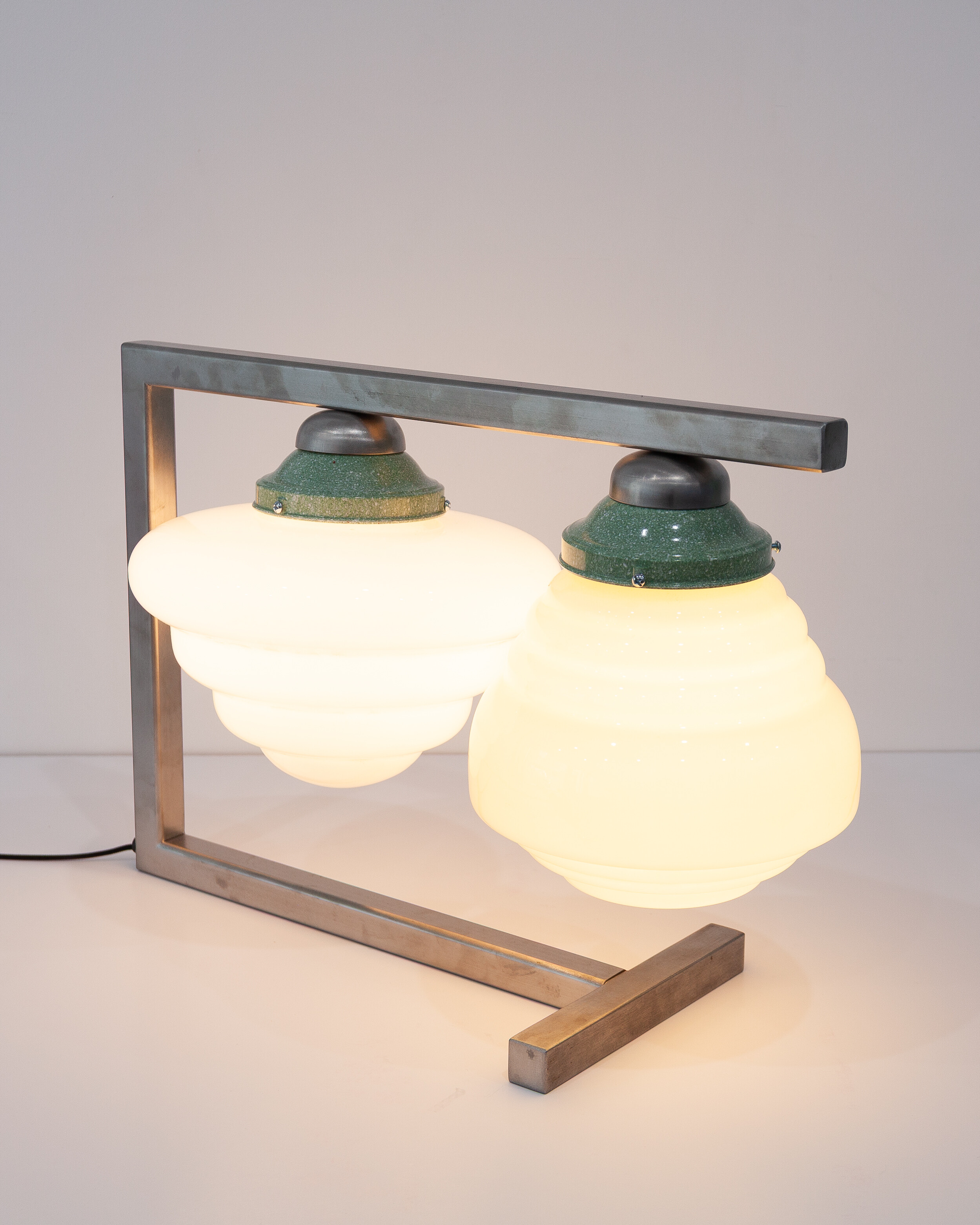
There are a few other light fixtures strewn about. Jack Hadley’s pink powder-coated aluminum geometric extrusion with LEDs, AFS1.02 (PINK) (2025), was just classic Memphis. As was his stool, AFS2.05 (2026). But Anna Varendorff’s Coppia Lamp (2026) was more difficult to place. “Coppia,” being Italian for couple or pair (implying intimacy, domesticity, coupledom), reaches, as design objects often do, for an Italianate authority the materials don’t quite support. The globes themselves are ribbed opaline forms that proliferated in 1920s French Art Deco commercial lighting, Holophane and Sabino, and exemplified the elegance of department stores and municipal foyers, accruing a kind of anonymous civic dignity. Then they were mass-produced and ended up in middle-class interiors the world over. Varendorff mounted two of them, slightly mismatched in tone and scale, on a cold brushed stainless steel frame. Here there was a distinct concept and an almost emotional register that the other fixtures seemed to lack. Naming them as a couple, as an intimate pair, while presenting them on this almost clinical display armature oddly suspends the globe’s soft bourgeois aspirational warmth. There are a few of these still available at Oigall Projects, who have a “manifesto” on their website that describes the space as “a commercial showroom and a conceptual playground, a site for serious ideas dressed up in fun outfits.” In the present showroom-playground, I asked curator and gallery director Matthew Ware who this person who has nice things was. He laughed and said that he didn’t know.

Anna Varendorff, Coppia Lamp, 2026, stainless steel, glass, baker light, 12 volt wiring, 35 x 50 x 25 cm. Courtesy Animal House Fine Arts.
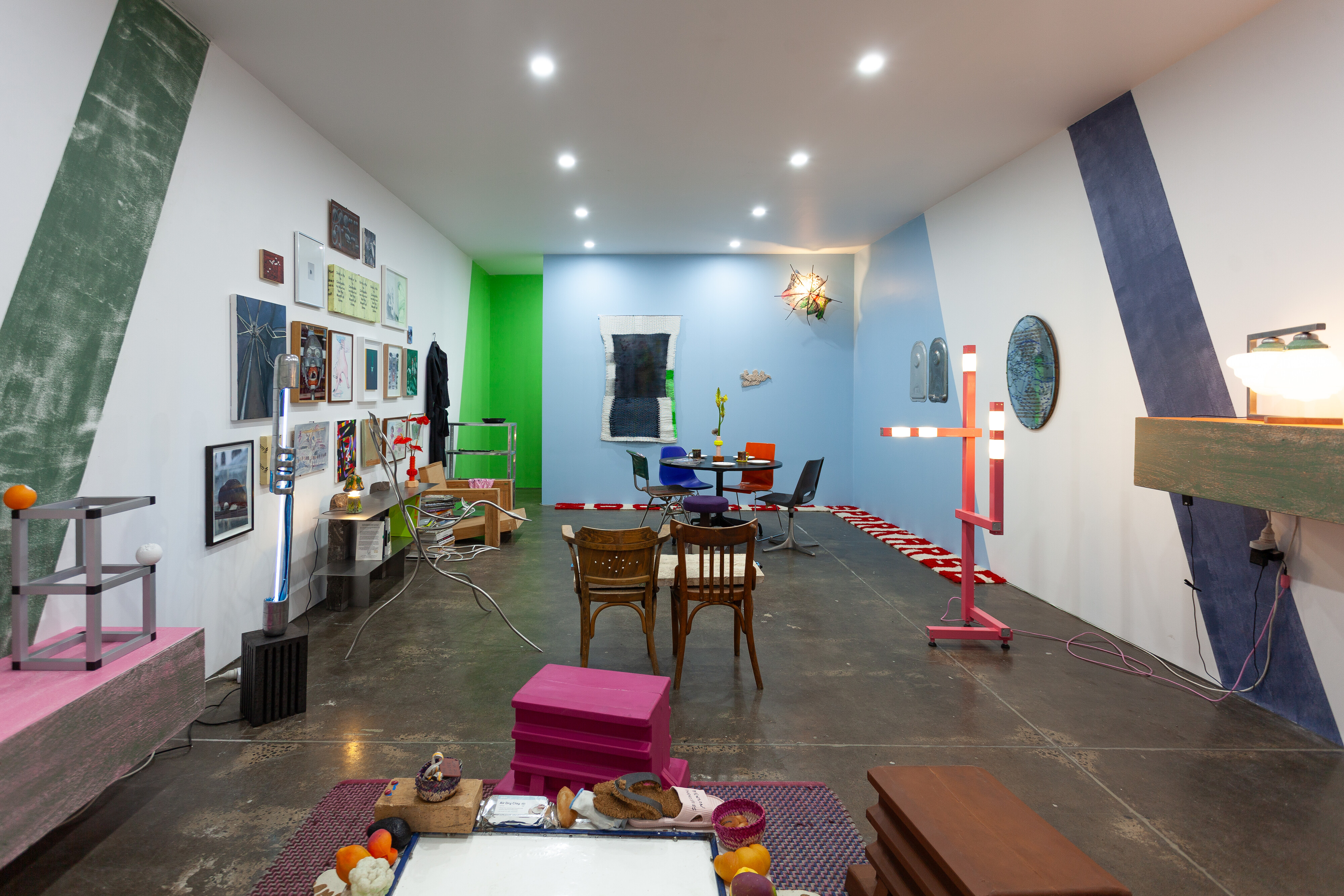
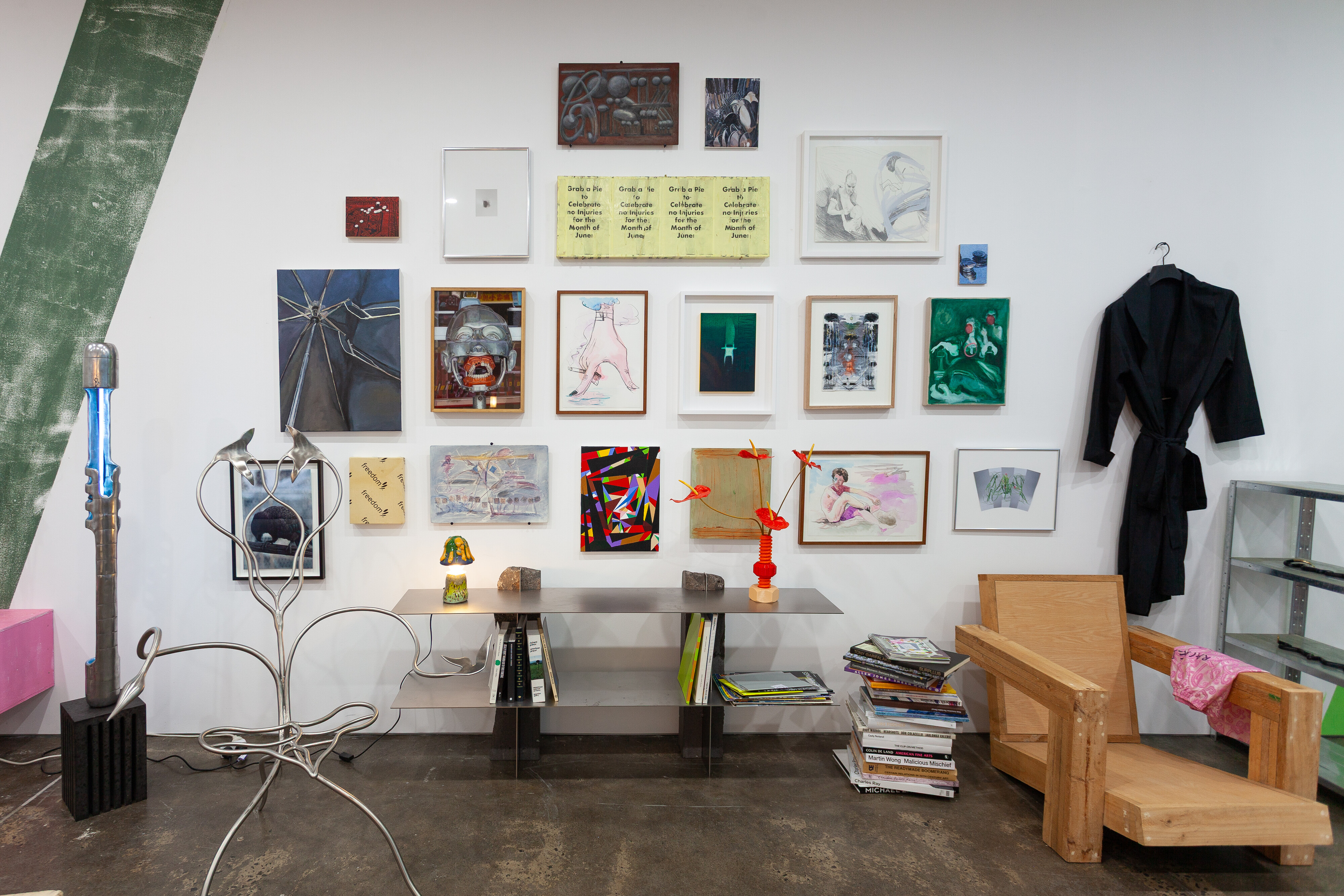
In addition to the works, there was some more straightforward set dressing: a PS5, a BlueAnt Wireless Karaoke Speaker, a variety of chairs not attributed to a specific maker but still for sale. A nice bookshelf by Dalton Stewart was packed with books from Ware’s collection, including books on Joseph Beuys, Robert Mapplethorpe, Damiano Bertoli, and The All New Australian Graffiti (1985) by Rennie Ellis propped up on a lean in prime position. Some, such as Andreas Slominski at Sammlung Goetz still had library tags affixed to their spines. The whole bookshelf arrangement was topped with another mushroom lamp and a kitsch plastic 3D-printed vase with a plastic anthurium in it that matched the bright oranges of the modular nut-and-bolt form by MODCON (an Aotearoa-based “domestic hardware company”). Above this, a salon hang, the ultimate domestic showcase for the collector who has nice things and limited wall space. It’s the practical decorative approach I have seen in many arts worker homes as a way to showcase one’s treasures (acquired on the job) en masse, a method that forsakes the autonomy of individual works to create one unified domestic narrative of personal taste.

Installation view of HOUSE at Animal House Fine Arts, 2026. Courtesy Animal House Fine Arts.
If it were a successful mise-en-scène, the gallery would become the stage, and the visitor would move through it as both audience member and potential character. Set design asks objects to produce a believable fiction of inhabitation, but HOUSE doesn’t really have this kind of conviction. At best it felt more like a playhouse. All playhouses and playspaces are “speculative (sub)urban ecologies” where children can have risk-free adventures in a behavioural microclimate to rehearse homemaking, ownership, and social inclusion and exclusion (who gets to enter). Children playing “house” are essentially doing a dry run of property relations and domestic roles. Is the make-believe here just a run-through of a millennial arts worker’s first time living on their own? The initial Instagram post also asked “what happens to these objects after they leave the gallery?” And the answer seemed to be that you’d cram one in your hatchback until you make it to Frames Readymade on Lygon street or plonk it on your bookshelf. In short, it’s deeply unaspirational.

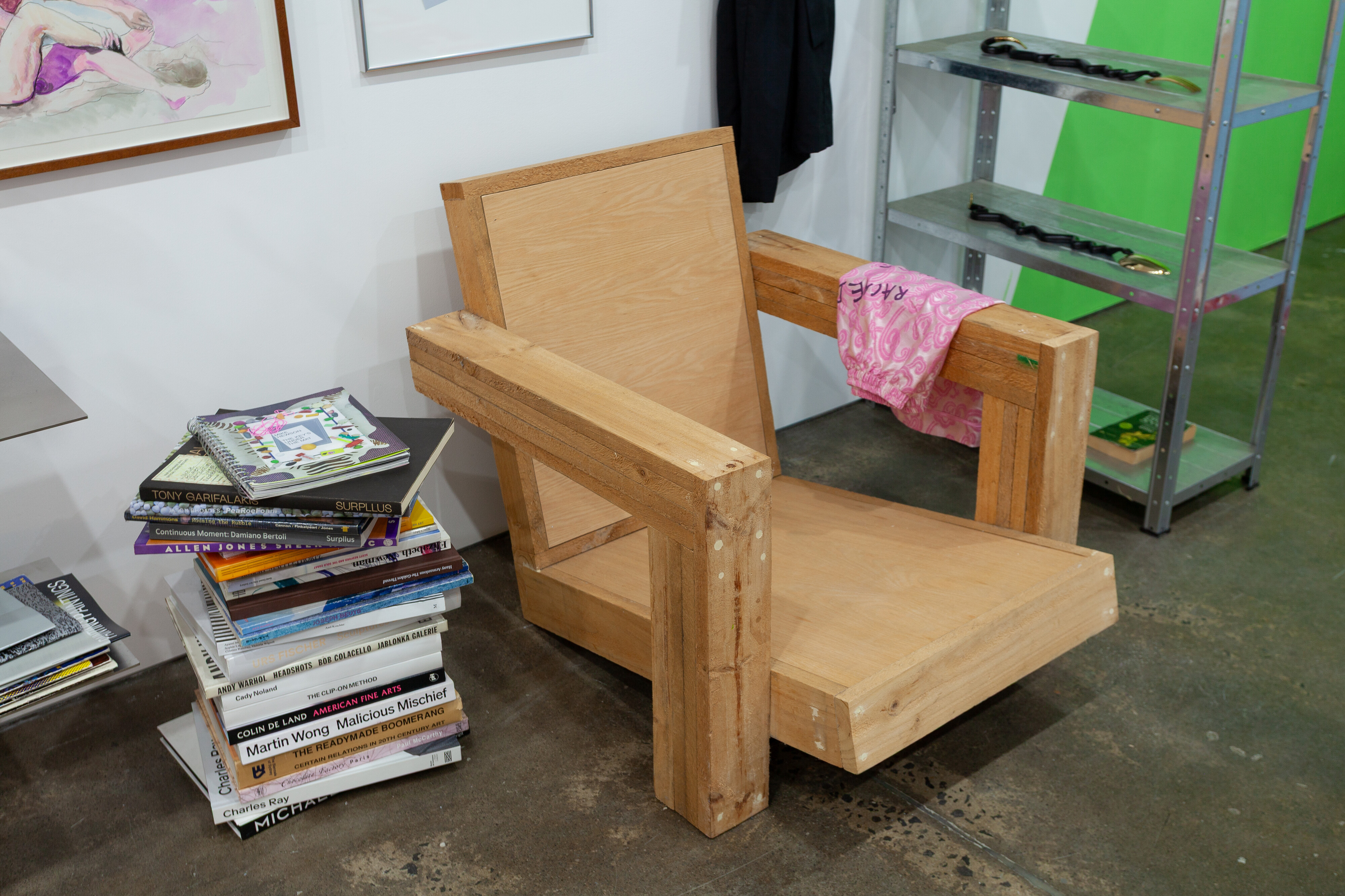
Peter Atkins, Gerrit Rietvelt’s Utrecht Lounge Chair, 2022, discarded Bunnings pallet. Courtesy Animal House Fine Arts.
Instead of particularly expensive things, or beautiful things, we get “nice” things: the aestheticisation of more affordable approximations such as Gerrit Rietvelt’s Utrecht Lounge Chair remade by Peter Atkins using a discarded Bunnings pallet. The aspirational is democratised as millennial economic foreclosure. But the show doesn’t seem to diagnose the condition so much as exemplify it. The walls were painted in block geometric colours that matched those used in the Molto Bello: Icons of Modern Italian Design at Heide last year. I heard a rumour that it was in fact the exact same paint. But any critique here is affordable—literally, in terms of price point, and structurally, as particleboard critical positioning.
House galleries are early career artist and curator necessities globally, and Ware began with a backyard gallery, Savage Garden with Jordan Halsall. And, as Amelia Winata opened a 2024 review of Beth Maslen at Animal House, “all backyard galleries die or professionalise.” But the domestic infrastructure also produces its own materiality, objects, and assemblages. Not just for their “recession art” accessibility, but because the “house” demands self-referentiality: interiority, taste, community, gender, public/private dissolutions, and so forth. This generative subject matter explains why we see the house or its materials reproduced beyond a literal house gallery context.
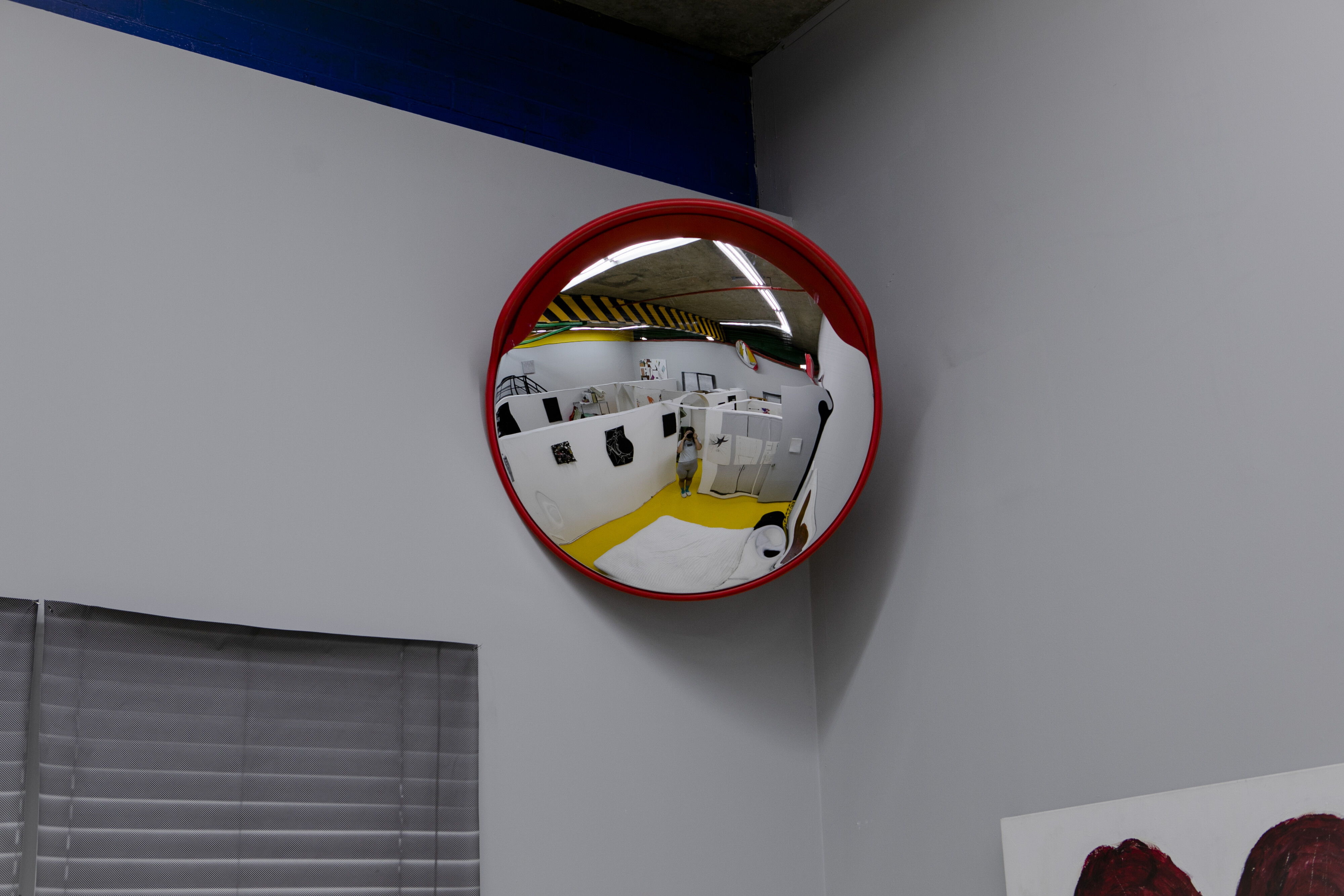
My favourite house simulation was Being Evelyn Poggioli (2022) by Evie Poggioli at Centre d’Editions’ large warehouse conversion. Poggioli recreated her apartment at the gallery, populating it with all the moveable furniture, rugs, books, and plants from her real apartment (which she lived in empty for the duration of the exhibition). The question here is reversed: what happens to the person after the objects leave the home? Who is Evie Poggioli at home without her things? Flat, 2D representations of her windows and blinds, built-in robes, bathroom, and kitchen fixtures were printed on grainy, grey-scale photocopies pasted onto temporary walls or cardboard boxes. Poggioli’s paintings and drawings on A4 and A3 paper were layered over these, ignoring the 2D edges of walls and furniture behind them. It had the feel of a trade showroom or display suite setting emphasised by the gap between the partition walls and the ceiling and additions such as several convex safety mirrors installed to improve visibility around “blind corners” like those used in warehouses, factories, retail stores, and parking garages.

Installation view of Evie Poggioli, Being Evelyn Poggioli, 2022, Centre d’Editions. Courtesy the artist.
People sat on the couch in the “living room” at the opening just as you would if you were visiting her real apartment. At the very back there was a viewing platform that gave you a god’s eye view that flattened the scene as though it were The Sims. The whole fantasy of autonomous life is revealed as a series of programmed routines directed from above. The Sims platform manoeuvre staged, even induced, the experience of surveillance-induced dissociation because viewers could inhabit the uncanny gap between subject and observer. It’s not just that it was more conceptually coherent, but it left something unresolved that you had to inhabit rather than observe and something truly uninhabitable (Poggioli or her emptied apartment).
HOUSE doesn’t complete the fantasy or produce a coherent subject beyond “someone who has nice things.” In this sense, it inadvertently produces an even more interesting subject: one constituted by lack (not knowing what to do with those things) and a subject/curator supposed-to-know that collapses. And yet it’s hard to credit this show with productive ambiguity when it feels more like classic cynical distance through disavowal (MDW is stupid) that keeps the fantasy intact (these are nice things you should buy) by appearing to surrender it. New Instagram stories covering the bases in preparation for this review being published included “this ridiculous show continues tomorrow,” and other such deflections.
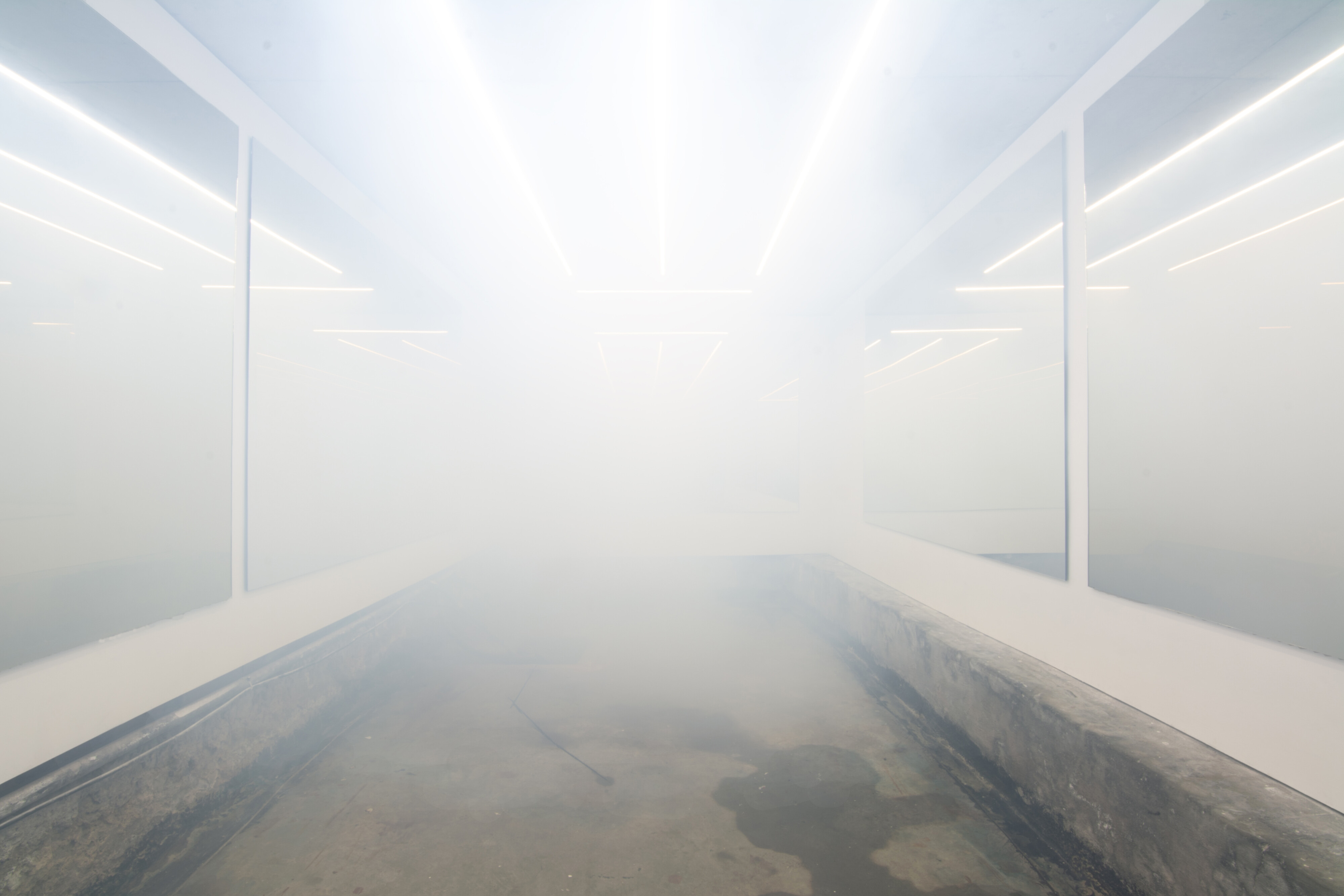
On Saturday, two days after the opening of HOUSE, Gemma Topliss’ show Couples Therapy (2026) opened at actual “house” gallery Peepshow. The walls were covered in mirrors and a smoke machine filled the space at timed intervals. It was literally just smoke and mirrors, and there was something about the materialisation of the well-worn idiom that threw the literalism of the Animal House show into relief. The machine mechanically shuddered and exhaled every few minutes—a sudden burst that swallowed the mirrors, the other people, and your own reflection, dissolving everything into the white walls of the gallery. Even as it dissipated you never got the infinity effect you’d expect from mirrors facing each other before the next exhalation. People lingered longer than usual in the space, visible from the shoulders up, faces soft and approximate, in the micro-groups you form at any social occasion, the people beyond them less legible. In Couples Therapy the relationship under examination is yours—with the room, the scene, the self. The scene produces you as much as you produce it.

Installation view of Gemma Topliss, Couples Therapy, 2026, Peepshow. Courtesy the artist.
House shows (both literal and thematic) are all mirrors of a kind—reflecting a recognisable scene back to us. Perhaps HOUSE also reflects a different scene of skaters and their radical toddlers? To be fair, this was my first time at the gallery. Regardless, these shows in tandem reveal that the proliferation of these total reflections keeps us returning every weekend just to see ourselves reflected in the other.
Every successful illusion requires conviction in the apparatus—the magician has to commit to the bit for the audience to be deceived. Aspiration works in a similar way in the sense that we need a plausible but elevated gap between self-image and the ideal. The magician needs the audience to not-quite-see, and aspiration needs the viewer to not-quite-have. If this gap is narrowed too far, the magician’s trick is exposed and the aspirational object becomes pure reflection. A five-year-old playing house reflects the adults in their life, stretched just slightly beyond current reality. The child plays the parent, not the peer. I didn’t see the PS5 or Karaoke Speaker in action when I was visiting HOUSE, but I did see an Instagram story of a couple of women singing Shania Twain’s “Man! I Feel Like a Woman”(“activating the space”) the following day. Unlike a five-year-old playing house, the simulation dissolved so completely into actual domestic use that it became the thing itself.

Installation view of HOUSE at Animal House Fine Arts, 2026. Courtesy Animal House Fine Arts.
Despite the Molto Bello paint and marketing copy, HOUSE is a “semi-functional” personal curatorial gesture rather than a coherent artistic proposition like the other shows mentioned here. The objects serve the catalogue rather than the experience. The simulation of HOUSE’s jam-packed millennial interior is a little flat because it shows you the house and hits a conceptual dead end. As a commercial group exhibition presented as a part of Design Week, we should forgive HOUSE for not committing to the critique, but the commitment to the aspiration is underwhelming too. In a characterless but almost believable studio apartment, at a price point pitched at the asset-light millennial collector (generally between $140 and $6500), rather than the Roslyn Oxley9 patron they’d like to become, this is more like an IKEA showroom—modelling products for rental temporalities.
Some of the things were genuinely nice, but they got a bit lost in the arrangement. I could see Augusta Vinall Richardson’s bronze reliefs on my bookshelf, and the conveniently-sized works of Chris Madden, Tim Woodward, Yusi Zang, Gabriella D’Costa, and Guy Benfield in my very own salon hang. Varendorff’s lamp is only $3300, but still out of my price range, so maybe it is aspirational after all. Luckily for his parents, Jimmy liked the $450 mushroom lamp more than Hewson’s $36,000 adventure playground coffee table.
Gallery