Hanako Murakami: Radiant Force
October 17, 2026
-
Hanako Murakami: Radiant Force
Venue: The Japan Foundation Gallery
25 Sep 2026 – 27 Feb 2027
Is AI slop beautiful or ugly? On the train home from the city, I look into how AI models actually generate their images. Apparently, many do so by a process of “diffusion”: the model breaks down an image dataset into a pixel mess before reforming it into a picture of its own creation. Sure, there is something unsavoury about this process; it suggests an indiscriminate gobbling up of things, their metabolization, and then regurgitation, a vomiting up of slop. But this says nothing about the sightliness of the image this process produces. It occurs to me that generative AI images are judged not on their beauty or ugliness, but rather on the perfection of their surfaces—the extent to which they are able to shrink the gap between the real and un-real, to conceal the conditions of their making.
As Laura Mulvey once said of the magical sheen of the silver screen, gorgeously artificial images have a dangerous way of “holding the eye in fascinated distraction away from the mechanics of (their) production.” The photographic image, the central conceit of the Japan Foundation’s current exhibition, tends also toward this image-fetishism by capturing our gaze at its surface. If the pervasiveness of such artificial images nowadays has dulled us a little, is it useful to turn our eyes toward a history of machine-made images for images which evict—or predate—the machine itself? In there, might we find a corrective to the surfacism of image-making today?
Hanako Murakami’s exhibition, curated by Antares Wells, explores this history, specifically through a return to camera-less photography; photography in the sense of photo-graphy (light drawing). The exhibition seeks, on the one hand, to commemorate the historical origins of the medium, and on the other hand, to comment on the state of (AI-saturated) image-making today. From the description in the brochure: “As we approach two centuries since the world’s oldest surviving photograph was made, at a moment when AI is redefining image-making itself, Hanako Murakami: Radiant Force encourages us to revisit what we think we know about photography.”
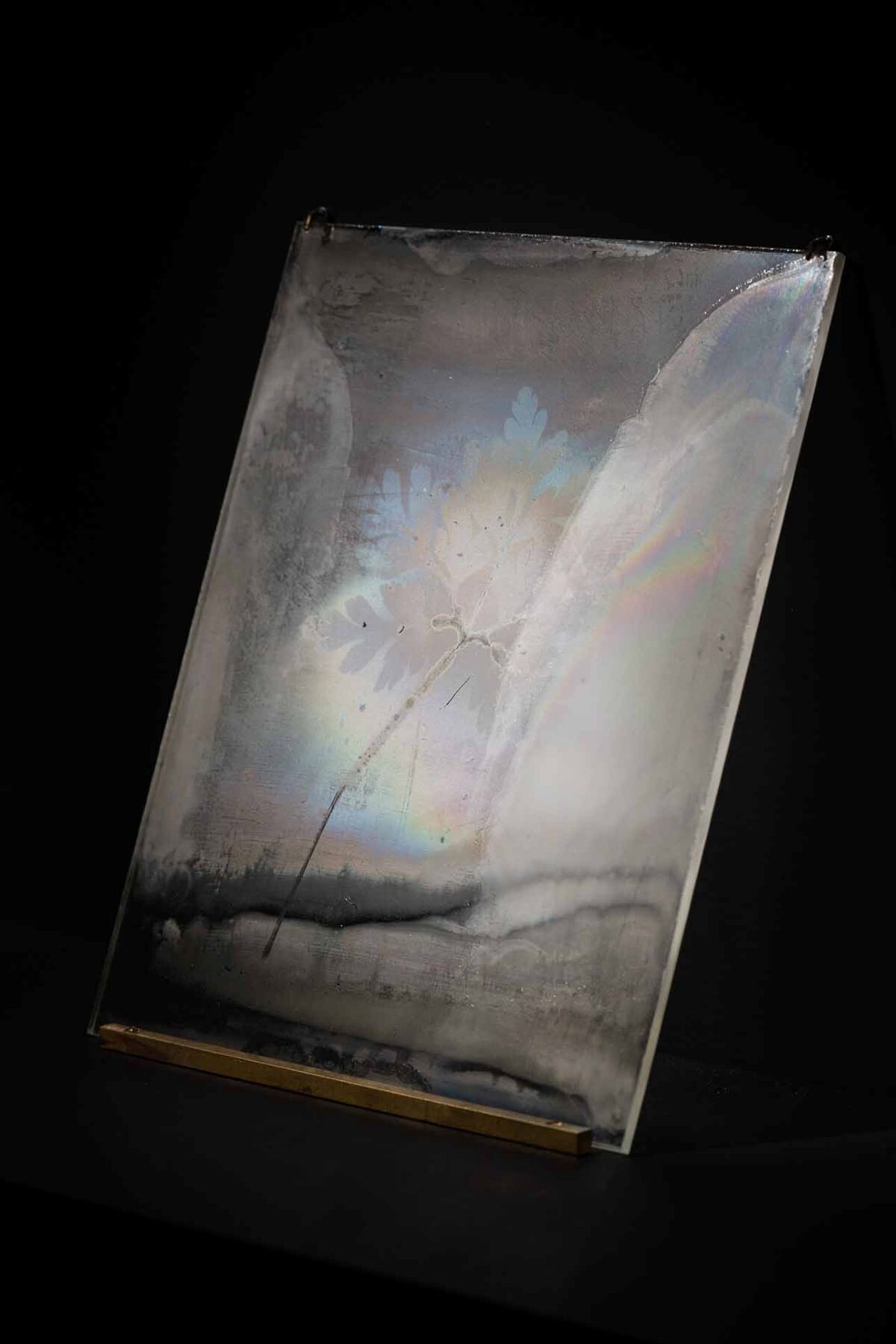
Radiant Force appears to me a salve for those who are tired of the suspiciously perfect AI image. To produce these works, Murakami researched the beginnings of photography, reconstructing early experiments such as the physautotype. (Invented during Joseph Nicéphore Niépce and Louis Jacques Mandé Daguerre’s early investigations in heliography, the physautotype is a polished silver or glass plate which is coated with a photosensitive solution before being exposed to light, and is a predecessor of the better-known Daguerreotype.) The resulting images—displayed like artefacts, sweetly small in scale—involve an encounter with their material constitution.
I say constitution and not production because a survey of early photograph’s industrial conditions—the global extraction of material resources (copper, silver, bitumen, chemical salts, and so on), and human labour it required—remain out of the exhibition’s scope. No, this is an exhibition focused on the discrete techniques of photography’s earliest experimenters, and there is something lovely about this. We can see Murakami’s interest in such material processes in the beating heart of the exhibition, a video work entitled Appearance of a Rainbow (2026). Here we are given a close-up glimpse at the subtle chemical transformations of copper, silver, and glass plates—the physautotypes—as they are doused in sensitising fluid. Against a darkened and undescribed ground, these small plates are magnified to appear much larger than life. As the liquid evaporates to leave a photosensitive film on the plate, we observe what the title forecasts. The previously bare plate now generates a plethora of beautiful associations, like slick refractions of light in a puddle of gasoline, the exoskeleton of a beetle, or seashell nacre.

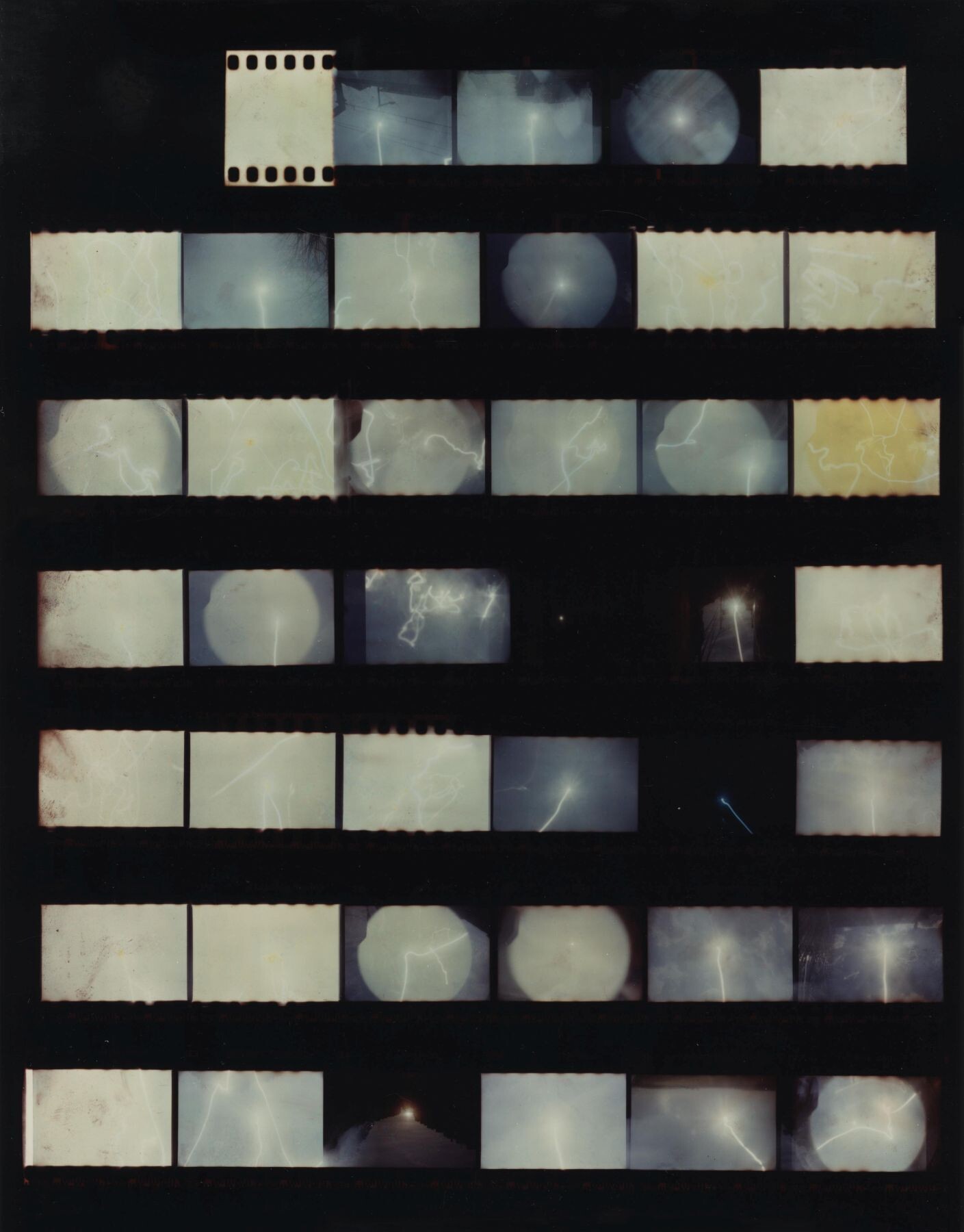
Hanako Murakami, Sun Diaries #5368, 2015–2016, contact sheet, gelatin silver print. Courtesy Yumiko Chiba Associates; image courtesy the artist.
Rather than optical clarity or truth, Murakami is interested in a visual language that emerges from the accidents, failures or unintended effects of early photographic practices. Beside the video just described is an actual example of a photosensitive plate hung high on the wall, so that you may have to tilt your head to see it. At this angle, the polished silver surface of the physautotype shifts flirtatiously in the light, revealing minute scratches and remnant splotches of evaporated solvent. Another physautotype on glass captures a barely discernible view of Sanjo Street in Nara, Japan, exposed over three days, with vertical telephone poles appearing vaguely through the dark glass. Another example is Murakami’s Sun Diaries series (2015-16), a set of contact sheets which capture a daily log of images taken with the artist’s camera lens aimed directly at the sun. As with the physautotypes, these sheets testify to the fallibility of the photographic process, and draw on this to establish their own set of aesthetic interests: an eye looking into a camera looking into the sun, with each of these things calling up the image of the other, simultaneously resembling and impairing it.

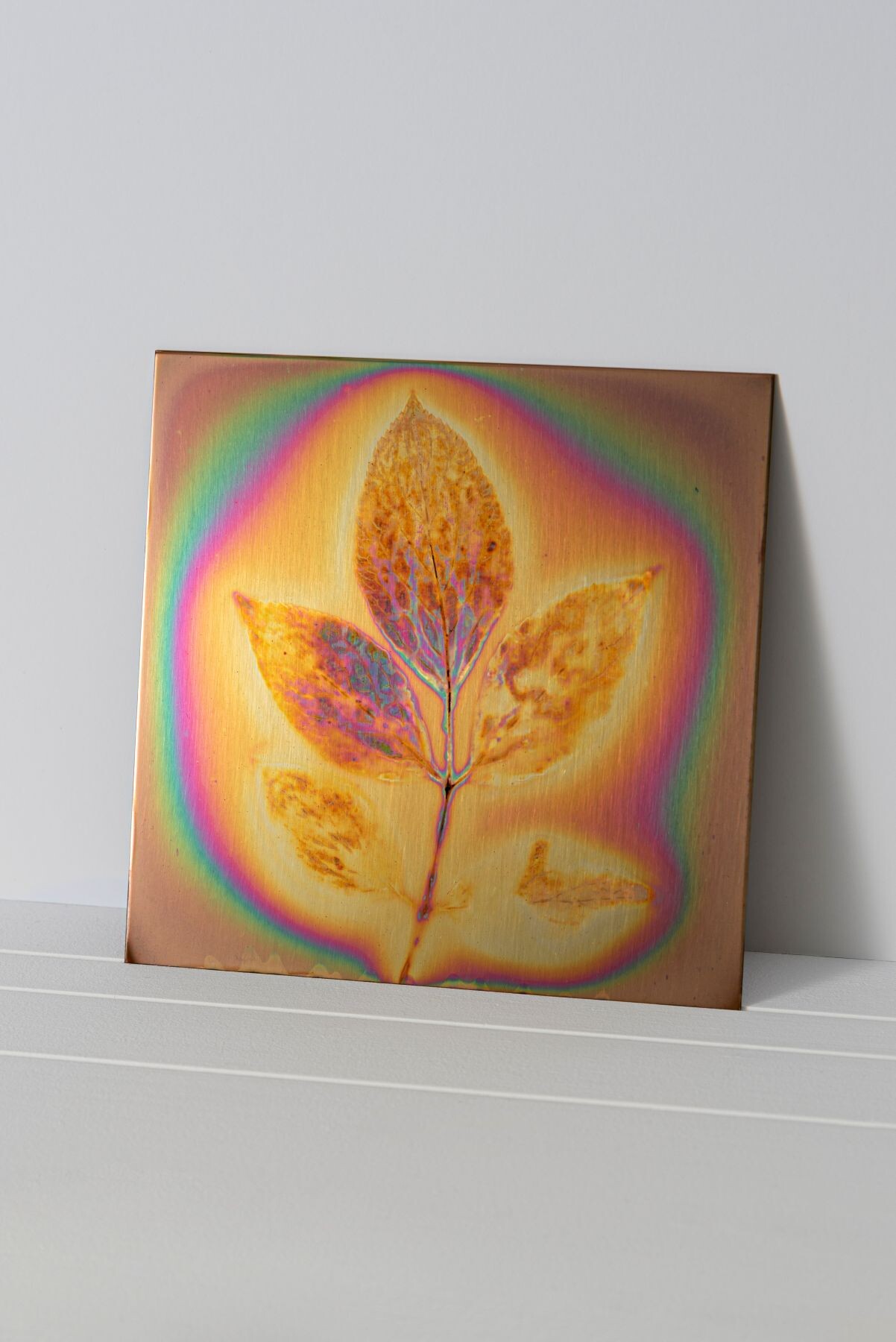
Hanako Murakami, Untitled (Thermography – Niépce’s Garden), 2026, thermography on copper. Courtesy Yumiko Chiba Associates; image courtesy the artist.
The highlight of the exhibition for me is surely the thermographic prints on copper. Here Murakami recreates an image-making experiment developed by the German physicist Ludwig Moser, published in 1842. Placing various objects—a shilling, glasses, rose-leaves—upon a polished copper plate prepared with mercury, Moser created different types of material negative that could then be developed into images through exposure to mercury and iodine vapours. Believing that the images were produced by the radiation of heat, Moser named the process Thermography. Murakami’s thermographs entertain Moser’s argument, published in the German periodical Poggendorff’s Annalen, that “contact is capable of imitating the action of light.”
As objects they are striking. Murakami’s thermographs are made using cuttings from plants in Niépce’s garden. They are the most well-defined images in the exhibition, with brilliant iridescent borders of colour. In these we can see that “radiant force” named in the exhibition title. Murakami’s lesson is that a photograph might be less about vision than it is about touch and sensation. A photograph could take the form of a smell, a vapour of lavender oil and turpentine—Murakami’s Air de l’image (2022) diffuses the room with the scents of solvents used to develop prints in the lab of the physautotype’s inventor, Niépce. It reminds me of the sentiment of showing Hiroshi Sugimoto’s photo works with his fossil collection, which I saw not long ago at Singapore Art Museum. In this context, the fossil appeared a sort of a photograph: a lens-less proto-photograph, if you are willing to conceive of the photograph more abstractly as a compression of time.

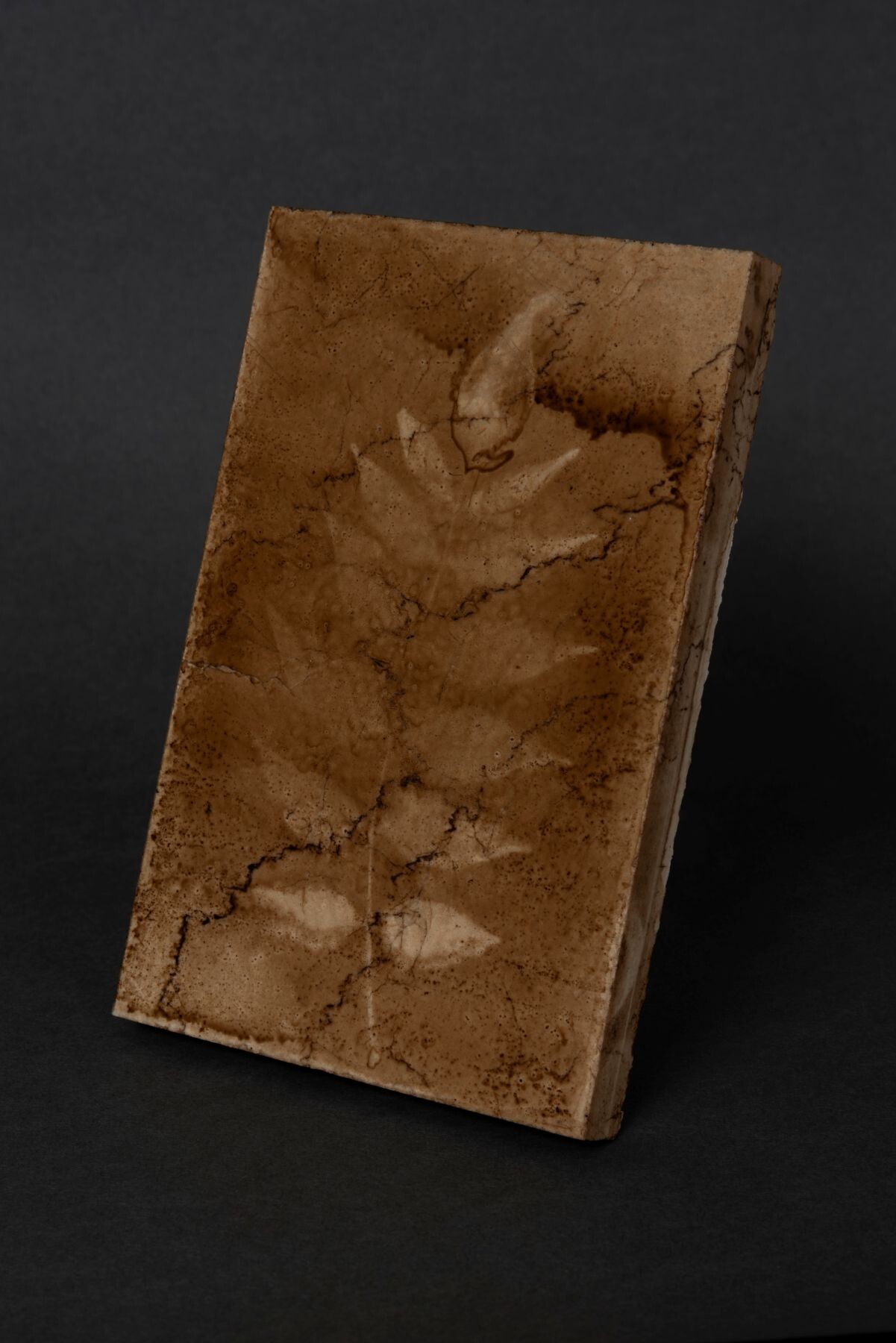
Hanako Murakami, Untitled (heliography), 2026, marble. Courtesy Yumiko Chiba Associates; image courtesy the artist.
It seems that before we can understand the work in Radiant Force, we must comprehend the history of the techniques on display, and their obscurity. That Murakami has managed to recreate these forgotten processes inspires wonderment alone. As the wall-texts make clear, there are no surviving examples of Moser’s thermography, and there is only a single historical example of a physautotype, developed by Niépce and Daguerre in 1832, which exists as a reproduction only. Indeed, the primacy of photographic history in this exhibition is flagged to the visitor as soon as they enter the exhibition, in the form of a heliograph on marble. Not only is this the earliest photographic process developed by Niépce—the oldest surviving photograph in the world is his heliograph View from the Window at Le Gras (1827)—but it also takes as its referent a leaf from Niépce’s garden, as do Murakami’s thermographic images. Looking at this slab of patinaed marble, we are greeted by a self-referential object made into the image of history.
The importance of the historical moment of photography’s “invention” in Radiant Force seems to me, at times, a little overstated. For Untitled (Hanazono) (2026), a dye sublimation print on curtain suspended nicely against a fogged glass divider, Murakami tracks down the rumoured location of the first photograph taken in Japan. What matters, however, is not so much what she finds—a parking lot, as it turns out—but the currency of re-indexing this moment in history. In a similar way, the exhibition starts to think of itself as both photography’s history, and its revision. And Murakami’s work is tactfully positioned as a provocation “at a moment when AI is redefining image-making itself.” What is this provocation? On the one hand, we might read Murakami’s act of reaching back into time as a kind of defiance against the onward march of technological progress. On the other hand, the show dissolves photography into a lineage of hybrid human-machine image-making techniques, with AI as only the most recent example. Radiant Force ultimately remains undecided about whether it is telling a history of image-making according to the grand tide of continuation or the breakwaters of disruption and change. My reading tends towards the former: images, the exhibition suggests to me, have always been formed through forces that exceed the capabilities of the human eye. Radiant Force offers no antidote for the eye-weary. If we may learn something from its images, it is of our own overestimation of the eye: the failed correspondence between our capacity to see and our capacity to decode, to see beneath the surface.

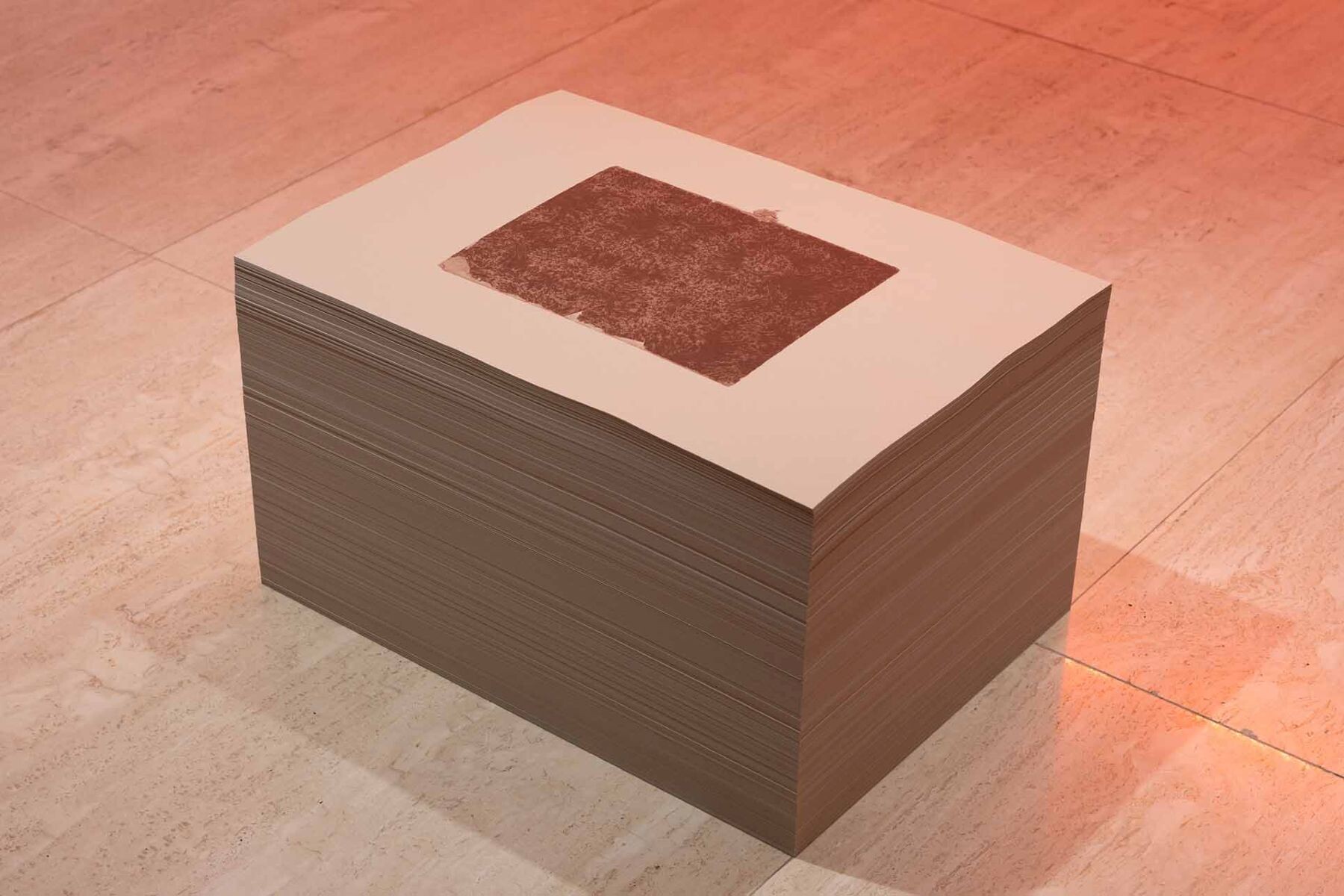
Hanako Murakami, Invention, 2022, Hanako Murakami: du désir de voir, Pola Museum of Art, Hakone, Japan, 2022. Courtesy Yumiko Chiba Associates. Photo: Ken Kato.
A beautiful exhibition, nonetheless. I consider the parting gift I take home with me from the exhibition: Invention (2026), an offset print on a dual-sided sheet of paper, picturing (recto) the front and (verso) the back cover of the original edition of Niepce’s 1829 treatise Notes on Heliography. This is a manuscript flattened into a single leaf of paper. Transferred from metal plate to roller to paper, the smoothly inked images of weathered covers, old-looking with their Spanish wave marbling, stand in place of the book, its content, knowledge, and the moment of invention itself. Here, after all, and rolled up in my bag on the train, is the beautiful surface of history, the beautiful surface of material process.
Gallery