Georgia Morgan, I Found a Marble and My Life Changed Forever
June 6, 2026
-
Georgia Morgan, I Found a Marble and My Life Changed Forever
Venue: Neon Parc | Brunswick
29 May 2026 – 20 Jun 2026
I am always amazed—but not surprised—at the fact that ceramics have never been of much interest in this country, especially once they move out of the domains of kitsch (take one look at the studio pottery that ends up in any Australiana auction) or pedestrian utility. Unlike portraiture, the other ugly duckling of our national canon, ceramic artists don’t even have a raft of industrially publicised, richly funded middle-brow art prizes to keep their aspirations high and their work flowing. But why is this the case? In a just world, a well-crafted vessel would appeal to everyone. To the collector fallen on hard times (or to the overly profligate), ceramics offer an endlessly varied yet budget-friendly solution to fuelling their habit. And they don’t even take up any valuable wall space!

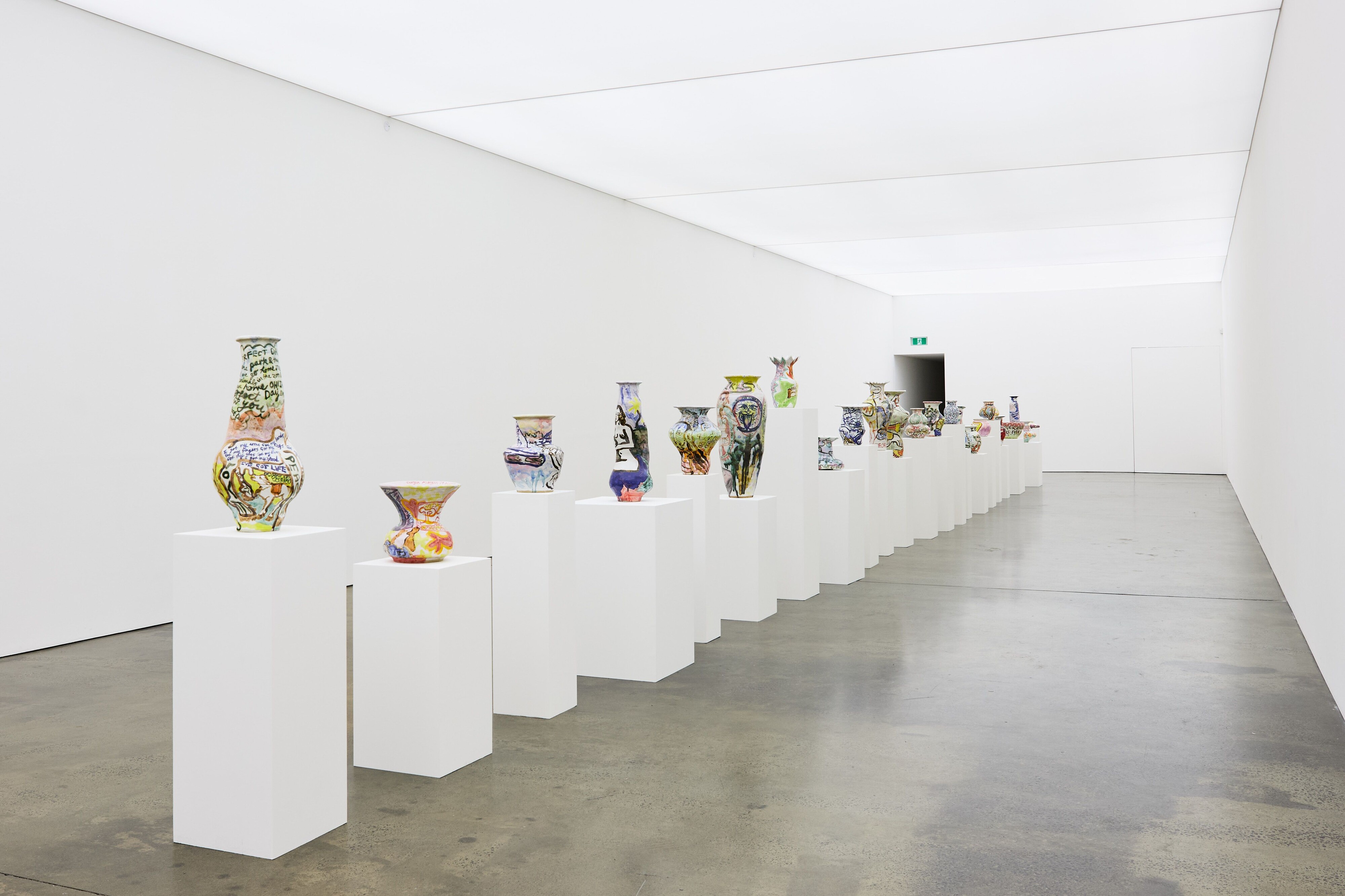
Installation view of Georgia Morgan, I Found A Marble And My Life Changed Forever, Neon Parc Brunswick, Narrm/Melbourne, 2026. Courtesy of the artist and Neon Parc. Photo: Hamish Macdonald.
Two reasons immediately present themselves. One is that almost every interesting, innovative or challenging ceramic artist to have ever practised in Australia has been a woman. Gwyn Hanssen Pigott, Thanakupi and Anne Dangar would begin the list of this very short canon—Pepai Jangala Carroll and Merric Boyd could be our token men—but extending the list into double digits would be a difficult task for all but the most dedicated pot-heads. Most people might not even be able to name a single one. The second is the deeply ingrained fear of the C-word. It is not a peculiarly Australian quality for the word “craft” to strike unease and condescension in the hearts of even the most generous connoisseurs. Patrick McCaughey was already describing art ceramics in 1968 as having become “a marginal pleasure and a marginal appetite.” While some curators, art historians (myself included) and gallerists have begun to deploy the less encumbered term “artisanal” to works historically labelled as “craft” in a rehabilitative effort, the baggage continues to more or less stick.
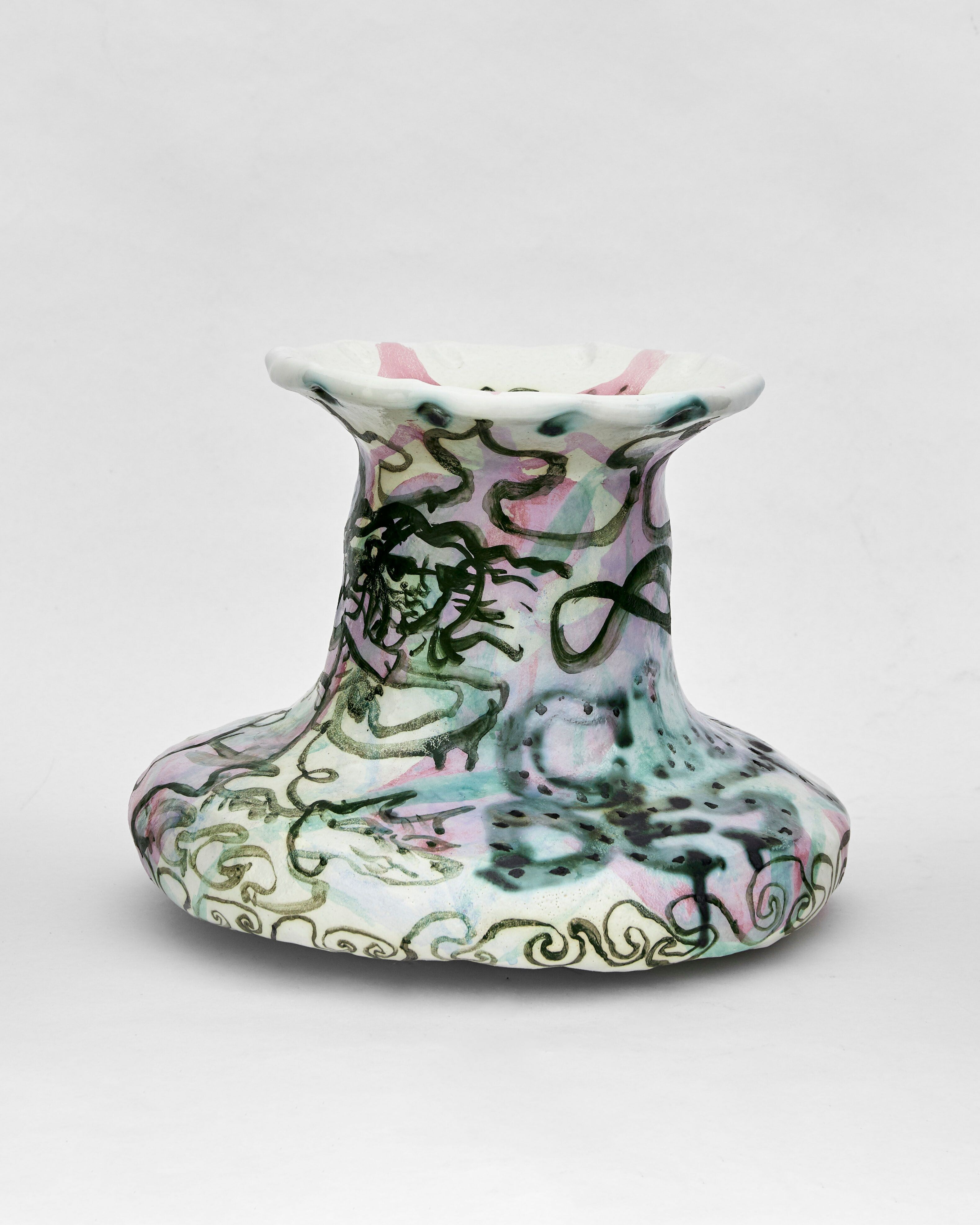
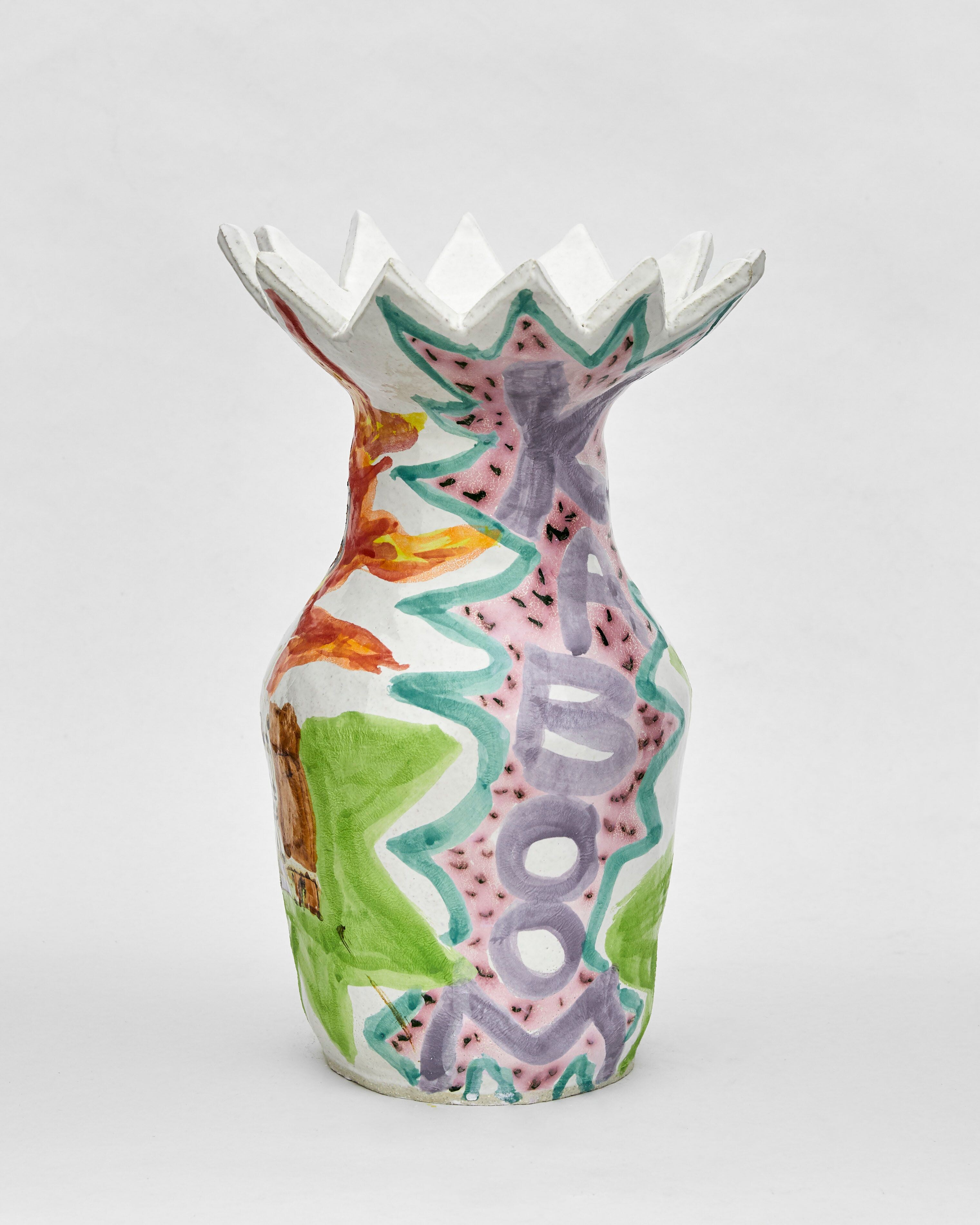
Whatever the popular conception of the state of Australian ceramics might be, it doesn’t seem to bother Georgia Morgan. Visiting I Found a Marble and My Life Changed Forever, I am, as always, astounded by the carefree and energetic ways in which Morgan takes to her ceramic practice. Although Morgan has been making pots since her days at art school, hers is not the rigid and precise work of a formally trained potter. Rather, her hand-built sculptures are always experimental, daring in their outrageously fecund forms. When I first saw Morgan’s pots as a sixteen-year-old in Hobart, it was as if a bomb had gone off in the polite world of staid, quietly lit landscapes that otherwise choke the Tasmanian exhibition cycle. Even though there’s a bit more competition for attention this side of the Bass Strait, Morgan’s work has not lost its explosive quality. I am glad to see this spirit literally expressed on the vase Our House In The Middle of Old South Head Road on Fire (2026), one side of which simply reads “KABOOM.” Her glazes are intuitive, sometimes crazed or wrinkled, coming in a range of brilliant, pearlescent hues. One work in particular, CHILL & DESTROY (2026), perfectly captures the nacreous greens and purples of an abalone shell. Morgan’s pots are loose, unconstrained and, simply put, phenomenal.

Georgia Morgan, CHILL & DESTROY, 2026, stoneware, glaze, oxides, 29 x 33 x 34 cm. Courtesy of the artist and Neon Parc. Photo: Hamish Macdonald.

Georgia Morgan, Our House in The Middle of Old South Head Road on Fire, 2026, stoneware, glaze, oxides, 40 x 27 x 25 cm. Courtesy of the artist and Neon Parc. Photo: Hamish Macdonald.
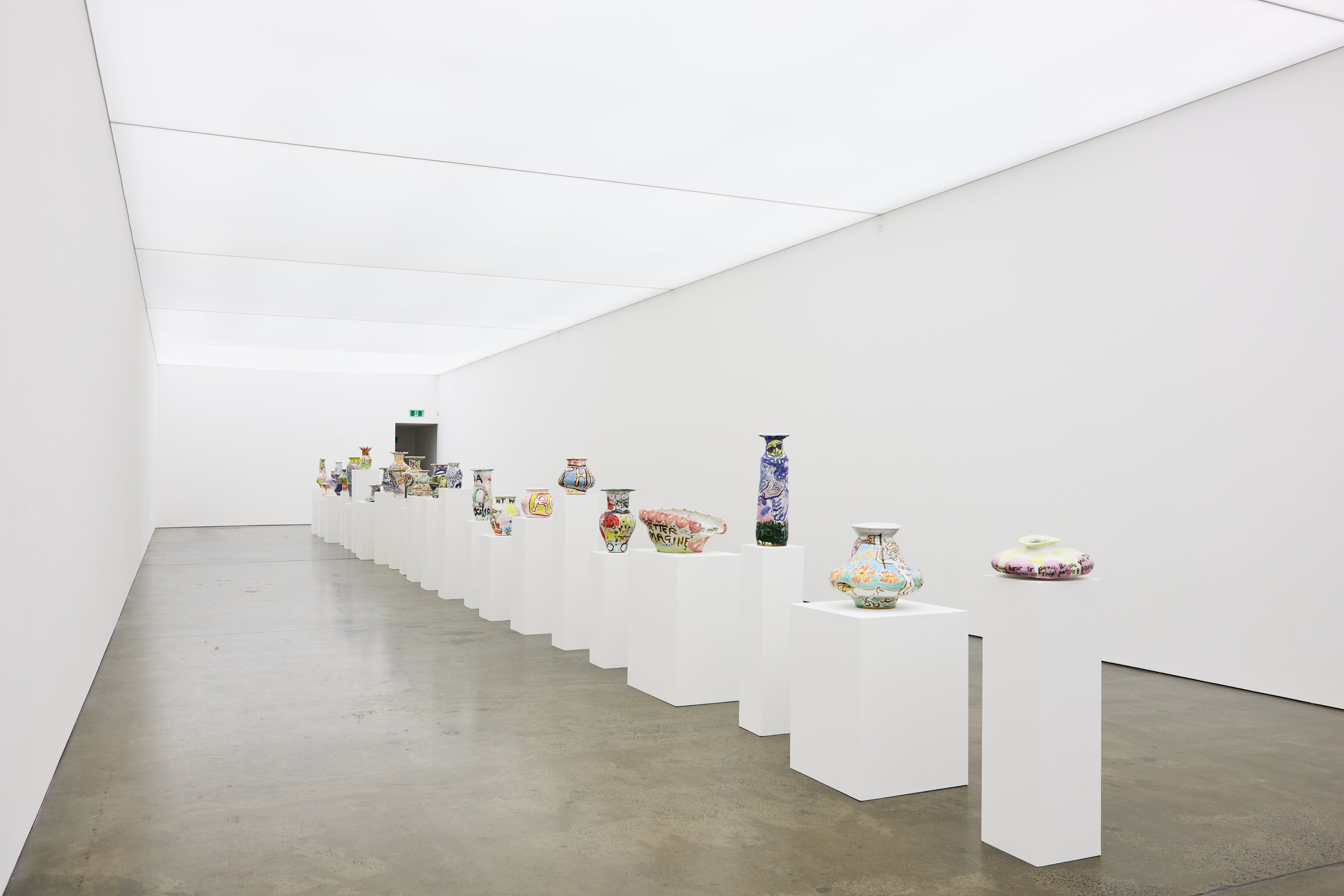
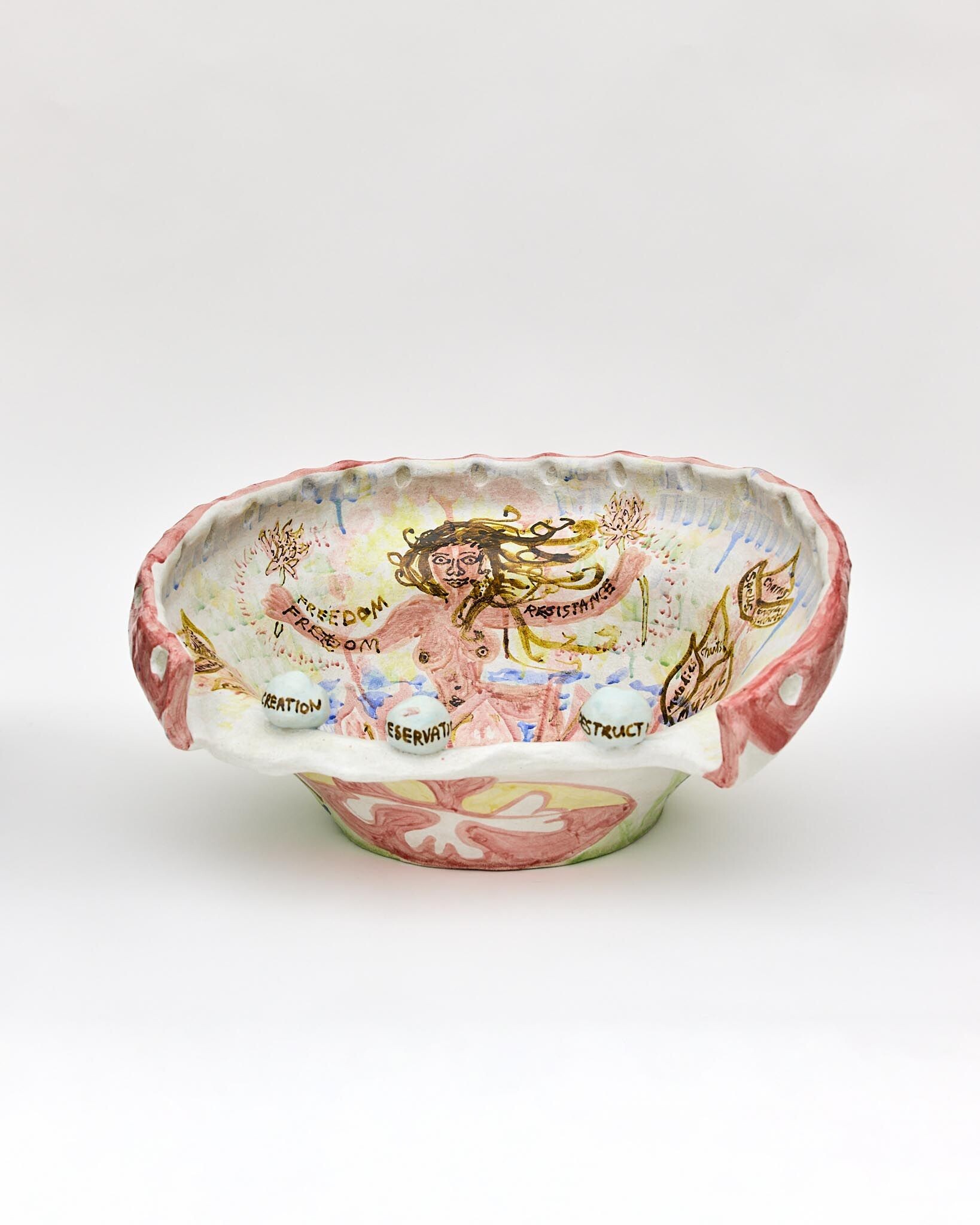
The twenty-three vessels that make up I Found a Marble and My Life Changed Forever sit in an undulating line that stretches the length of Neon Parc’s Brunswick gallery. I’m used to seeing Morgan’s work in smaller quantities; this is the largest group of her pots shown together to date. Each sculpture sits on a narrow plinth, and the relative heights of these supports and the pots themselves give the whole show the feel of a procession. The energy of this group reminds me of the joy and grotesquerie of Basler Fasnacht, or the éclat of Navaratri, the festival dedicated to the goddess Durga. Both of these festivals have a deeper resonance with Morgan’s work than simple visual evocation. The celebration of Fasnacht, Swiss Carnival, draws on pre-Christian observances of seasonal change, ancestral veneration and fertility rituals. The symbolic renewal that emerges from chaos is the name of this game, something that could also be said of Morgan’s work. Durga on the other hand is understood across various traditions of Hinduism as the embodiment of creation, preservation, and destruction. The goddess is especially venerated by followers of Shaktism, those who believe in the ultimate reality of divine feminine energy. This is the subject of one of the most sculptural works in the show, Girls are from Venus (2026). A core element of the observation of Navaratri, and Hinduism more generally, is the practice of puja. Morgan describes puja as “a Hindu act of worship that involves offering physical objects—such as gold, fruit or flowers—to an image of a god.” No matter the objects used in this worship, Morgan notes that “it is the conviction of the action that matters.”
Morgan’s Tamil heritage vividly colours both her devotional approach to artmaking and the visual language of her ceramic works. Even before she was showing ceramics, in the days when she was making photos and coaxing concrete and tarpaulin into votive, aniconic forms, her work was underpinned by a sense of inheritance and time. Morgan’s maternal grandparents migrated to Malaysia from India in the 1930s, her mother to Australia in 1985. While Morgan did not grow up speaking Tamil, one of the world’s oldest languages, seeing her bold signature on each piece reminds me again of time and endurance: some of the first recorded Tamil writing appears in the form of personal names on fragments of pottery from the third century BCE. The cyclical text of You Believe ‘cause I Believe (2026) expresses some of this sentiment: “I asked my mum how to pray and she said just say what you mean.” Morgan does just that in these works, from the exuberantly affirming (“at this point the most punk thing you can do is just blast love from your heart”) to the confessional (“I don’t want to fall out of love with the world”).

Installation view, Georgia Morgan, I Found a Marble and My Life Changed Forever, Neon Parc Brunswick, Narrm/Melbourne, 2026. Courtesy of the artist and Neon Parc. Photo: Hamish Macdonald.
But Morgan’s practice is more than a straightforward reclamation of cultural signs and symbols, complicating any attempts to paint her in the reductive trope of the “diaspora artist.” Although there are references to the Hindu pantheon on these pots, alongside references to concepts like chakra and the divine feminine, they sit in easy company with text and images drawn from hippie visual culture and the likes of Hilaire Belloc, Popeye, Lou Reed, and Nina Simone. The artist “does not care to correct others” when it comes to culture; pulling up neo-hippie influencers on Instagram for their third-hand appropriative takes on Hindu traditions is determinedly not her game. Yet there remains a cheeky sense of reappropriation of the tactics and methods of Orientalism in this show, perhaps best summed up by a work entitled MAKE HIPPIE ART INDIAN AGAIN (Chakra Man) (2026). The gourd-like form and celadon glazing of “Snakes” the Sentinel (2026) recall a bloated Ming dynasty vase, while a group of blue-and-white works take up the centuries-old cultural exchange between Chinese ceramics and their Dutch and English delftware imitations.
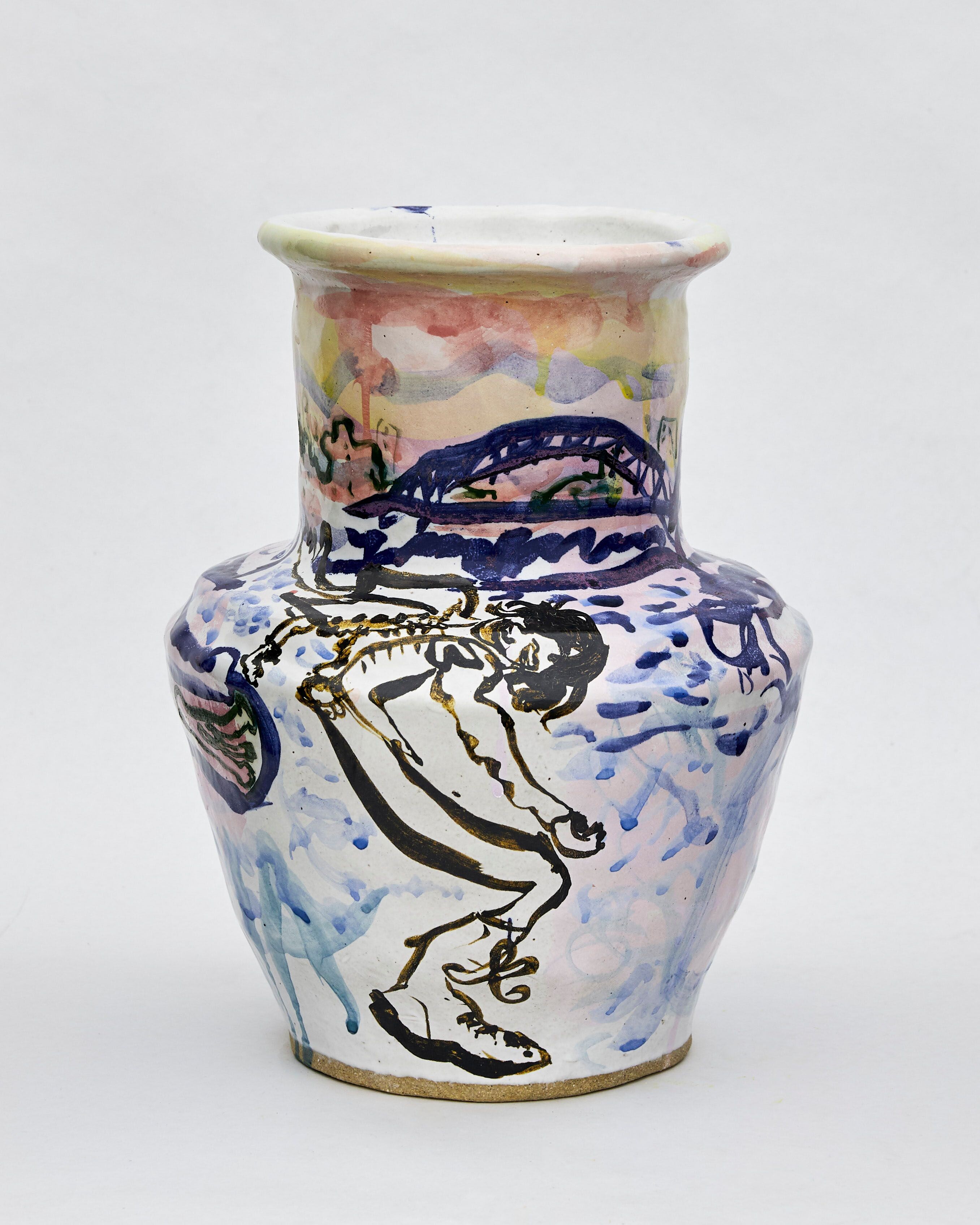
One such work, Granny Went Overboard with No Life Jacket but she was Always Wearing Boots and a Coat (2026), immediately reminds me of Brett Whiteley for its portrayal of Sydney Harbour in brilliant ultramarine. Although Whiteley’s work routinely dominates the secondary market (a whopping $16.2 million in 2024 alone), his own efforts in producing ceramics are still somewhat underlooked and underrated. Whiteley’s ceramics, uniformly blue-and-white and made in collaboration with potters including Shigeo Shiga, Derek Smith, Harriet Collard, and John Dellow, are more conservative in form (yet rather more salaciously decorated) than Morgan’s. But a handful of the more experimental pieces—such as Candle Holder (1975), made with Smith—would not be out of place in this show with their spirit of debauched bohemia. Whiteley was an Orientalist par excellence and lifted his ceramic style straight from the curves of his own extensive collection of blue-and-white porcelain. Morgan’s work may be many things, but imitative (of anything!) it is not.

Georgia Morgan, Granny Went Overboard with No Life Jacket but She Was Always Wearing Boots and a Coat, 2026, stoneware, glaze, oxides, 37 x 28 x 31 cm. Courtesy of the artist and Neon Parc. Photo: Hamish Macdonald.

Georgia Morgan, Girls are from Venus, 2026, stoneware, glaze, oxides, 28 x 53 x 51 cm. Courtesy of the artist and Neon Parc. Photo: Hamish Macdonald.
Leaving Big Brett aside though, I am most struck by how Morgan’s use of text and image in these works demands direct bodily engagement. Attempting to comprehend the graffitiesque scrawlings across each pot requires the viewer to move in a circular fashion around the vessel, often three or four times to take in the entirety of the decoration. The plinths are spaced generously enough to allow this, a welcome (and very necessary!) exhibition design move, but I still can’t help but feel deeply anxious about my own spatial awareness as I weave through the conga-line of works. Neon Parc’s exhibition text describes Morgan’s pots as “ceramic sculptures,” maybe another attempt to throw off the pallid associations of “craft.” But as much as I prefer to call things what they are, it really is an apt description of how these pots fundamentally function. This corporeal movement required in viewing the works in the round emphasises their sculptural identity, and is key to both experiencing and understanding these works. It’s also what makes them so interesting, even (trigger warning!) interactive, compared to other ceramics or “craftwork,” invariably relegated to a shelf or table.
This cyclical motion underpins Morgan’s clay universe. Circumambulation, the practice of circling a sacred object or structure, is a crucial element to prayer in some form across most major world religions: in Hinduism it is traditionally performed as the final step of puja. The rotation of heavenly bodies represented in You Believe ‘cause I Believe (2026) is placed in direct conversation with the pot’s text concerning prayer and devotion. The words of French mystic Simone Weil’s Gravity and Grace come to mind: “Having as its principle unlimited straight movement and no longer circular movement, modern science could no longer be a bridge towards God.” In Melbourne institutions this post-enlightenment sentiment seems to be the curatorial strategy du jour (the most recent is currently on show at ACCA). However, I can’t think of many such shows that have made more than a slight gesture to escape the “straight movement” that underpins the value systems they rally against. Morgan’s is a rare and welcome exception.
While I am sorry not to see any of Morgan’s boisterous paintings in this show (has the gallery ever shown them?), it’s great to see so many pots, and to be able to fully comprehend their forms and iconographies. But Morgan’s practice is too broad to profile her so narrowly as simply a ceramicist—and maybe a bit of visual overindulgence wouldn’t hurt next time. For now, Neon Parc’s minimalist mandate works well. The riotous visual effect of the pots and the deep corporal consciousness that they demand might just be overwhelmed—certainly dampened—if they were joined by more energetic colour on the wall.

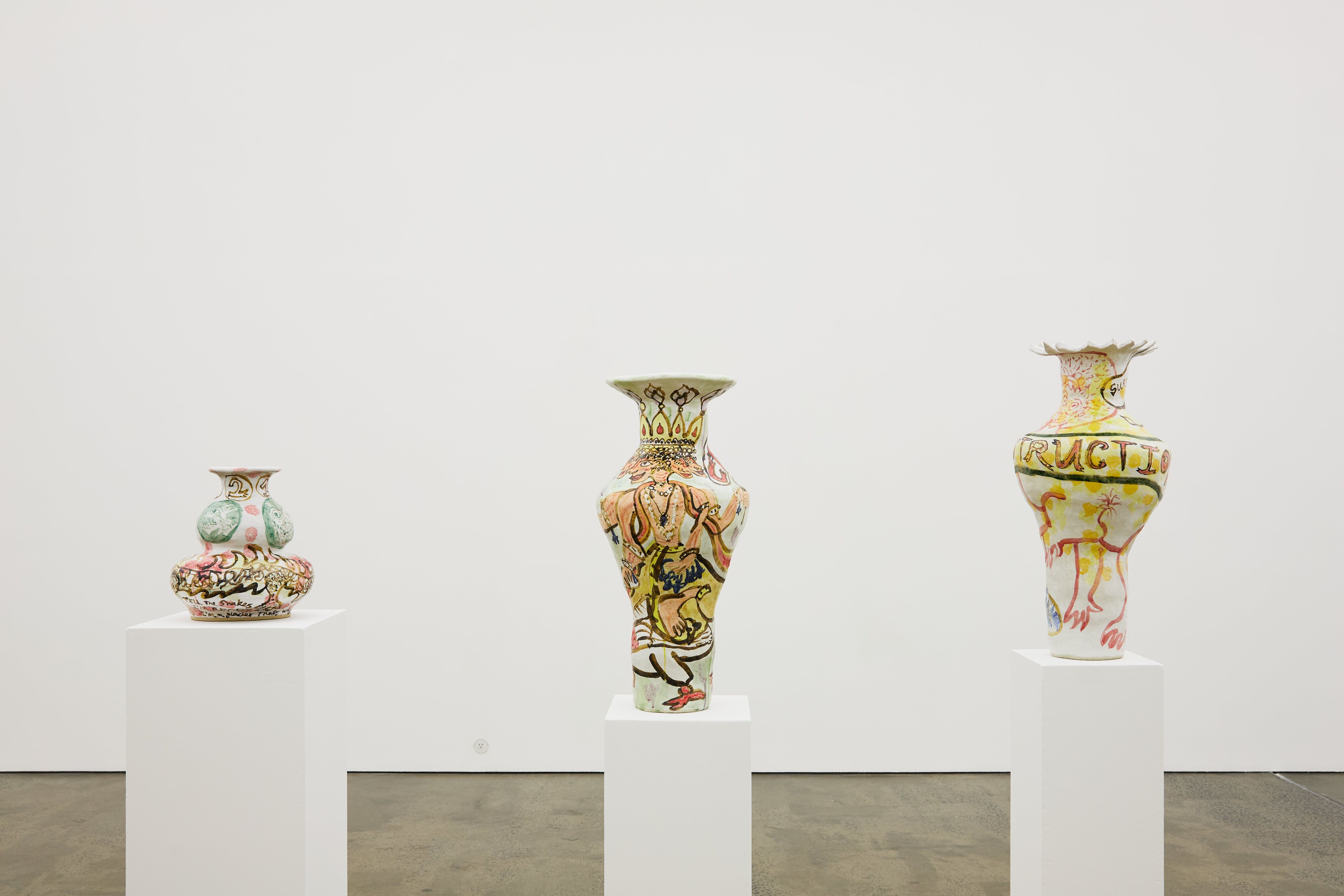
Georgia Morgan, left to right: “Snakes” the Sentinel, 2026, 34 x 32 x 31 cm, Creation through Resistance (Eternal Feedback Loop #1), 2026, 69 x 37 x 38 cm, and Destruction through Surrender (Eternal Feedback Loop #2), 2026, 66 x 35 x 37 cm. Each stoneware, glaze, oxides. Installation view, I Found a Marble and My Life Changed Forever, Neon Parc Brunswick, Narrm/Melbourne, 2026. Photo: Hamish Macdonald.
Cyclical motion is also the fundamental nature of time in Hindu cosmology, structured around creation, preservation and destruction. There are references to these concepts in several works, particularly visible in a pair of especially elaborate pots: Creation through Resistance (Eternal Feedback Loop #1) (2026), which depicts the four-headed creator god Brahma; and Destruction through Surrender (Eternal Feedback Loop #2) (2026), which shows his destructive counterpart Shiva. In some ways, these cycles also inform the unpredictable nature of making ceramics, where creation and destruction sit together in uneasy company; yet once the work emerges from the kiln, it becomes preserved forever, as permanent as stone. For Weil, who understood the world as a text with several layers of meaning, apprehending and passing through these meanings “must be work in which the body constantly bears a part.” Orbiting these bodies—lined up in a moment of syzygy—acts almost as a microcosm of this worldly comprehension, connecting bodily consciousness, layered time and spatial presence.
Morgan is a firm believer in “making something real” in her work, so thinking of her ceramic practice as a method of world-building in this way feels apt. Stoneware, fired to the highest temperatures, is not the usual choice for a decorative ceramicist: it’s unpredictable, and cando strange things to glazes not designed for total incineration. A few years ago, an established ceramic artist told Morgan to not bother with all that, to instead try a midfire clay and reduce the risk of such chaotic outcomes. But her drive to “make something real” triumphed; to sacrifice perfection for the sake of vitrifying into absolute permanence the signs, stories, and ideas that inform the ways in which Morgan takes life in her stride. It is clear the artist has a strong sense of the resistance involved in optimism; these works are vessels that hold the joy of simply being in the world. Morgan’s work is jubilantly egalitarian in its post-national worldliness and hippie spirit, but always reinforced by a persistent sense of cultural specificity.
Gallery