Blocked Duwar
April 18, 2026
-
Blocked Duwar
Venue: Campbelltown Arts Centre
26 Mar 2026 – 28 Mar 2026
The 25th Biennale of Sydney has extended its stage to the Southwest once again, and its theme of Rememory—denoting the reclamation, reconstruction, and revisitation of otherwise unacknowledged histories—has offered a lens to allow through art a profound catharsis. Sitting in the darkened performance hall of the Campbelltown Arts Centre (CAC), this impresses on me a need for vindication. The city has its own mythology after all, its creeks being haunted by the ghost of that unhappy ex-convict Fred Fisher, who was murdered in 1826 by a neighbour in order to steal his land; a minor repetition of the settler-colonial violence that had preceded the establishment of so-called Australia. It is in line with such wretched cyclicism that the CAC now hosts Tasmania-based Gazan artist Feras Shaheen, whose work Blocked Duwar, created in collaboration with Tasmania-based artist Jonny Scholes, merges interactive video game technology with dance, live music, and familial archives to voice yet another story of land theft and displacement.
The work originated in conversations carried between Shaheen and his uncle, who immigrated to Australia six months ago to escape the ongoing genocide in Gaza, mirroring Shaheen’s own arrival to Australia at ten years old. Recorded fragments taken from these discussions surface at brief intervals throughout the work. They provide an expression of the awful disorientation that is a symptom of exile, severed from home, a devastated people, and the past; we learn in candid Arabic of Shaheen’s uncle’s struggles with the English language, comments on his nephew’s life, as well as stories from his youth in Gaza. The purple flush of Sydney’s jacarandas, he remarks, is reminiscent of a purple tree he once loved, brought into the Gazan Church he served at by a Greek Archbishop. The tree appears as a spiny virtual effigy onscreen, a strange will-o-the-wisp that spins, grows branches and bells, and drops through the ground out of reach.
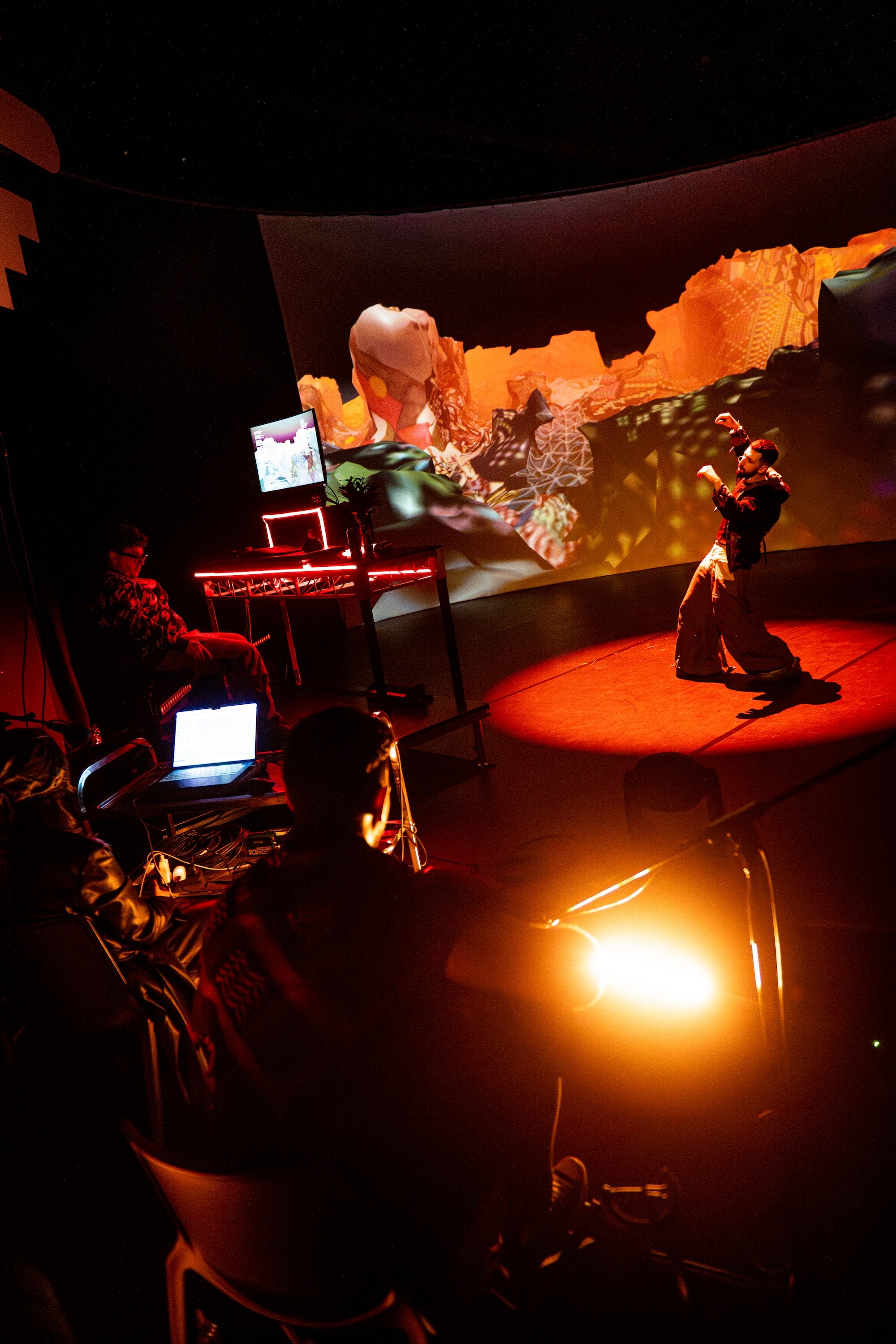
The video game itself is akin to a travel log, with the snippets of conversation accompanying the movements of an avatar (of Shaheen himself) journeying from Campbelltown, across Sydney, and to Ramallah, and whose decisions are controlled in part by the audience. The unrefined graphics of the game’s video projection show a surreal (yet endlessly familiar) urban terrain, a Campbelltown whose skin has been peeled back to reveal the uncanny. Invited to explore, the audience stops at incongruously superimposed photos of different local haunts, an odd pocket of reality overlaid on the virtual landscape—here, a gas station with prices of a bygone era, there, the Mall—and we are prompted with questions that challenge our complicity and sensitivity as settlers on unceded Dharawal land. To this self-reflection, the interface responds. For the quiet admittance that I must do more to advocate for First Nations people, I receive a pixelated handful of water; for the act of boycotting the former Moey icon El Jannah, I am awarded with a BDS cap. In a moment of such aggravated violence, with the US-backed state of Israel inflicting a violent imperialism against Palestine and Lebanon, with the mass incarceration of First Nations youths here in Australia, with the mounting casualties of the Iran war, Shaheen and Scholes’ work reminds the audience of the very real consequences our day-today actions have, being citizens of a country whose government and corporations have been involved in the weapons supply chain to Israel. Blocked Duwar urges a constant reflection on one’s self-determination and ethics. Activism, it declares, cannot be reserved for the picket, or a reposted infographic on Instagram—it must exist in the actions, decisions, and purchases of your daily routines. To quote Jonny Scholes:
Social media apps that have thrust the genocide (of) Palestinians into the spotlight and educated millions (also) let us conveniently contain our guilt and turn away when we’ve had enough. And of course, live-streaming culture which enables voyeurism at its worst.

Feras Shaheen and Jonny Scholes, Blocked Duwar. Mixed media performance, Campbelltown Arts Centre, 2026. Photo Credit: Johnny Chaing.
In the work’s debut across the 26th–28th of March, the video channel was elevated by a live performance from Feras Shaheen himself. During the initial exploration of Campbelltown, he moved across the stage almost reverently, dancing in slow, languid sequences that evoked the wide-eyed unfamiliarity with which he first encountered the West as a child. Accompanied by his cousin Majdi Aljelda on the oud and qanun (traditional Arab instruments), as well as an artificial, dreamy soundscape engineered by electronic music producer Jenny Trinh, Shaheen’s dancing combines the forms of his Palestinian heritage with Western subcultures that have influenced him throughout his life in Australia. Hip-hop in particular, Shaheen says in an interview, offered him a community and direction, although with Hip Hop’s roots in African, Latin, and Queer communities, he is conscious not to claim any ownership.
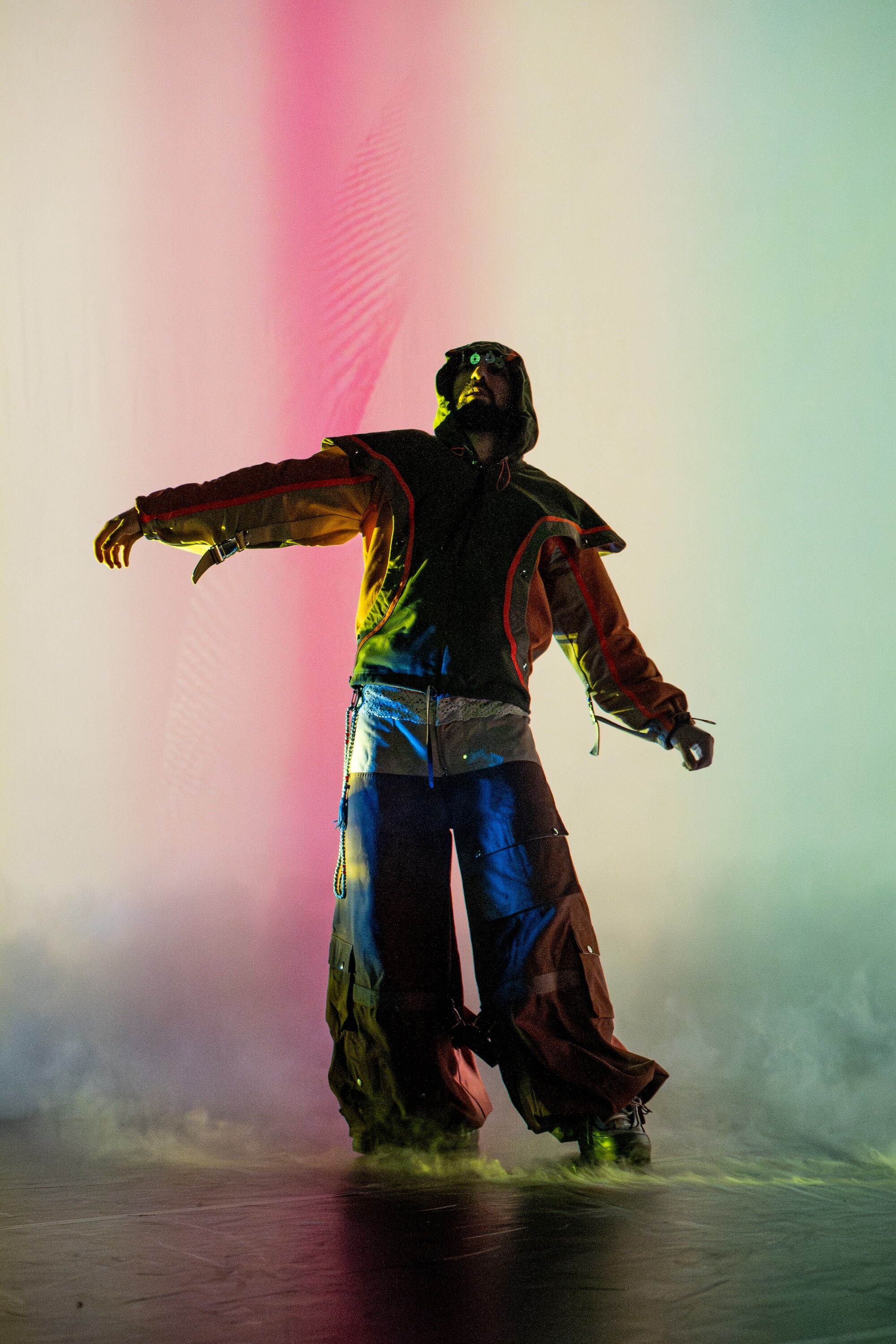
Yet Shaheen’s cultural hybridity is perhaps best expressed in his outfit; baggy bondage pants meet an urban orange jacket, incongruously lined at the hood with replicas of coins from British-Mandate Palestine. As the video installation takes us further into Western Sydney, into Punchbowl, Shaheen’s movements become frenetic. He unclips the straps on his legs to afford both greater range of movement, and offering a metaphorical gesture of liberation. His jacket, too, is turned inside out to reveal that the inside is covered in the bright, geometric patterns of tatreez—a centuries old Palestinian embroidery of such variety that, prior to 1948, each village had its own specific vocabulary of motifs, colours, and styles. Western passions; Palestinian blood.
Blocked Duwar’s convergence of such disparate genres in both music, fashion, and dance exemplify what Edward Said may have described as being “contrapuntal”—a myriad of experiences and coexisting narratives all interwoven into a single heterogeneous identity. However, it would be remiss not to also remark that by engaging both with the specific customs of his Palestinian ancestry, as well as more familiar Western genres of art, Shaheen is also commenting on the cultural assimilation forced onto refugees, who in seeking to adapt to life in the West often feel compelled to abandon or compromise their heritage and traditions. In other words, to adhere to a white gaze. In Shaheen’s words:
Growing up in so-called Australia, I have always felt like I needed to fill a void while I was chasing my Palestinian identity. One of the main cultures that I found myself being connected to was Hip Hop… but I connect to it very differently to how I connect to my Palestinian identity.
(…)
My reality is that I am a Palestinian man who can’t access his land and is now a coloured settler on this land. I am trying to understand my traditional body and dance through the rhythms, the movements, and the marks my ancestors and their Indigenous siblings leave through their existence.
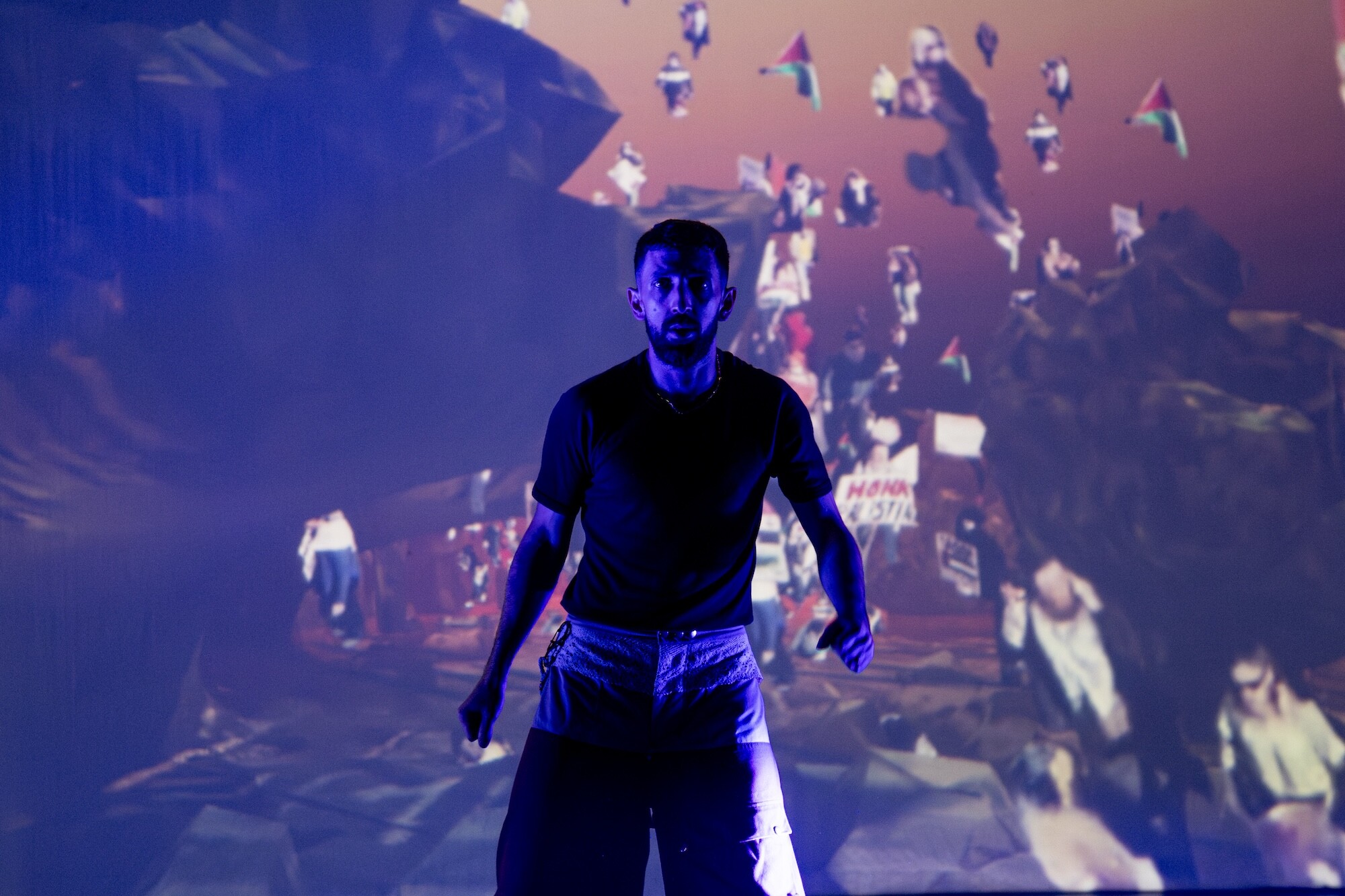
This is brought into startling relief with the video’s inclusion of familial archives. At one point, the screen is covered in a rapid barrage of family photographs, showing Shaheen in his youth, paint-balling, dressed as the Pink Panther, in his family home surrounded by tokens of his Arab heritage. From the pharmacies of Western Sydney we are carried to moments from Sydney’s Hyde Park protests (2023–present), where we are met with waves of pro-Palestine protestors, backed by recordings of now-familiar chants. Yet despite this display of Australian solidarity and community, we remain divorced from Palestine. Armed with half a can of fuel, a horse decorated with a saddle bearing the pink tatreez motifs specific to Gaza, and a “dance dance intifada!” sign, the traveler begins a journey through Jordan, headed to Ramallah.

Feras Shaheen and Jonny Scholes, Blocked Duwar. Mixed media performance, Campbelltown Arts Centre, 2026. Photo Credit: Johnny Chaing.
As the video game marches the audience through an abstracted Jordanian desert, the screen lights up with the gaudy pattern of falling emojis—giant sunflower seeds, cigarettes, and discs of khibbez all bounce across the digitised ground. To another’s eye, this oddity of raining food may seem absurd. However for me, being half-Palestinian, it was difficult to see such images and not point and exclaim: Home! They speak of the careless domestic moments in any Arab household. Of that age-old Arab hospitality that demands you house any stranger for three days before you ask why he arrived, or of jiddos and 3amos chain-smoking over games of backgammon. It reminds me of pouring over small cups of Arabic coffee with other women, teasing out some glimpse of the future. Hearing the voice of Fairouz by morning, Umm Khaltoum and Abdel Halim by night (and indeed, I can just make out the latter played softly behind the screen). And who can forget the quick glide of za’atar on bread before leaving the house: “to help you focus on your studies!” Food, suggests the voice of Shaheen’s uncle, is the last thing to leave you as a cultural heritage.
And, of course, dabke, that age-old Levantine dance once performed on the roofs of houses, to compact the mud. As the video neared its destination, Shaheen and his cousin moved to centre-stage to dance, kicking their legs in a joyful declaration of their culture’s steadfastness. However in this moment there was also a nostalgia—for a kinder past, for the Gaza of the young Shaheen’s memory, and a desire for a gentler future. As Shaheen’s avatar walked towards the military checkpoint that marks Ramallah, the audience was taken through row after row of aid trucks, useless and immobile. It is a wrenching reality check that ripped the audience from the elation of Shaheen’s dance, a brutal reminder of the starvation and displacement carried out against the people of Gaza, that continues even as we sit in the shared space of the Arts Centre.

Feras Shaheen and Jonny Scholes, Blocked Duwar. Mixed media performance, Campbelltown Arts Centre, 2026. Photo Credit: Johnny Chaing.
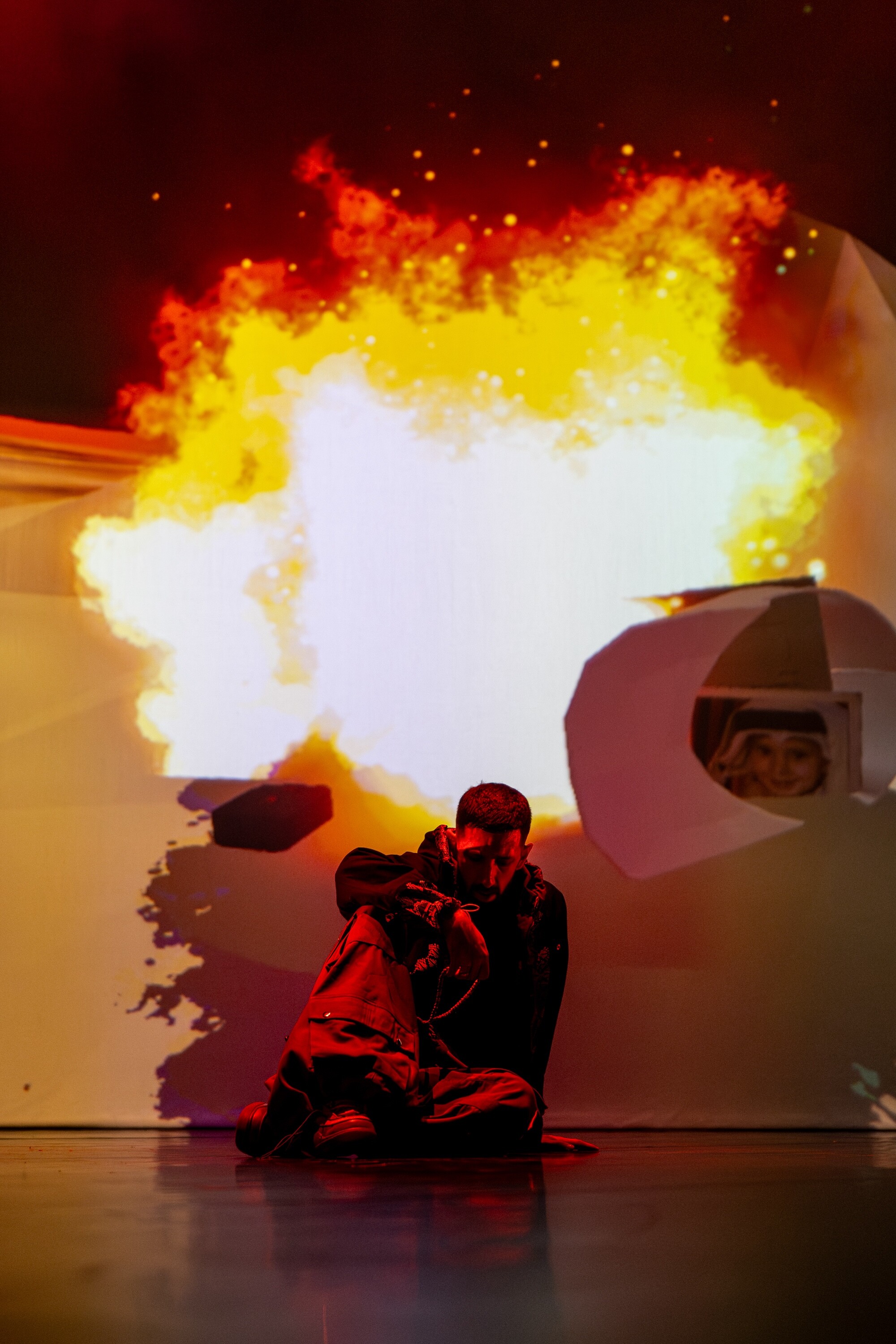
Of course, the work’s digital journey to Ramallah is not a solely imagined one. As Shaheen narrates to his uncle, last year he undertook the very same trip alongside his wife Caitlin, only to be denied access to the West Bank. His wife, not of Palestinian heritage, was free to enter. What, then, is the answer? Do you erase your Palestinian heritage, deny your identity, for the chance to walk on your own land, to visit your relatives, visit your past self for a moment freely? On the screen, Shaheen takes up the avatar’s half-can of fuel, and sets fire to the intifada sign, the BDS paraphernalia, his ID. The photo of a child’s face peers back, smiling at the audience, as it catches fire. Shaheen slumps to the ground. It is a raw outburst of his helplessness, and anger at the unreasonable system that interrupts his relationship to his home. Yet when met with such a terrible disavowal of his own identity, the video offers up the comforting words of his uncle: “This injustice will not last.”

Feras Shaheen and Jonny Scholes, Blocked Duwar. Mixed media performance, Campbelltown Arts Centre, 2026. Photo Credit: Johnny Chaing.
Shaheen’s work thus ultimately poses the question: how may those of us in the diaspora continue on? The language of analysis is lacking. In times of such immense turmoil, we rely on poetry. So, as the beloved Mahmoud Darwish once penned: “Carry your country wherever you go, and be a narcissist if need be. The external world is an exile, so is the internal world. And between them, who are you?” As I exit the performance hall, I pause a breath by the sneakers and embroidered jacket Shaheen has left behind, folded neatly by the foot of the seating. Their placement echoes that near universal ritual of removing your shoes before entering someone’s house, a simple gesture of respect to the owners of a home that is not your own.
“This injustice will not last.” To all this, I have but one word to say: Inshallah.
Postscript: I would like to extend my appreciation and thanks to both Feras Shaheen and Jonny Scholes, for the time and earnest sincerity with which they responded to my interview questions.
Gallery