Are You Lonely Tonight? I’m So Lonesome I Could Cry and Poetry Goes No Further Than Language: A Historical Moment of Art Becoming Art Again
July 11, 2026
-
Are You Lonely Tonight? I’m So Lonesome I Could Cry.
Venue: Australian Centre for Contemporary Art (ACCA)
03 Jul 2026 – 30 Aug 2026
-
Poetry Goes No Further Than Language: A Historical Moment of Art Becoming Art Again
Venue: Buxton Contemporary
01 May 2026 – 03 Oct 2026
The best—no, I can’t say that any more—my favourite art exhibition of the year so far?
It’s got to be Chunxiao Qu’s Ten Descriptions for the Same Object, which I saw at Conners Conners at the Fitzroy Town Hall a couple of months ago.
I originally went to see Mikala Dwyer’s riff on Punch, the motherless macaque at a zoo in Japan that captured the world’s attention—more on him later—but it was Qu’s Ten Descriptions that has stayed with me.
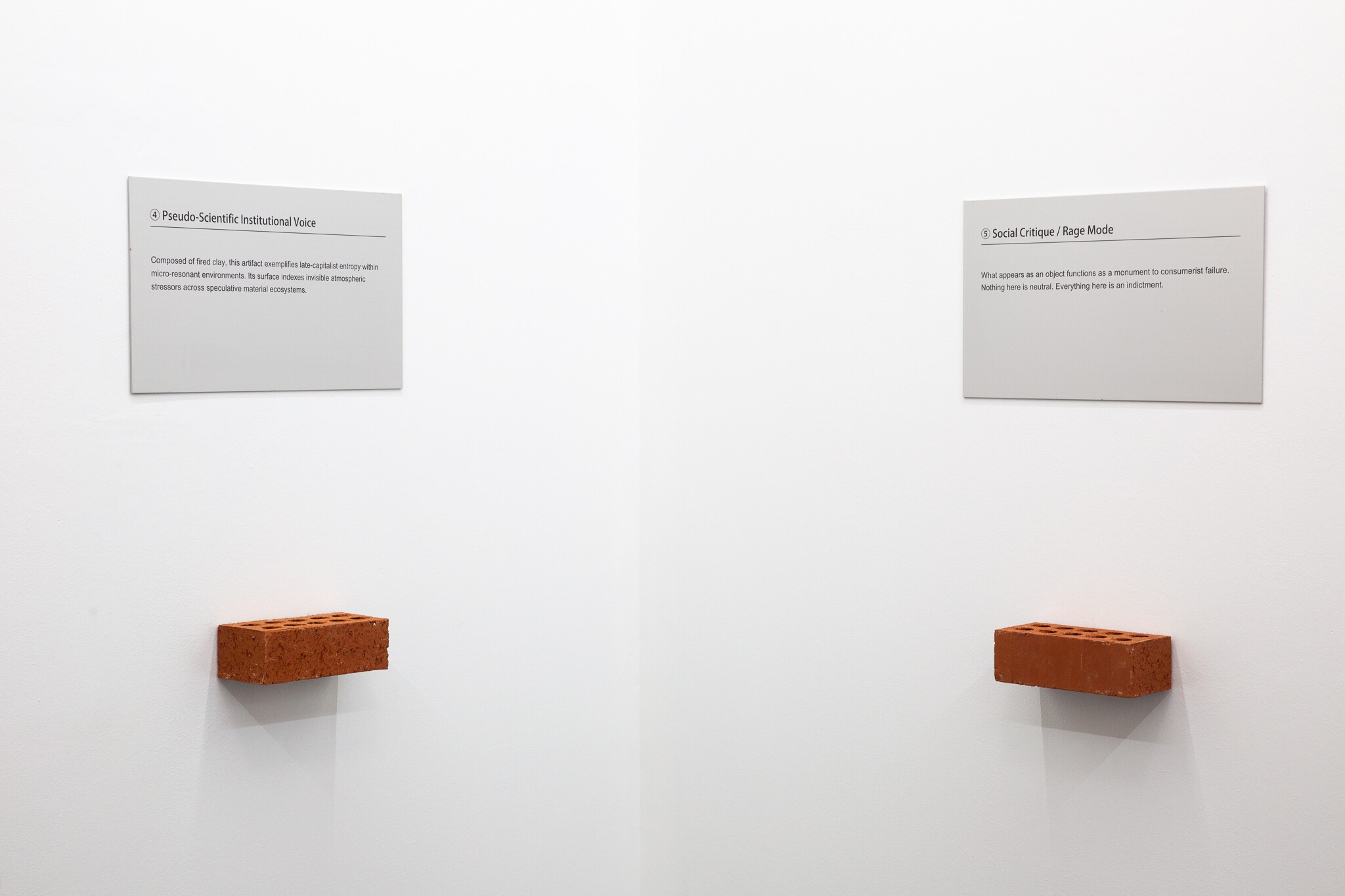
There in the small, spot-lit front gallery—I’m not even sure the space was open, but luckily someone let us in—were a bunch of identical house bricks mounted on the wall, each with a different title. There was one called Deconstructive Theory Mode, another called Postcolonial/Migrant Narrative, and another called Autobiographical: Intimate Memory. There were ten bricks in all, each with a title that came from contemporary art discourse, or at least from the discourses that contemporary art is seen to fit within.

Chunxiao Qu, Ten Descriptions for the Same Object, 2026, Conners Conners, Melbourne. Photo: Mia Davidson.
Of course, it’s a delicious parody of the way art writers read their own concerns into works of art, and that the same work can be seen to speak of so many different things, reflecting the interests and obsessions of the one who comes to it. But perhaps that’s just me reading myself into the work and making it say what I want it to say, trying effectively to sign it with my own name and make it mine.
Or maybe I’m not thinking deeply enough and still haven’t got to what the work is really about. Maybe it is cleverer than that and I still haven’t figured it out. After all, it is a brick: dense, obdurate, material. Actually, as the work kept rolling around in my head, I couldn’t help thinking of that great phrase from Gilles Deleuze and Félix Guattari’s A Thousand Plateaus, “a concept is a brick,” but maybe it should be reversed and we should be saying “a brick is a concept.”
But that would just be to put the word “concept” under one of the bricks, and the “brick”—is that even what I would want to call it now, or is that just one of its labels?—would once again escape me. The clever, witty thing about Qu’s work is that she makes the brick at once heavy, resistant, beyond the reach of language, and light, fugitive, able to be lifted up and carried away by the slightest of linguistic associations. But maybe that’s just me putting another label under it.
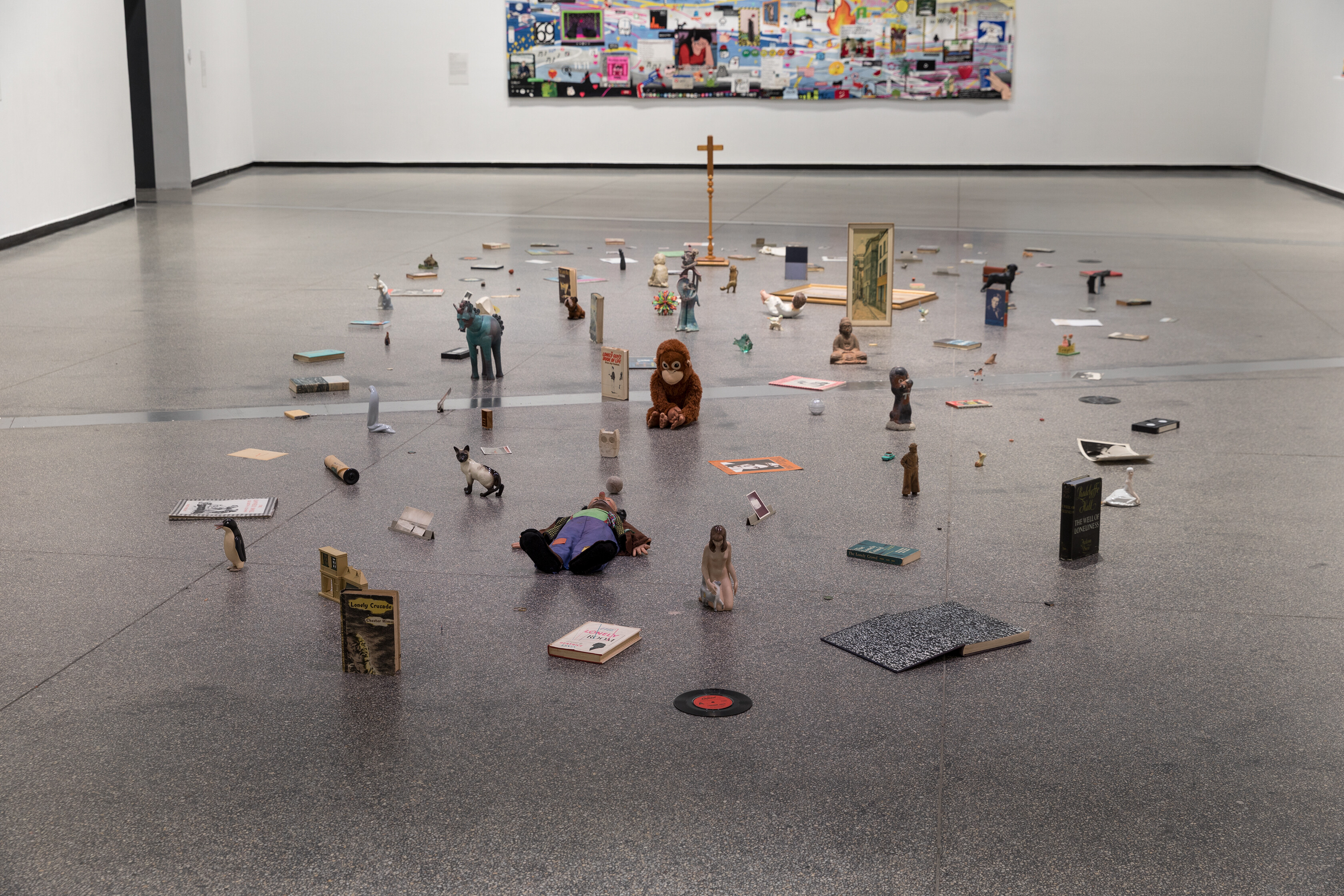
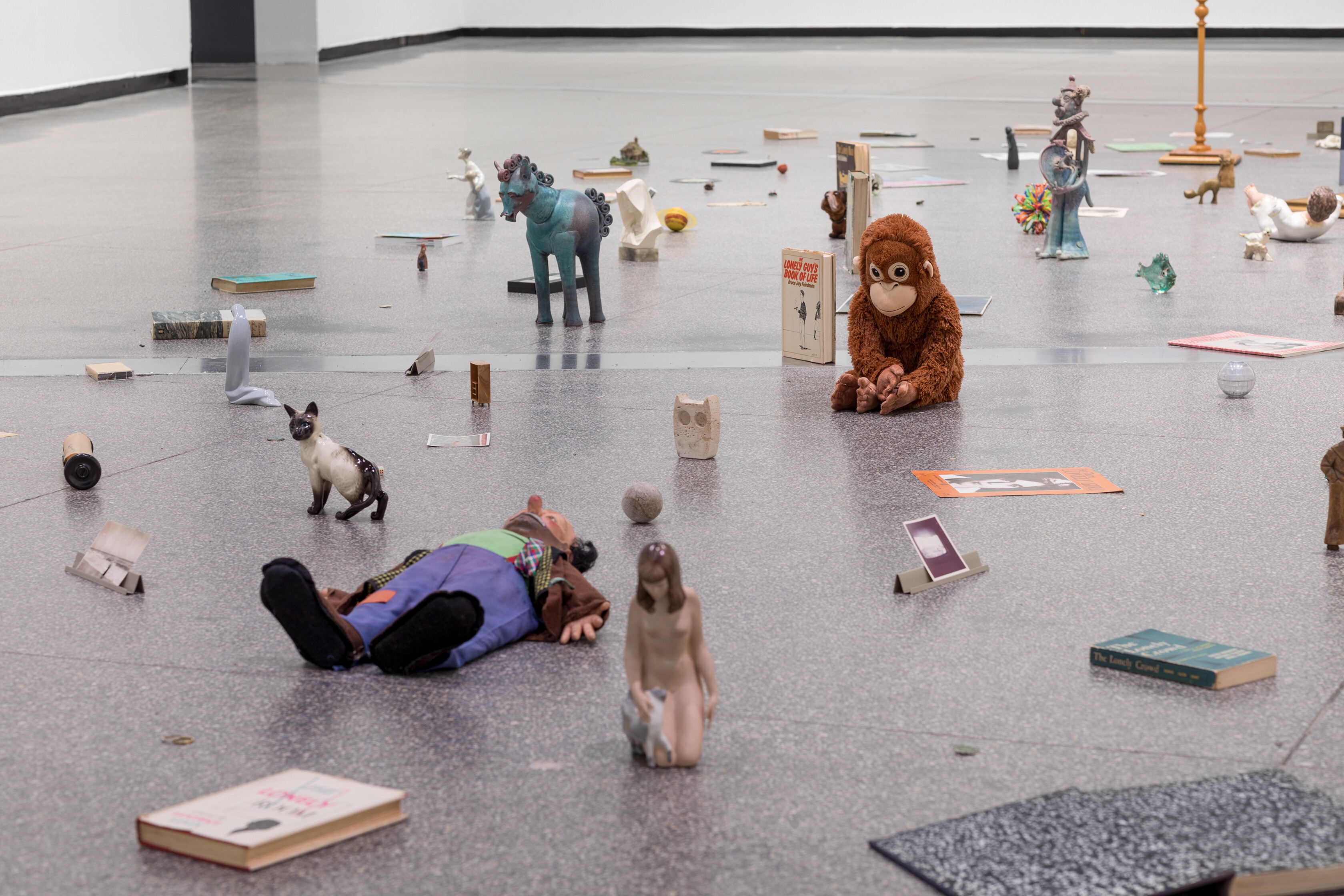
The reason I thought we might begin with a recollection of Qu’s show is that at the moment the Australian Centre for Contemporary Art has an exhibition on that raises many of the same questions. (And it features the ubiquitous Punch in no fewer than two of its works: Patrick Pound’s The Museum of Loneliness (2026), in which a stuffed toy orangutan from IKEA sits on the floor amidst a scattering of objects, and Kayla Mattes’ Lonely Planet (2025–26), in which, up on a complicated woven wallhanging depicting multiple iPhones and computer screens, we see little Punch being beaten by another monkey now that his mother is not there to protect him in the kind of footage that went viral around the world.)

Detail of Patrick Pound, The museum of loneliness, 2026. Commissioned by Australian Centre for Contemporary Art, Naarm/Melbourne. Courtesy the artist, STATION, Naarm/Melbourne, and Darren Knight Gallery, Gadigal/Sydney. Photo: Andrew Curtis.
The show is called Are You Lonely Tonight? I’m So Lonesome I Could Cry.—its title paying tribute to two great Elvis Presley and Hank Williams songs—and it is the first of three proposed ACCA shows taking emotion as their subject, with one on rage being planned next year and another on joy the year after that. (And I guess I can’t help mentioning at this point that another of Qu’s bricks is titled Social Critique/Rage Inside.)
Of course, Are You Lonely? can be seen as another in that long line of projects and exhibitions taking up the notion of “care” in the visual arts (the others I can remember are Duty of Care at the Institute of Modern Art in Brisbane and Griffith University Art Museum in 2024 and the ongoing Care and Repair project led by a team of academics at Monash University). It is the idea that in our desolate, post-COVID times art is a way of bringing us together, sharing an experience, getting us to interact with each other, and maybe even making us feel better about ourselves. The idea has its proponents and detractors, but that’s not exactly what I want to speak about here.
Actually, some of the work wasn’t bad, or at least no worse than you’d expect from an exhibition of contemporary art whose curators don’t concern themselves with the aesthetic properties of the work.
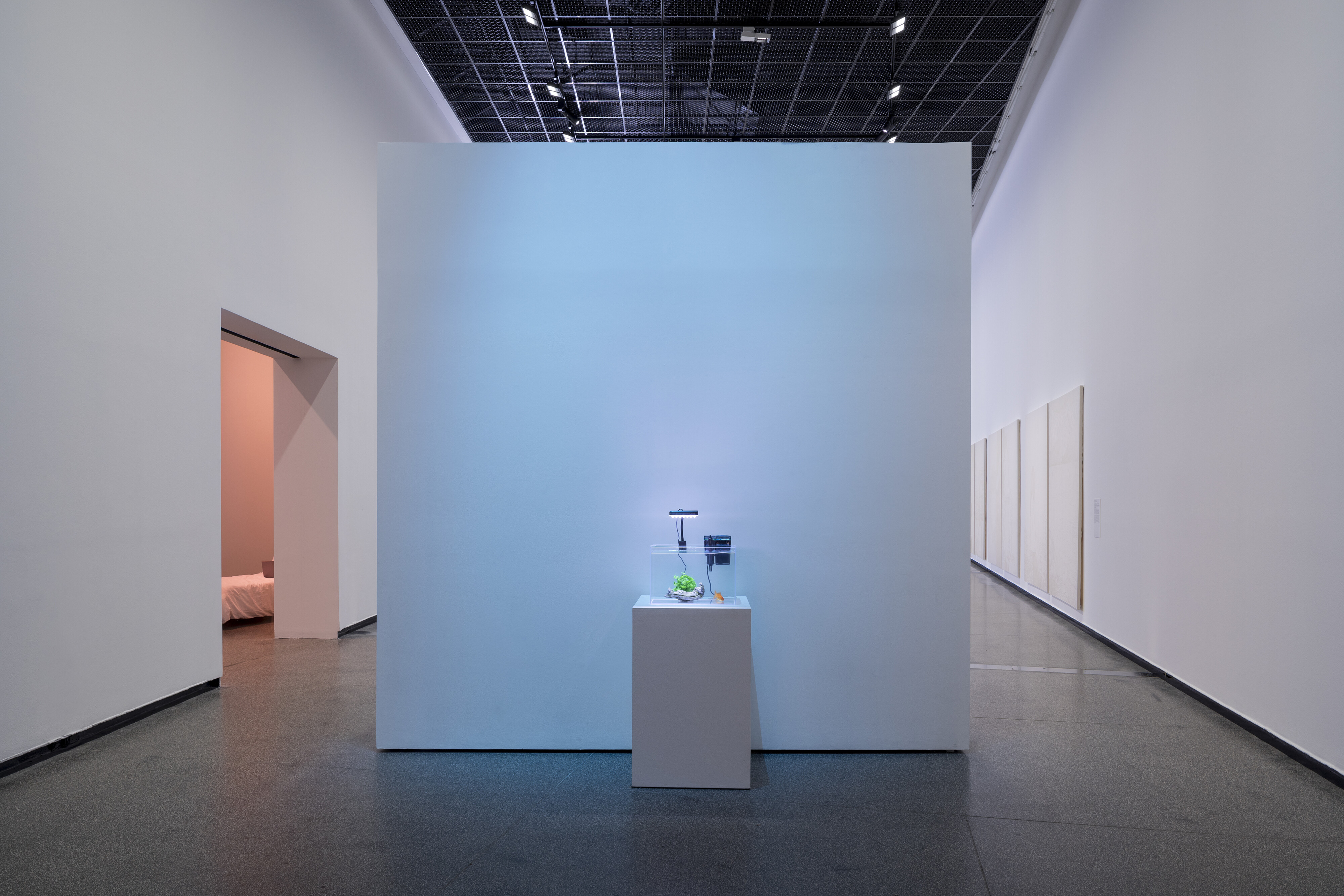
At the entrance to the exhibition, amusingly dwarfed by the lofty, cavernous, I’m tempted to say cathedral-like, proportions of the space behind, is a tiny plastic aquarium holding a single goldfish swimming amidst a green plastic underwater forest.

Installation view of Are you lonely tonight? I’m so lonesome I could cry, Australian Centre for Contemporary Art, Melbourne, 2026. Photo: Andrew Curtis.
I was told it was the ACCA director’s own. It’s a lovely metaphor for the spectator floating around the gallery, turning their head this way and that, not knowing where to stop and look and pay proper attention.
Then in the main gallery immediately on the other side of the wall—and this is why the goldfish—we have Kelly Yu’s short film Ending (2024), about the last goldfish in the world, playing on a small television, which the spectator is encouraged to watch while seated on an old chesterfield sofa (also owned by the director) with books like Robinson Crusoe, One Hundred Years of Solitude, and The Lonely City on small tables on either side.
On the floor stretching out before you is Pound’s Museum of Loneliness, which, as well as Punch, has small statues of Christ, Buddha, dogs and cats, and a bunch of books and records on the floor with titles like Lady Lonely and One Is a Lonely Number. On the left-hand side wall, we have Nick Mullaly’s series of luminous, almost incandescent but in fact nighttime paintings of the insides and outsides of LGBTQIA+-friendly nightclubs, and on the right-hand side wall we have Melissa Nguyen’s delicate rabbit-skin glue on canvas renderings of found family photographs, imagining her mother’s life before she came to Australia after fleeing Vietnam. Also on the right-hand side wall is Seth Brown’s Frank (2024), which in a frankly stupid kind of way is meant to show a hotdog scrolling through social media pages on an iPhone, which is presumably meant to echo with Mattes’ fabric frieze on the back wall, which similarly depicts a whole series of computer screens.

Seth Brown, Frank, 2024, Australian Centre for Contemporary Art, Melbourne, 2026. Courtesy the artist. Photo: Astrid Mulder.
Passing through the door on the left—I’m sure most people reading this know the layout of ACCA—in the usual darkened theatre room with curtains there is a two-channel video by Callum McGrath playing on both sides of a giant screen depicting, in something of an echo of Mullaly, both the quiet empty interiors and the dancing crowds of a series of queer nightclubs in Melbourne. Then in the next room we have a series of large-scale paintings by Lucy Liu, in which she replays Japanese erotic shunga in a considerably more explicit style. And opposite this we have Gideon Appah’s painting Boy with a Bird (2023), which depicts a boy tenderly holding a parrot in his hand, and the two-channel video Beyond the Shadows: Gideon Appah Poetic Vision (2025), which shows the artist and friends surfing on the West African coast.
In the final room we have Natasha Matila-Smith’s If I Die, Please Delete My Soundcloud (2019), in which headphones rest on a rumpled, unmade bed beside a computer showing mise en abyme someone on a bed watching a computer. And, echoing this, we have first a series of smaller Polly Borland sculptures in marble, resin, and aluminium depicting her typically misshapen and distorted figures, and, at the very end before we exit the show, a much larger figure, which almost looks as though it is covered with a bedsheet.

Natasha Matila-Smith, If I die, please delete my Soundcloud, 2019. Australian Centre for Contemporary Art, Naarm/Melbourne, 2026. Courtesy the artist. Photo: Andrew Curtis.
Except that this isn’t really the end. Like what’s on those small side tables as we enter the gallery, out in the ACCA bookshop there are a range of books that are obviously thought to match the concerns of the show: Care When No-One Does by Set Margins, Grandma’s Story by Trinh T. Minh-ha, and The Joy of Connections by Dr Ruth K. Westheimer, but also, amusingly, How to Enter the Art World by Hettie Judah, as though this is the solution to all of life’s lonelinesses and the cruel, uncaring world that awaits you as soon as you pass out the doors of ACCA.
But here’s my thought, maybe prompted by Qu’s bricks. The show is not bad. It’s good for out-of-touch older critics like me to see a sample of the art currently being made around the place, but really the show with the works in it could have been about anything, or to put it another way there was no real reason—apart from the show—that the works were meaningfully or at least exclusively about loneliness. I know that a number of works ACCA commissioned, like Pound’s The Museum of Loneliness and Mattes’ Lonely Planet, had the word “lonely” in their title. I know that a number of them, like Yu’s Ending and Pound’s again, feature books and records with the word “lonely” in their titles. But does this necessarily make them about loneliness? Do they really have anything more meaningful to tell us about loneliness than one of those fifteenth- or sixteenth-century portraits of an Italian monarch’s daughter up on the unvisited mezzanine of the National Gallery of Victoria on St Kilda Road? No, “Are you lonely?” is attached to the works like one of those labels Qu pastes beneath her bricks, and someone else coming along could always call them something else, put them in another show with another title or subject, and they’d make just as much sense.
All this is not really a criticism of the curators or ACCA. It’s the state of much art writing and discussion today. When it’s not about the art as art, then it could really be about anything.
And here is where I turn briefly to the other show I will review here, which I see as a kind of implicit rebuke of Are You Lonely?, or at least in some kind of dialogue with it: Poetry Goes No Further Than Language: A Historical Moment of Art Becoming Art Again, just around the corner at Buxton Contemporary.
I can’t really do it justice here, but it’s something of a survey of the New Measurement Group in 1980s and ’90s China, which sought—and here I’m quoting from one of the didactics—to “explore the extent to which rules could standardise individual expression, behaviour and outcomes.”
Actually—and it’s entirely appropriate for a show all about the relationship between art and language—Poetry Goes No Further has the best and most helpfully explanatory didactic texts I’ve read for a long time. Translated from Mandarin, which is also up on the wall, they tell the story of a small group of Chinese artists, among them Gu Dexin, Wang Luyan, and Chen Shaoping, living in Beijing, and Qian Weikang, living in Shanghai, who in a brief moment of freedom arising at the end of Mao’s Cultural Revolution at first argued for the end of the long-running traditions of Chinese art and even “humanism,” but then, realising that the “relativism” or even “nihilism” of Western postmodernism was not for them, sought to invent new aims and standards for art, which in many ways resembled those of science (and hence the name they came up with for themselves, the New Measurement Group). Here is a small passage from a 1989 essay “About ‘Analysis’” written by Shaoping that explains some of this—and we might begin to think its relationship to what we were speaking of with regard to Are You Lonely?:
“Analysis” employs measurement as its fundamental artistic language, simultaneously excluding the direct intervention of emotional experience while refraining from drawing conclusions.

Qian Weikang, Ladder Poem 1990, 2026, in Poetry goes no further than language: A historical moment of art becoming art again, Buxton Contemporary, the University of Melbourne. Courtesy the artist and Inside-Out Art Museum, Beijing. Photo: Christian Capurro.
A lot of the work presented in the show, housed under glass like—dare I say it?—the goldfish in Are You Lonely?, are pages from the essays the group published over the period, full of obscure gridded diagrams with words in them, looking for all the world like a game of Scrabble or a crossword puzzle. There is a so-called Ladder Poem, 1990 (2026) by Weikang, made by dropping pieces of paper with words on them from a ladder and seeing where they landed, plus a breaking-up of words in the Group’s Rules for Work, which they made in collaboration with the German Op artist Günther Uecker when he visited Beijing in 1994 and looks for all the world like the kind of thing Stéphane Mallarmé did about one hundred years before.

Darcey Bella Arnold, Reconstruction ladder poem, 2026, 200 x 150 cm, acrylic, varnish and pencil on canvas, in Poetry goes no further than language: A historical moment of art becoming art again, Buxton Contemporary, the University of Melbourne. Photo: Christian Capurro.
I suppose in truth the work is a little visually uncompelling. That’s why the curators decided to ask Melbourne artist Darcey Bella Arnold to make more pleasing versions of many of the same things. Arnold redoes Weikang’s Ladder Poem as Reconstruction Ladder Poem (2026), and produces a series of large paintings wheeled around like blackboards with words on them, drawing both on New Measurement’s linguistic experiments and her mother’s notebooks. In other works, she has phrases like “Clearing Away Humanistic Enthusiasm” winding sinuously around in a curve, which can even look like a work by Janet Burchill up at Neon Parc at the moment. She also scatters a series of large, recreated orange peels around the gallery (she says that they express some kind of pun in Mandarin, but for all the world it looks like Buxton has forgotten to clean up after the Hany Armanious retrospective earlier this year). Finally, in a small room up on the second level, Arnold decides to paint an orange being smoked in the pipe from René Magritte’s The Treachery of Images (1929) in, I suppose, some attempt to make the New Measurement Group more familiar or relatable.

Darcey Bella Arnold, A Pipe is not a Poem, 2025, in Poetry goes no further than language: A historical moment of art becoming art again, Buxton Contemporary, the University of Melbourne. Courtesy the artist. Photo: Christian Capurro.
Much of the work the Group made is lost, and at a certain point they even decided to burn it themselves. The Group broke up and the artists went their various ways. But at least they tried. They didn’t want to make work that was “relativistic,” that was about everything and nothing, that drew on “emotional experience.” They aimed instead for a certain truth, a certain testability, a certain at least pseudo-scientific rigour. (There is a very amusing piece in the show, Human Bio-Energy Input/Output Physics Experiment (1994), which is meant to measure what the artist eats and drinks for a day and what he excretes to see if they balance, and this is actually quite a brilliant metaphor for the idea that we perhaps cannot expect a work of art to represent or stand in for what was originally not put into it.)
Altogether, Poetry Goes No Further Than Language was a beautiful and austerely presented show. (Wouldn’t it be great if the New Measurement Group was one day paired with Art & Language?) It didn’t pander, it didn’t seek to please—except maybe with those orange peels—and I felt a lot more invigorated and provoked—more in tune with people who in many ways are so far distant from me—than wandering like a goldfish through the transparent fishtank of Are You Lonely? Certainly, what both they and I have in common is the knowledge that the historical moment of art being art is over, and that’s probably why we’ve both broken up with ourselves. Are You Lonely? was too needy, too much wanting to be liked, just the kind of person I try to avoid and try to avoid being myself. Am I lonely looking at art? Probably no more or less than anybody else. But I don’t really want my art pretending that it can help me.
Gallery