A Velvet Ant, a Flower and a Bird
May 30, 2026
-
A Velvet Ant, a Flower and a Bird
Venue: The Potter Museum of Art
19 Feb 2026 – 06 Jun 2026
The first thing we see when we walk into the renovated Potter is a blown-up didactic on the entrance wall. We read it carefully. This latest exhibition is guest curated by Spanish-born Chus Martínez. It says the exhibition:
is an exercise of the senses and the mind, exploring how cognition extends beyond humans—and how media, art, technology, and biology participate in cognition. Millions of networks of cognisers—human, non-human, and technological—continuously share information and even unconsciously cooperate in producing the intelligence of the world. We live inside a web of processes that perceive, decide, and act without awareness.
These abstract, highbrow, and untethered words hover over the show like a flock of wild birds. We’ll see how they fly.
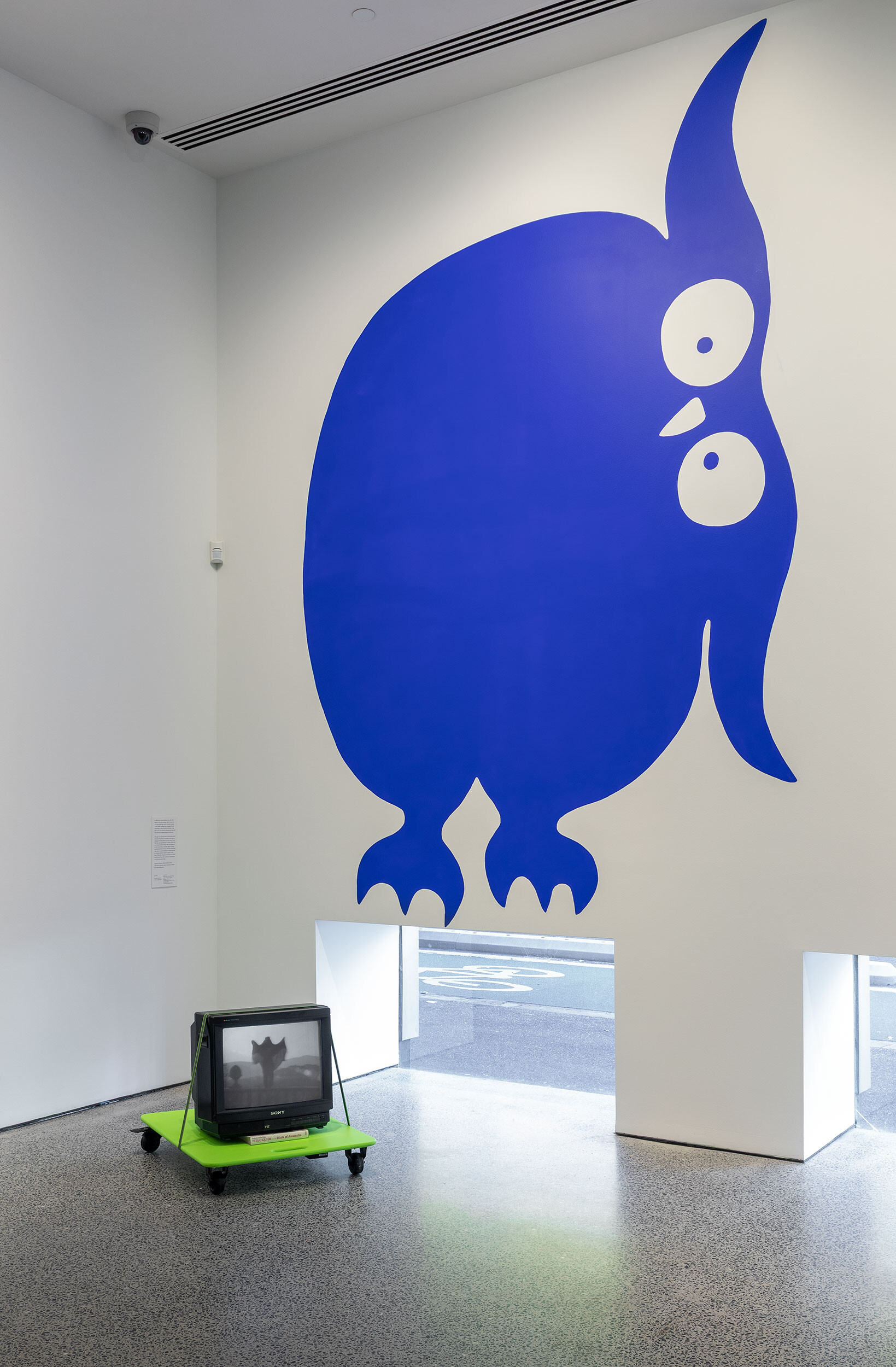
The first work that catches our eye is Joan Jonas’s Merlo (1974), playing on a television strapped to a brightly coloured trolley, propped up by a field guide to Australian birds. We’re not exactly sure why. Italian for “blackbird,” Merlo becomes our point of entry into Martínez’s curatorial philosophy and the exhibition itself. Wearing a rudimentary bird costume, made up of a black cloak stretched into wings and a simple paper cone mimicking a beak, Jonas performs a deliberately unconvincing transformation into a bird figure. The work recalls childhood play-acting, where understanding the world begins through imitation and metaphor.

Installation view of A velvet ant, a flower and a bird, Potter Museum of Art, the University of Melbourne, 2026. Featuring Joan Jonas, Merlo, 1974, courtesy of The Kitchen Archives. Photo: Christian Capurro.
Before encountering the exhibition’s sprawling networks of fungi, archives, insects, collective intelligence, and even sun-fed intelligence (flowers), we are first asked to loosen our attachment to anthropocentric forms of understanding. Merlo proposes that “nature”—however unstable or insufficient that category may be—offers the possibility of another relation to the world, one grounded less in mastery than in intuition, embodiment, and imaginative identification with non-human forms. Faced with increasingly complex technologies and ecological crises, Jonas’s improvised performance appears almost naïve, yet this naïveté is precisely what gives the work its force. Like Jonas’s improvised transformation in Merlo, Martínez asks us to look again at the world with an immediacy we may have lost. The show offers no singular argument. Instead, the curator poses us a question: “Can you imagine a new, secular art pilgrimage tradition—one where visiting an exhibition or encountering an artwork becomes the ultimate, accessible way to find peace of mind and joy?”
Across the Potter’s three levels, the exhibition progresses from flower to velvet ant (actually a large family of fuzzy wasps whose wingless females resemble ants) to bird. Potter Museum curator Pippa Milne explained that the flowers occupy the ground floor largely for logistical reasons, though the arrangement also acquires its own rationale: ants climb flowers and birds fly above them. One also suspects that “velvet ant” gives it a certain poetic sensibility absent from the more ordinary “ant.” The resulting sequence suggests a loose ascension, even as Martínez defies stable systems of order elsewhere.

Installation view of A velvet ant, a flower and a bird, Potter Museum of Art, the University of Melbourne, 2026. Photo: Christian Capurro.
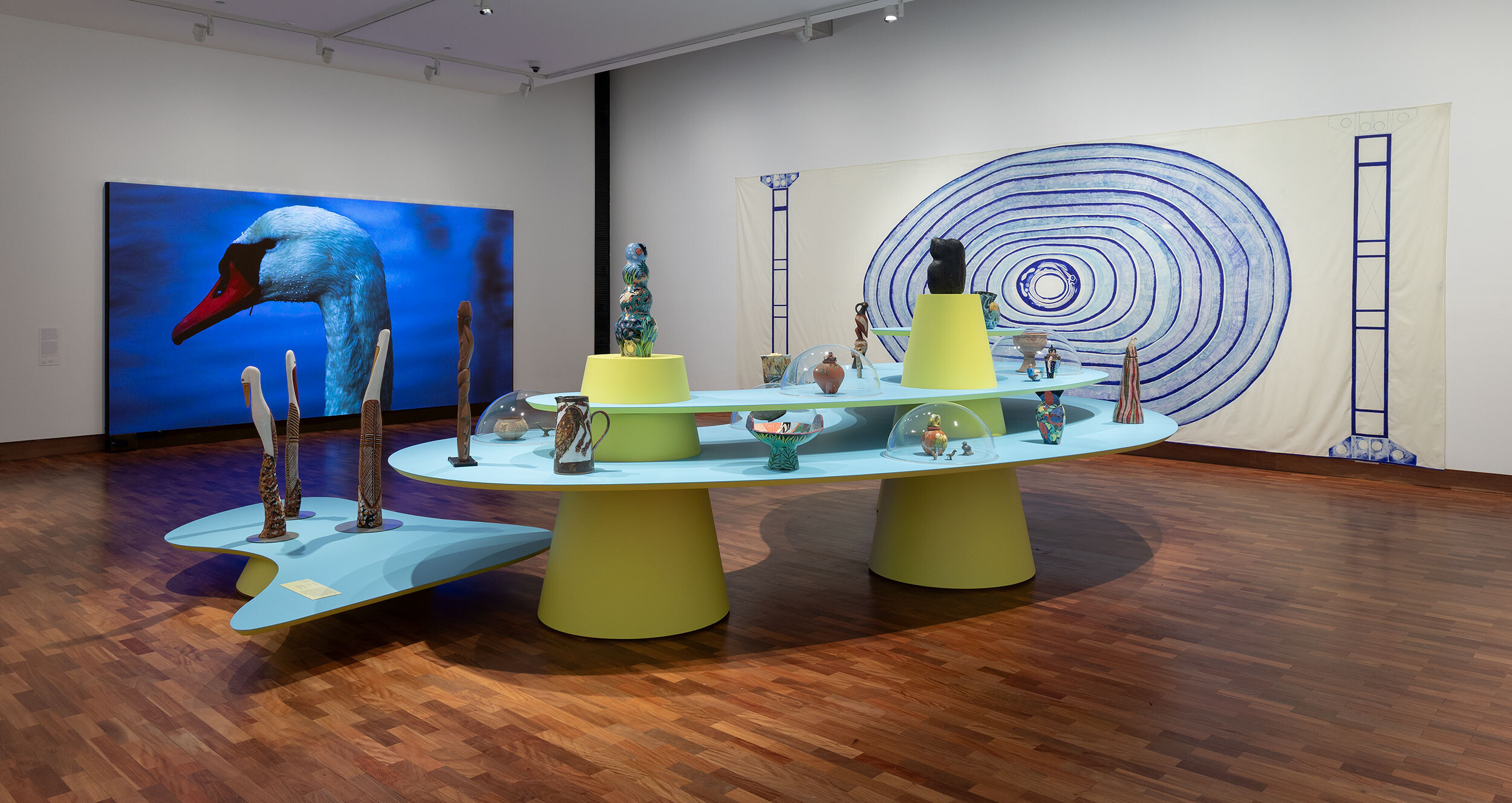
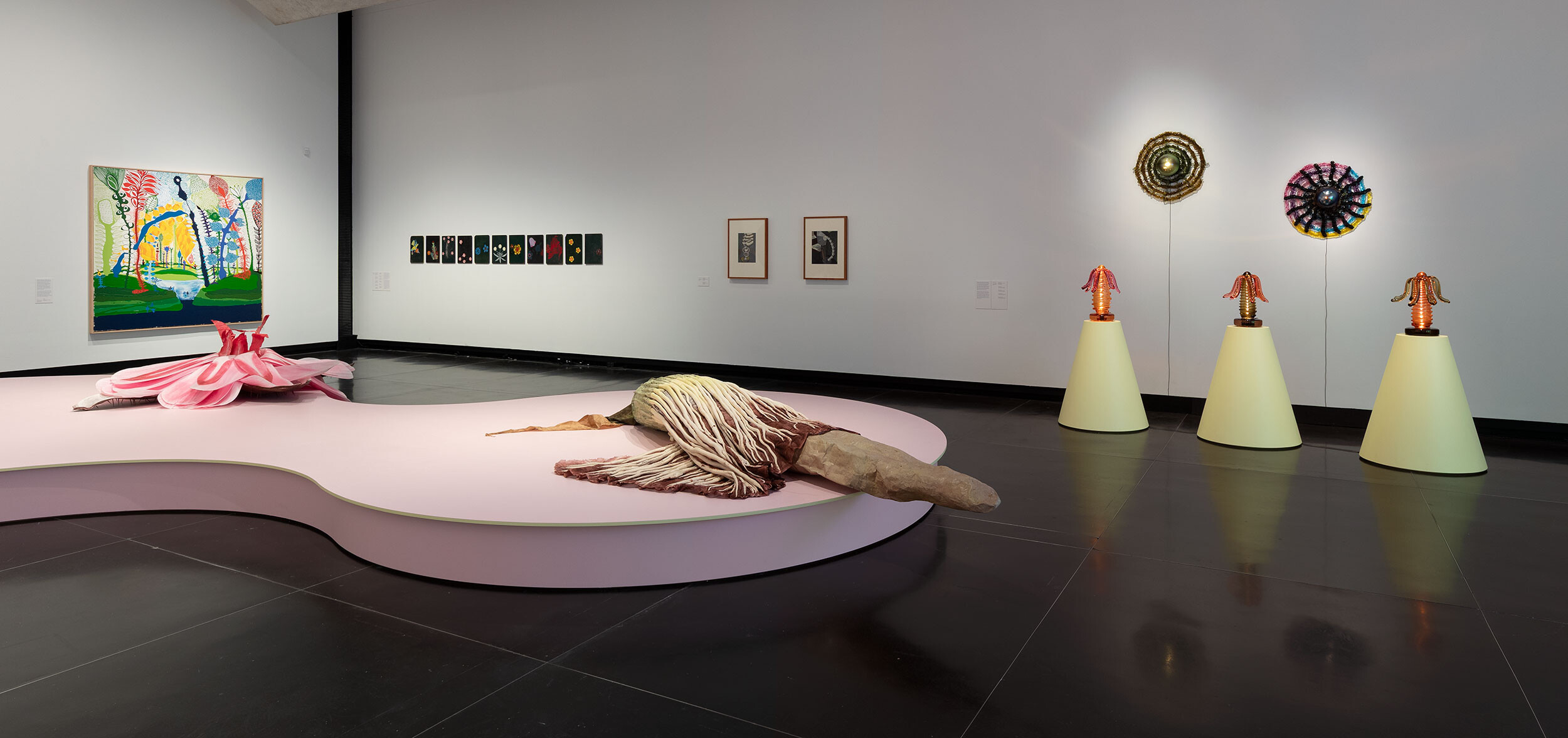
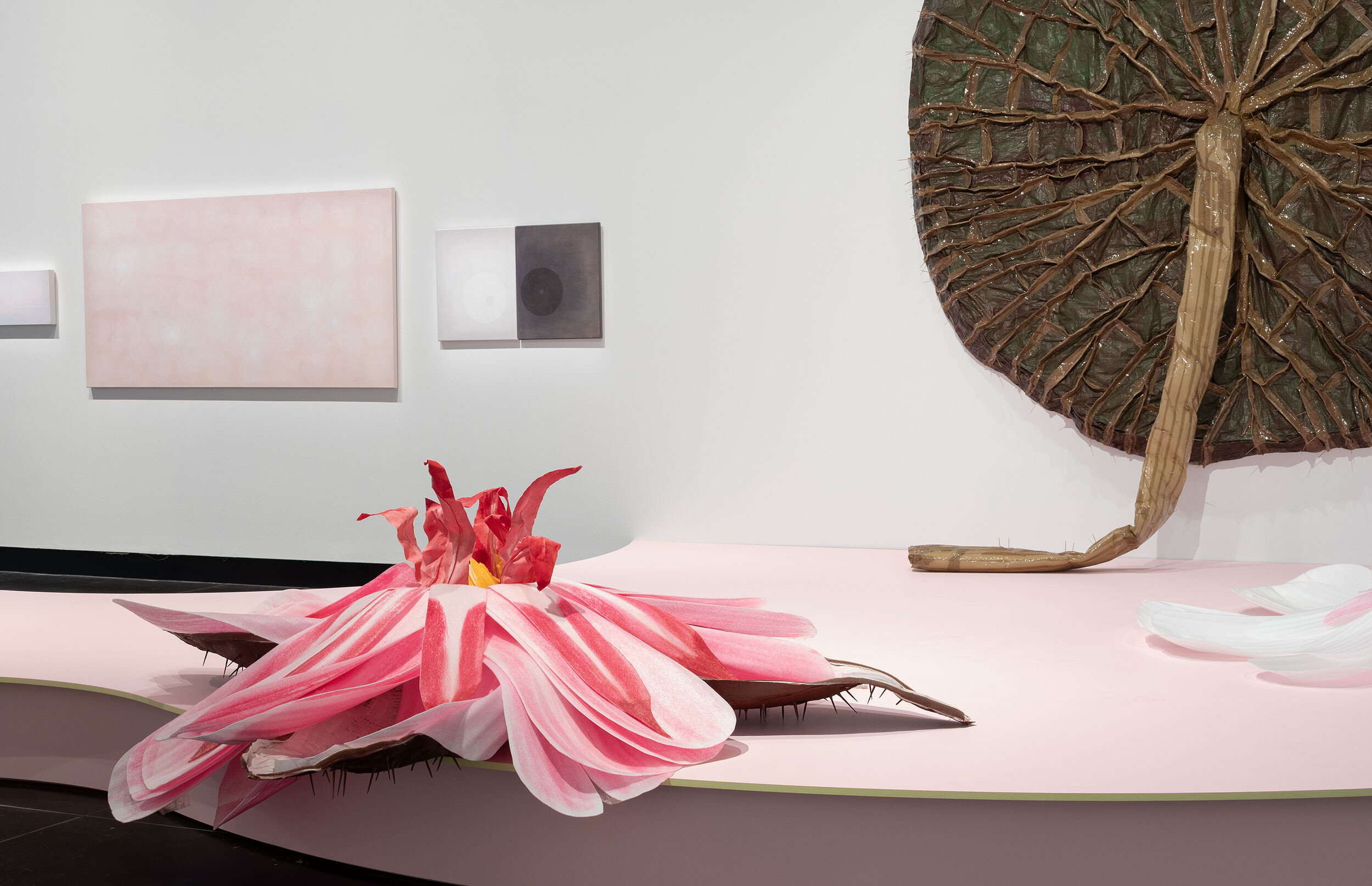
Bringing together works by over sixty artists alongside materials drawn from the University of Melbourne’s Classics, Biology, and Art collections, the exhibition places archival objects, scientific illustrations, sculptures, sound works, and specimens into shifting dialogue with one another, opposing any singular interpretive framework. Rather than moving linearly through the exhibition, we found ourselves wandering through recurring motifs, unexpected juxtapositions and formal affinities between works. This structure reflects Martínez’s interest in what she describes in her “contextual introduction” pamphlet as a “childlike” mode of perception that is exploratory, playful, intuitive. Even artwork dimensions are omitted from wall labels, subtly skewing our sense of scale and orientation. The exhibition encourages us to approach the world not through mastery or certainty, but through curiosity and association. On the ground-floor “flower” level, oversized floral sculptures, large luminous video installations, pastel display platforms, and intensely artificial colours produce a kind of staged botanical excess, where “nature” appears less as a stable category than as something continually constructed through ecological imagery, institutional classification, fantasy, ornament, and projection.

Installation view of A velvet ant, a flower and a bird, Potter Museum of Art, the University of Melbourne, 2026. Photo: Christian Capurro.
The show at large eludes totality and closure. Populated by a sprawling constellation of objects, artworks, specimens, films, and archival materials, A Velvet Ant, a Flower and a Bird attempts, as Milne explained during the exhibition walkthrough, to “take the institutional straitjacket off.” Materials drawn from the University of collections are effectively “cut open” from their usual taxonomic frameworks and reorganised outside conventional art-historical categories such as nation, period, or medium. Moving up and down between the exhibition’s three levels, some works begin to speak to one another through formal resemblance and thematic overlap, resulting in a viewing experience that feels continually in formation.
But this openness also becomes something of a double-edged sword: in resisting set meanings so thoroughly, the exhibition can paradoxically make meaningful connections harder to sustain, as the abundance of possible interpretations threatens to disperse our attention rather than focus it.

Installation view of A velvet ant, a flower and a bird, Potter Museum of Art, the University of Melbourne, 2026. Photo: Christian Capurro.
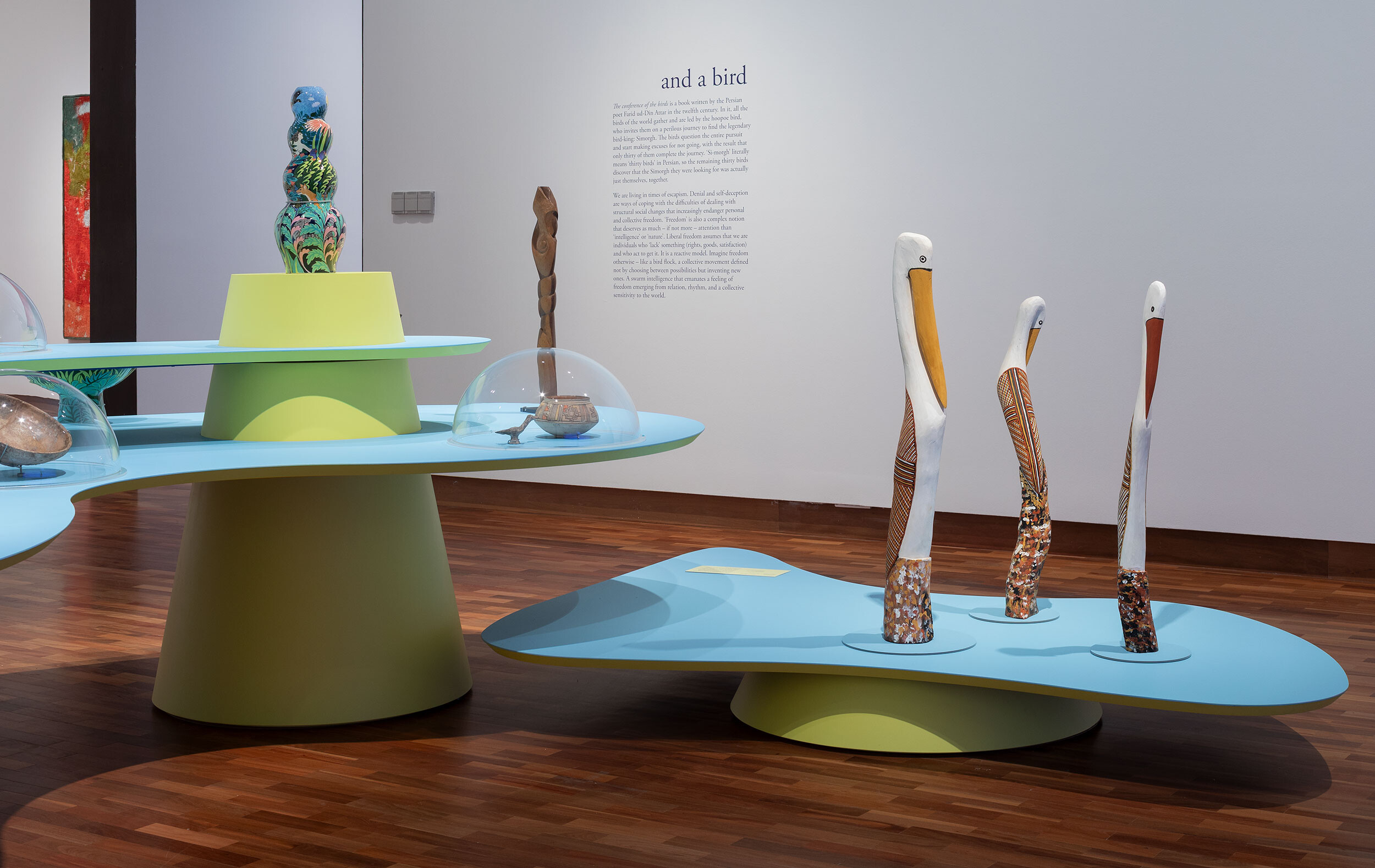
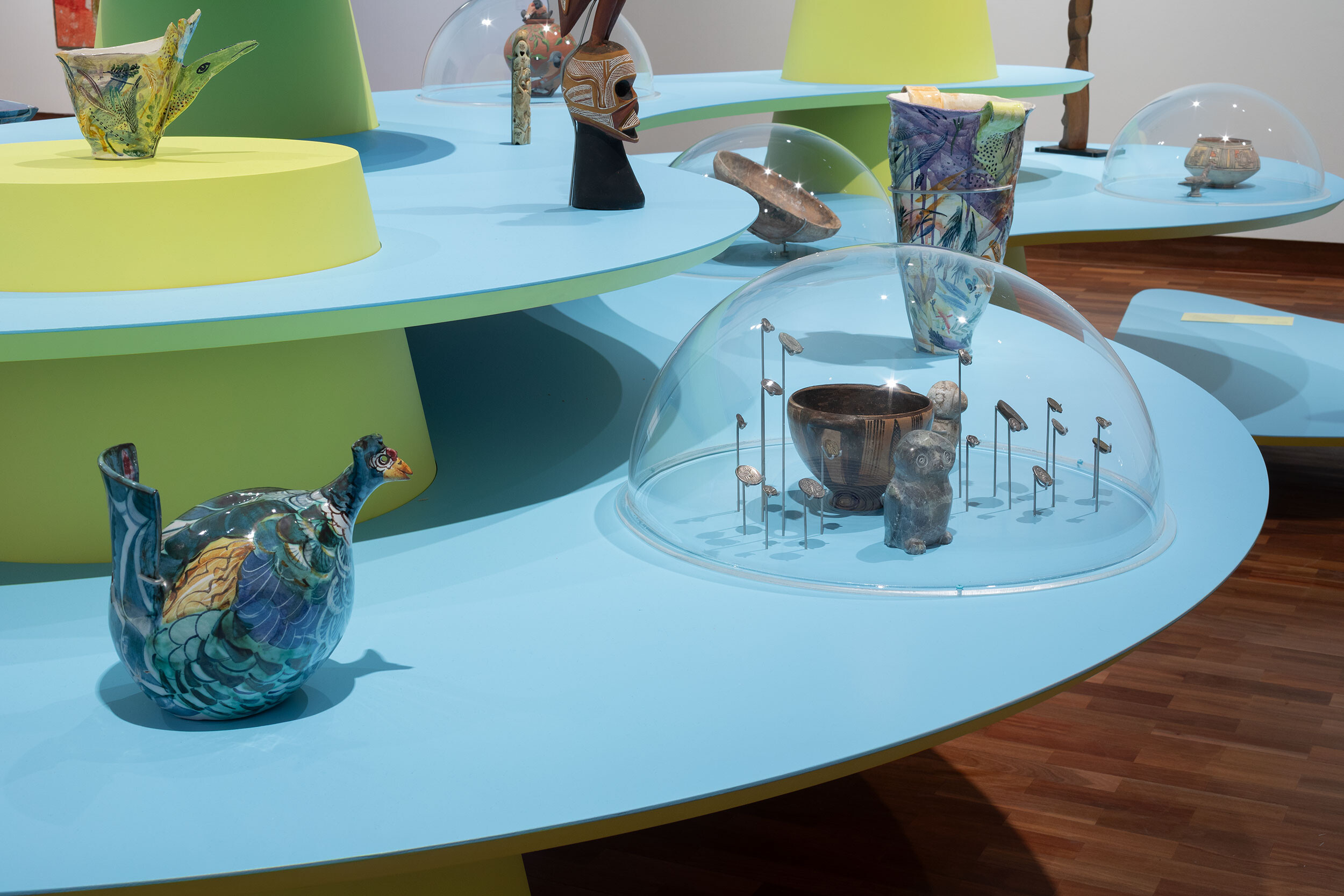
This tension between openness and dispersal becomes especially apparent in the exhibition’s more easily overlooked works, as well as its ambitious yet uneven exhibition design, whose oversized kidney-shaped tables and pastel, tiered biomorphic display structures lend the centre of each of the gallery on each floor a self-conscious playroom quality. At times, the exhibition design competes with, rather than clarifies, the relationships between works. On the “bird” level, a cluster of ancient Greek coins from the University’s Classics and Archaeology collection are uniformly flipped to reveal birds rather than the profile of a ruler, redirecting attention away from human authority toward the exhibition’s recurring emphasis on the non-human.

Installation view of A velvet ant, a flower and a bird, Potter Museum of Art, the University of Melbourne, 2026. Photo: Christian Capurro.
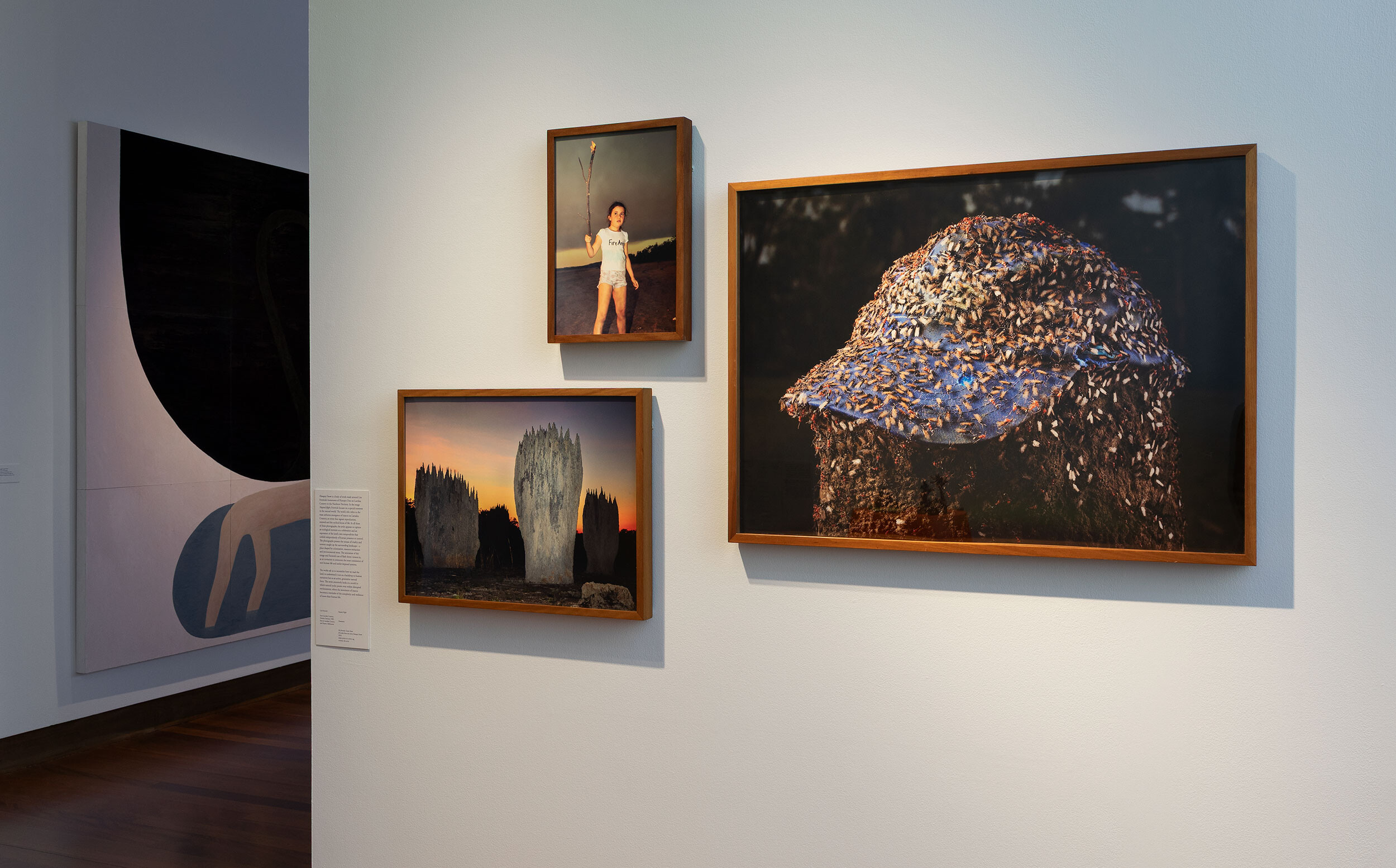
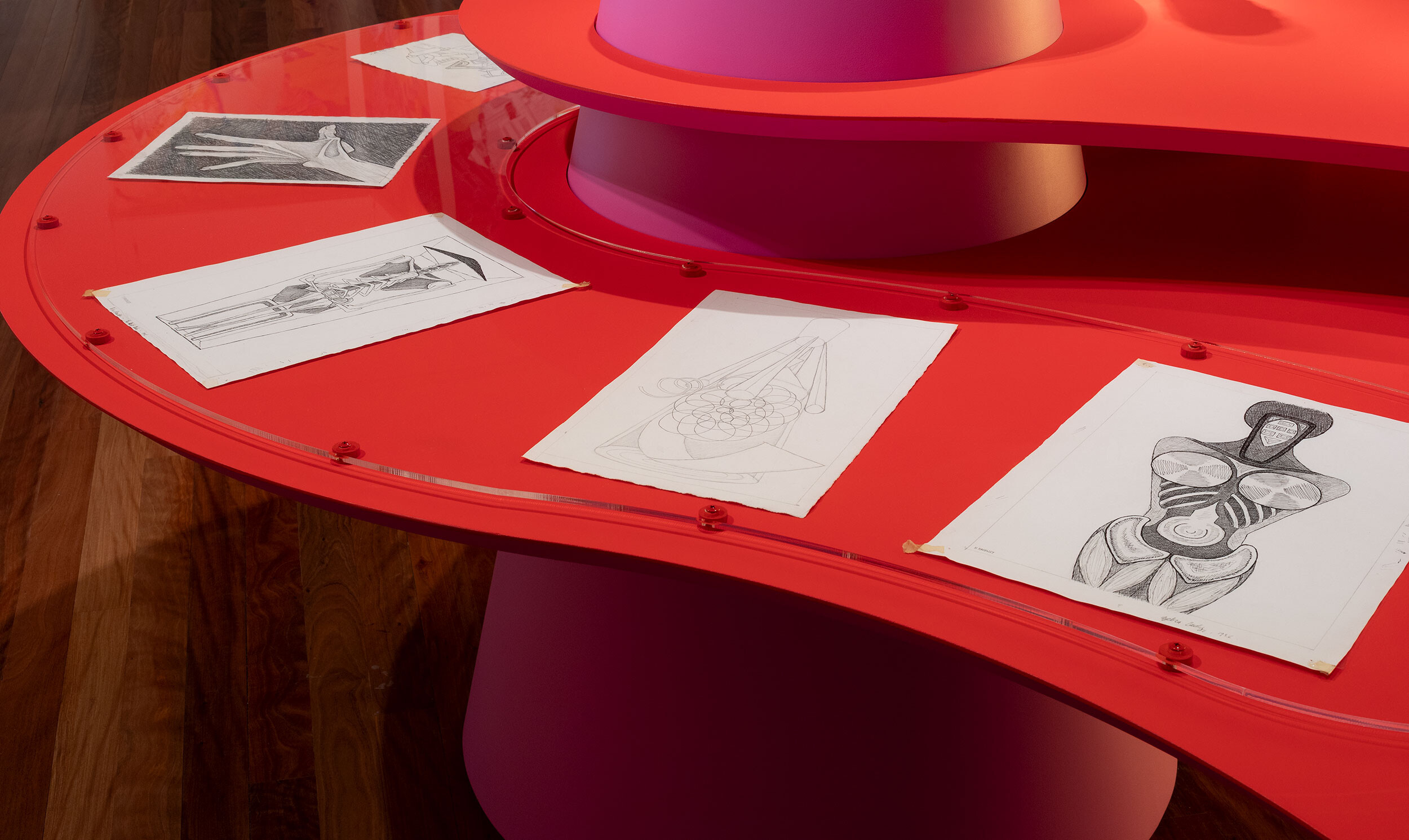
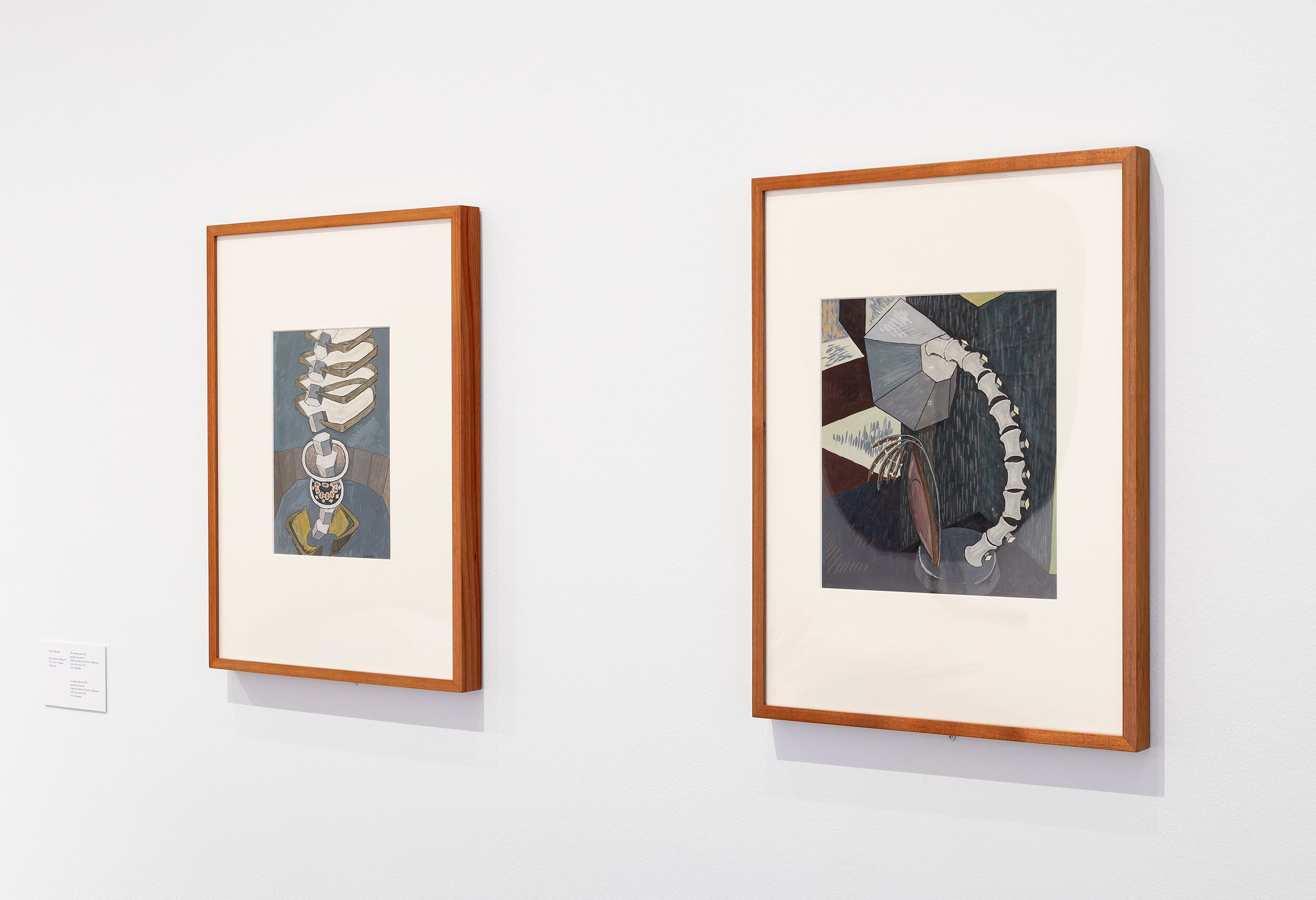
Given the emphasis on collective systems within the curatorial framework, it felt surprising that so much real estate was given to Heather B Swann’s expansive paintings and not to Liss Fenwick, whose dedicated projects on the termite worlds are so heavily evoked across the exhibition and were encountered almost accidentally, tucked away around a corner on the “velvet ant” level, with only a small selection of three photographs from their earlier Humpty Doom series from 2023. Similarly, two gouache and pencil drawings of spines by Helen Maudsley, made when she was just twenty-nine in 1956, are strangely easy to miss on the ground-floor “flower” level, where emphasis instead falls on Ingela Ihrman’s expansive floral works from 2012 and 2013 stretching across the floor and creeping up one of the walls. Further drawings by Maudsley from 1955–6 reappear later on the “ant” level under perspex: abstracted studies of hands and torsos, complete with visible pencil test marks in the margins. Nearby, the exhibition’s most overtly Surrealist gesture—a reproduction of a Salvador Dalí print from 1947 (displayed so informally we entertained thoughts of stealing it) alongside the Disney collaboration Destino (released in 2003)—extends these relational impulses even further.

Installation view of A velvet ant, a flower and a bird, Potter Museum of Art, the University of Melbourne, 2026. Photo: Christian Capurro.
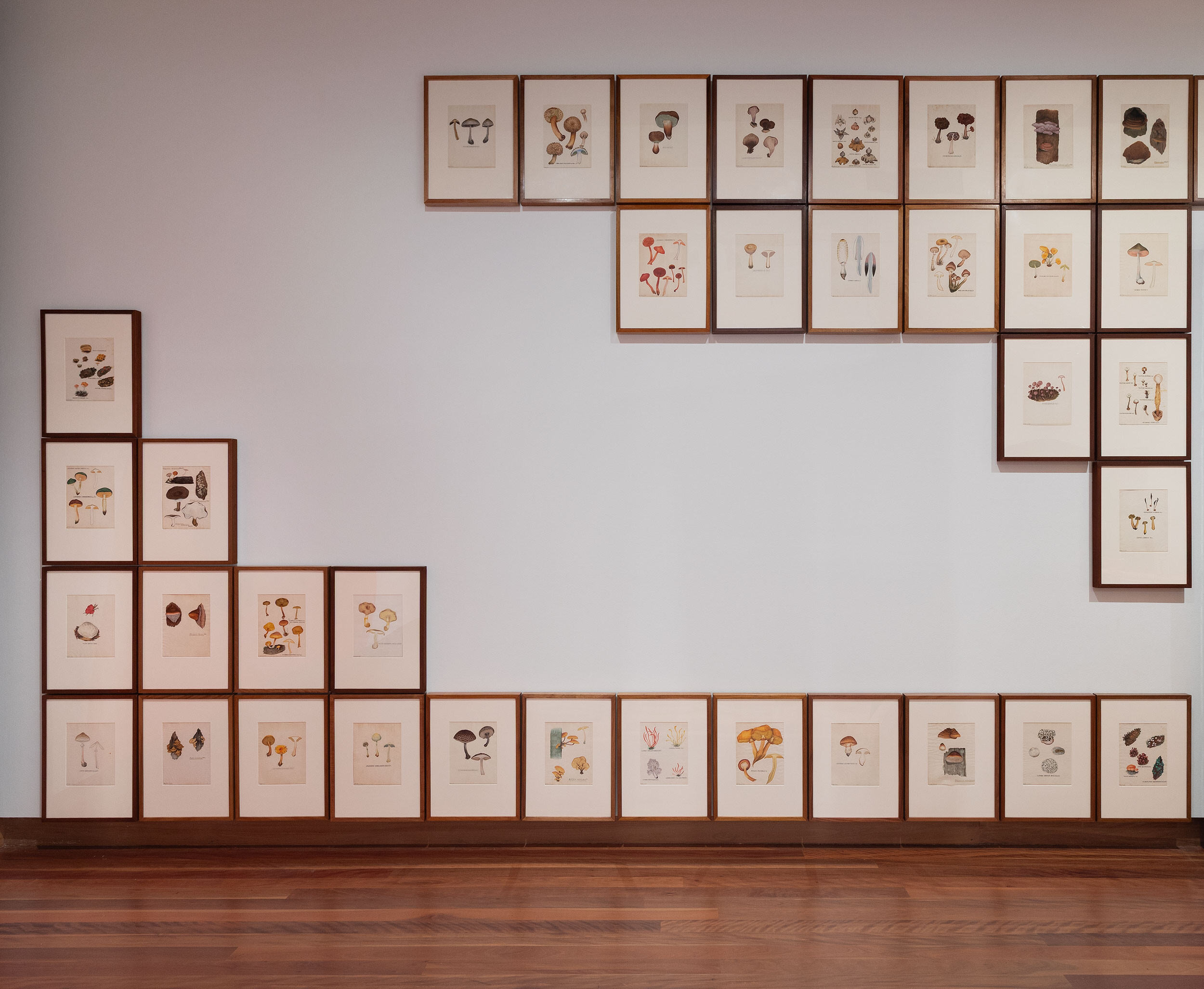
If the exhibition’s Surrealist tendencies encourage relational or even psychoanalytic thinking, the returning motif of ants offers another way for us to understand the exhibition altogether: as a collective system that only coheres through our movement and participation within it. In Brazilian artists Rivane Neuenschwander and Cao Guimarães’s video work Quarta-feira de cinzas/Epilogue (2006), ants carry fragments of brightly coloured confetti back toward their nest, repurposing the remnants of human celebration into building material. Opposite it, a wall of delicate fungal watercolours by Australian botanical illustrator Malcolm Howie from the 1930s discretely mirrors this logic of repetition and collection, their uneven branching formations suggesting another kind of distributed intelligence operating through growth, classification, and sustained observation.

Installation view of A velvet ant, a flower and a bird, Potter Museum of Art, the University of Melbourne, 2026. Malcolm Howie, Watercolour paintings of Victorian fungi from the 1930s 1931-35, from The University of Melbourne Herbarium, School of BioSciences Naarm. Photo: Christian Capurro.

Installation view of A velvet ant, a flower and a bird, Potter Museum of Art, the University of Melbourne, 2026. Photo: Christian Capurro.
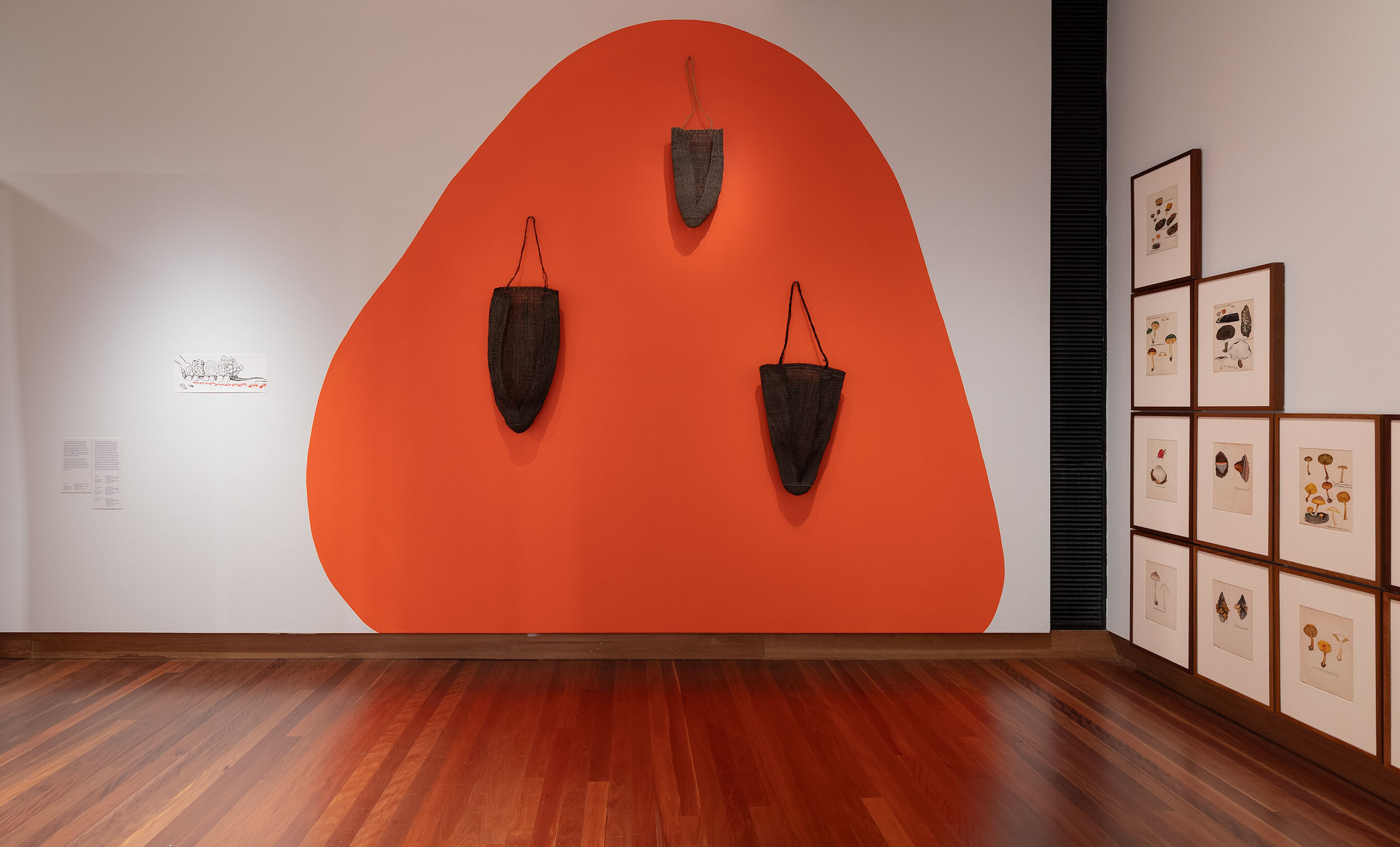
Nearby, behind Gracia Haby and Louise Jennison’s folded and suspended screens Specimen 1963 (2026) (here we find the only velvet ant in the show), are three hanging mol djinbakara (black baskets) from 2024 by Helen Ganalmirriwuy Garrawurra and Margaret Rarru Garrawurra, continuing the exhibition’s emphasis on accumulation, containment, and collective organisation. Likewise, Neha Choski’s Sugar Train Ride for the Ants (1997), encountered only through a single sketch for the performance, imagines systems of labour and disruption through sugary offerings that lure both ants and passersby away from their routines. Throughout the exhibition, references to colonies, networks, fungi, root systems, and collective forms of cognition recur incessantly, suggesting that knowledge itself emerges collaboratively rather than individually. Moving through the Potter, we gradually found ourselves behaving similarly, like a flock: collecting fragments, wandering between rooms, scribbling in our notebooks and on our phones, doubling back, and constructing meaning incrementally rather than all at once.

Installation view of A velvet ant, a flower and a bird, Potter Museum of Art, the University of Melbourne, 2026. Photo: Christian Capurro.
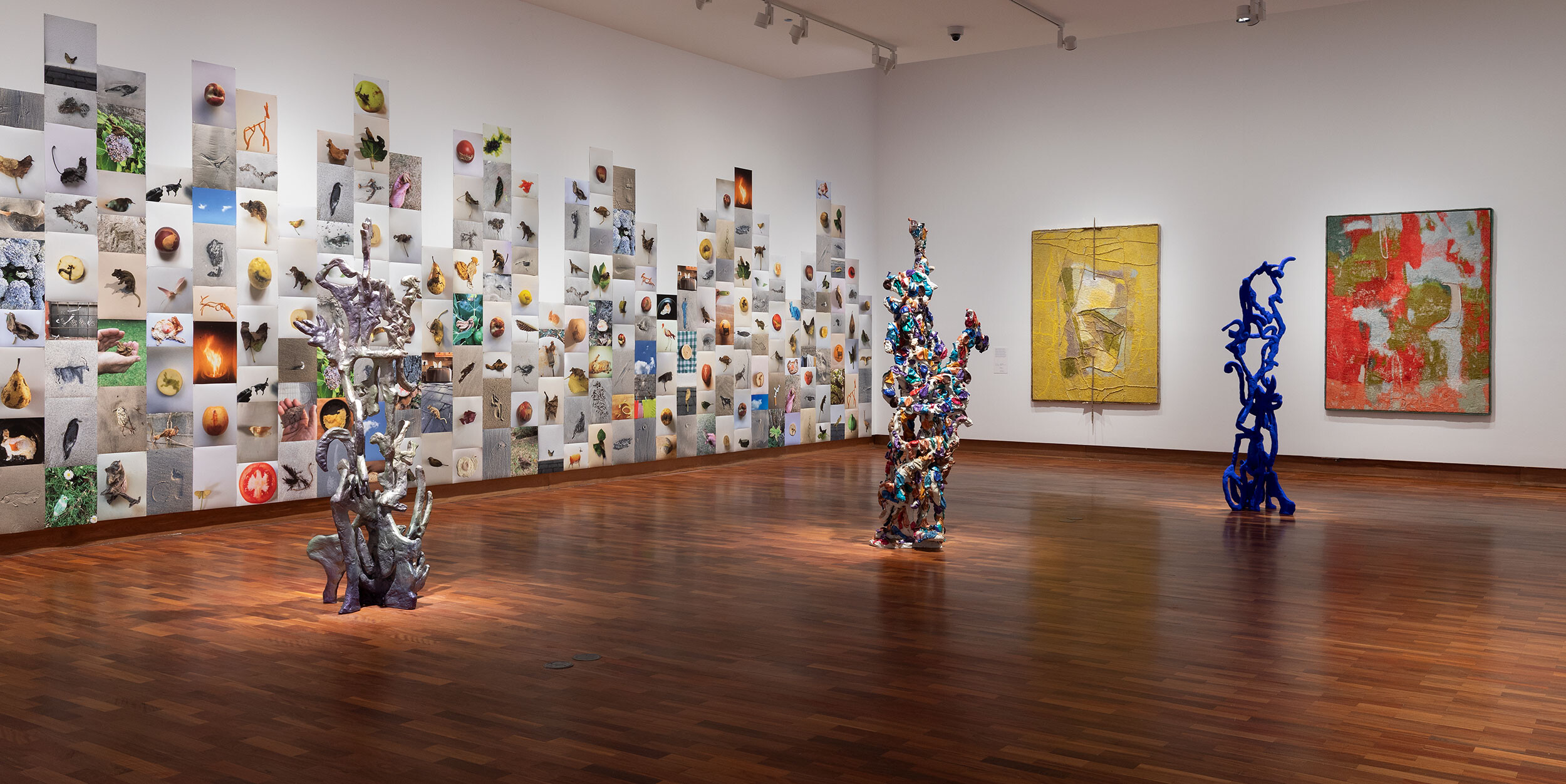
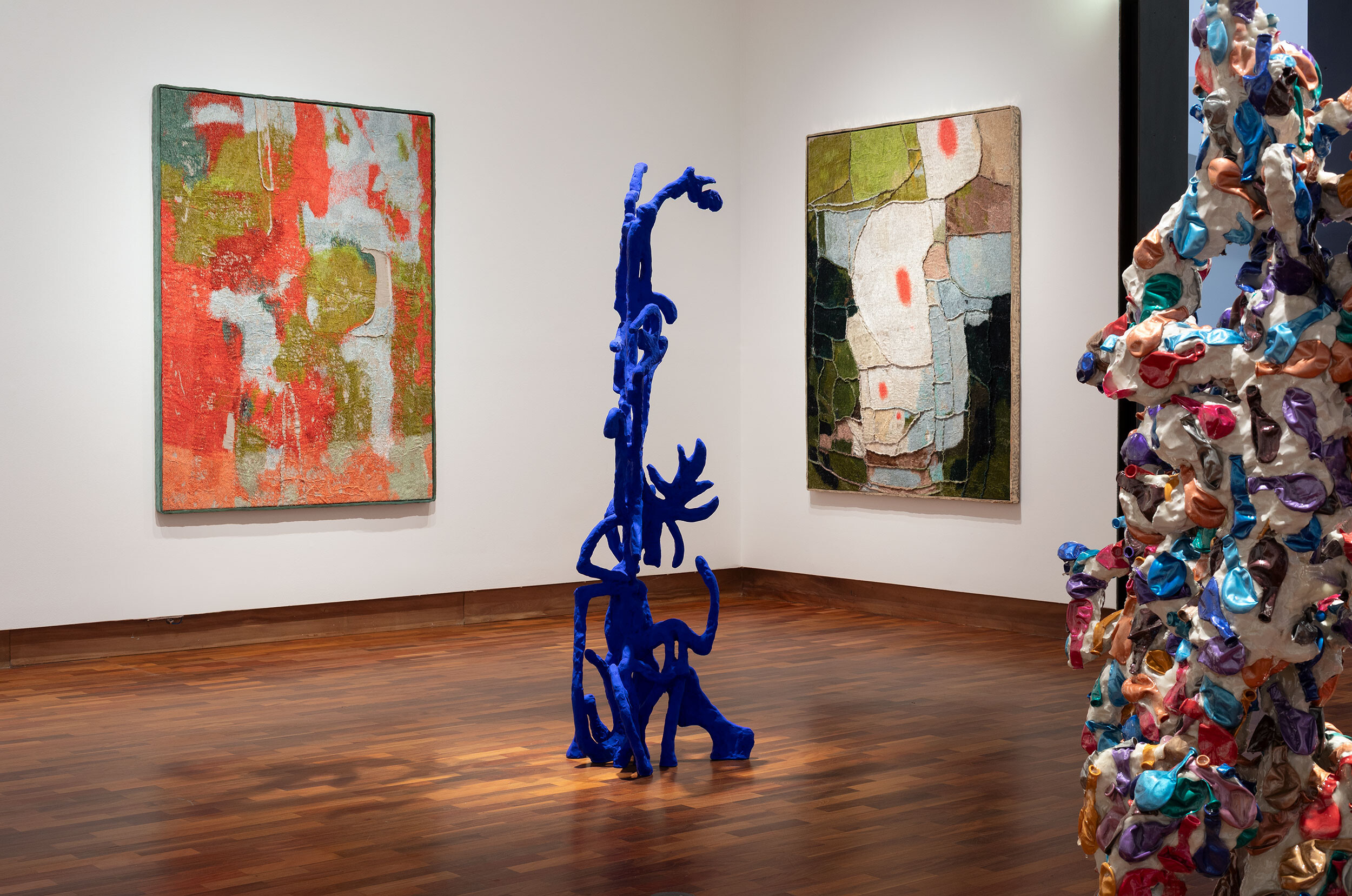
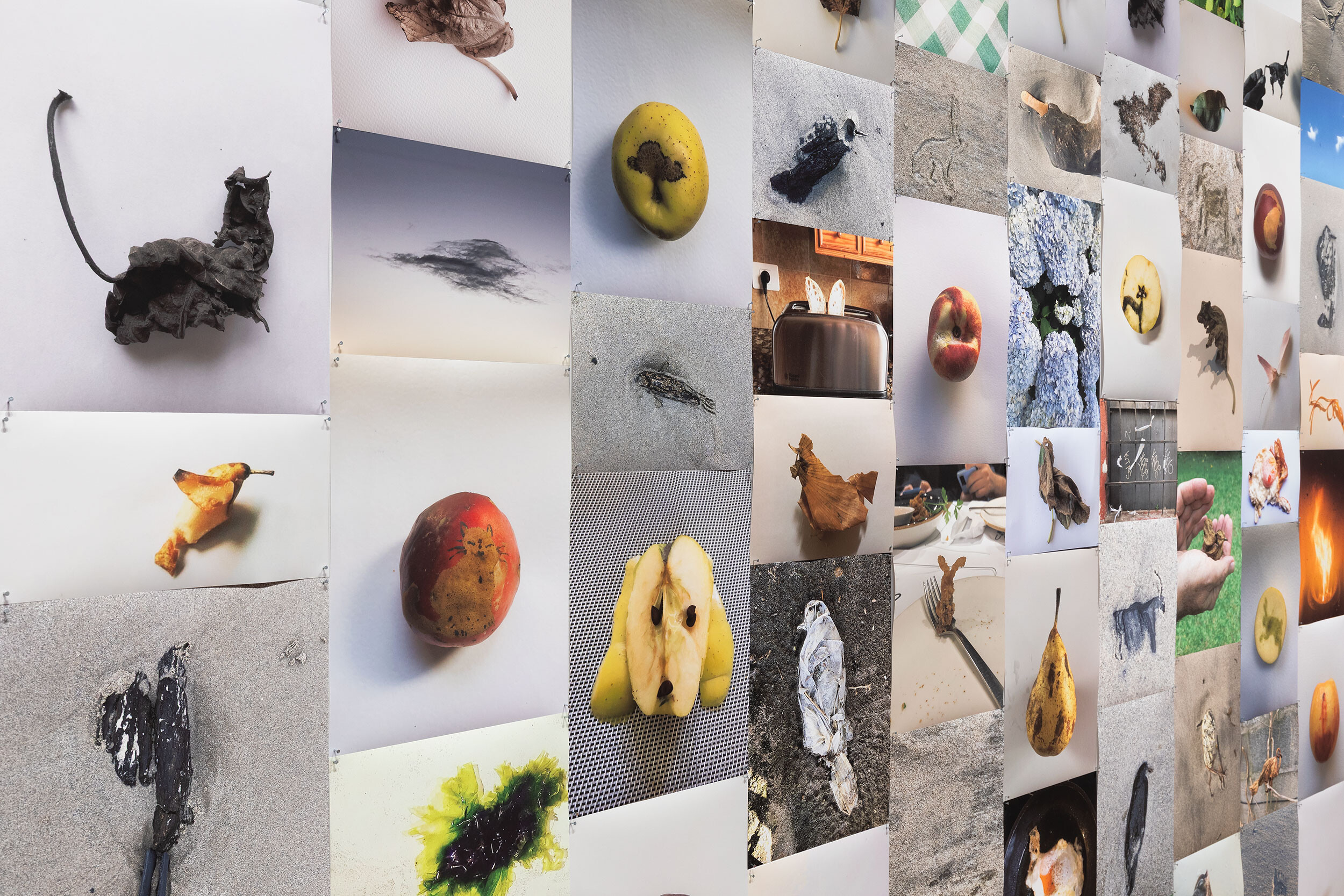
By the exhibition’s final “bird” upper level, however, these associative structures begin to loosen even further, our flock beginning to scatter. Teelah George’s tapestry-like works, with their layered feather-like textures, are connected through the suggestion of a “bird’s-eye” view, while Nabilah Nordin’s tall and gangly brightly coloured epoxy sculptures are framed through the proposition that the works “become a method of thinking.” At times, the relationships between works feel increasingly speculative, as though the exhibition’s commitment to open-ended association risks drifting into pure adjacency. Still, this instability also clarifies something central to Martínez’s curatorial approach. In Din Matamoro’s photographic series opposite these works, rotting fruit, leaves, clouds, and stains begin to resemble faces, animals, and bodily forms, invoking pareidolia—the tendency to perceive meaningful images within randomness. Extending the exhibition’s investment in “childlike” perception, these works suggest a world not quite fully organised through adult cognition, where meaning emerges intuitively or even irrationally, and through projection as much as observation. For some of us, this openness became increasingly irritating; for others, it remained one of the exhibition’s greatest pleasures.

Installation view of A velvet ant, a flower and a bird, Potter Museum of Art, the University of Melbourne, 2026. Photo: Christian Capurro.

Installation view of A velvet ant, a flower and a bird, Potter Museum of Art, the University of Melbourne, 2026. Featuring Din Matamoro, Pájaro y otros animales (Birds and other animals) 2008-20, courtesy the artist. Photo: Christian Capurro.
If we could end with a punchline, we might cast our eyes across to another exhibition currently on at Conners Conners in Fitzroy, which featured a Mikala Dwyer performance that dramatised the tragedy of Punch. At the exhibition opening, cloaked in a make-shift fur costume, a performer, was filmed crawling on their hands and knees, dragged around a monkey toy, resembling the world-famous baby Japanese macaque in the Japanese zoo who, abandoned by his mother and bullied by other macaques, instead became attached to a stuffed toy orangutan given to him by his handlers to replace his mother—a story that made our hearts bleed (and still does) the world over. Perhaps we could imagine ourselves as Punch looking on, only this time clutching art instead of a stuffed toy substitute. But Punch is growing up now and soon won’t need his “mother.” The difference, Martínez would likely argue, is that art promises connection rather than substitution. Still the distinction is not always clear. And similarly we wonder, walking out of A Velvet Ant, a Flower and a Bird, whether we might have grown up a little and can now leave all of its good and vague feelings behind. We look forward to Potter’s upcoming show about gumtrees, which might actually reach up and touch the sky.
Gallery