A Temple in Three Acts
September 19, 2026
-
A Temple in Three Acts
Venue: Gertrude Contemporary
22 Aug 2026 – 17 Oct 2026
In A Temple in Three Acts Australian-Balinese artist Leyla Stevens documents the traces and spatial conditions of Pura Taman Sari, a temple under the care of her extended family. The temple is located near the artist’s family home in Jalan Poppies I (Poppies Lane 1) in Kuta, within the Kabupaten Badung (Badung Regency) of Bali, Indonesia. Between the late 1980s and 1994, the family residence was converted into the Fat Yogi Cottages, a response to the area’s rapid growth as a site for services needed to accommodate an increasingly itinerant population.
If you have visited Kuta Beach, you have no doubt entered the tightly framed, horizon-line defying laneways of Jalan Poppies I and II, named after the longstanding dining establishment Poppies. It is Bali’s tourist epicentre, a place where you will undoubtedly hear the twang of an Australian “no worries” within the first few minutes of navigating either laneway. For a foreign visitor, it is a place where you can build up your entitlement muscle and haggle down a Bintang singlet or Batik sarong to $3.50. The pace of consumption is here matched by the heaviness in the tropical air, as you navigate the heaving crowd, the unpredictable movement of scooters and the Canang Sari offerings placed on the ground, all while yearning for the icy air-conditioned space of your hotel room.
A quadrant can be drawn between Jalan Poppies I and II, bordered to the east by Jalan Legian and to the west by Kuta beach. The intersection of Jalan Legian and Jalan Poppies II is now a memorial for the Sari Club bombing in 2002, commemorating the 202 lives lost and the over 240 injured. This very public and legitimised mourning marker contrasts with the silence that accompanies the many unmarked mass graves throughout the archipelago, which contain the remains of some of the 500,000 to 1 million people who were killed during Indonesia’s 1965-66 mass murder of alleged communists. There is in fact one such unmarked mass grave just nearby, initially identified by Stevens during conversations with her father and translated into the work Witness (2016) within Of Love and Decomposition (2016), her first solo exhibition held at Firstdraft, Sydney.
Pura Taman Sari is one of the oldest temples within the area. The temple’s name translates to “beautiful garden” or “fragrant garden,” deriving from Bahasa Jawa or Javanese. Stevens relays that the oldest components of the temple are in fact the fragrant punyan Jepun (frangipani trees) located within the temple complex. In a conversation with me about her reflections of Pura Taman, Sari Stevens notes that in Bali the frangipani tree is considered a temple tree, and in Java it is a cemetery tree.
The site of the temple and its surrounds is a place that Stevens is deeply connected to, a place where she brings her child to engage in the autochthonous experiences that take place amidst the cultural extraction that tourism necessitates. Stevens’s work is interested in the way such experiences and practices, and the meanings projected onto them, can transform a site into a place. One way to understand place is through critical morphology, the study of form and structure and the interconnected micro and macros settings that situate an object or structure. Another is through an awareness of how conditions of globalisation filter into a local site, constructing a particular constellation of social relations, meeting and weaving together. In this mode, place knowledge presents extrovertedly, with a consciousness of its links with the wider world, integrating the global with the local. A final way to comprehend place knowledge is within the study and creation of archives. This is the frame in which A Temple in Three Acts emerges, as a testing and countering of archival practice, and an enquiry held between the permanence and impermanence of place knowledge.

Leyla Stevens, A Temple in Three Acts, 2026, installation view, Gertrude Contemporary, Naarm Melbourne, image courtesy of the artist and Gertrude © the artist. Photograph: Christian Capurro
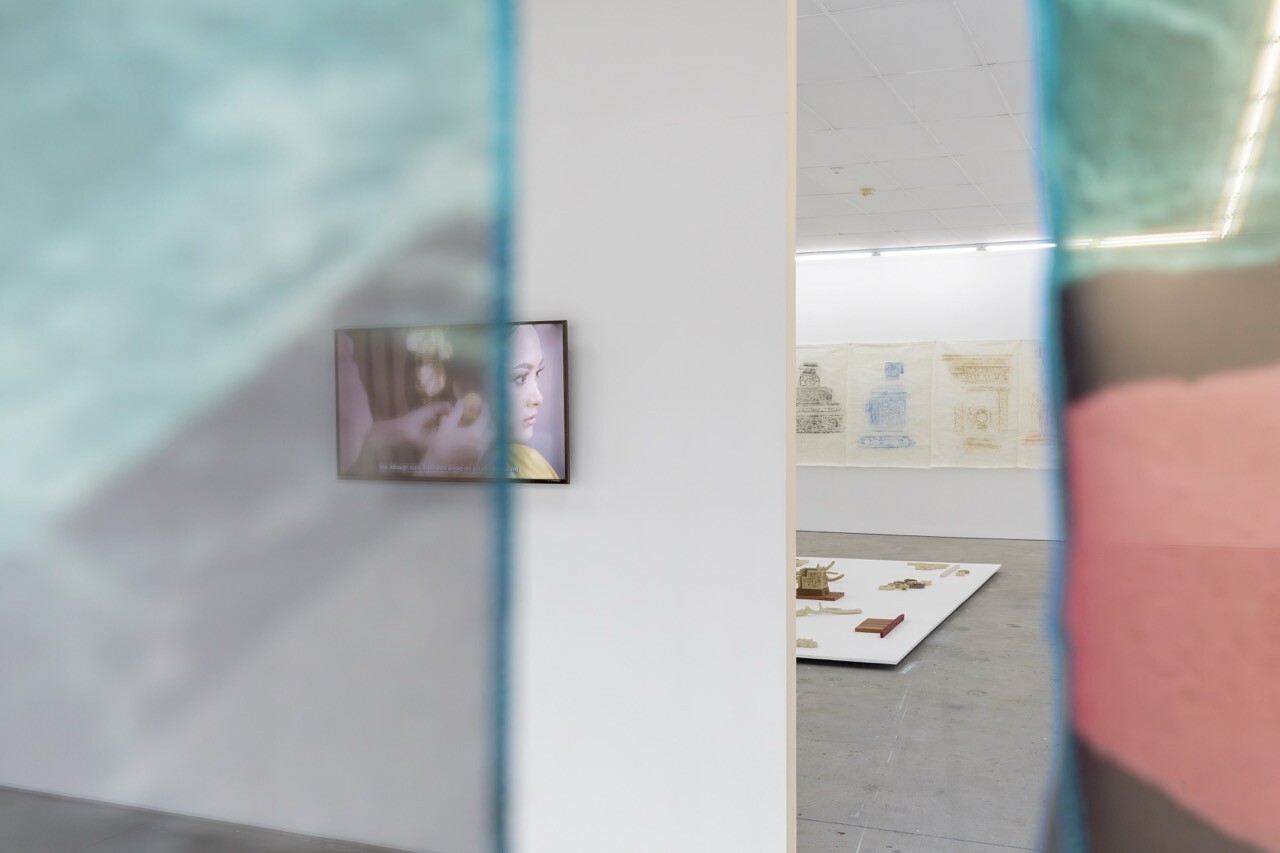
The broader setting for the place in Stevens’s exhibition is first introduced as you enter Gertrude Contemporary, between two contextualising works Payasan (2026) and Fat Yogi (2026). Payasan is a single-channel video work. Its title, translated from Bahasa Bali, means “to adorn.” The work is presented at a screen size that evokes retail or shopfront advertising. It features scenes of a payas agung adornment being prepared ahead of a ceremony, interlaced with the details of jewellery and components of the payas agung crafted by the artist’s grandfather, a pandai emas skilled in gold casting methods particular to Bali.
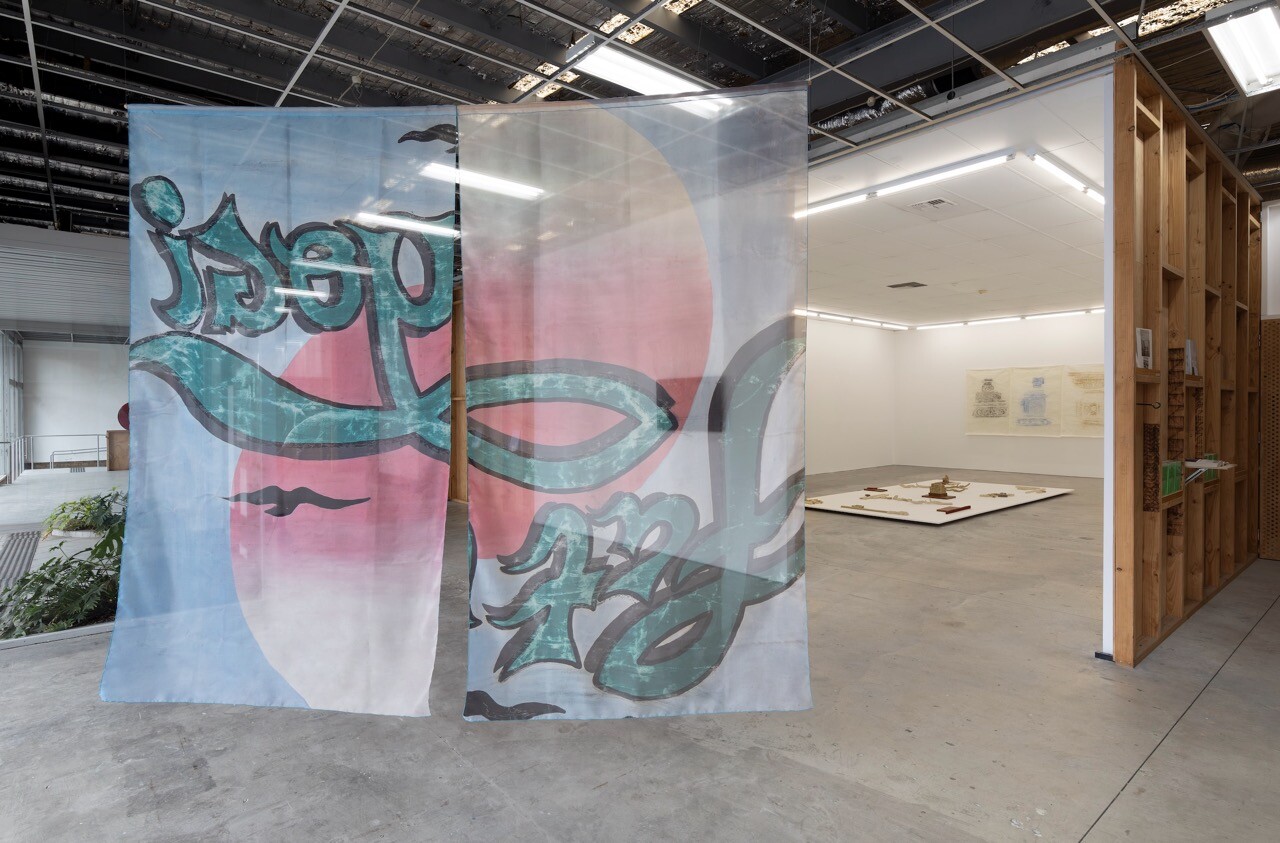
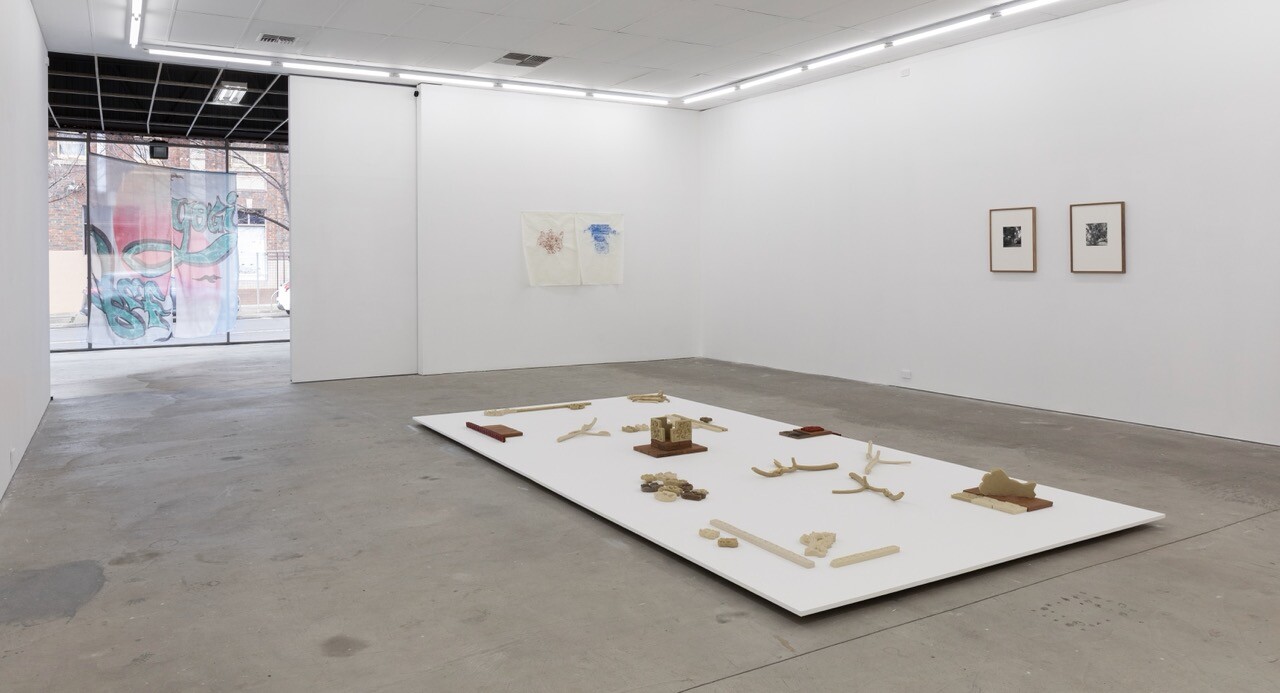
On the right wall, gently flowing in response to passersby, is the gossamer textile work Fat Yogi, consisting of two adjoining pieces hung in mid-air, akin to a doorway or passage. This photographic textile print depicts a detail of the Fat Yogi Cottages sign that greets tourists turning into the courtyard of the residence. If you were to do some digging, you would find that the logo for the cottages also includes a rumbustious looking smiling yogi. In the artist’s reconfiguration, the graphic has been cropped to focus on the hand-lettered typography and dulcet tones of a setting sun—a nostalgic setting. The three birds from the original logo are almost unrecognisable, sliced or disjointed in the reassembled graphic. The piece can be interpreted as a candi bentar, a split gate typically found at the entrance to a temple.
Both Payasan and Fat Yogi speak to the tensions of Pura Taman Sari’s surroundings. Tensions such as the loss of place knowledge that occurs when a master craftsman no longer practices. When a cultural practice becomes visual stimuli and an experience to be consumed by a visiting traveller. When a place quickly expands due to an external demand and in doing so becomes an earnestly kitsch representation of a bygone era, as tastes and expectations of authenticity shift.
Moving from the setting captured between Payasan and Fat Yogi with perhaps an understanding of the morphology and conditions of globalisation that are at play in this place, you step into the artist’s archival enquiry. The central component of A Temple in Three Acts is a set of silver gelatin printed photographs, wafer-thin charcoal transfers, and an abstracted field of cast sculptural forms made from beeswax. One can consider these works to be a testing and countering of archival practice due to the three mediums used and the playful considerations or beginnings that the artist is undertaking to capture or document the place knowledge of Pura Taman Sari.
One primary mission of a more formalised archive is the long-term preservation of unique records. A state of permanency is required to maintain an archive’s historical value and authenticity, to ensure its use as a generator of knowledge. In contexts where multiple and interlinked conditions are at play—a society responding to colonial legacies, hyper-globalisation resulting in the commodification of material culture and an entropic context for cultural continuity, a creeping autocracy, and a tropical environment that is generative of decay rather than preservation—this version of an archive is perhaps implausible.
In my conversation with Stevens, I learn that the Pura Taman Sari was demolished and rebuilt just over a decade ago, an action that felt like an act of knowledge-destruction for the artist. It wasn’t until there was a conversation with her family on what heritage practice looked like from a Balinese cultural perspective that Stevens considered the dichotomy within heritage management and the distinct opportunities present between preservation and renewal.
This reflection could be the rationale for the distinct material sensibility held within the pieces Pura Taman Sari I, the photographs all remaining untitled, and the six charcoal prints that make up Pura Taman Sari II. A silver gelatin printed photograph, for example, can remain unchanged for centuries, if kept in controlled archival conditions. Okwui Enwezor in his essay ‘Archive Fever, Photography between History and the Monument’ states that “a photograph becomes an immediate archival record … an analogue representation of a substantiated real or assumed fact present in nature.”

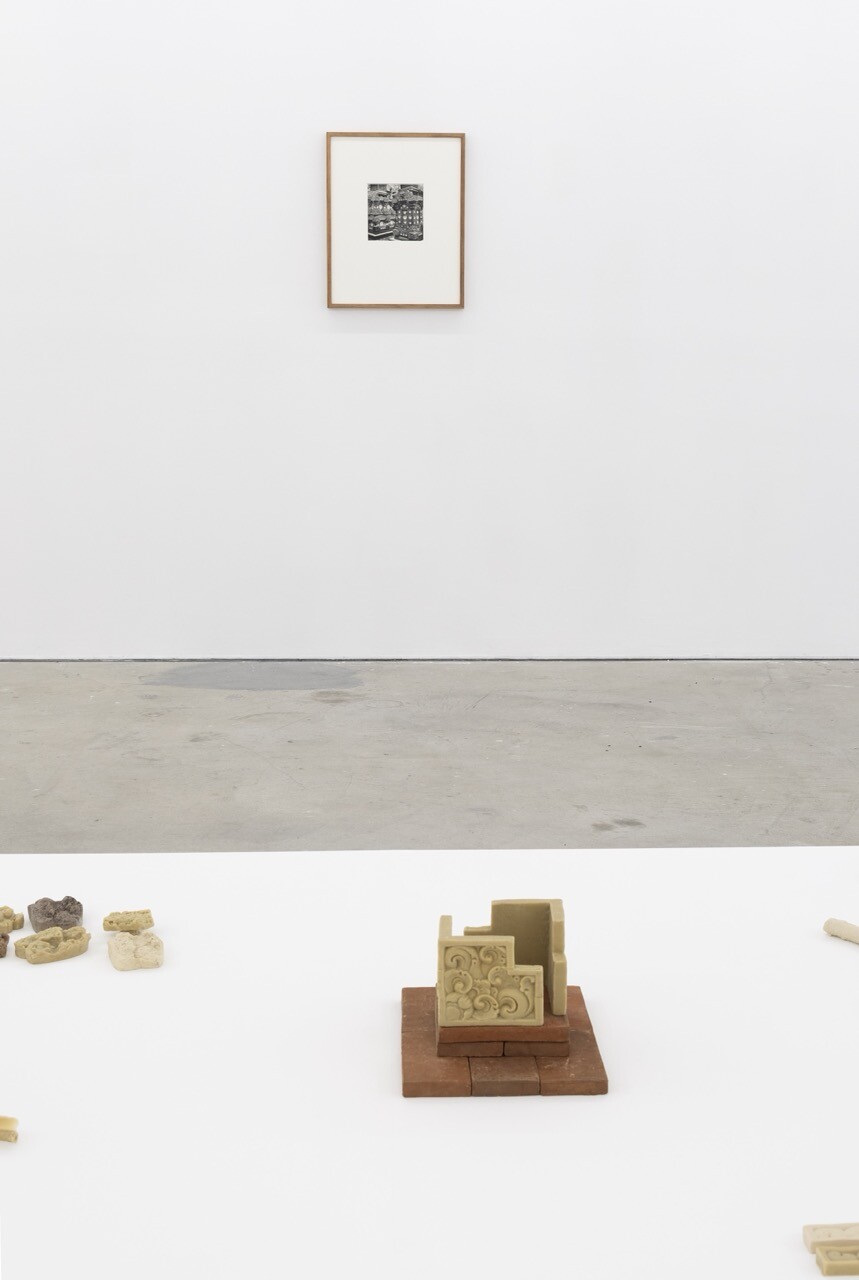
Leyla Stevens, Untitled 3, 2026, silver gelatin print; Pura Taman Sari I (detail), beeswax, damar resin, limestone, terracotta brick, 2026, installation view, A Temple in Three Acts, Gertrude Contemporary, Naarm Melbourne, 2026, image courtesy of the artist and Gertrude © the artist. Photograph: Christian Capurro
The three untitled photographs capture various scenes within the temple. The two smaller photographs are of different trees; the larger photograph of the trio shows the most comprehensive fragment of the temple, tiered pillars with plates embedded on the faces of each. The presence of the plates within these pillars presents as an incongruity, particularly if you take a moment to look at what is printed on them: snowy Dutch scenery and foreign flora, incomprehensible in the balmy reality of their installation. Stevens acknowledges that it was these plates that first sparked her interest in documenting the temple. The presence of the Dutch plates using fine bone china within a sacred Hindu temple can only be described as an outcome of syncretism, and a signal to an earlier passage of globalisation that has touched on this place. Stevens tells me such plates feature within temples and places of civic importance across Bali, often looted at times of civil unrest. Their societal embeddedness and appeal are made clear through the dedicated industry that has been created following their introduction, the print designs being either replicated or replaced with scenes depicting Balinese belief systems across ceramic factories in Indonesia. In the familiar archival form of the crisp black and white photograph, Stevens’s photograph of the temple’s Hindu architecture and Dutch adornments fixes its (still ongoing) process of syncretism in time.
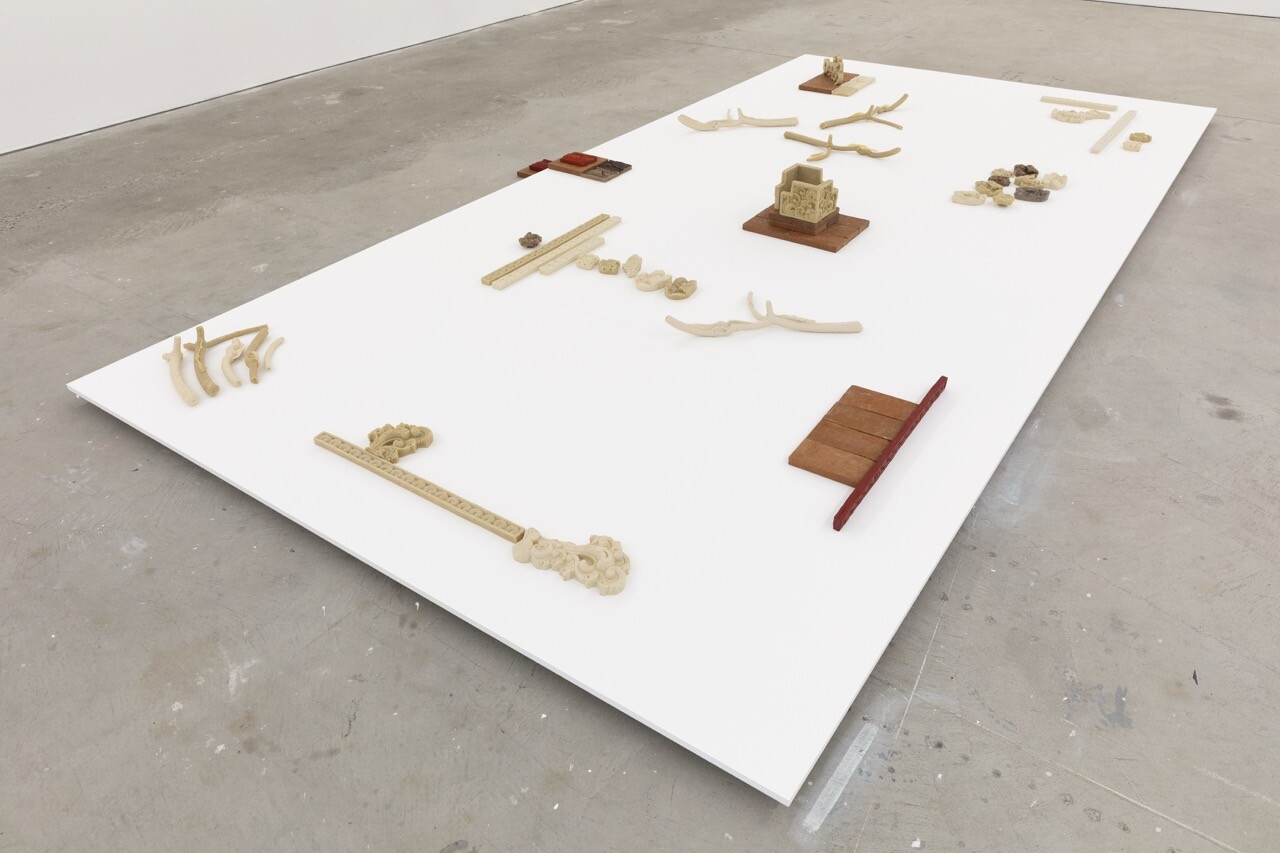
In contrast to this photograph’s documentary impulse, the cast elements that make up Pura Taman Sari I toggle between permanence and impermanence, their creation an inverted manifestation of the casting process that is utilised in traditional Balinese goldsmithing methods. This traditional process requires a sacrifice or a contact with an archetype—in this instance, a sculpted wax form. The original wax form is pressed, coated, and often destroyed by the molten metal that is poured over it. The archetype wax form is created for the purpose of summoning a different material expression. For Pura Taman Sari I Stevens creates impressions and moulds from different armatures of the temple; the corner of a column, the fillagree pattern on a stone carving, the impression of the coral stone that is integrated into the structure, the limbs of a frangipani tree. To create the final form of each impression, Stevens has used beeswax hardened with damar resin, presenting a trace that has been tangibly captured and yet elusive to permanency, or the archival desire to create an exact replica.

Leyla Stevens, Pura Taman Sari I, 2026, installation view, A Temple in Three Acts, Gertrude Contemporary, Naarm Melbourne, 2026, beeswax, damar resin, limestone, terracotta brick, image courtesy of the artist and Gertrude © the artist. Photograph: Christian Capurro
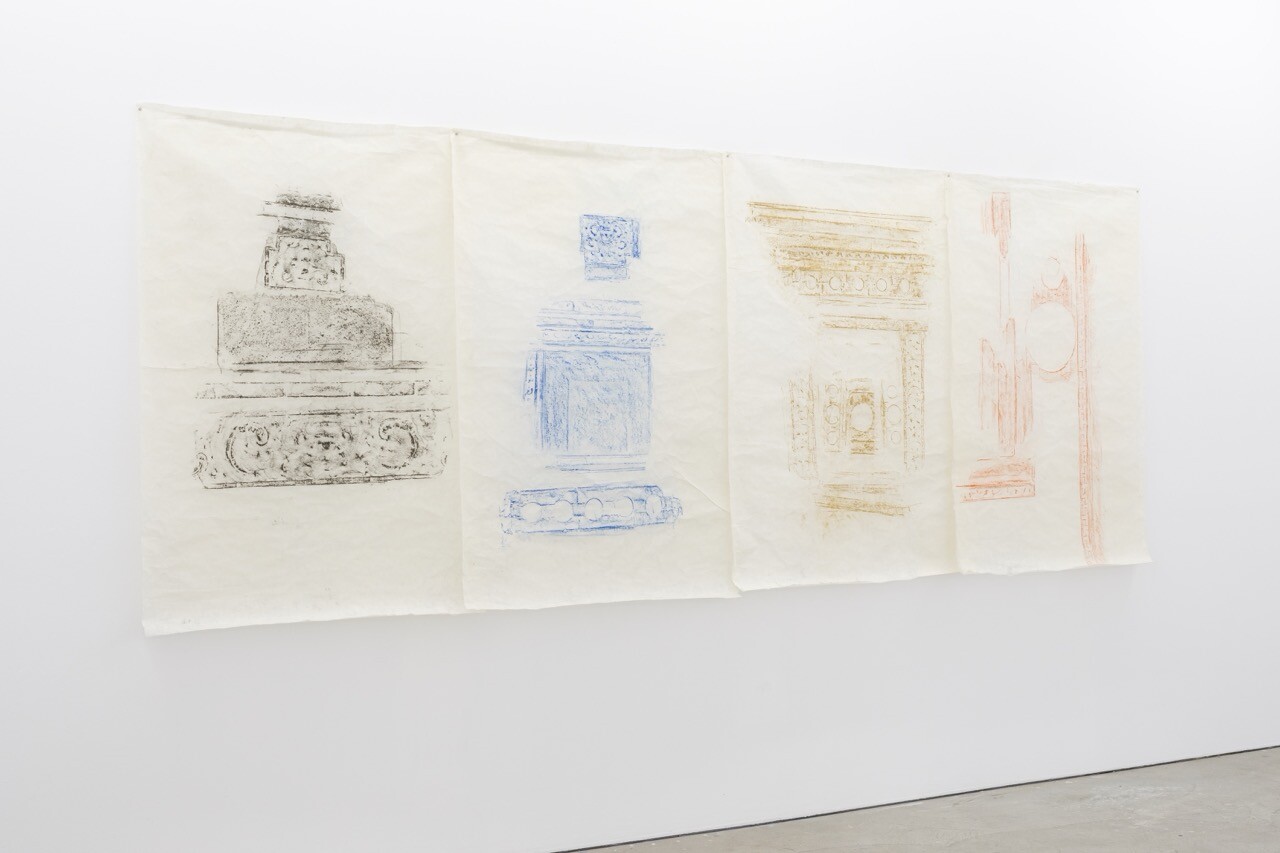
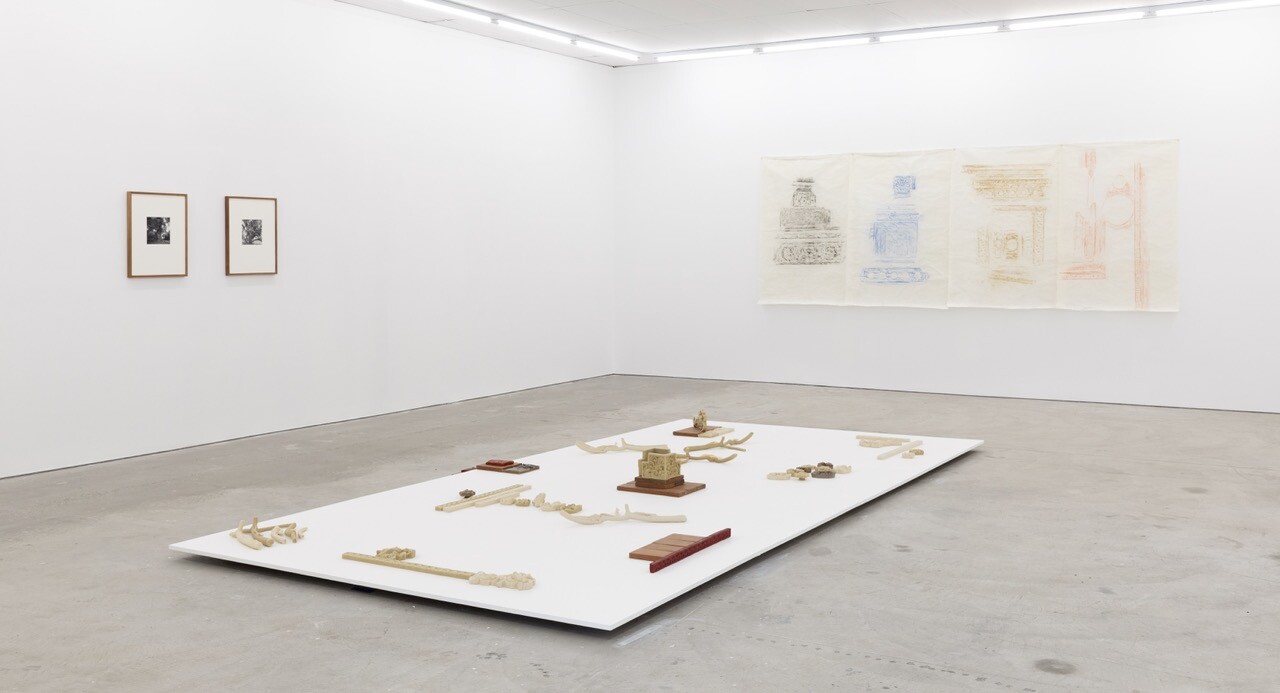
The six charcoal rubbings of the temple present as perhaps the most impermanent and imprecise act of archiving. The six works each titled Pura Taman Sari II read as if they are the first tests undertaken to create an indexical archive of the temple. They present as the unresolved or preliminary version of the tapian ink rubbing technique, formed in ancient China as a convenient method of capture to make future reproductions. Tapian played an important role as primary source and study material for proceeding generations of craftsman, stone carvers, and artisans across China, facilitating a cultural and stylistic continuity prior to the invention of other image- and form-making technologies.
The approach Stevens has taken is reminiscent of Do Ho Suh’s multiyear devotional work Rubbing/Loving Project: Seoul Home (2013-2022), a painstaking endeavour in which the Korean artist rubs pencil marks on mulberry paper sheets attached to the exteriors of his childhood home or the inner surfaces of its rooms. The aim, he says, is to document the information of the spaces he once inhabited. In A Temple in Three Acts this becomes an act of realising the imprint of the tropical environment the temple is in, capturing the tactility of the environment’s weathered textures, something that is impossible to truly record through casting or photography.
Stevens’s engagement with Pura Taman Sari situates and highlights the tension between past and present, as well as how that tension manifests itself in the study and making of archives, remnants that help piece together priori place knowledge. One could read Stevens’s exhibition as a narrative arch, where meaning-making sits within the three acts defined by Syd Field; beginning, middle and end or setting, conflict and resolution. These three acts could be the three mediums tracing the temple: photograph, sculpture and transfer. Or perhaps the acts are held between the setting relayed in Payasan, the conflict noted in Fat Yogi and the resolution intended between Pura Taman Sari I and Pura Taman Sari II. If one returns to the contextual web that situates the objects or events within A Temple in Three Acts, the work can be understood as the emergent acts undertaken when archiving a place that is personal to an individual. In this work Stevens grapples with the limitations of permanence, an imprint of a place, and the ways heritage evolves across time.
It is unclear if a “total image” can be readily constructed in the mind of the viewer from the components that make up A Temple in Three Acts. If it can be, it is perhaps distinctive and unresolved each time. Whilst positioned as a “material turn within the artist’s predominantly lens-based practice” on the Gertrude website, the delicately balanced composition of A Temple in Three Acts would not be possible without the medium-specificity presented within photography, and the considered sensibility Stevens has honed throughout her lens-based documentation practice.
Gallery