6th Tamworth Textiles Triennial: Nature Machine
October 30, 2026
-
6th Tamworth Textiles Triennial: Nature Machine
Venue: Tamworth Regional Gallery
19 Sep 2026 – 22 Nov 2026
NASA’s recent Artemis expedition would not have been possible without textiles. Using Jacquard looms, a new generation of weavers was able to produce 3D woven materials robust enough to support aerospace structures and machines. In a world of rapidly developing automation, there remain instances where practices stemming from handcrafts offer solutions to technological limits. The margin between human and machine grows paradoxically smaller and more distinct. Textiles are far more than wearable fashion and household rugs; they border industry, science, and art.
Like many regional galleries, Tamworth specialises in the acquisition and collection of a specific medium. In this case, they are home to the National Textiles Collection, which, built over a series of decades, documents the changes in textile arts over the past fifty years. What started in the 1970s as a small-scale annual textiles show has today grown into a major survey of textiles by artists from across Australia, and at various stages in their careers, with an open expression of interest occurring every three years. This year, Blake Griffiths has curated the 6th Tamworth Textile Triennial, Nature Machine. In conversation, Griffiths noted that, as a conceptual and artistic provocation, Nature Machine sought to reflect on the revolutionary history of textiles. With the ongoing growth of mass production, particularly with fast fashion in the textiles industry, the processes, practices, and cycles of environmental understanding that feed into fabric and textiles production are often lost. For example, to grow and harvest cotton still requires specific horticultural knowledge, with an attunement to weather cycles and other ecological factors. Within the context of this exhibition, the concepts of “nature” and “machine” are not at odds; rather, they subsume each other.
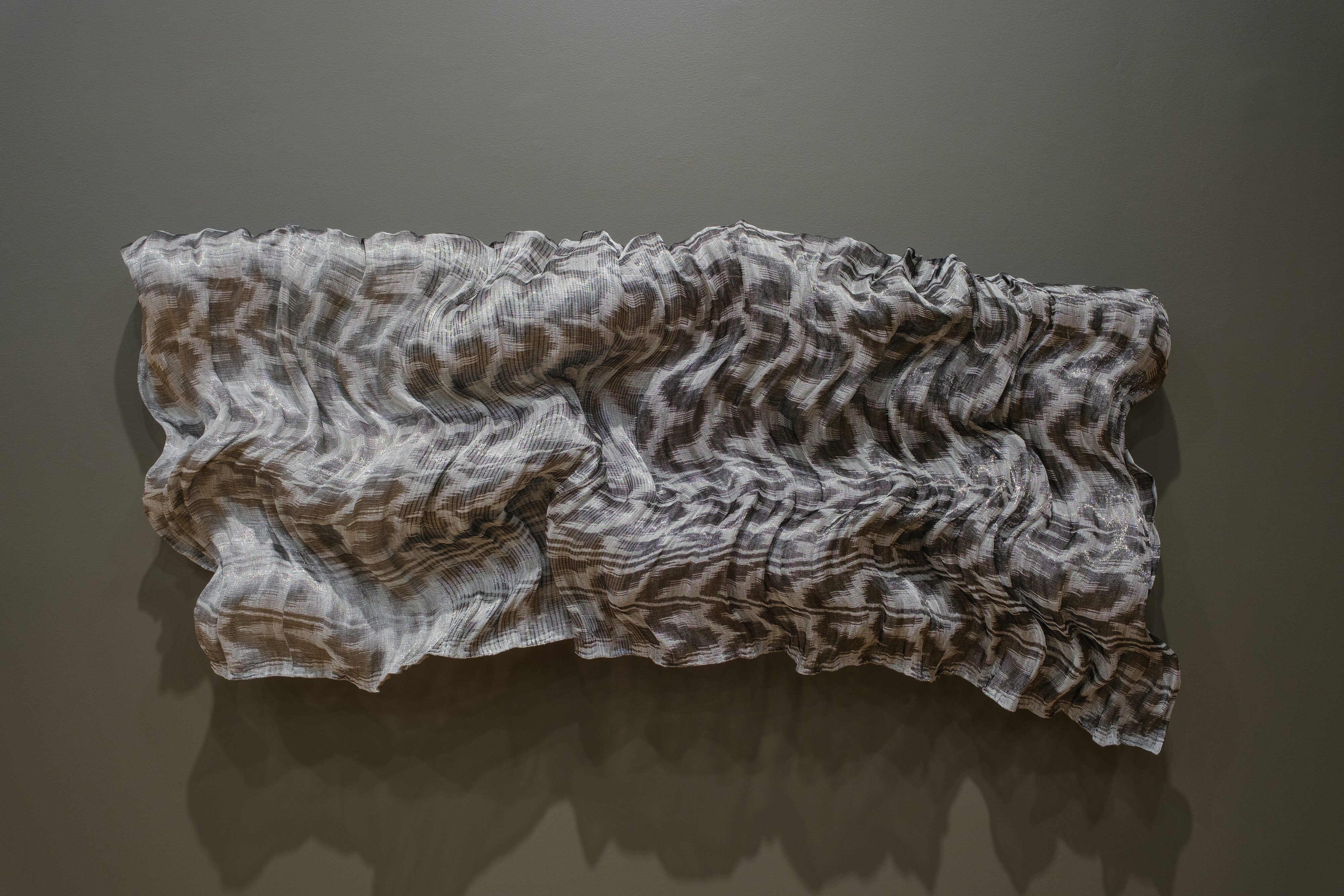
One of the technologies at the heart of the exhibition is the Jacquard loom. Named after its early nineteenth-century inventor, Joseph Marie Jacquard, the Jacquard loom is a programmable mechanical device used to weave fabric through the manipulation of individual threads—a device that is today often understood as a prototype for not only modern industrial production, but also programmable technologies like computers. Many of the works on display have used Jacquard looms in some way, whether it be the artist’s own loom or an outsourced creation. Jennifer Robertson, a Canberra-based artist whose textile practice stretches back several decades, has a keen interest in geomorphology; her work looks for connections between weaving and the processes that shape the natural world. Robertson honours the invention of the Jacquard loom as a revolutionary creation for textiles, as both an industry and art form. For Curved Fold (2026), she has developed her own code that is compatible with her loom, which is essentially the size of a room in her home. Combining stainless steel, quartz, carbon blend fibre, and linen, Robertson creates a three-dimensional form that resembles both a cocoon and a rain cloud. Its metal threads are easily mistaken for silk. Her practice is slow, methodical, and ecologically aware, as she explores the natural repetitions and cycles that produce rocks. To investigate this method of geological making, Robertson harnesses her own form of nature machine.

Installation view of Jennifer Robertson, Curved Fold, 2026, stainless steel, quartz, carbon blend fibre, linen, Tamworth Regional Gallery. Photo: Courtesy Tamworth Regional Gallery.
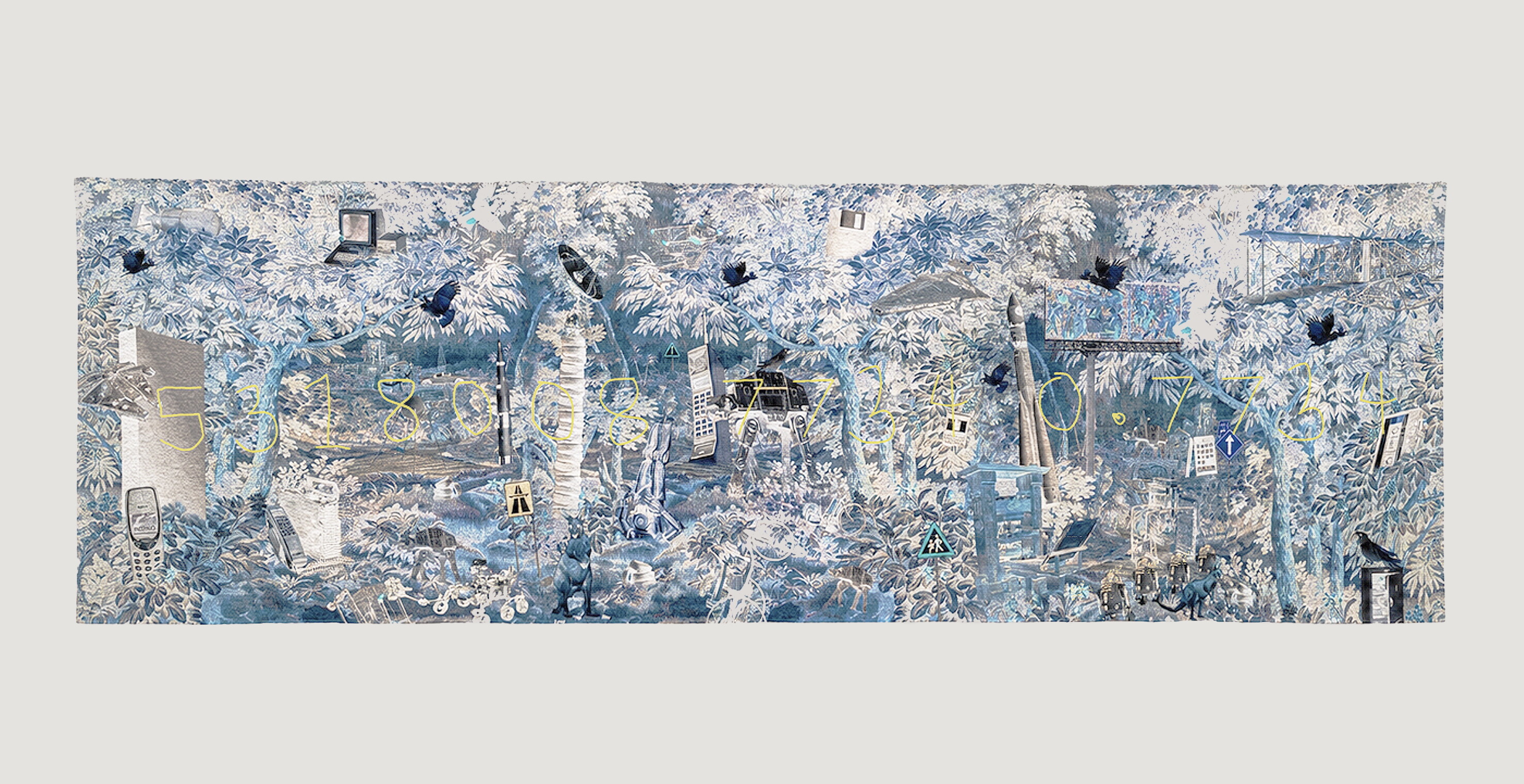
I was struck by the relationship between Robertson’s work and Sydney-based artist Jackson Farley’s 5318008 773 0.7734 (2026). Farley has outsourced the production of his appropriated Flemish pastoral landscape, which he designed digitally then sent to an external maker for its creation using a Jacquard loom. The scene of this digital collage manifests as a speculative narrative on the birth of AI. Together, these works tell a nuanced history of the Jacquard loom as a precursor to modern computing. Robertson and Farley show how the Jacquard loom remains an innovative piece of technology—one that mediates nature and machine by absorbing both. Robertson focuses on the refinement of this technology, using her loom as a tool for critical thinking and the creation of bespoke art objects. Meanwhile, Farley critiques the mass-production and juvenile bro culture that surrounds growing technological automation. In yellow hand-embroidery, Farley adds the numbers “5318008 7734 0.7734” (after which the work is titled). This sequence sparked an unexpected familiarity in me, returning me to my adolescence with visions of playing with the calculator on my father’s desk after school. When written on a calculator then inverted, these numbers read hello / hell / boobies. Farley comments on the degradation of critical thinking that has appeared in-line with growing technological automation. Whilst formally dissimilar, Robertson and Farley make sense together, with their interest in the language and history of technology, textiles, and culture more broadly.

Jackson Farley, 5318008 7734 0.7734, 2026, digital collage, woven Jacquard tapestry, hand embroidery, Tamworth Regional Gallery. Photo: Courtesy the artist.
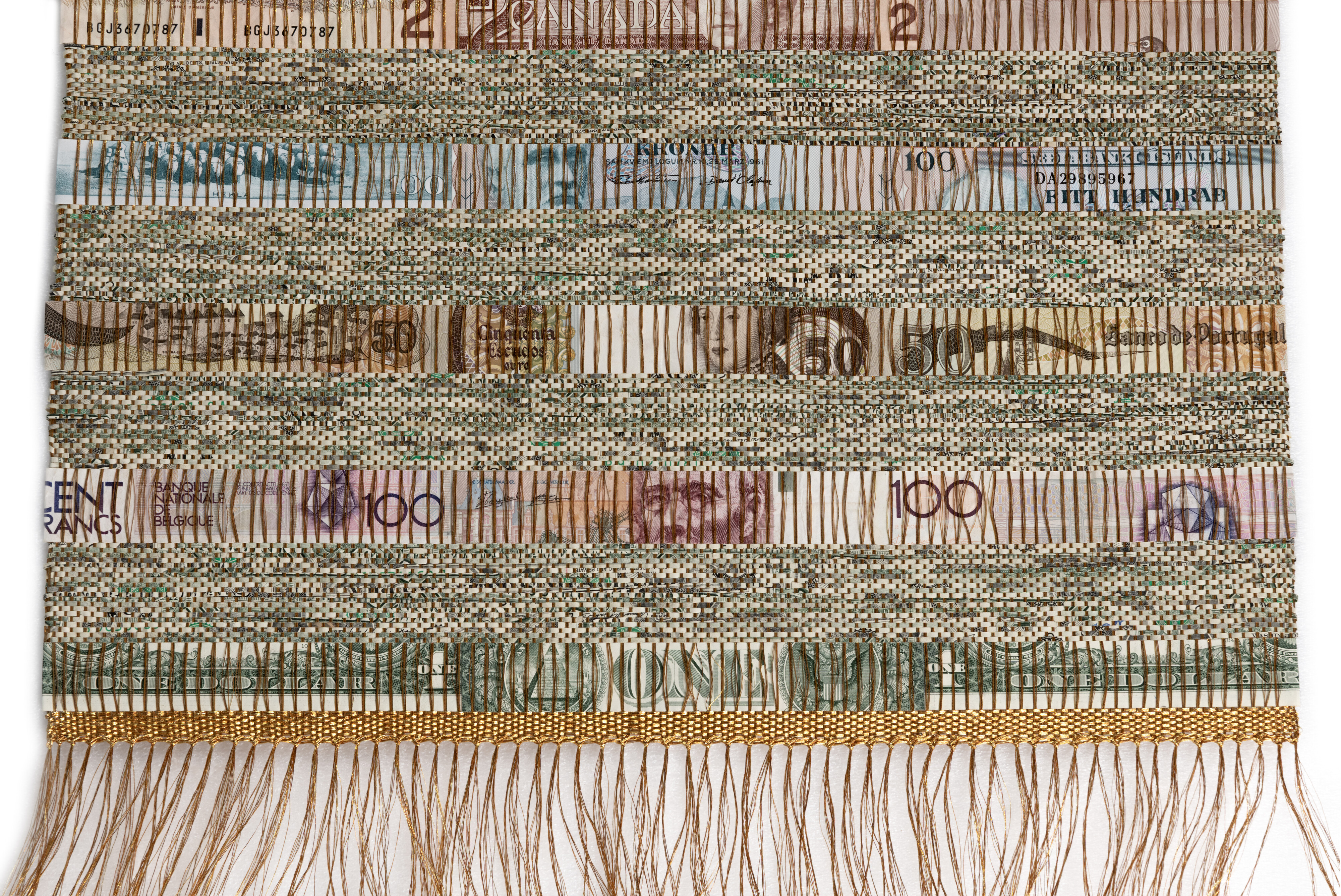
Abdullah M.I. Syed’s works 1001 Beads (2026) and NATO Rug (2026) stand out in their dual complexity and simplicity. Like Farley, elements of Syed’s works have been outsourced, which speaks to the fact that textile production, despite its automation, still requires highly specialised skillsets. NATO Rug is made from decommissioned banknotes from the founding NATO countries, and, formally, it mimics a prayer mat. The hand-rolled beads in 1001 Beads are made from Western banknotes, and they have been paired with Syed’s mother’s prayer beads to create a wreath. Syed speaks to the relationship between class, religion, and economic status, directing his audience towards an assessment of this relationship as being, quite literally, manufactured. Simultaneously, these works spark a conversation about our global investment in capital as a system of faith. What do we value in the machine that is late-stage capital? What does the “nature” referenced in the exhibition’s title actually mean?

Detail of Abdullah M.I. Syed, NATO Rug, 2026, handloomed found shredded US dollars and hand-cut uncirculated banknotes of 13 NATO founding member nations, gold thread, perspex, Tamworth Regional Gallery. Woven by Janet Maughan. Photo: Courtesy the artist and Miranda Heckenberg.
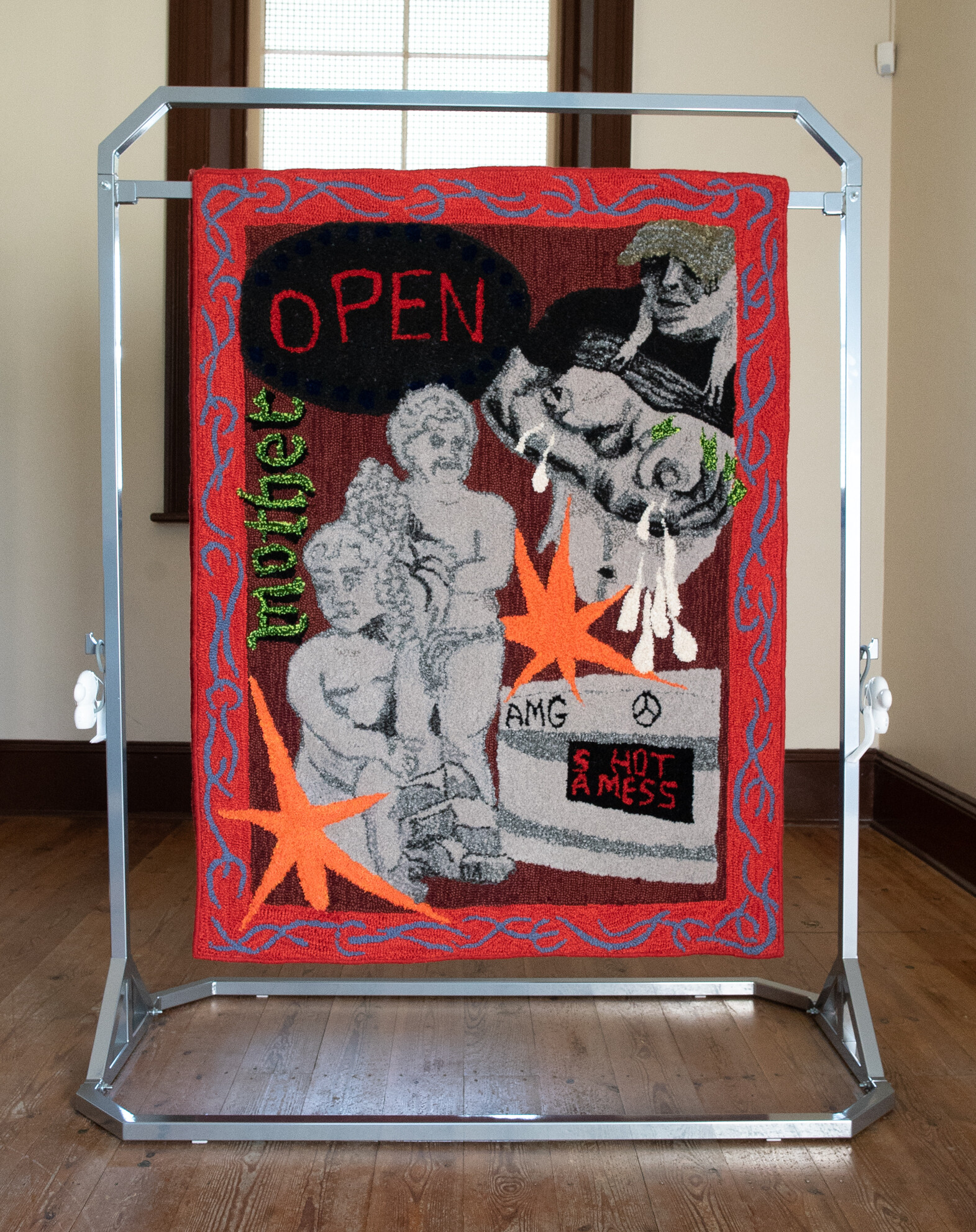
An answer to this second, impossibly large, question is offered by the work of Alycia Bennett. In Data Doubles (2026), a self-portrait made using the artist’s own biometrics and online search history, Bennett draws curious parallels between human nature, mother nature, and digital culture. Bennett visualises how much technology knows about us as individual creatures and a collective species, with Data Doubles offering a sharp critique of our contemporary culture of mass surveillance by reminding her audience that nothing is private. On one side of her work, she depicts herself squeezing her breasts with talons for nails, with breastmilk dripping haphazardly. The word “mother” appears, mimicking the typeface of the energy drink by the same name, with an “OPEN” sign appearing in the top left corner. On the back side, Bennett illustrates her version of “sleep mode”, with two saccharine cherubs hovering beneath a “CLOSED” sign. Bennett’s self-portrait reveals a snippet of the labour of care that comes with motherhood. In this sense, motherhood can be perceived as the process by which women become nature machines. What is often depicted as a beautiful, natural, and nurturing stage of a woman’s life is unravelled as a chaotic, desperate, and clawing attempt at maintaining a functional sleep schedule.
Melbourne-based artist Cara Johnson, too, reflects on the weight of caring in a hyper-consumerist society. In her Pastures (2026) series, Johnson combines organic animal-made materials (like wool and chicken feathers) with re-purposed/re-processed plastic, creating objects that resemble jewellery. These works are quiet in a room full of competing colours and materials, but this quietness marks the sorrow of Johnson’s own observations of ecological deterioration and devastation. Her care and exhaustion are felt through these objects. While the objects themselves appear neat and tidy, the process of turning feathers into a honeycomb-structured net is dirty, messy, and corporeal. Johnson’s series is raw in many senses of the word, and when I leaned in for a closer look, the works still smelled of the sheep and chickens whose bioproducts have been made almost wearable.

Alycia Bennett, Data Doubles, 2026, carpet, wool and polypropylene fibre, felt backing, powder-coated aluminium, white noise machine, cord, Tamworth Regional Gallery. Photo: Alycia Bennett.
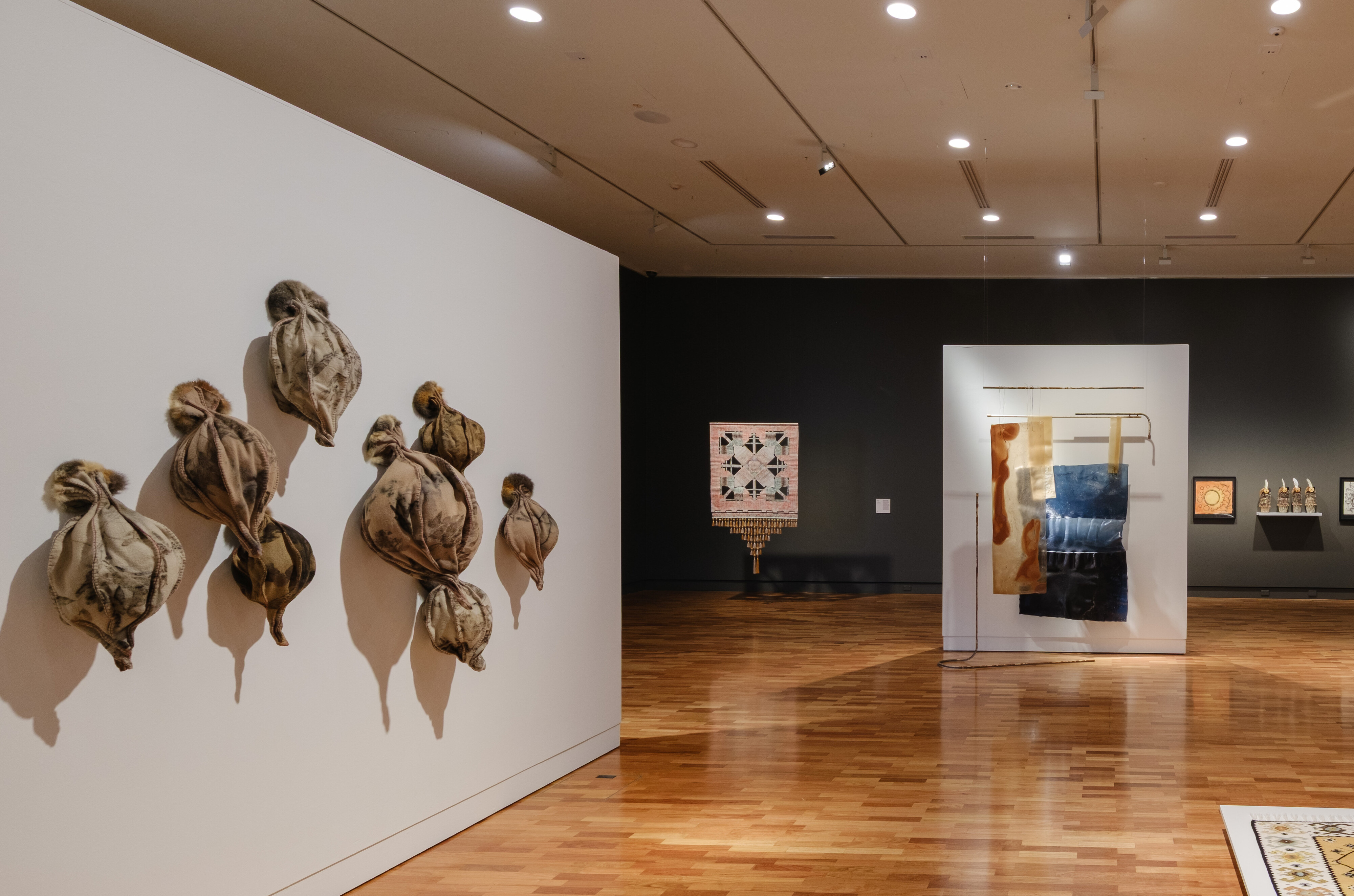
Behind the entry panel to the exhibition lies an eerie tension between Gamilaraay artist Juanita McLauchlan’s mayanggang (case moth) (2026) and Portland NSW-based artist Ellen Ferrier’s Second Skin (2026). McLauchlan turns the familiarity of a woolen blanket into a collection of puffed pods protruding from the gallery wall, resembling case moth cocoons that she first encountered when exploring in nature as a child. Each pod is covered with eucalyptus contact prints, stitched together using red cotton thread with possum fur appearing as an excess pouring from the pods’ openings. In the early 1800s, woolen blankets that had been issued by settlers to First Nations people in NSW became the conduit for disease, particularly smallpox, which spread rapidly. McLauchlan recognises that woolen blankets have a strong connection to colonial history in Australia and intentionally co-opts them for the telling of a different narrative. At the same time, McLauchlan also reminds us that First Nations textile practices long pre-date the invention of Jacquard loom. Rather than placing technology and nature in opposition, McLauchlan explores how textile-making can be a reparative practice, returning industrialised materials to organic forms.

While we like to think of nature as warm, welcoming, and nurturing, nature often feels alien, encompassing places and spaces with unpredictable objects, creatures, and textures. This alienness is made tangible through Ferrier’s Second Skin (2026), which looks as though it has been delivered straight from an abattoir. Ferrier reflects on the concept of hides being the first textile, and returns what is now a very complex and advanced industry back to its sinewy roots. Two thick, opaque sheets of goopy-looking material hang from a rusting rod, curtain-like and viscous. I felt compelled to stroke my hand along the sheets that I presumed would feel like a fruit roll-up. Thankfully, the touch kit in the foyer allowed me to confirm my hypothesis. Second Skin is distinctly bodily and abject—made from a material that, visually, could be discarded from a nasal passage. It occupies a liminality by having creature-like qualities without representing a creature itself, much like mayanggang (case moth). At the same time, Ferrier offers an alternative take on the materiality of textiles in a way that considers cycles of waste, regeneration, and sustainability through objects that appear somewhat futuristic or otherworldly.
Nature Machine interrogates the relationship between hand, body, and machine as much as it explores the dynamics between arts, history, and capital. In its attempt to be both local and global in scope, Nature Machine lies somewhere in-between. The selection of artists from across the country has formed a series of narratives and counter-histories surrounding the textiles industry and textile arts. It is a challenge to narrow down the impact of this exhibition, as it perhaps left me with more questions than answers. It did, however, urge me to reconsider my own preconceptions of what textiles look and feel like, particularly when it came to Ferrier and Syed’s works. This exhibition makes the case that the textiles industry and textile arts are inevitably ecologically grounded, and a return to these roots feels equal parts hopeful and sombre. While an ecological focus brings a valuable critical lens, it is hard to ignore the discomfort that comes with being reminded of how capitalist production turns nature abstract.
Gallery