25th Biennale of Sydney, Rememory
June 13, 2026
-
25th Biennale of Sydney, Rememory
Venue: White Bay Power Station, Penrith Regional Gallery & The Lewers Bequest, Campbelltown Arts Centre, Art Gallery of New South Wales (AGNSW), Chau Chak Wing Museum
14 Mar 2026 – 14 Jun 2026
The 25th Biennale of Sydney opened in a moment of political scrutiny. In early March, it seemed reasonable to fear that the Biennale would be sucked into what is now a familiar playbook. A cultural event, award, or grant is announced. Then, Zionist and conservative lobby groups petition the organisation to cancel this or that “problematic” person who has said something critical of Israel and its ongoing genocide against Palestinians. A spate of lurid diatribes is published in The Australian. The organiser gets cold feet or succumbs to external pressure. Consequently, the event either capsizes or is shakily restored with a diminished program. The targets and methods are the same. It is almost always a Palestinian or Lebanese or First Nations person who is the subject of cancellation. There is no shortage of examples to draw on.
Predictably, the appointment of Emirati curator Hoor al-Qasimi to curate the Biennale was like a red rag to a Murdoch media bull. In the weeks leading up to its opening, we heard patently false claims that al-Qasimi’s “anti-Israel bias” would foment a “hate Israel jamboree”. She has been criticised for her “political” selection of artworks and accused of snubbing the Vernissage. Sceptical letter-writers and lobbyists did not have to wait long for something to affirm their preconceived judgements. After DJ Haram’s opening night tirade denouncing the “Zio-Australian-Epstein empire”, the Biennale issued an official institutional statement to smooth things over and disown her “strongly worded” remarks.
All of this matters because it is increasingly the context in which the arts are produced, funded, taught, spoken, and written about in Australia, and in plenty of other places too. Certain artists, books, exhibitions, and performances are declared “political” (derogative) prior to their politics being announced or engaged with. At the same time, however, this can result in a sense of anticipation as well as premature and overinflated claims to something being “political” (desirable), as if an artwork or exhibition’s “radicality” is a fait accompli, simply by virtue of it being under attack. So now, after the dust has settled, how should we assess the 25th Biennale of Sydney and al-Qasimi’s curatorial framework?
Al-Qasimi chose Toni Morrison’s neologism “rememory”, drawn from her celebrated novel Beloved (1987), to guide this iteration of the Biennale. On the Biennale website, the term is defined as a “means of revisiting, reconstructing, and reclaiming histories that have been erased or repressed.” In Beloved, Morrison’s protagonist, Sethe, explains:
If a house burns down, it’s gone, but the place—the picture of it—stays, and not just in my rememory, but out there, in the world… Some day you be walking down the road and you hear something or see something going on. So clear. And you think it’s you thinking it up… But no. It’s when you bump into a rememory that belongs to somebody else.
In other words, a memory does not remain housed inside a single individual or even a collective of people. Memories wander and stick to the world with a searing clarity. The operative prefix “re” is the exhibition’s temporal compass; it can move backward and forward through time. To redo, repeat, to pick something up and move it into the future. Or to go back, to return, revisit, or remember the past. Naturally, this fluidity is appealing in the art world, where artists and curators prefer to dwell in open-ended questions, complexities, and ambiguities. But it also indicative of a kind of poetic capaciousness that distances Rememory from the declarative political statements some might have expected or perhaps hoped for, and which others were determined to find and hang their critiques on.
This is White Bay Power Station’s second outing as a Biennale venue. We are regularly reminded that this charismatic piece of architecture, marketed as an “inspiring backdrop” where “history meets innovation”, is a significant investment for the New South Wales state government. Of course, the re-energising of forlorn industrial spaces in nothing new in the arts. And with its cavernous, abandoned noir aesthetic, White Bay provides convenient fodder for curators looking to engage with time, labour, to waken the spirits of working-class forebears, and so on. Indeed, this was the explicit premise of the Biennale’s brief flicker of a performance weekend produced in collaboration with Inner West Council, titled Working Memory and featuring a collection of static and roaming performances, such as Body of Work’s Workers’ Wives, an energetic, ritualistic sequence that sought to reanimate feminised domestic labour, and Amrita Hepi’s Wetlands, a choreographic ode to the waterways of White Bay.

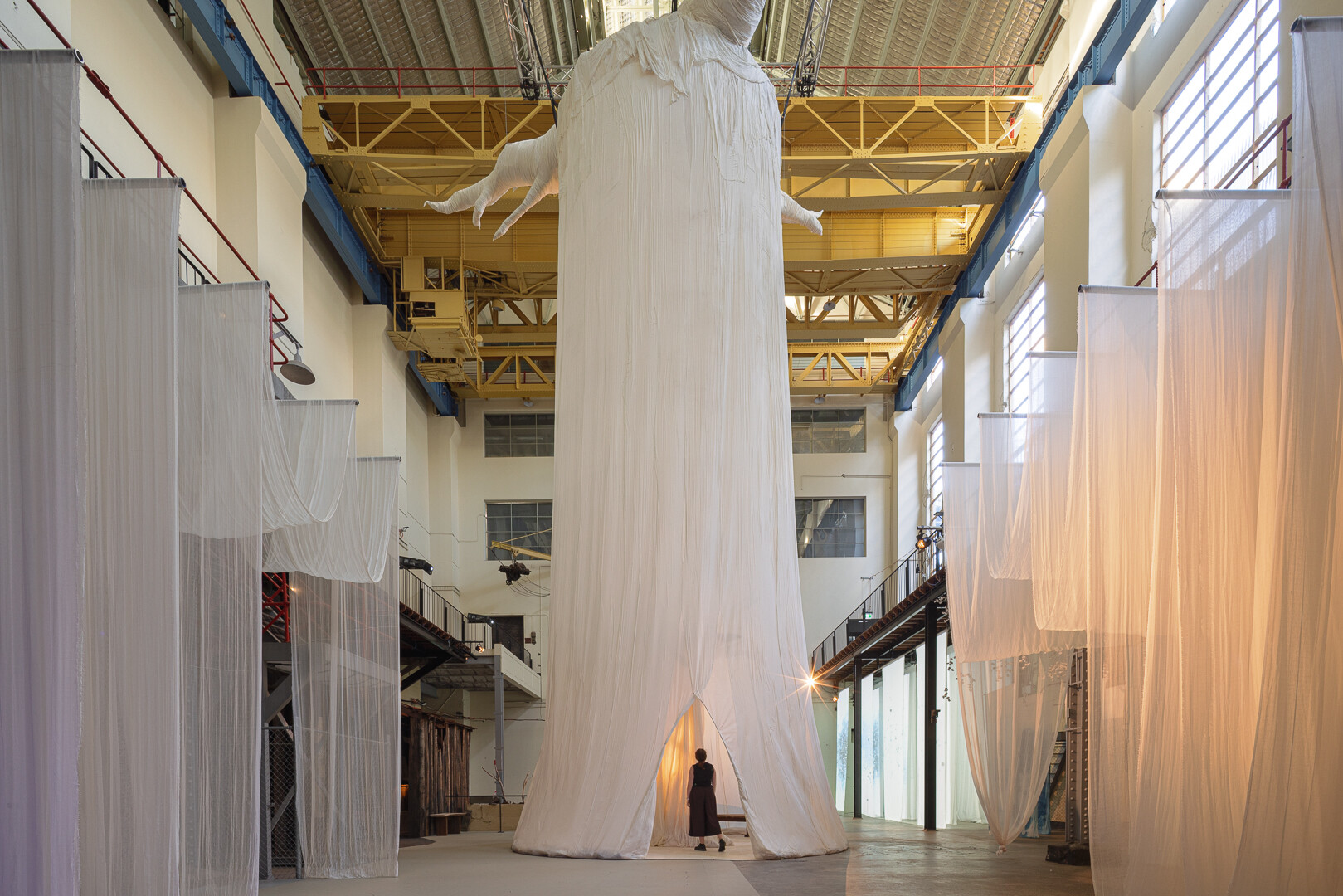
Nikesha Breeze, Living Histories, 2026, cotton gauze, wood, steel, cyanotype prints, furniture, sound, video projection, paper. Commissioned by the Biennale of Sydney. Courtesy of the artist. Photograph: Document Photography
Much of the exhibition at White Bay is muted and monochrome. Nikesha Breeze’s Living Histories (2026) serves as a clear thematic anchor for the concept of rememory. This work is a monumental, multi-media translation of more than 2,300 first-person accounts of slavery in the United States, comprising a wooden hut lined with archival newspaper cuttings as well as a series of quietly imposing blue ink portraits printed on cascading cotton gauze. The centrepiece of the work is the soft cotton trunk of an African Boab tree spanning two storeys. On the top floor of the Turbine Hall, walk a little further along from the uppermost branches of Breeze’s tree and you will encounter another work in the form of an assortment of defunct materials stacked into teetering piles—a column of burnt books and pillows strung through the rungs of a ladder. First conceived in the nineties, after the collapse of the Soviet Union, this is Peter Kennedy’s rumination on Walter Benjamin’s famous interpretation of Paul Klee’s Angelus Novus (1920). To summarise Benjamin, we are caught in the forward-blowing storm of Progress while gazing back upon the debris of the past. These two examples are telling of the tone of the Biennale at White Bay—soft, ethereal, and melancholic, perhaps meant to match the haunting lyricism of Morrison’s Beloved. Even Breeze’s work, which is large in scale, feels almost anti-spectacular—a ghost tree poking through the building’s scaffolding. It’s a striking contrast to the previous iteration of the Biennale under the curatorship of Cosmin Costinas and Inti Guerrero, who produced a cartoonishly festive Carnivale titled Ten Thousand Suns, splashing the old power station with bling and bright colours.
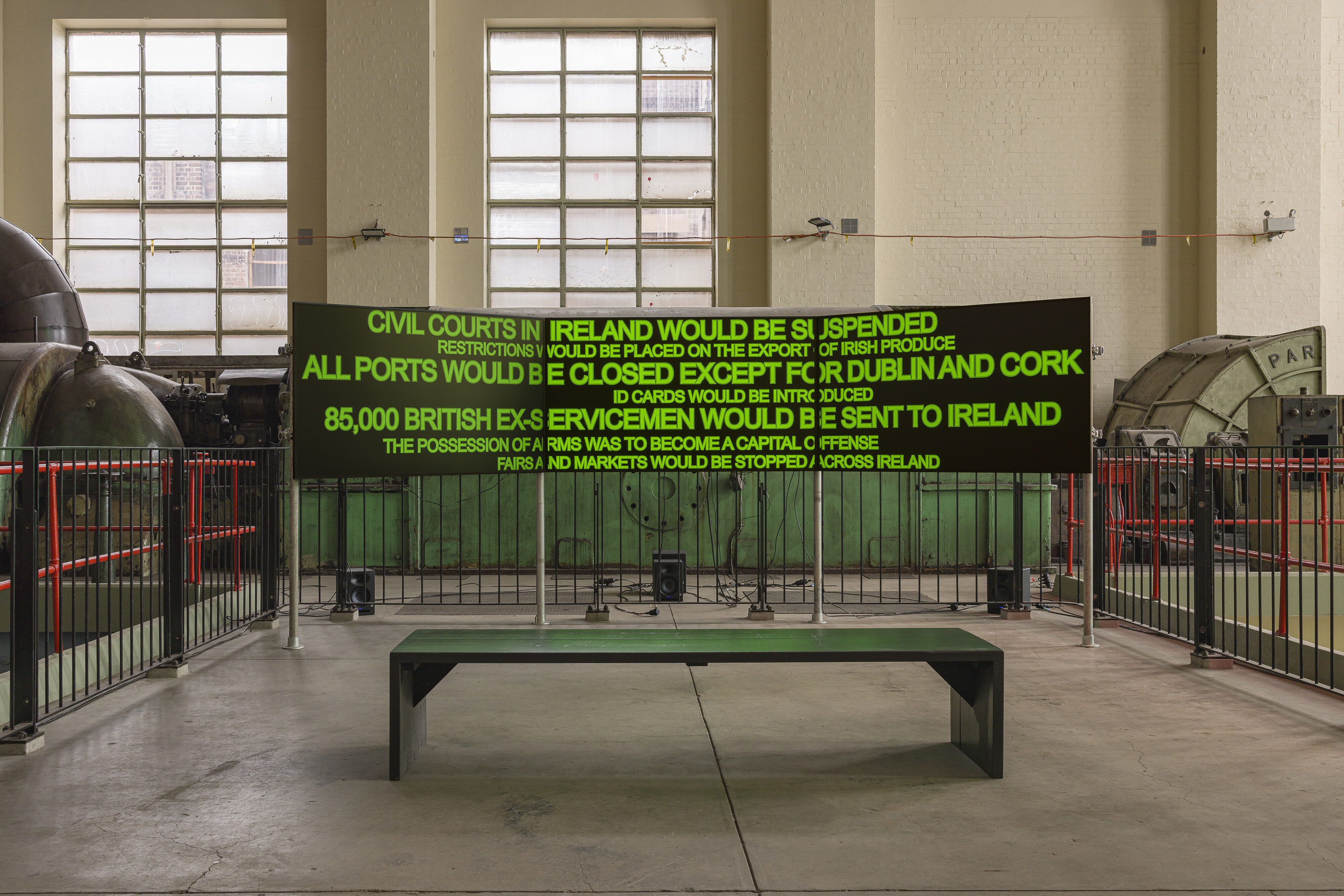
Despite the promise of White Bay’s industrial detritus, this context does not always materialise into satisfying encounters with the exhibition. The sheer mass of stuff—bits of defunct machinery, pumps, pipes, dusty control rooms, all of the railings bordering the building’s punctured floors—results in a number of cramped, awkward viewing spaces. In Rememory, the fact that a significant proportion of the works are videos exacerbates this problem. Some of these, spanning up to sixty, eighty, or a hundred minutes, are not well supported. Upstairs, for instance, Marianne Keating’s three-channel hour-long video installation An Ciúnas/The Silence (2023) is representative of the kind of geopolitical intrigue that I hope to encounter at a Biennale. It tells the story of indentured Irish labourers sent to post-abolition Jamaica after the Great Famine (1845-52), examining two intersecting anti-colonial struggles for liberation. Positioned on an open landing in the upper echelons of the power station, its subtleties are lost in a grating acoustic atmosphere. Throw in the Biennale’s attempts to “activate” the exhibition with weekend DJs and food markets, and at best (and if you’re in the mood) it’s a vibe; at worst, it inhibits a close engagement with individual artworks. Excitable attempts to “fill” the space and “realise” its dynamic potential are hostile to the kind of patience and quiet reflection al-Qasimi’s selection of artworks might otherwise instil.

Marianne Keating, An Ciúnas / The Silence, 2023. Presentation at the 25th Biennale of Sydney was made possible with generous support from Culture Ireland, and generous assistance from British Council in Sydney, The Showroom, London, UK and The Arts Council of Ireland. Courtesy of the artist © Marianne Keating. Installation view, White Bay Power Station. Photograph: Document Photography.
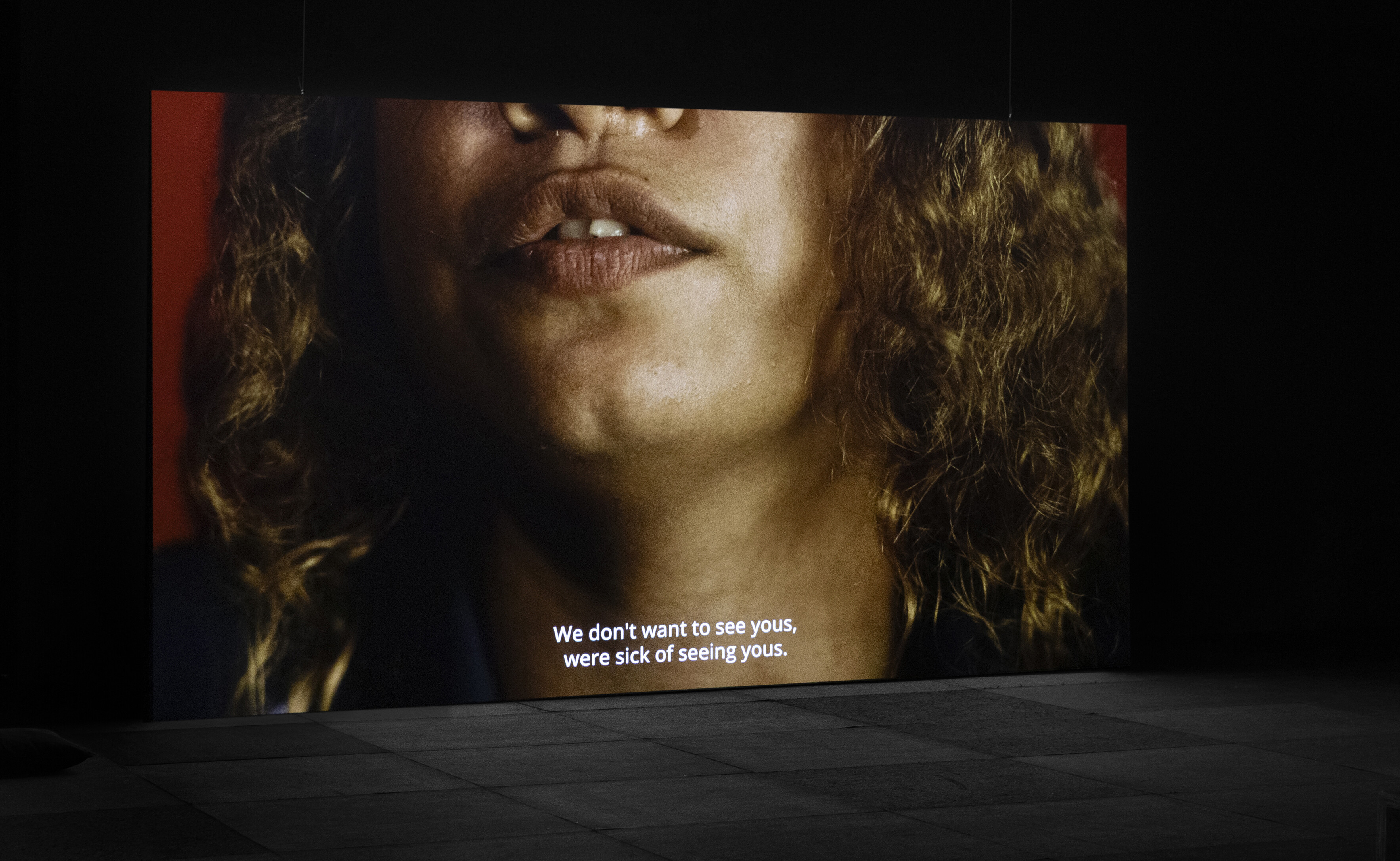
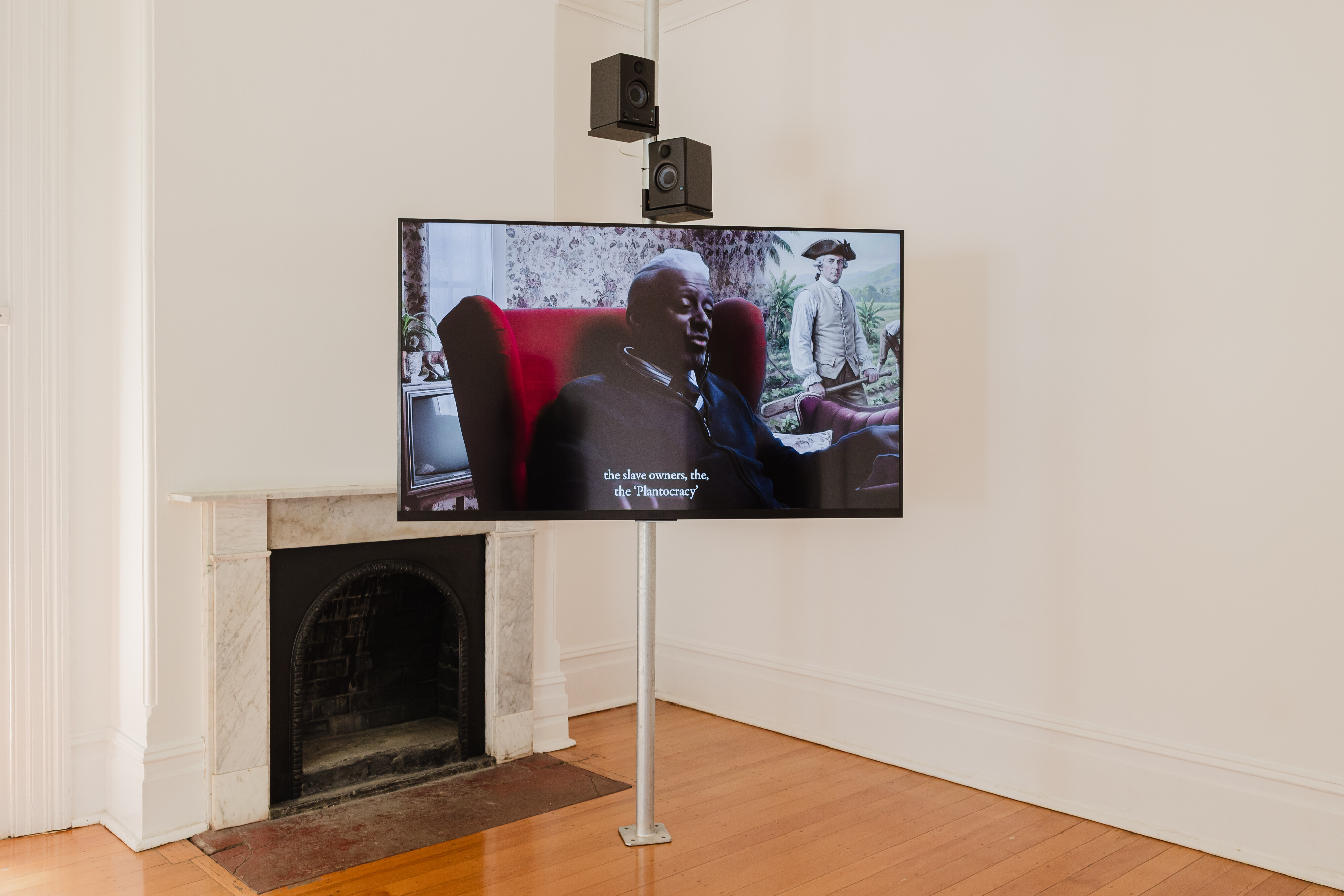
Another problem with White Bay is that its charisma overshadows the Biennale’s four other venues: Campbelltown Arts Centre, Art Gallery of New South Wales, Chau Chak Wing Museum, and Lewers: Penrith Regional Gallery. There are more longer-form video works at Campbelltown, but here we are afforded large, dark, and carpeted rooms with ample viewing space. This is the “carceral” venue, collating stories from incarcerated people, campaigns to free them, and the struggles of migrating people marked as illegal. In the centre of the exhibition is Code Black/Riot (2025), a four-channel, collaborative video by Behrouz Boochani, Hoda Afshar and Vernon Ah Kee that centres the testimonies of incarcerated First Nations teenagers in Far North Queensland. The editing is sharp and compelling, forcing the viewer to swivel from one screen to the next. Cropping the faces and bodies of the narrating teenagers, it creates an unsentimental platform for their voices, their critiques of the prison system and their plans for the future.

Behrouz Boochani, Hoda Afshar, Vernon Ah Kee, Code Black/Riot, 2025, four-channel digital video, colour, sound, looped 33 mins Commissioned by the Biennale of Sydney with generous support from the Australian Government through Creative Australia, its principal arts investment and advisory body, and University of Melbourne, and generous assistance from the Queensland Government through Arts Queensland. Courtesy of the artists (Hoda Afshar and Vernon Ah Kee) and Milani Gallery, Meanjin (Brisbane).
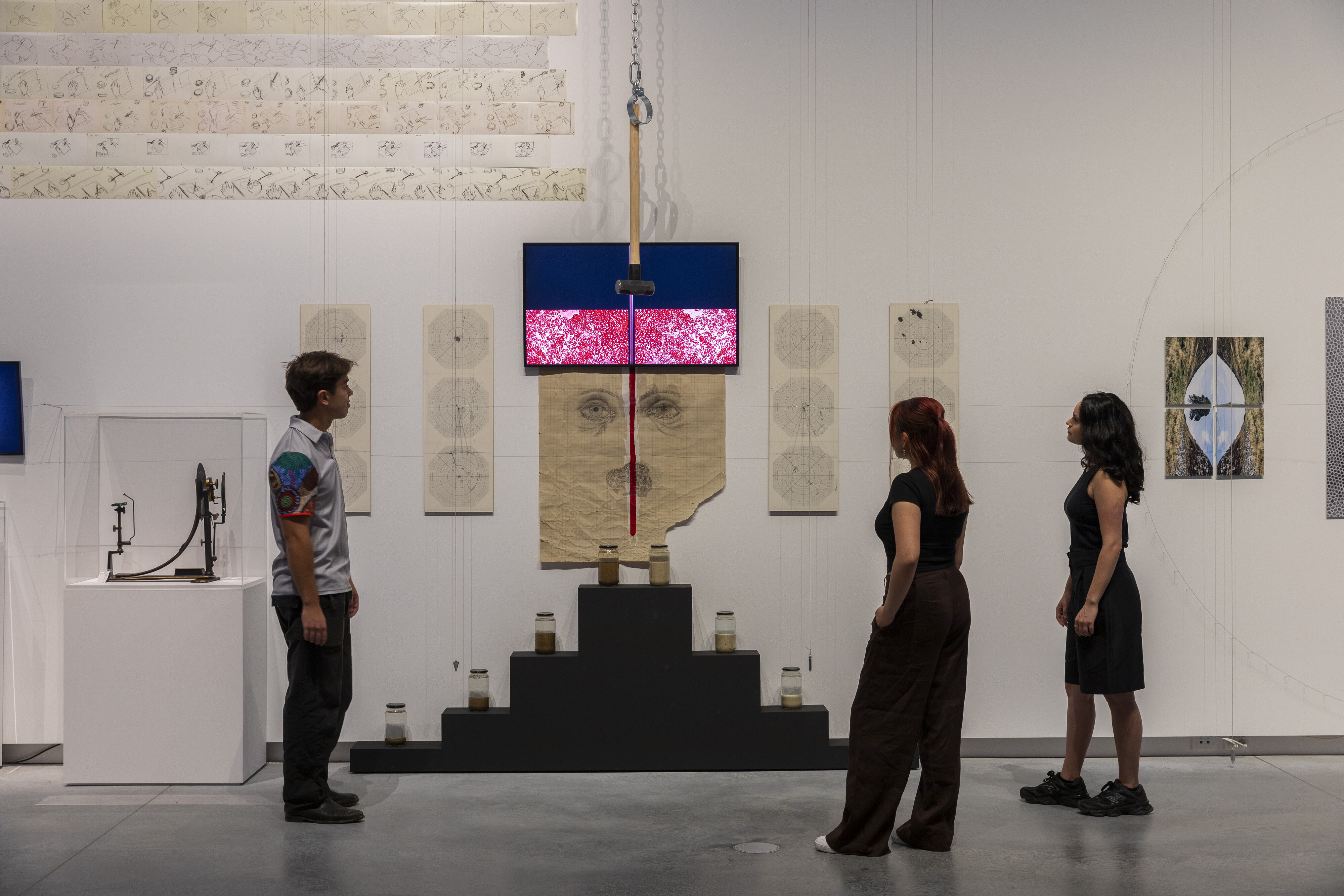
Three more works from Boochani, Afshar, and Ah Kee are presented at the Chau Chak Wing Museum, crediting them as individual artists. This part of the Biennale deploys a neat thematic framework, attending to how vision structures, filters, and refracts traumatic experiences. The work that accentuates this premise most explicitly, perhaps, is Derek Ogbourne’s Land of Fovea (2025), an idiosyncratic assemblage of drawings, diagrams, and experimental devices devoted to the forgotten science of optography, a practice that attempts to retrieve the last image a person sees before death. We can link this project of retrieval back to Sethe’s explanation of rememory: “If a house burns down, it’s gone, but the place—the picture of it—stays”. On a similar note, Belinda Kazeem-Kaminski’s research-based practice engages with surviving pictures of the Congo under Belgian occupation. In a Saidiya Hartman-esque turn, Kazeem-Kaminski reckons with the weight of the colonial archive and the ethics of looking. Lines and blocks of colour slice through large-scale black and white photographs, originally produced by the Austro-Czech missionary and ethnologist Paul Schebesta (1887-1967). In Unearthing. In Conversation (2017), a thirteen-minute companion video, the artist sits in an empty cinema and teases out the fraught politics of her interventions: the strategic redactions are meant as a protective gesture, to obstruct the dehumanising lens of the camera; however, in doing so, she risks reproducing the erasure of colonised subjects and the violence enacted upon them.
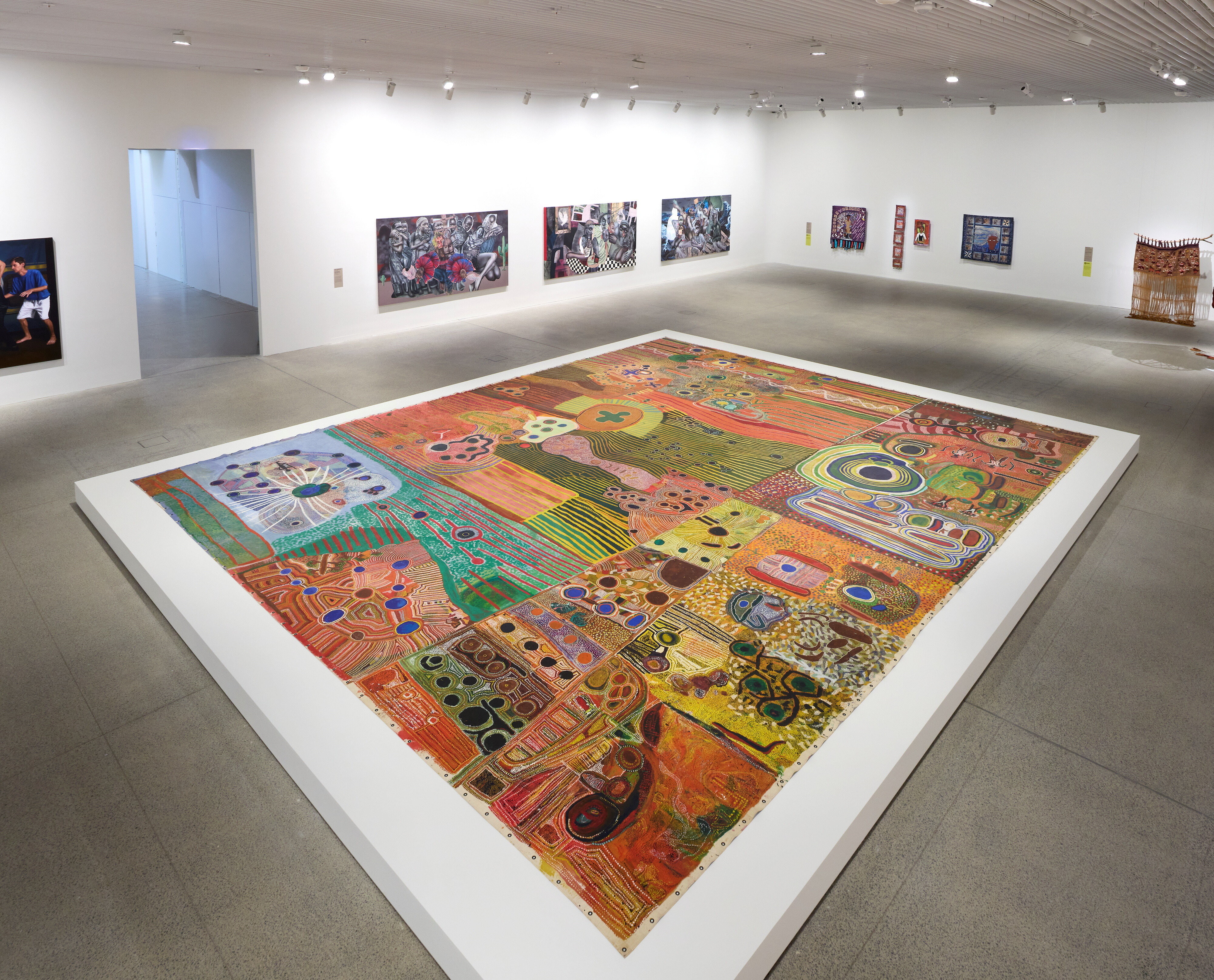
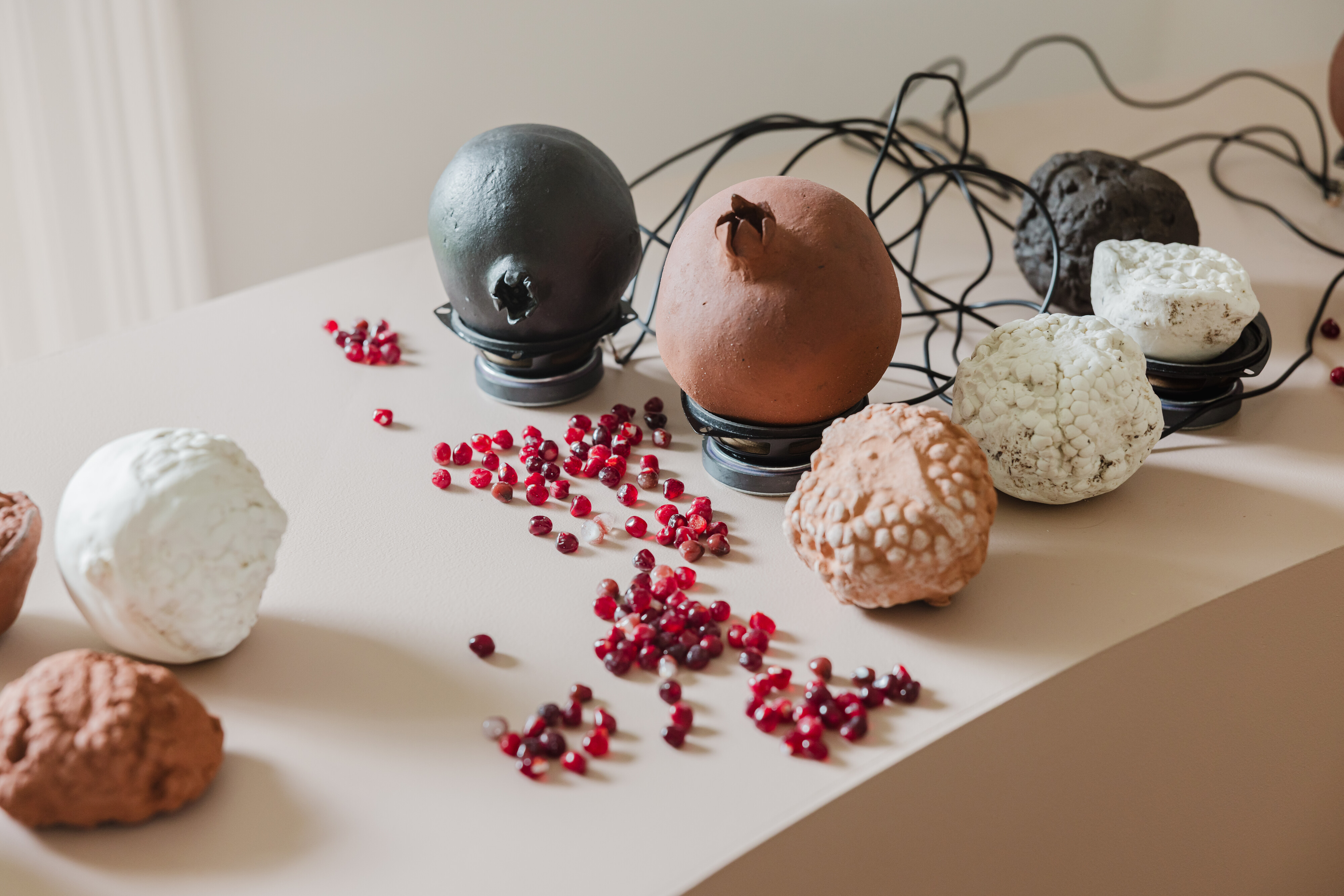
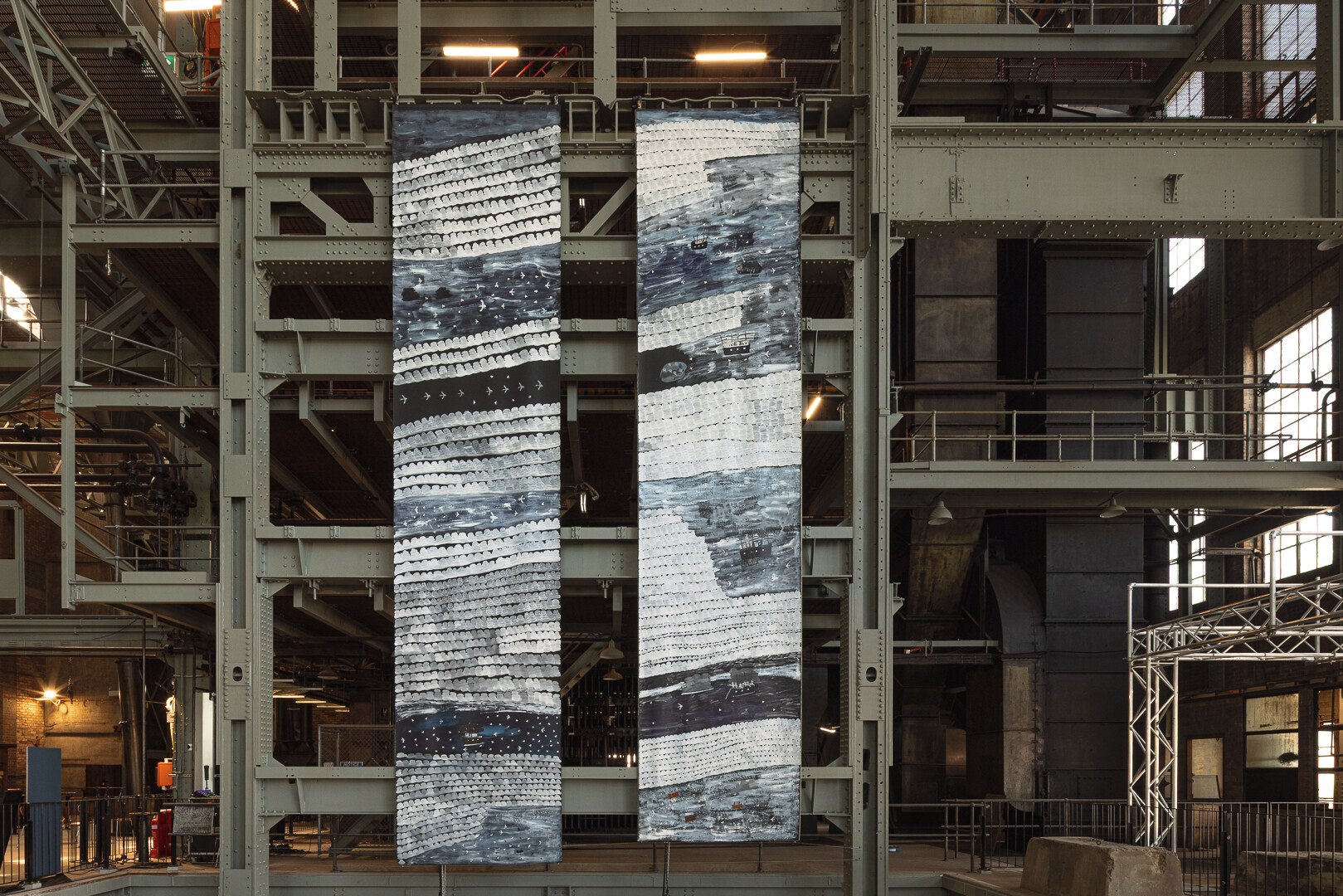
The exhibition at Lewers: Penrith Regional Gallery (a Biennale debut venue) capitalises on its location on the banks of the Nepean River and at the foot of the Blue Mountains. To call it whimsical feels a bit too trite. But there is a pleasurable ecological tenor that knits together a range of artworks—Deidre Mahony’s more-than-human hymn to Irish farmland, Nora Adwan’s ceramic pomegranates fitted with humidity sensors, and Keith Piper’s comic video work excavating the politics of the cricket pitch, to name a few. At the Art Gallery of New South Wales, the exhibition is spread across the old and the new buildings, a decision that seems to weaken its overall impact. In the former, the selection of artworks feels disjointed and too porous with the surrounding collection. A clear standout, however, is the Ngurrara artists’ enormous painting Ngurrara Canvas II (1997), given rightful prominence in the Naala Badu gallery. The work is an eight by ten metre map of the artists’ Country, which includes the Great Sandy Desert, a repository of cultural knowledge used as evidence in their 1996 Native Title claim. It is politically pragmatic in a way that art often aspires to be but rarely is.

Installation view of the 25th Biennale of Sydney, ‘Rememory’, at the Art Gallery of New South Wales, 14 March – 14 June 2026, artworks © the artists, photo © Art Gallery of New South Wales, Felicity Jenkins
Rememory is presented as an explosion of fragmented memories. However, I suggest al-Qasimi’s approach to rememory, a fluid temporal compass, drifts too much into dreams and contemplation, losing its anchor in the present. Rememory was another art exhibition with a flexible, elegiac theme, featuring a lot of good artworks and a handful of great ones. If I feel some deflation, it is perhaps because I was primed for “politics” (desirable). Overall, Rememory doesn’t break or challenge the format of a Biennale, it does not expose the politics of art or institutional machinations; in fact, when something unexpected did erupt, the whole operation was swiftly pulled back into line.
The late Nigerian curator Okwui Enwezor’s concept of “postcolonial constellations” is clearly an influential reference for al-Qasimi. The term, coined in 2003, articulates how different cultural entanglements, affinities, and proximities, have redefined global relations. More than two decades on, however, the Biennale format is well-established; it is no longer a site for experimentation and there is an encroaching sense of fatigue with its authoritative organisational grip on global contemporary art. In a sense, I have written the Biennale review I tire of reading, a formulaic coverage that is difficult to dislodge: the superstar curator, the chosen theme, the big venue, the rest of the venues, venue two is stronger than venue four, and so on. This kind of scattershot criticism is part of the terrain. To naively hope for “politics” (desirable) is to butt up against the limits of the Biennale as a format and its logic of containment, or what Sinead Murphy calls “art-kettling”, allowing for—and therefore neutralising—expressions of dissent within bounded institutional spaces. This kind of argument is repeated ad nauseum. And yet, in rehearsing it once more, one wonders whether the persistence of this critique signals not its exhaustion so much as the absence of any viable alternative.
Gallery